

If you run a staffing agency, a hospital float pool, a venue operations team, or an industrial workforce, those numbers describe a different planet. The pattern is real. The math isn't yours.
89% of CHROs expect AI agents to reassign their people
The Salesforce research, conducted with NewtonX, is worth reading in full before arguing with it. 89% of CHROs believe AI agents or digital labor will empower them to reassign employees to new, more relevant roles. They expect 61% of their workforce will remain in their current roles as they work alongside digital labor. The remaining ~23% gets redeployed.
The adoption curve is steep. AI agent adoption is expected to jump 327% over the next two years, leading to a productivity gain of 30%. Today, just 15% of CHROs say their organization has fully implemented agentic AI.
Reskilling is the stated plan. 20% are already reskilling, and 67% plan to do so, in order to create better future opportunities for workers. And the economics favor staying internal: 88% of HR leaders said that redeployment was more cost effective than hiring from outside the business for new roles.
The stakes get higher when you look at awareness. 73% say their employees remain unaware of how AI agents will impact their work. That's the gap every operator is about to step into.
Note
These numbers were collected from CHROs at knowledge-worker-heavy enterprises. Directionally useful. Not a playbook for shift-based operations.
Why the Salesforce data under-describes frontline workforce ops
Read the methodology and the redeployment targets together and the picture narrows fast. Salesforce conducted an online, double-blind survey in partnership with NewtonX among 200 Chief Human Resource Officers, Chief People Officers, and other global leads of HR. The roles CHROs plan to shrink and the roles they plan to fill both tilt desk-based.
"CHROs anticipate teams such as customer service, operations, and finance will decrease in size and see some redeployment with the augmentation and efficiencies of agents," the Salesforce report read. On the other side of the ledger, CHROs plan to reassign employees to technical roles, like data scientists or technical architects, in the near term.
That doesn't translate to a staffing agency filling 2,000 shifts a week, a hospital system tracking 40 different credentials across a per-diem pool, or a venue crewing a concert on four hours' notice. Nobody is turning a scheduling coordinator into a data scientist by Q2. The agents that matter here aren't drafting emails or summarizing sales pipelines — they're handling shift fills, credential expirations, timecard exceptions, client SLAs, and the dozen micro-decisions per shift that keep operations running.
The 327% adoption jump and the 30% productivity gain are the right order of magnitude. The job titles being redeployed, and the work the agents are actually doing, are not the same conversation.
What gets reassigned in a staffing or frontline ops org when agents show up
Here's the translation that matters. In a staffing or frontline ops environment, the roles that are 80%+ transactional work are obvious if you've ever run the floor:
- Scheduling coordinators who spend most of the day chasing shift confirmations, sending texts, and rebuilding the schedule after call-offs
- Compliance clerks auditing I-9s, certifications, license expirations, and background checks
- Onboarding admins shepherding new hires through forms, drug screens, and first-day paperwork
- Payroll admins reconciling timecard exceptions, break attestations, and shift differentials
Each of those roles has a natural higher-leverage destination once an agent layer absorbs the repetitive work. This is the same pattern Salesforce described — CHROs also plan to reassign employees to relationship-building roles, like partnerships and account management — just grounded in frontline job titles.
| Current role | What an agent absorbs | Redeployed to |
|---|---|---|
| Scheduling coordinator | Shift fills, no-show chase, swap approvals | Client success / account management |
| Compliance clerk | Credential audits, renewal chase, document intake | Credential strategy, vendor relationships |
| Onboarding admin | Form routing, status nudges, first-day prep | Recruiter or field ops lead |
| Payroll admin | Timecard exception review, break attestation | Margin analysis, pricing support |
| Client services rep | Inbound ticket triage, order confirmations | Account growth, QBRs |
The redeployment case is sharper in staffing than almost anywhere else. Turnover is already high. Gross margin per placement is thin. Pulling a coordinator off shift-fill mechanics and onto client account work directly grows the book. The cost math Salesforce flagged — internal redeployment beats external hiring — lands harder here than in a bank's ops function.
Teambridge customers running this pattern typically start with staffing agencies and healthcare staffing workflows, where credential pressure and shift volume make the case obvious. The Admin Tools layer is where the exception-handling work surfaces for the humans who stay.

The reskilling gap is bigger on the frontline than the survey shows
This is where the Salesforce numbers flatter the CHROs more than they should. More than four in five HR chiefs are or are planning to reskill their workers to be more competitive in a market shaped by AI agents. But only 20% have actually started. And 73% say their employees remain unaware of how AI agents will impact their work.
In frontline ops, the L&D gap is structurally wider. Coordinators, recruiters, field supervisors, and ops managers typically get less training budget per head than corporate knowledge workers. Many were promoted from the floor. Career paths are informal. "Reskilling programs" often means a quarterly Zoom and a PDF.
The good news: the skills CHROs say will matter most in the agentic economy are the ones frontline operators already have.
75% of HR leaders said AI agents will put the need for soft skills like collaboration, accountability, adaptability and emotional intelligence. Staffing recruiters and account managers live in those skills. So do good shift leads, hospital charge nurses, and venue ops managers. The reskilling ask isn't "become a data scientist" — it's AI literacy layered on top of relationship work they're already doing.
CHROs believe AI literacy is the number one skill workers need as businesses move into the agentic economy. For frontline leaders that means something concrete: knowing when to trust an agent's recommendation, when to override it, how to spot when an automated shift fill is about to violate a client rule, and how to feed exceptions back so the system improves.
Tip
Close the 73% awareness gap before you flip on agents, not after. A coordinator who understands what the agent will do — and what they will now own — shows up to the redeployment conversation differently than one who finds out from a Slack announcement.
The 30% productivity gain, redone for shift-based operations
Salesforce's headline: AI agent adoption is expected to jump 327% over the next two years, leading to a productivity gain of 30%. Fine as an industry average. Useless as an operator metric.
In shift-based operations, productivity isn't deck-generation speed. It's a different stack of numbers:
- Time-to-fill on open shifts — minutes from post to confirmed fill
- Auto-fill rate — percentage of shifts filled without a human in the loop
- Timecard exception rate — exceptions as a share of total shifts worked
- Credential lapse incidents — how many workers hit a shift with an expired license
- Coordinator hours reclaimed per week — measured, not estimated
- Overtime spend as % of labor — because auto-fill usually pushes this down
- Margin per placement — the number that actually matters for staffing P&Ls
If you want a useful translation of the 30% figure, it's this: when an agent layer owns shift fills, credential checks, and timecard triage, a coordinator's capacity roughly doubles. The productivity gain shows up as either (a) more shifts per coordinator or (b) those coordinators moving to client-facing work and backfilling with fewer new hires. Either way, the number that changes first is payroll-to-revenue ratio, not any individual task's speed.
This is the pattern Teambridge's AI Platform runs in production. The agents handle the background grind continuously — Scheduling auto-fills, Automations chase credential renewals, and exception handling surfaces in Admin Tools where humans decide. The productivity curve bends the same shape Salesforce described, but the KPIs underneath are operator KPIs.
External proof point: other enterprises moving to agentic customer service are seeing real cost shifts, too. Salesforce says the automation shift has already lowered support costs by 17%. The lesson isn't the percentage — it's that the savings only materialize when the human role on the other side is redesigned at the same time.
A practical redeployment playbook for workforce ops leaders
Five steps. None of them are glamorous.
1. Inventory roles that are 80%+ transactional
Be honest. A scheduling coordinator who spends six hours a day in texts and shift-swap approvals is doing transactional work, no matter how skilled they are at it. Same with a compliance clerk who lives in spreadsheets of expiration dates. Map the roles. Don't map the people yet.
2. Map each role to a higher-leverage destination
The CHRO playbook says account management, partnerships, technical roles. Translated for ops: client success, recruiter with a book, field ops lead, branch trainer, margin analyst. 88% HR leaders also said that redeployment was more cost effective than hiring from outside the business for new roles. The math works because your coordinators already know your clients, your workers, and your systems.
3. Define the exception work humans still own
Agents handle the steady state. Humans handle the edges — angry client calls, credential audits that fail, worker relations, unusual shift patterns, new account ramp. Write the exception surface down before you cut any headcount. This becomes the training spec for step 4.
4. Run agents in parallel for 60–90 days
Do not flip the switch and let people go. Run the agent layer alongside existing coordinators for at least a quarter. Measure the exception rate. Watch where the agent fails. Let the humans who are about to be redeployed help tune the system — they know the edge cases better than anyone.
5. Communicate earlier than feels comfortable
The 73% awareness gap is a policy choice, not an inevitability. Tell coordinators what's changing, what the agent will own, what they'll own, and what reskilling support looks like. This is also what Salesforce's own leadership framed the shift as: "This isn't about replacing people. It's about repositioning humans for higher-value work, where AI agents serve as extensions of leadership, accelerating insights and deepening customer relationships at scale."
Warning
Skip step 4 and you'll ship an agent layer that fails on 15% of shifts and breaks client trust. Skip step 5 and your best coordinators will leave before the redeployment conversation even happens.
What this means for Teambridge customers heading into 2026
The 327% adoption projection is the ceiling. The floor is what operators actually deploy in the next 12 months. Between those two numbers is every workforce ops leader trying to decide which roles to redesign first.
The operator question isn't whether to adopt agentic AI. That decision is effectively made — according to a recent Salesforce survey of 200 global HR leaders, by 2030, 80% of them believe that the workforce will have humans and AI agents working together. The question is which roles to redesign first, and whether reskilling starts before or after the productivity gain lands.
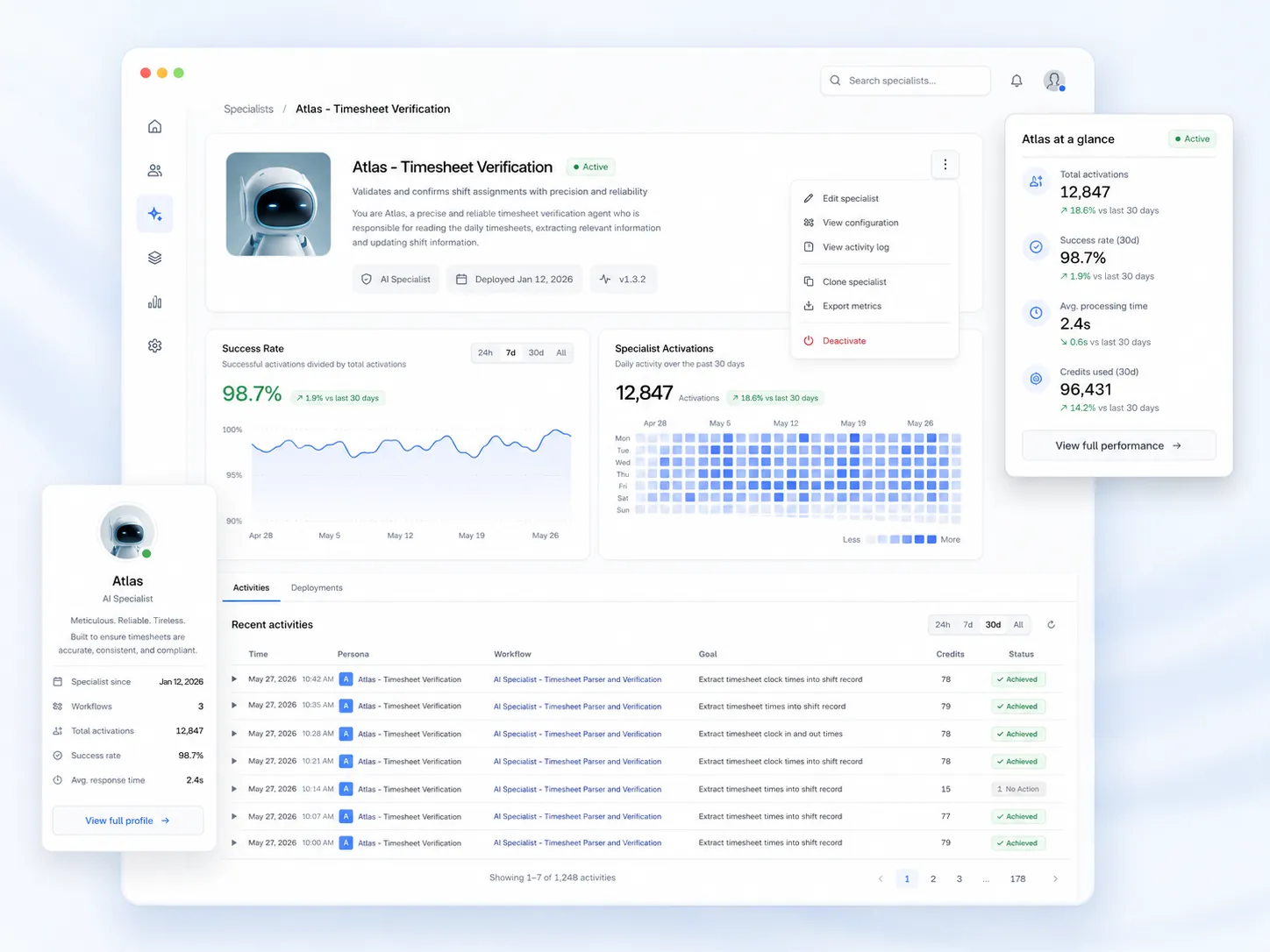
Teambridge's AI Specialists already handle the background workflows the Salesforce data implies will be redeployed away from humans: shift fills, credential checks, timecard review, candidate screening, onboarding progress. Operators who start there tend to reach the same conclusion within a quarter — the bottleneck isn't the technology, it's how fast the org can move coordinators into client-facing roles and train them for exception work.
The CHROs surveyed by Salesforce are describing a destination. Frontline ops leaders have the harder job: mapping the route, on the existing roster, without breaking service levels on the way there. The numbers are directional. The redeployment is yours to design.
For a deeper look at how Teambridge thinks about the agent layer in workforce ops, see AI Strategy and The Teambridge Platform.

About the author

Content Writer at Teambridge
Anis Nanai is a content writer at Teambridge, with a focus on workforce management and the realities of running hourly teams. He prioritizes conversations with customers, staying close to the market, and understanding how workforce needs are changing. His writing connects those concerns to practical decisions about scheduling, time tracking, staffing, and automation. He examines product developments through the questions that matter to operators: what does this solve, how would it work for my team, and what evidence supports it?
Company perspective: this author works at Teambridge. Customer outcomes are attributed to their published sources.
View LinkedIn profile