


This is what OSHA compliance actually costs superintendents — not the federal standards themselves, but the silent renewal cliffs underneath them.
The Real Problem Isn't the Card — It's the Renewal Cliff You Didn't See Coming
Ask any super what keeps them up at night and the answer is rarely a citation. It's the 6am reshuffle. The crew is staged, the trucks are loaded, and one credential aged out over the weekend that nobody flagged.
Part of why this happens is a genuine gap in how OSHA training is structured. OSHA 10 certification doesn't ever expire federally — once you've taken the training, your card is technically good indefinitely. The back of the card says so. Crews read that and assume they're covered.
They aren't. State laws, municipal ordinances, and GC-specific site rules layer on top of the federal baseline, and most of those layers absolutely do expire. Many employers overlook when OSHA 10- and 30-hour training is required by state laws, local rules, or contracts. That's the cliff. A laborer walks onsite Monday convinced his card is fine because OSHA said so, and the GC's compliance system flags him at the gate because the jurisdiction he's working in requires a refresher every five years.
Warning
The federal card's "does not expire" language is exactly what gets supers blindsided. The card is valid. The project's access rule is not.
The operational consequence is predictable: a morning of rebuilding the crew instead of running work, a GC relationship bruised, and a billable day compressed into six productive hours.
Which OSHA-Adjacent Credentials Actually Expire (and When)
If you're a super running work across multiple jurisdictions, you're tracking at least four overlapping clocks. Most compliance platforms track one. Here's what actually matters:
NYC Site Safety Training (Local Law 196)
SST cards are valid for five years from the date of issuance. That's non-negotiable, and the renewal rules are unforgiving. SST cards can only be renewed while they are still active. Once a card has expired, it cannot be renewed.
Read that again. If your laborer's SST lapses by a single day, he doesn't renew — he re-qualifies from scratch. SST cards can be renewed upon completing SST Refresher training credits with any Course Provider in 12 months preceding the expiration. That's your renewal window. Miss it and you're pulling that worker off every NYC site with a Site Safety Plan until they complete a full recertification pathway.
Miami-Dade Residents First
Under the Miami-Dade Residents First Training and Employment Program, contractors are required to submit a notarized affidavit stating that every employee reported on the payroll has completed OSHA-authorized 10-hour or OSHA 30-hour Construction safety training prior to working on the project. This applies to public and private projects above the $1M threshold on County land.
Philadelphia Contractor Licensing
All Contractors licensed under section 9-1004 of the Philadelphia Code must employ at least one supervisory employee who has completed the OSHA 30 Safety Training, or approved equivalent, within the last 5 years. The card never technically expires — but your Philly contractor license renewal absolutely does, and it's tied to a recent OSHA 30.
Connecticut Public Works
On July 1, 2011 Connecticut Senate and House of representatives approved Public Act No. 11-63: An Act Concerning Construction Safety Refresher Training Courses. This act has made a rule stating that even though OSHA says that your certification card never expires, the state of Connecticut wants you to get re-certified every 5 years.
Competent-Person Retraining (Federal)
Scaffold (1926.451) and fall protection (1926.503) require competent-person retraining whenever site conditions, equipment, or observed performance indicate the original training is no longer adequate. There's no calendar date — which is worse, because nobody remembers to trigger it.
| Jurisdiction / Rule | Credential | Renewal Clock | Lapse Consequence |
|---|---|---|---|
| NYC Local Law 196 | SST Worker Card | 5 years | Full recertification; no grace |
| NYC Local Law 196 | SST Supervisor Card | 5 years, 16 hrs refresher | Full recertification; no grace |
| Miami-Dade Residents First | OSHA 10/30 affidavit | Per-project | Contract payment withheld |
| Philadelphia §9-1004 | OSHA 30 (one supervisor) | Within last 5 years | License non-renewal |
| Connecticut PA 11-63 | OSHA 10 refresher | 5 years | Removal from public works site |
| Nevada AB 148 | OSHA 10 | 5 years | Site removal |
| 1926.451 / 1926.503 | Competent person | Condition-triggered | Citation + rework |
Why Spreadsheets and Safety Binders Fail on Active Projects
The failure mode isn't that supers don't care about credentials. It's that the data lives in the wrong place relative to the decision.
Credential records sit in HR or in a safety manager's binder. The schedule is built in a separate tool — Excel, a whiteboard, a scheduling app that doesn't know what an SST card is. When the super assigns a laborer to a shift, nothing in the workflow checks whether that laborer's credentials will still be valid on the shift date.
Renewal reminders, when they exist, go to the worker's personal email. The super never sees them. The safety manager sees them but isn't the one building the schedule. Three weeks later the card lapses and nobody noticed.
Subs make it worse. Their certs sit in a shared PDF folder nobody opens between audits. A sub foreman rotates a new laborer onto your site Monday morning and you find out at the gate whether his card is current.
The reshuffle isn't a scheduling failure. It's a data-architecture failure disguised as a scheduling failure.

Build a Credential-Aware Schedule: Eligibility Rules That Block the Assignment Before It Happens
More reminders won't fix this. The schedule itself has to refuse to assign a worker whose credentials expire before or during the shift window.
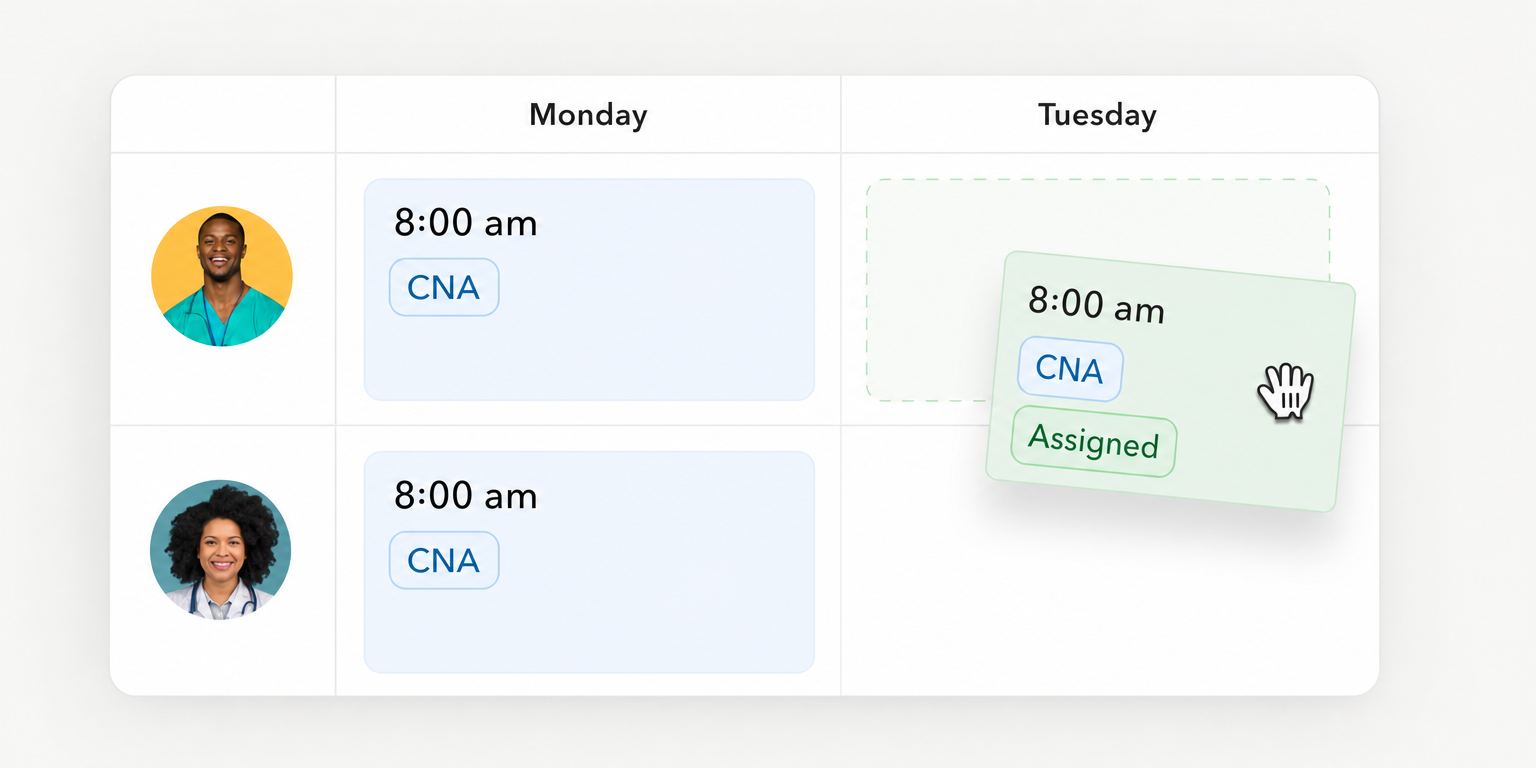
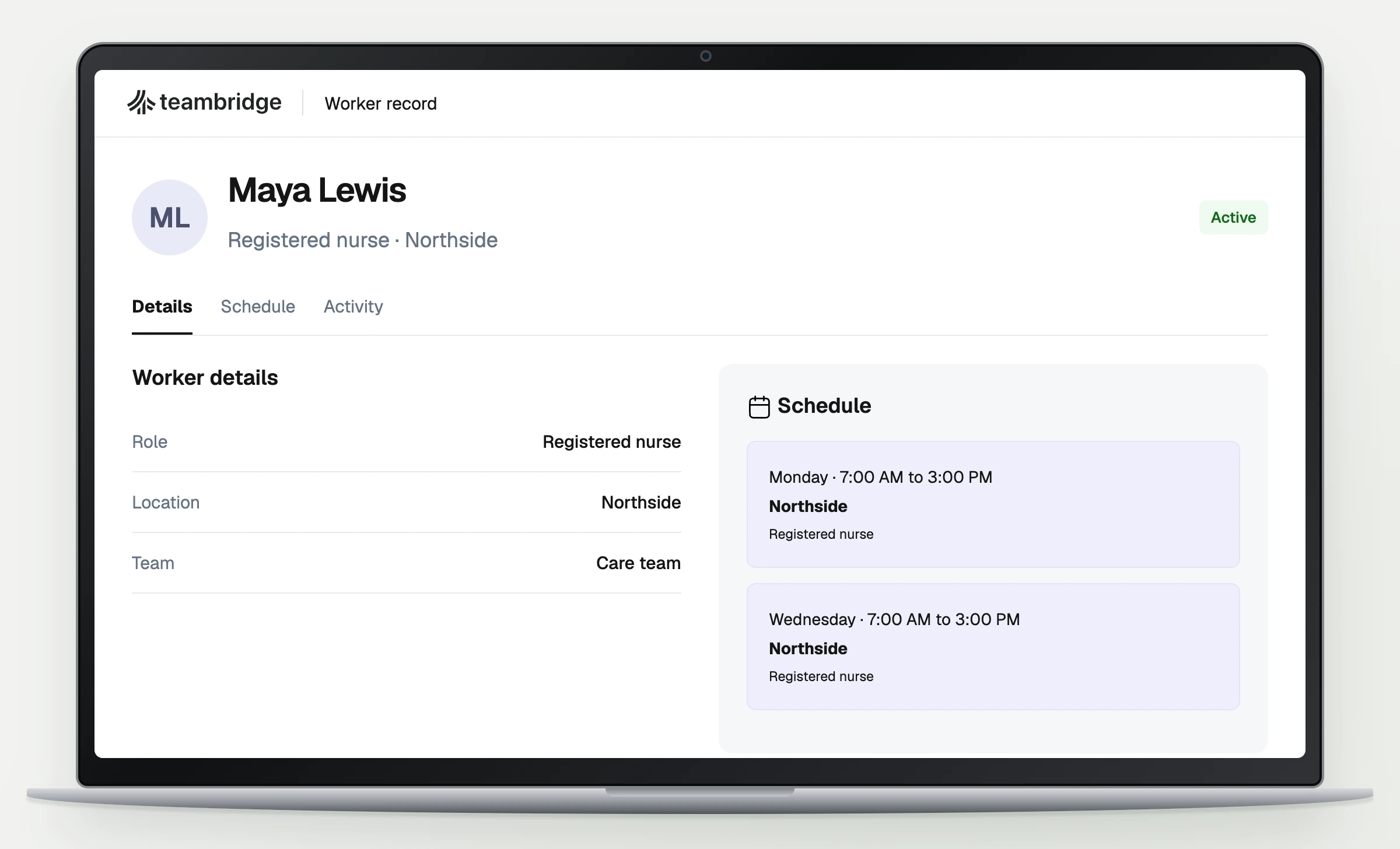
The mechanic is simple: every shift has a set of required credentials attached to it, derived from the jobsite. Every worker has a credential record with issuance and expiration dates. When the scheduler drags a worker onto a shift, the system checks the intersection — and blocks the assignment if any required credential will lapse before the shift ends.
Layer the rules by jobsite, because the requirements stack differently:
- NYC site with Site Safety Plan: SST Worker card (or Supervisor card) required, active through shift end date
- Miami-Dade public project over $1M: OSHA 10 or 30 with documented completion date on file
- Philadelphia permitted job: At least one assigned supervisor with OSHA 30 within last 5 years
- Federal/USACE project: EM 385-1-1 competent-person status on record
- Any scaffold erection: 1926.451 competent-person retraining current
- Any leading-edge work over 6': 1926.503 fall protection retraining current
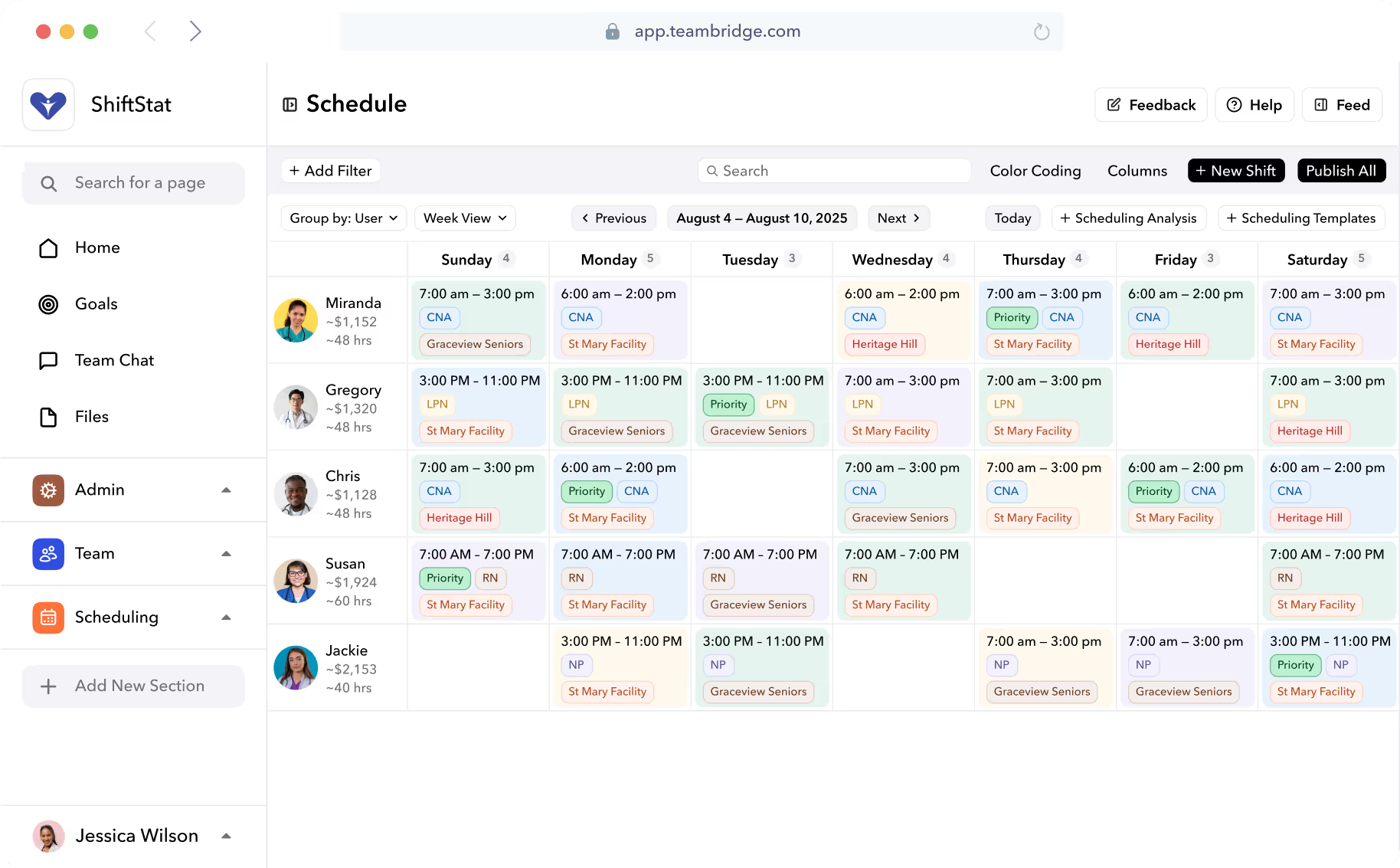
The point isn't that the scheduler has to memorize this. The point is the scheduler doesn't have to — the eligibility rules do the work. When a super tries to drop Miguel onto a Wednesday NYC shift and Miguel's SST expires Tuesday, the system refuses the assignment and surfaces the next eligible worker. Teambridge's scheduling engine is built around this pattern: credentials are first-class citizens of the schedule, not a spreadsheet that lives somewhere else.
This single change kills the 6:45am reshuffle at the source, because the bad assignment never got made on Friday.
The 90/60/30/7 Renewal Cadence That Actually Gets Workers Recertified
Blocking assignments protects the jobsite. It doesn't keep your workforce qualified. For that you need an upstream pipeline that gets workers recertified before they become schedule-restricted.
Here's the cadence that works:
- 90 days out: Auto-enroll the worker in the appropriate renewal course. Notify the super and the safety manager. Log the enrollment against the worker's record.
- 60 days out: If the refresher isn't complete, escalate to the safety manager with a list of eligible course dates and providers. Copy the super.
- 30 days out: Flag the worker in the schedule as "restricted after [date]." Future shift assignments past the expiration are blocked automatically.
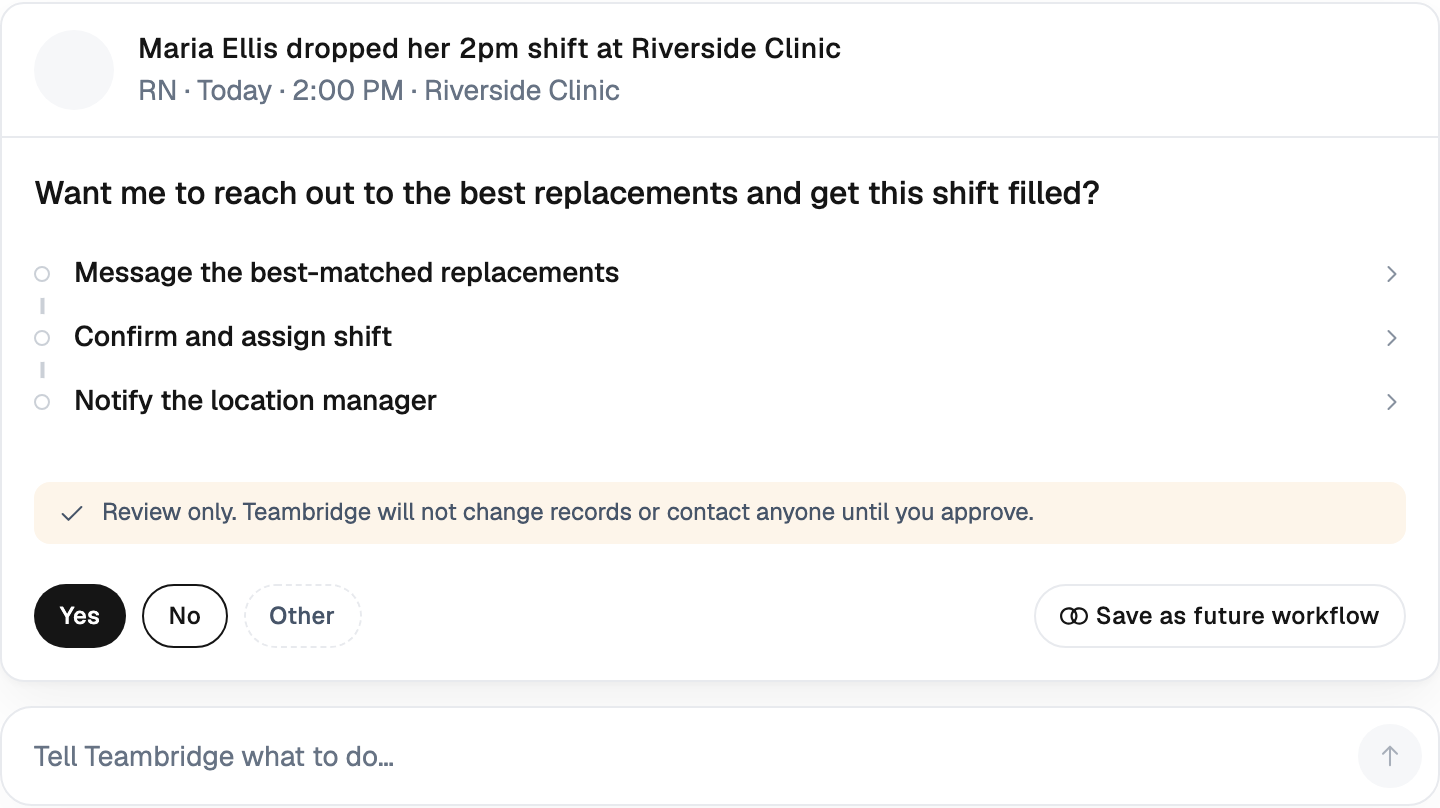
- 7 days out: Auto-swap the worker off any shifts scheduled past their expiration. Notify the super of the swap so they can approve or manually adjust.
This cadence got tighter in October 2024. As part of its continuing effort to improve the Outreach Training Program, the Occupational Safety and Health Administration (OSHA) eliminated the authorized trainer's 90-day grace period. Trainers who used to have a cushion after their own authorization expired no longer have one, which means fewer trainers are in-market at any given time and course availability is tighter. The full details are in OSHA's Outreach Training Program guidance.
Important
Because trainer availability has tightened, 90 days is no longer a comfortable lead time — it's the minimum. If your first notification goes out at 60 days, you're already behind the booking curve in major metros.
The upstream pipeline only works if it runs on its own. A safety manager chasing 200 expirations in a spreadsheet will miss 20. An automation workflow that triggers on credential expiration date — with no human in the critical path — won't.
Handling Subs and Travelers: Credential Capture Without the Email Chase
Supers don't employ the sub's laborers, but they own the risk the second that laborer walks through the gate. A GC doesn't care that the expired card belongs to your framing sub's second-year apprentice — it's your site, your stop-work exposure.
The right pattern is self-serve capture at onboarding:
- Sub foreman submits crew roster through a shared portal before mobilization
- Each laborer uploads a photo of their DOL card, SST card, and any site-specific credentials
- OCR extracts the issuance date, trainer ID, and card number
- The system auto-verifies the trainer ID against the active authorization database and flags any cards issued by a trainer whose authorization had already expired
- The sub foreman sees an expiring-credential dashboard for their own crew without needing a login into your GC system
This last piece matters more than it sounds. Sub foremen won't log into your tool. They will look at a link texted to them that shows which of their people are 30 days from an expiration. The difference between those two experiences is the difference between "subs handle their own compliance" and "supers handle it for them."
For the broader pattern on managing trades credentials at scale, Teambridge's construction industry page walks through how credential tracking, job-site time tracking, and project billing tie together in a single system.

What Changes on the Jobsite When Compliance Runs in the Background
Imagine the Monday morning where none of this is your problem.
The super opens the schedule at 5am on his phone in the truck. Every assignment for the day is already pre-cleared: OSHA 30 currency checked, scaffold competent-person status verified, fall protection retraining current, NYC SST active through the shift end. Any worker whose credentials would have lapsed over the weekend was swapped off the schedule on Friday by an automation, and a replacement was auto-proposed from the available bench with matching qualifications.
No 6:45am reshuffle. No GC audit scramble. No stop-work order because a $35 renewal course didn't get booked.
The savings aren't theoretical. A stop-work order on a mid-rise in Manhattan over a lapsed SST can run into five figures once you factor in the stand-around crew, the lost concrete load, and the GC back-charge. Avoiding one of those per quarter pays for your entire compliance-tracking stack several times over.
This is what the Teambridge platform is built to make the default state. Credential rules, eligibility checks, renewal automations, and schedule enforcement all run in the same system, on the same data, in the background. You don't manage it. It manages itself, and surfaces the exceptions.
Tip
If you want a concrete test of your current setup, pull your expiring-credential report for the next 90 days and overlay it on your project schedule. Any worker whose card expires during a shift they're already assigned to is a reshuffle that's already been scheduled — you just haven't found out yet.
Start With the Next 90 Days of Expirations
You don't need to boil the ocean. Start with one exercise:
- Export every certification on your active crews expiring in the next 90 days
- Map each expiration against your current project schedule
- Circle every shift assignment that extends past the relevant expiration date
Those circled shifts are the reshuffles already baked into your next quarter. Every one of them is a morning your super will spend rebuilding the crew instead of running work — unless something upstream changes.
That's the gap a credential-aware scheduling system closes. Not by sending more reminders. By refusing to let the bad assignment happen in the first place, and by running the renewal pipeline in the background so workers get recertified before they become a scheduling problem.
If you want to see what that looks like for a real construction crew — with your actual credential mix, your actual jurisdictions, your actual subs — book a walkthrough focused on construction credential and scheduling integration. Bring a recent compliance audit and a week of your current schedule. Thirty minutes is enough to show where the cliffs are hiding.

About the author

Content Writer at Teambridge
Anis Nanai is a content writer at Teambridge, with a focus on workforce management and the realities of running hourly teams. He prioritizes conversations with customers, staying close to the market, and understanding how workforce needs are changing. His writing connects those concerns to practical decisions about scheduling, time tracking, staffing, and automation. He examines product developments through the questions that matter to operators: what does this solve, how would it work for my team, and what evidence supports it?
Company perspective: this author works at Teambridge. Customer outcomes are attributed to their published sources.
View LinkedIn profile