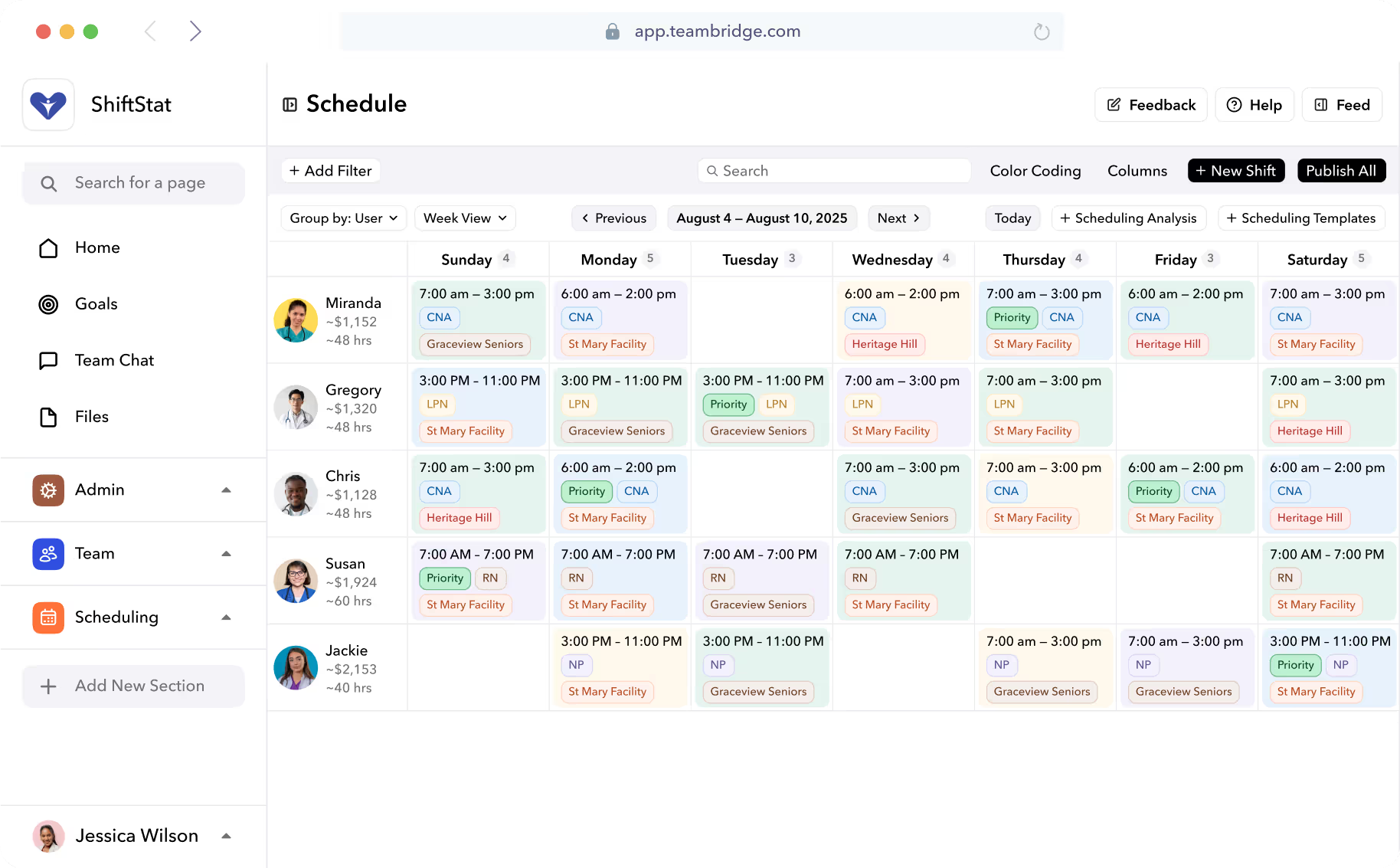


The Panama schedule draws beautifully on a whiteboard. Four teams, two shifts, every hour covered, every other weekend off. Then week three hits — a nurse calls out, a guard's license expired overnight, two swap requests stack on a Tuesday — and the rotation that looked self-sustaining is suddenly held together by your phone.
This is the gap between the 2-2-3 schedule on paper and the 2-2-3 schedule in production. Operators in healthcare, security, utilities, and continuous manufacturing keep coming back to it because the math works. The question is whether your scheduling system can keep up when reality stops cooperating.
What 24/7 Coverage Actually Costs Schedulers
Continuous operations don't bend. A nursing floor, a guard post, a fulfillment line, a control room — none of these care that your scheduler is out sick or that two people swapped without telling anyone. The shift starts at 18:00 whether or not somebody clocks in.
Non-daytime work is a bigger slice of the U.S. labor market than most operators realize. Sixteen percent of workers usually worked a non-daytime schedule, including 6 percent who worked evenings and 4 percent who worked nights, with the remaining 6 percent on rotating, split, irregular, or other schedules. In continuous-operation environments, the share is far higher — closer to the entire operational headcount.
The pain is concentrated on whoever owns the schedule. Fatigue, turnover, callouts, and conflicts compound. The Panama schedule — also called the 2-2-3 — is one of the few rotations that can actually balance coverage and rest, but only if you run it with discipline. Sloppy execution turns its biggest advantage (predictability) into its biggest liability (rigid plans that shatter on contact with reality).
How the Panama Schedule (2-2-3) Works
The mechanics are simple. The 2-2-3 schedule is a rotating shift pattern designed for operations that need 24/7 coverage, using 12-hour shifts and requiring 4 teams to cover all hours, with each team working a repeating 14-day cycle: 2 days on, 2 days off, 3 days on, 2 days off, 2 days on, 3 days off. Two teams are working at any given moment — one on days, one on nights. The other two teams are off.
The name "Panama" traces back to the Panama Canal, where the pattern was originally developed and is now widely used to maintain continuous operations while giving employees adequate rest. In practice, "2-2-3" and "Panama" are used interchangeably, but there's a real distinction worth knowing. Unlike a fixed 2-2-3, Panama shifts rotate every 28 days between day and night shifts instead of every 14, so the full cycle of the Panama schedule rotates every 56 days instead of every 28.
A sample team grid
Using D for day, N for night, and O for off, a 14-day slice looks like this:
| Day | 1 | 2 | 3 | 4 | 5 | 6 | 7 | 8 | 9 | 10 | 11 | 12 | 13 | 14 |
|---|---|---|---|---|---|---|---|---|---|---|---|---|---|---|
| Team A | D | D | O | O | D | D | D | O | O | D | D | O | O | O |
| Team B | O | O | D | D | O | O | O | D | D | O | O | D | D | D |
| Team C | N | N | O | O | N | N | N | O | O | N | N | O | O | O |
| Team D | O | O | N | N | O | O | O | N | N | O | O | N | N | N |
At every hour of the 14 days, exactly two teams are on (one D, one N) and two are off. After 28 days, A and B flip to nights and C and D flip to days. After 56 days, the whole cycle starts over.
The Math: 42-Hour Weeks, Built-In Overtime, and 182 Days Off
The rotation's biggest selling point is also where most operators get blindsided. The schedule averages out to 42 hours per week over the course of the rotation, which simplifies staffing requirements while keeping the weekly average close to the standard full-time threshold. But that 42-hour average masks a 36/48 swing — one week is short, the next is long.
That 48-hour week matters. The Panama schedule involves 12-hour shifts, meaning employees can frequently exceed the standard 40-hour workweek, working three or four 12-hour shifts per week totaling 36 to 48 hours, and in weeks where employees work 48 hours, the 8 hours exceeding the standard 40 hours should be considered overtime. If you have daily overtime rules in your state, it gets worse — every shift past hour 8 triggers premium pay.
Important
If you operate in California, Colorado, Nevada, Alaska, or any other daily-OT jurisdiction, model the labor cost before you switch. Depending on your jurisdiction and overtime rules, in states with daily overtime, the 2-2-3 schedule may cost 15–20% more in labor than an 8-hour shift schedule that avoids daily overtime triggers.
On the employee side, the math sells itself. Each team works seven shifts every 14 days. That's roughly 182 days on per year vs. 260 for a standard five-day worker — and working 12-hour shifts means employees only commute 14 days out of the 28-day cycle, which reduces travel time and associated costs compared to a standard five-day, eight-hour work week.
Annual labor budget cheat sheet
| Metric | Standard 5x8 | Panama 2-2-3 |
|---|---|---|
| Avg. weekly hours | 40 | 42 |
| Annual OT hours per worker | 0 (baseline) | ~104 |
| Days worked per year | ~260 | ~182 |
| Days off per year | ~104 | ~182 |
| Shift handoffs per 24h | 3 | 2 |
| Weekends fully off | Most | Every other |
The predictable OT is a feature, not a bug — as long as you budget for it. Since the schedule averages 42 hours per week, it minimizes the need for unscheduled overtime to fill coverage gaps, which helps stabilize labor costs and provides a predictable budget for staffing expenses.

Where Panama Fits — And Where It Doesn't
The rotation isn't universal. It's a strong fit where work is steady-state and 24/7, and a poor fit where work spikes unpredictably or requires sustained high cognitive load. Honest breakdown:
Strong fit:
- Healthcare, especially nursing and EDs. Twelve-hour shifts are already the norm, and hospitals and emergency departments use Panama for nursing and patient care, because it reduces handoffs and improves continuity. Fewer handoffs means fewer dropped clinical details. Teambridge's healthcare staffing workflows are built around this.
- Security and guard posts. Static posts, predictable coverage, and every-other-weekend off is a real recruiting edge. See security staffing.
- Utilities and continuous manufacturing. Control rooms, water treatment, power generation, and process lines all need bodies on-post every hour, with relatively steady cognitive load. Light industrial operations frequently run Panama or close variants.
- 24/7 call centers and NOCs with experienced staff who can sustain a 12-hour console rotation.
Weaker fit:
- Part-time-heavy rosters. The schedule assumes full-time bodies; you can't easily slice a 12-hour shift in half.
- Roles with peak cognitive load on hour 11 — surgical teams, air-traffic-style monitoring, complex troubleshooting. The fatigue curve is real.
- Workforces with tight childcare constraints. Alternating long weeks and the day/night flip every 28 days can break personal logistics.
The Real Problems: Fatigue, Childcare, and the Third Consecutive Shift
The Panama schedule's reputation as "employee friendly" is half true. The days off are great. The shifts themselves are punishing — and the third consecutive one is where the damage shows up.
The research is unambiguous. Compared with day shifts, risks are 15% higher for evening shifts and 28% higher for night shifts; compared with 8-hour shifts, 10-hour shifts increased risk by 13% and 12-hour shifts increased risk by 28%; risk increased by 17% for the third consecutive night shift and 36% for the fourth. The 2-2-3's three-on stretch is right at the edge of where injury and error rates inflect upward.
OSHA's worker-fatigue guidance is equally direct: accident and injury rates are 18% greater during evening shifts and 30% greater during night shifts when compared to day shifts, and research indicates that working 12 hours per day is associated with a 37% increased risk of injury.
The specific operational risks you'll see show up in your timecard exception queue:
- Missed clock-ins on the third consecutive day, especially night-side.
- Timecard exceptions piling up — short breaks, missed punches, early departures.
- Swap requests outpacing scheduler bandwidth. One swap triggers two more, and now Tuesday looks nothing like the published schedule.
- Driving incidents on the commute home. Night shift nurses had significantly greater lane deviation during the post-shift drive home compared to day shift nurses, demonstrating impaired driving safety, and consecutive 12-hour night shifts pose a significant driving safety risk.
- New-hire attrition in the first 90 days. The rotation is physically harder than candidates expect, and the day/night flip catches them flat-footed.
Warning
Treat the third consecutive shift as a fatigue checkpoint, not a routine workday. If you auto-fill open shifts, your rules should refuse to assign someone to a third consecutive 12 on top of the rotation — that's how you end up with a tired worker on a fourth night and an incident report you didn't need.
Running Panama in Software, Not Spreadsheets
Anyone can draw a 2-2-3 rotation. Maintaining it through callouts, swaps, credential expirations, and PTO is where spreadsheets collapse. The shift from "published schedule" to "actual coverage" is where the wheels come off — and it happens in week three of every cycle.
A few non-negotiables for running Panama in software:
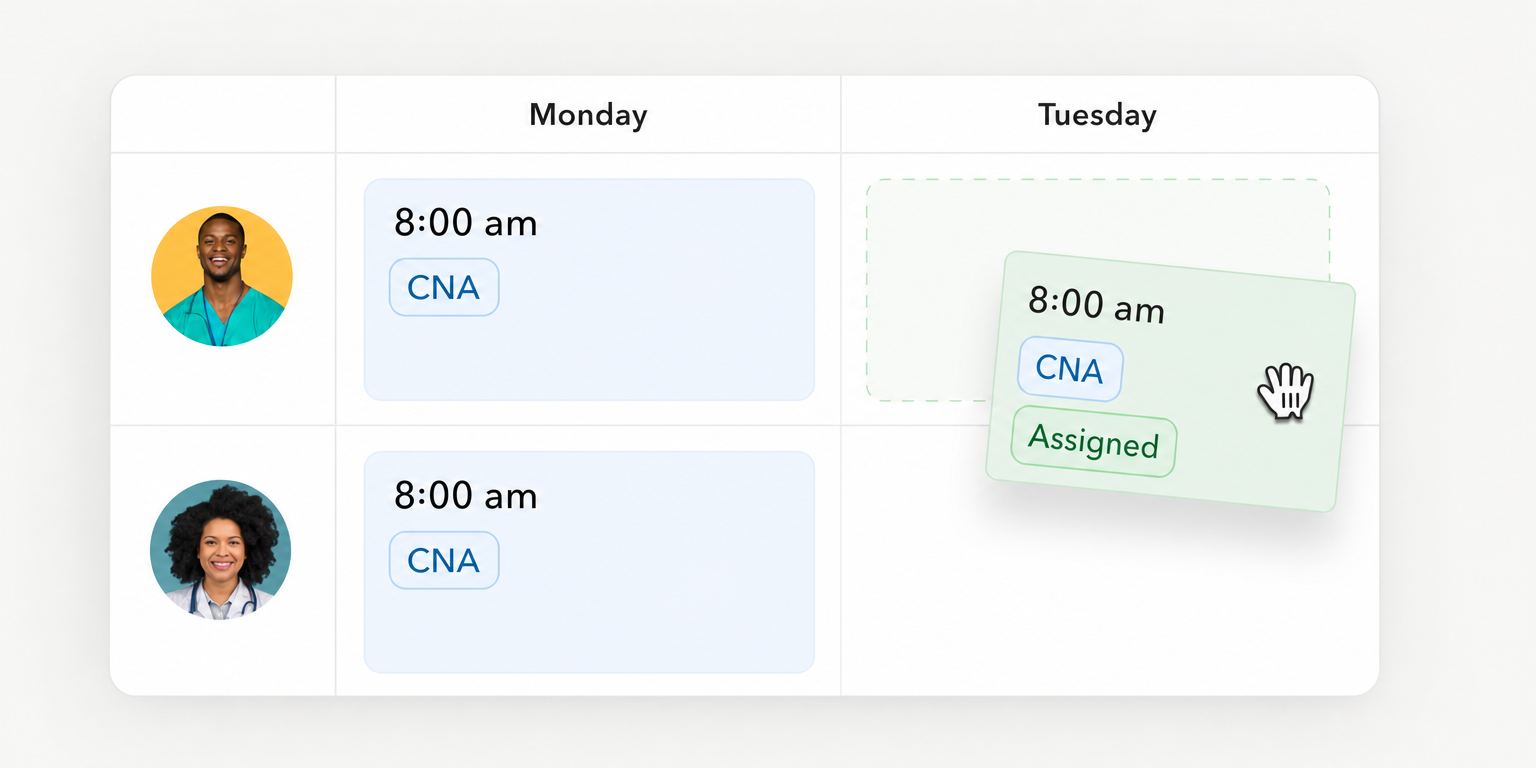
- Encode the rule set, don't redraw the calendar. The 2-2-3 pattern, the four-team structure, day/night rotation cadence — all of it lives as rules in the scheduling engine. The rotation auto-generates instead of being rebuilt every cycle. With Teambridge, you can set granular rules that define who works when so your 2-2-3 schedule auto-builds accurately every cycle, which means you spend less time tweaking shifts and more time focusing on operations.
- Publish 2–4 weeks in advance. Workers need to plan childcare around the alternating long week. Create employee rosters showing 28-day cycles, publish 2–4 weeks in advance, and use workforce software to automate scheduling.
- Require equal swaps. Block OT manipulation by enforcing that a Tuesday day shift can only be swapped for another Tuesday day shift — not a Saturday night that pushes someone into 60+ hours.
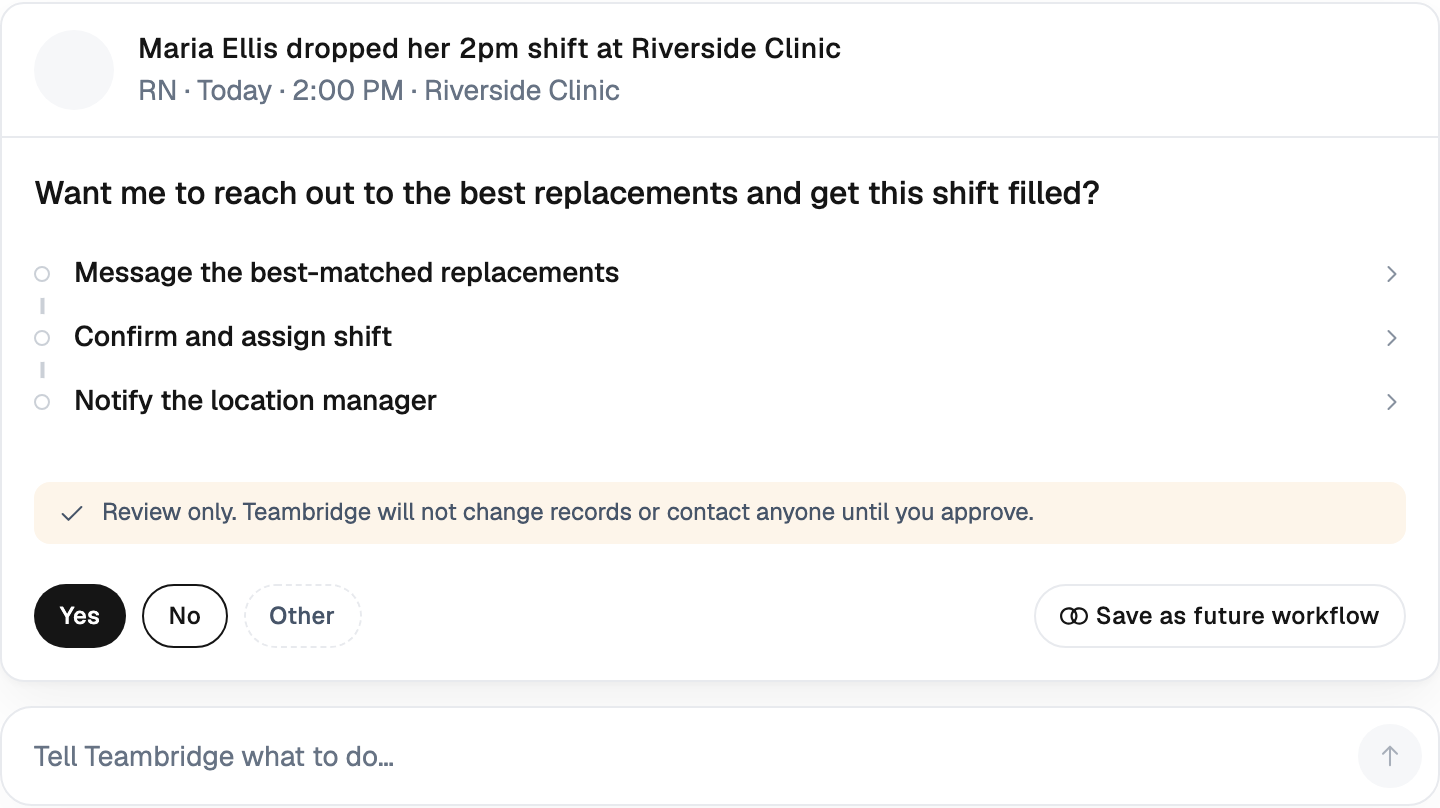
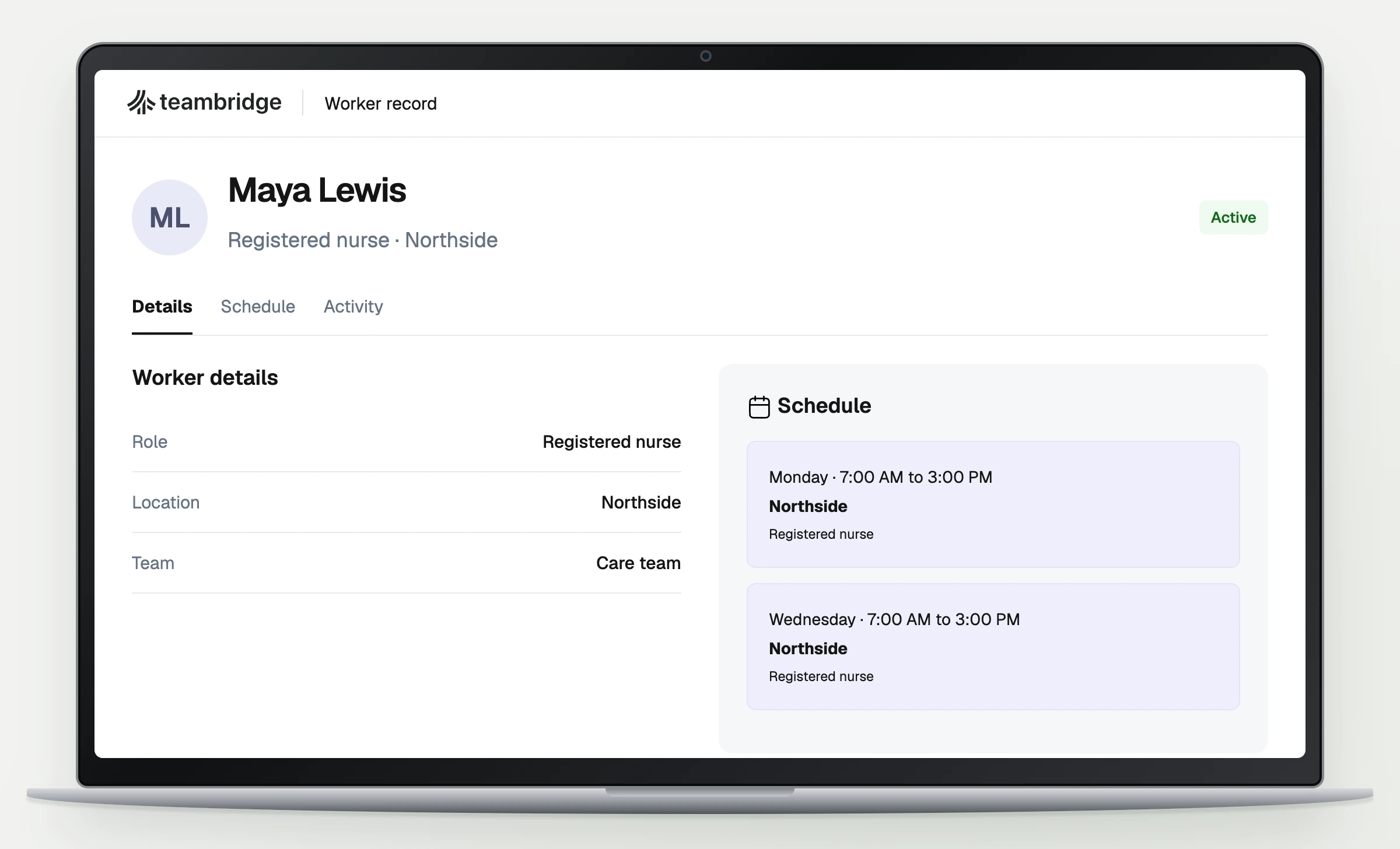
- Gate auto-fill on credentials and fatigue. A worker with an expired guard card, a nurse past her CPR cert, or anyone already on their third consecutive 12 should not be eligible for auto-assignment. This is what Teambridge's scheduling engine is built for.
- Push changes to phones, not bulletin boards. Swap requests, pickup offers, and last-minute coverage move through the mobile app, not a group text and a whiteboard photo.
The rotation doesn't fail because the math is wrong. It fails because nobody has time to redraw it when reality hits week three.
Variations Worth Considering Before You Commit
Panama isn't the only 24/7 rotation, and it isn't always the right one. Weigh these alternatives before you commit a workforce to it.
Pitman. Same 2-2-3 rhythm, but typically fixed days or fixed nights instead of rotating. The Pitman work schedule comes in two variations — fixed and rotating; Pitman's fixed work schedule follows a 2-3-2 pattern in which all four teams follow the same schedule, with two teams working during the day and the other two working at night. If your workforce splits cleanly into day people and night people, Pitman removes the circadian flip and the fatigue cost that comes with it.
Panama Plus. Adds extra off days or shorter shifts for high-demand roles. The key benefit of the Panama Plus schedule is its utilization of eight-hour shifts; these shorter work periods provide a significant break and serve as a stress reliever, especially after a stretch of consecutive twelve-hour days.
DuPont. Four-week cycle with a built-in seven-day rest block. The complexity of this shift pattern exposes employees to the challenge of working 72 hours in some weeks, leading to fatigue and stress; additionally, finding replacements for sick employees can be difficult, risking overworking of staff and disrupting the established shift cycle. The long rest block is appealing, but the 72-hour weeks are brutal.
4-on-4-off. Simpler to administer, but weekends aren't predictable. 4-on-4-off is simpler with consistent breaks but less weekend predictability, while Panama guarantees every-other-weekend.
Quick decision lens
| If your priority is... | Consider |
|---|---|
| Fewer fatigue incidents | Pitman (fixed) or Panama Plus |
| Predictable weekends | Panama (2-2-3) |
| Longest possible rest block | DuPont |
| Simplest admin | 4-on-4-off |
| Lowest OT exposure | 8-hour 3-shift rotations |
Pick by fatigue tolerance, weekend predictability needs, and how much OT you're willing to bake in.
Make the Rotation Run Itself
The Panama schedule isn't hard to draw. It's hard to maintain when reality hits — callouts, expired credentials, swap chains, fatigue exceptions, the day/night flip on week five. Spreadsheets handle the drawing; they don't handle the running.
The operators who make 2-2-3 work treat the rotation as code, not a calendar. Rules auto-generate the cycle. Credentials gate auto-fill. Equal-swap policies prevent OT manipulation. Fatigue and OT exceptions surface before they become incidents. Workers see changes on their phones in real time, not on a corkboard at shift change.
That's the system Teambridge is built to run — scheduling that encodes the 2-2-3 rule set, a mobile app workers actually use for swaps and pickups, and exception surfacing that catches the third-consecutive-shift problem before the safety report does.
If you're running Panama on a spreadsheet and feeling the strain on week three of every cycle, that's the symptom. The fix is moving the rule set into software that can hold the line when reality stops cooperating.

Put this research into operation
Review the rotation pattern and complete schedule explanation before applying the operating controls in this guide. complete Panama schedule guide.
Place the rotation on real dates and inspect crew coverage before adapting it to live worker constraints. Panama schedule generator.
Compare fatigue load, weekend cadence, overtime, and operating complexity before committing to Panama. DuPont versus Panama comparison.
About the author

Content Writer at Teambridge
Anis Nanai is a content writer at Teambridge, with a focus on workforce management and the realities of running hourly teams. He prioritizes conversations with customers, staying close to the market, and understanding how workforce needs are changing. His writing connects those concerns to practical decisions about scheduling, time tracking, staffing, and automation. He examines product developments through the questions that matter to operators: what does this solve, how would it work for my team, and what evidence supports it?
Company perspective: this author works at Teambridge. Customer outcomes are attributed to their published sources.
View LinkedIn profile