

Editable planning resource
Build a four crew schedule and check coverage
Four crews sharing one continuous position work an average of 42 hours each per week. The example below uses two day crews and two night crews, each working seven 12 hour shifts every 14 days. Download the 28 day CSV and edit it in your spreadsheet.
A and B alternate day coverage. C and D alternate night coverage. This example keeps each crew on the same shift. Add your shift start times, worker assignments, site and role requirements before using it.
How many people does coverage require?
6 people needed, rounded up
Calculation: 168 hours × people needed at once ÷ (weekly hours per person × available share of time). Include leave and training in unavailable time. This is a capacity estimate. It does not test individual availability, break coverage, qualifications or overtime rules.
Why Schedulers Keep Searching "Panama Schedule Meaning"
The Panama pattern exists because someone needs the lights on 24/7 and a fixed Monday-to-Friday model can't deliver that without burning through staff. Whether you run a guard contract, a nursing floor, or a power plant, the underlying problem is the same: coverage that doesn't stop, with a finite headcount and a payroll budget that does.
The pressure on schedulers is real. A nationally representative Gallup survey of more than 18,000 U.S. workers found that 27% of employees face unpredictability, 28% report instability and 41% have little or no control over their work schedule. That instability is exactly what a well-run Panama rotation is supposed to fix — predictable cycles, known days off, no last-minute scrambling. The trouble is that a poorly-run Panama rotation amplifies the same problems instead of solving them.
Note
If you're evaluating Panama against 8-hour shifts, the real question isn't which pattern is better in the abstract. It's which one your operation can actually execute without constant manual patching.
Panama Schedule Meaning: The 2-2-3 Rotation in Plain Terms
The Panama schedule is a rotating 12-hour shift pattern run by four teams across a 14- or 28-day cycle. Each team works two days on, two days off, three days on — then the inverse the following week.
Here's the structural definition: a rotating shift pattern designed for operations that need 24/7 coverage. It uses 12-hour shifts and requires 4 teams to cover all hours. Each team works a repeating 14-day cycle: 2 days on, 2 days off, 3 days on, 2 days off, 2 days on, 3 days off. The result is that every employee works 7 out of 14 days — an average of 42 hours per week — and gets a 3-day weekend every other week.
Two teams cover days (typically 6 AM–6 PM). Two cover nights (6 PM–6 AM). At any hour, one day team and one night team are on the clock. The other two teams are off.
The Naming Mess
You'll see this rotation called the Panama schedule, the 2-2-3, or the Pitman schedule, depending on who's writing the spreadsheet. For practical purposes they describe the same 12-hour, four-team, 14-day pattern. With a Pitman schedule, the organization uses a 14-day cycle in which each employee works seven 12-hour shifts. The four teams alternate between two day or night shifts, two days off, and three additional day or night shifts. If your team is debating terminology, stop. Pick one name and move on.
Walk-Through: A Real Two-Week Panama Cycle
The pattern is easier to see than to describe. Here's a clean two-week view with four teams — A and B on days, C and D on nights.
| Day | Team A | Team B | Team C | Team D |
|---|---|---|---|---|
| Mon (Wk 1) | Day | Off | Night | Off |
| Tue | Day | Off | Night | Off |
| Wed | Off | Day | Off | Night |
| Thu | Off | Day | Off | Night |
| Fri | Day | Off | Night | Off |
| Sat | Day | Off | Night | Off |
| Sun | Day | Off | Night | Off |
| Mon (Wk 2) | Off | Day | Off | Night |
| Tue | Off | Day | Off | Night |
| Wed | Day | Off | Night | Off |
| Thu | Day | Off | Night | Off |
| Fri | Off | Day | Off | Night |
| Sat | Off | Day | Off | Night |
| Sun | Off | Day | Off | Night |
Look down any column. Exactly one day team and one night team are on. No overlap, no gaps. Every team gets a three-day weekend every other week.
After 14 or 28 days, the day teams swap with the night teams — A and B move to nights, C and D move to days. That's the day/night flip the rest of the article keeps referring to.
The operational implication is worth saying out loud: from a planning standpoint, this is clean. From a worker's standpoint, the weekday pattern shifts constantly. They can't memorize "I work Tuesdays." Managers can't rely on "same shift, same person." The cycle is predictable on a 14-day clock, not a 7-day one.

Where the Panama Schedule Actually Fits
Panama holds up where coverage gaps cost more than overtime. It breaks where the work isn't actually continuous.
Good fits:
- Security and guard services — posts that can't go dark
- Healthcare — nursing floors, emergency departments, long-term care
- Manufacturing — continuous production lines
- Utilities — power, water, telecom monitoring
- Dispatch and emergency communications
- 24/7 call centers and tech support
Police stations/law enforcement, fire departments, emergency medical services (EMS), and emergency communications centers (dispatch), Healthcare organizations, particularly hospitals, nursing homes, and other facilities that offer round-the-clock care, Manufacturing companies that operate continuously to keep up with product demand, Customer support centers that provide customers with phone or live chat assistance with products or services 24/7 are the textbook use cases — and the reason this pattern shows up in both security staffing and healthcare staffing operations.
Bad fits:
- Project-based crews that need overlap and collaboration
- Daytime-only roles where the second half of a 12-hour shift is dead time
- Operations with weak handoffs — Panama exposes handoff problems, it doesn't fix them
- Teams with thin coverage where one call-out cascades into mandatory holdovers
The schedule is a stress test for your scheduling discipline. If your handoff process is sloppy on an 8-hour rotation, it will be worse on a 12-hour Panama cycle because the consequences of a missed detail compound over a longer shift.
The Hidden Overtime Math Nobody Mentions
This is where the conversation usually gets uncomfortable. The Panama rotation doesn't produce 40 hours a week. It produces uneven weeks that average to 42.
That's 84 hours per cycle, which averages out to 42 hours per week. But here's the thing: your weeks aren't equal. They alternate like this: That 48-hour week means 8 hours of overtime every other week (assuming your employer uses the standard 40-hour threshold).
Week 1 = 36 hours. Week 2 = 48 hours. That second week generates 8 hours of overtime every other week — roughly 104 overtime hours per employee per year baked into the rotation before anyone calls out, picks up an extra shift, or stays late on a handoff.
You either budget for that or you don't run Panama. There is no third option.
State Daily-OT Traps
Federal FLSA overtime is calculated weekly, but several states layer daily overtime rules on top. California, Alaska, Nevada, and others trigger overtime after 8 hours in a day regardless of weekly totals. A 12-hour shift in those states means 4 hours of daily overtime per shift — every shift.
12-hour shifts: The Panama schedule involves 12-hour shifts, meaning employees can frequently exceed the standard 40-hour workweek. Employees work three or four 12-hour shifts per week, totaling 36 to 48 hours. Weekly overtime: In weeks where employees work 48 hours, the 8 hours exceeding the standard 40 hours should be considered overtime. Daily overtime: In jurisdictions with daily overtime thresholds, such as 8 hours, employees on 12-hour shifts earn 4 hours of daily overtime pay.
California adds another wrinkle. In California, for instance, employers must conduct a poll before leveraging a 12-hour shift pattern, allowing employees to determine whether the organization should adopt the model. If two-thirds of employees agree with the approach, the agency must mail the approving results to the Department of Industrial Relationships for legal verification. If you operate in California, the rotation isn't just a payroll question — it's a vote.
Warning
The "Panama Plus" variant tries to smooth the overtime by adding an 8-hour day in a five-team rotation. In addition to the traditional 12-hour shifts in a 2-2-3 schedule, a Panama Plus pattern includes some eight-hour days. Within one of five teams (instead of four), each employee works two 12-hour shifts, takes two days off, works two 12-hour shifts, then works one 8-hour weekday shift before repeating the cycle. It can help with fatigue, but it compounds scheduling complexity and rarely solves the overtime math cleanly.
Accurate, automated overtime calculation isn't optional here. If your time tracking system can't apply daily and weekly OT rules per jurisdiction, Panama will eat your margin.
Ready to move?
Ready to see Teambridge in action?
Fatigue, Day/Night Flips, and the Things That Break First
A Panama rotation puts 12-hour shifts on safety-critical work for weeks at a time, then flips workers from days to nights. Both pieces have costs.
The 12-hour shift is itself a fatigue load — alertness drops in the back half, and incident rates climb in the last two hours regardless of role. May disrupt employee sleep — Because 12- and 24-hour shifts often require employees to work long hours on multiple consecutive days, it can contribute to poor sleep patterns that impact health, productivity, satisfaction, and even safety. Properly managed Panama shifts can help prevent extreme exhaustion by allowing adequate time for rest, making it easier and safer for employees to do their jobs. May lead to health issues — When not managed correctly, rotating shifts have been associated with increased risks of cardiovascular disease and other stress-related conditions. This typically results from poor diet, insufficient sleep, and high stress levels, all of which can be mitigated with optimal scheduling and shift management.
The day/night flip is the second cost. The day-to-night rotation is the most disruptive element of the 2-2-3 schedule. Agents switching from day shifts to night shifts (or vice versa) need time to adjust. Circadian recovery from a multi-week night block takes days, not hours. Workers who rotate every 14 or 28 days never fully adapt to either pattern.
Practical Mitigations
The operators who run Panama successfully build guardrails into the schedule itself:
- Mandatory minimum rest between shifts. 8–12 hours is the floor, not the goal. Anything less and the rotation starts producing safety incidents.
- Cap consecutive shifts at 4–5. The pattern itself caps at 3, but holdovers and pickups can stack quickly.
- Run fatigue training annually. Workers need to recognize impairment in themselves and peers.
- Track incident rates by shift position. If errors cluster in hours 10–12 or in the first two days after a day/night flip, you have data to act on.
- Stagger the flip when possible. Rotating one team at a time, rather than all four at once, reduces the simultaneous adaptation load.
These aren't HR preferences. They're the difference between a sustainable rotation and one that quietly bleeds people out the door.

Running a Panama Rotation Without Constant Patching
Most operators don't fail at Panama because they misunderstand the pattern. They fail because they rebuild it manually every cycle in a spreadsheet, then patch it every time someone calls out, swaps, or hits an OT cap.
Here's what running it cleanly actually requires:
- Codify the 2-2-3 rule inside your scheduling system. Not as a spreadsheet template — as a rule the system enforces. Define the 14- or 28-day cycle, the four teams, the day/night flip cadence, and let the system auto-build cycles forward.
- Publish 2–4 weeks in advance. Gallup's definition of a high-quality schedule includes predictability of at least two weeks. Predictability: The employee knows their schedule at least two weeks in advance, unless they have substantial control over when and how much they work. Panama makes that achievable. Don't squander the advantage by publishing late.
- Define swap rules as equal-for-equal. A day shift for a day shift, a night for a night, hours-matched. Otherwise swaps become an overtime arbitrage workers will absolutely figure out.
- Automate credential and certification checks. Before the system auto-assigns a guard, nurse, or technician, it should verify license, training, and any role-specific certifications are current. This is non-negotiable in licensed industries.
- Build call-out coverage into the rule, not the manager. Define which teams are eligible to pick up, in what order, and at what OT rate. If your supervisor is making those calls at 4 AM, the system has failed.
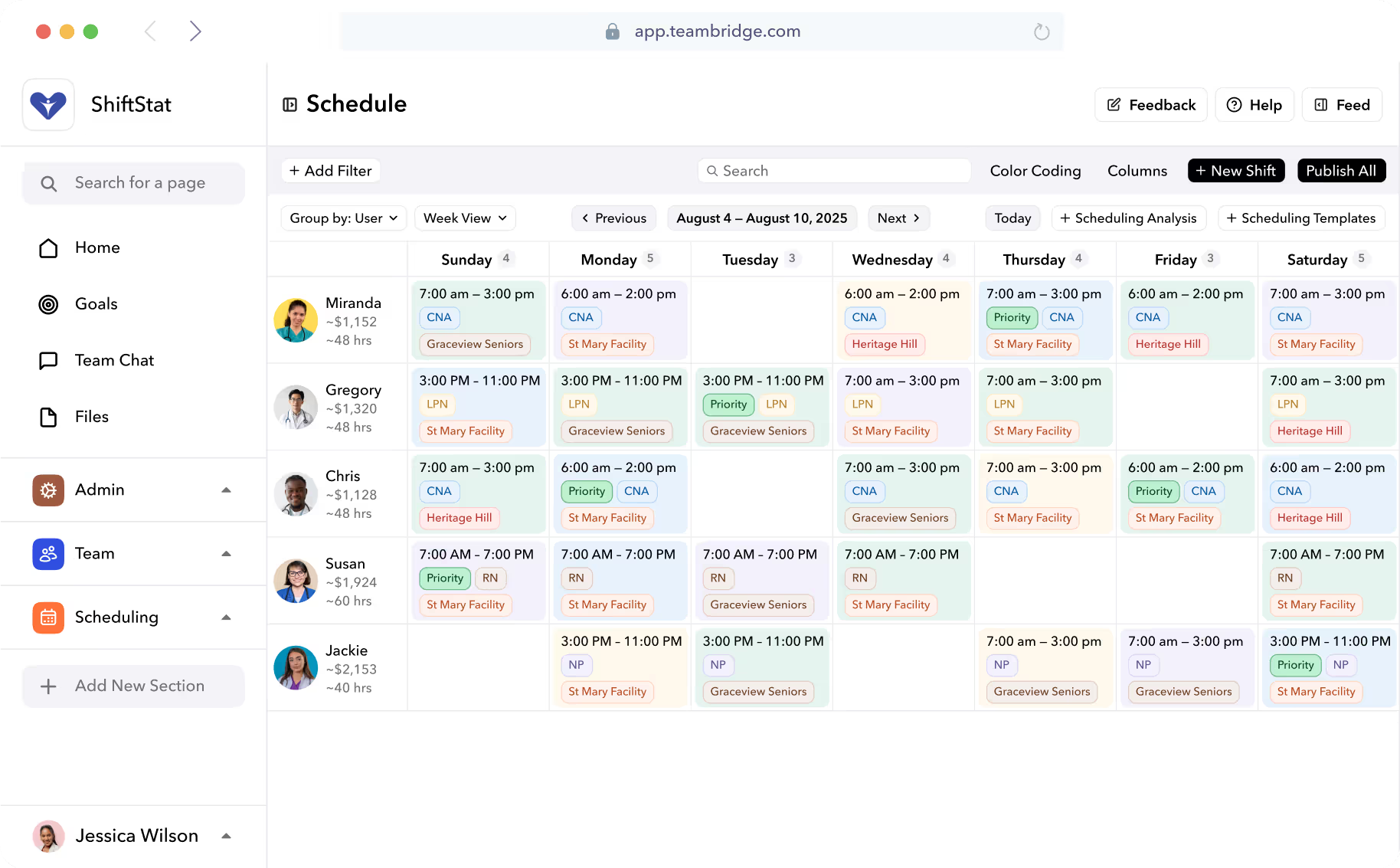
This is what Teambridge's scheduling is built to do — rule-based auto-build for 2-2-3 cycles, credential enforcement before assignment, and swap rules that can't be gamed. The full Teambridge platform ties scheduling to time tracking and pay so the overtime math runs automatically instead of showing up as a surprise at payroll close.
A Panama rotation that lives in a spreadsheet is a part-time job for a scheduler. A Panama rotation that lives in a rule is a one-time setup.
Is Panama the Right Schedule for Your Operation?
Use this filter honestly. Pick Panama if all three of these are true:
- You genuinely need 24/7 coverage. Not "extended hours." Not "sometimes weekends." Actual round-the-clock.
- Your workforce can absorb 12-hour shifts. Safety-critical roles, physical roles, and roles requiring sustained cognitive load all degrade at hour 10.
- You can budget predictable overtime. ~8 hours every other week, baked in. If that breaks your margin, the model breaks too.
Skip Panama if your real problem is one of these:
- Daytime understaffing — a Panama rotation won't fix a hiring gap.
- Handoff quality — fix the handoff first, then change the rotation.
- Last-minute call-ins — that's a scheduling discipline and communication problem, not a pattern problem.
If those are your actual issues, look at alternatives: 4-on-4-off for simpler 12-hour cycles, DuPont for longer rest blocks, or traditional 3x8 if you can afford the headcount and want shorter shifts.
The Panama schedule isn't a clever solution. It's a tool that does one thing well — keep four teams covering the clock with predictable rest — and exposes every weakness in your scheduling operation while it does. Run it with the rules codified, the overtime budgeted, and the fatigue guardrails enforced, and it works. Run it on a spreadsheet and hope, and it doesn't.
For a deeper look at how operators model these rotations alongside compliance, credentials, and pay, the Teambridge platform is built around exactly this kind of 24/7 operational reality. External readers wanting the underlying scheduling-quality research can see the full Gallup American Job Quality Study.

About the author

Content Writer at Teambridge
Anis Nanai is a content writer at Teambridge, with a focus on workforce management and the realities of running hourly teams. He prioritizes conversations with customers, staying close to the market, and understanding how workforce needs are changing. His writing connects those concerns to practical decisions about scheduling, time tracking, staffing, and automation. He examines product developments through the questions that matter to operators: what does this solve, how would it work for my team, and what evidence supports it?
Company perspective: this author works at Teambridge. Customer outcomes are attributed to their published sources.
View LinkedIn profile