

Editable planning resource
Build a four crew schedule and check coverage
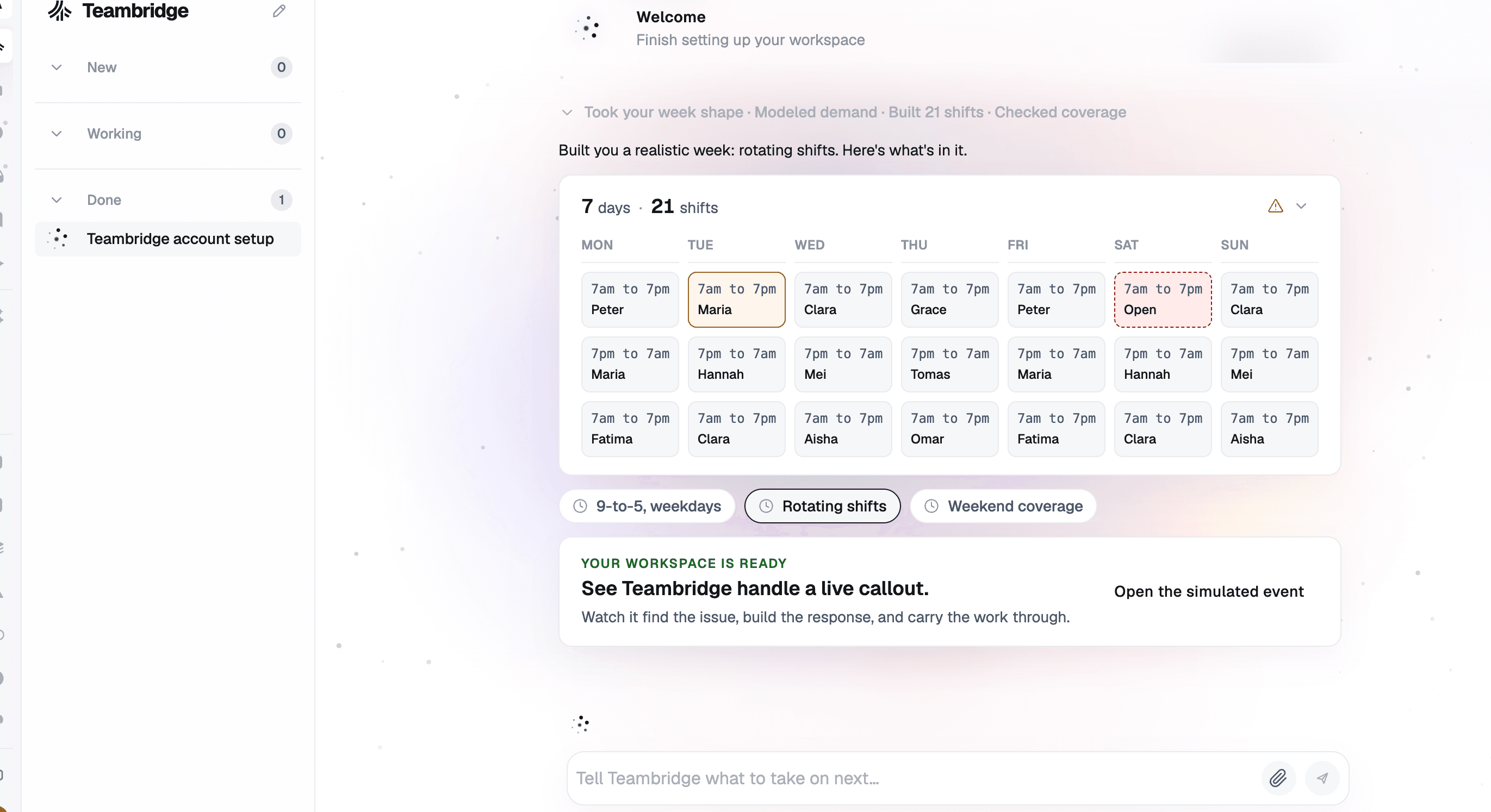
Four crews sharing one continuous position work an average of 42 hours each per week. The example below uses two day crews and two night crews, each working seven 12 hour shifts every 14 days. Download the 28 day CSV and edit it in your spreadsheet.
A and B alternate day coverage. C and D alternate night coverage. This example keeps each crew on the same shift. Add your shift start times, worker assignments, site and role requirements before using it.
How many people does coverage require?
6 people needed, rounded up
Calculation: 168 hours × people needed at once ÷ (weekly hours per person × available share of time). Include leave and training in unavailable time. This is a capacity estimate. It does not test individual availability, break coverage, qualifications or overtime rules.
Reviewed September 2026
Can three, four, or five crews cover continuous work?
One continuously staffed position requires 168 coverage hours each week. Shared evenly, four crews average 42 hours, three crews average 56 hours, and five crews average 33.6 hours before absences, training, and overtime rules. A workable rotation must match that math to actual staffing, local rules, and fatigue controls.
Check coverage math
Compare available crew hours with the 168 hours required for each continuously staffed position, then add relief capacity for leave, training, and vacancies.
Map the full rotation
Write every day shift, night shift, rest period, handoff, weekend, and rotation change across the complete cycle before publishing it.
Test common disruptions
Remove one person or crew, add training, and model a demand increase to see where overtime, fatigue, or uncovered work appears.
Product boundary
Teambridge can model schedules, coverage, worker availability, open work, communication, and time records. Employers remain responsible for labor rules, fatigue policies, collective agreements, and safe staffing decisions.
Research brief
Coverage math is the first test, not the final schedule
A continuously staffed position requires 168 coverage hours each week. Dividing those hours across crews reveals the baseline load, but employers must still test overtime, rest, consecutive nights, absences, and local requirements before adopting a rotation.
Product view
Primary research and guidance
Reader tool
Continuous coverage worksheet
Use this baseline to compare crew counts. Then add relief for leave, training, absence, and demand changes before selecting a rotation.
| Planning input | Example | How to use it |
|---|---|---|
| Positions needed at once | 1 | Enter the minimum people required at every hour |
| Weekly coverage hours | 168 | Multiply positions by 24 hours and 7 days |
| Crew count | 4 | Compare three, four, and five crew options |
| Average weekly hours per crew | 42 | Divide weekly coverage hours by crew count |
| Relief allowance | 15 percent | Add the allowance used for leave, training, and absence |
| Planned weekly hours with relief | 193.2 | Multiply weekly coverage hours by one plus the relief rate |
| Overtime review | Required | Test each workweek instead of relying only on the average |
The arithmetic is a planning baseline. Employers remain responsible for applicable federal, state, local, contractual, and safety requirements.
A 4-crew, 12-hour, 24/7 rotation is one of those schedules that looks elegant on a whiteboard and collapses under real operations within a quarter. The calendar isn't the hard part. The hard part is the overtime math, the credential expirations that don't care what week of the cycle it is, the no-show on a Saturday night when half your bench is on their seven-day break, and the pay policies still written for an 8-hour Monday-through-Friday world.
This guide walks through the patterns operators actually run — DuPont, Pitman, 4-on-4-off — what the hours look like, where they break, and what has to be true in your scheduling and payroll system before you commit your team to one.
Why 4 Crews Is the Floor for 24/7 12-Hour Coverage
The math is unforgiving. You need 168 hours of coverage per week (7 days × 24 hours). With patterns like 2-2-3 or DuPont, each employee works roughly 42 hours weekly on average. Include scheduled days off built into the rotation. So you need four separate teams rotating through the pattern to maintain continuous coverage.
Three crews can technically cover 168 hours, but only by averaging 56 hours per crew per week with no margin for vacation, sick days, or training. You end up running mandatory overtime as a structural feature rather than an exception. That's a turnover engine, not a schedule.
Four crews give you a workable baseline: roughly 182 workdays per year, or about 2,184 hours per crew member. That leaves room for the real world — credentials renewals, PTO, the night-shift caller-off, and the inevitable gap when someone quits in the middle of a cycle.
Note
Four crews is the floor, not the ceiling. A 5-crew variant typically produces longer breaks, lower overtime, and better fatigue outcomes than the classic 4-crew structure, at the cost of higher headcount. If your safety-incident or turnover numbers are climbing, the cheapest fix may be adding a crew, not optimizing the rotation.
The Math: Hours, Crews, and Overtime Exposure
The core feature of any 4-crew 12-hour rotation is that weekly hours are uneven by design. Week 1 runs 36 hours (3 shifts × 12 hours). Week 2 runs 48 hours (4 shifts × 12 hours). The schedule naturally builds in 2 hours of overtime weekly.
That 2-hour-per-week average is not 2 hours of overtime. It's 8 hours of overtime every other week, because FLSA overtime is calculated against the 40-hour workweek, not a 14-day average. Over a year, that's roughly 208 hours of guaranteed overtime per crew member before anyone calls out sick.
Here's how the hour math compares across the common 12-hour patterns:
| Pattern | Cycle Length | Avg Hours/Week | Built-In OT/Week | Longest Stretch |
|---|---|---|---|---|
| Pitman (2-2-3) | 14 days | 42 | 8 hrs every other week | 3 shifts |
| Panama (2-2-3 rotating) | 28 days | 42 | 8 hrs every other week | 3 shifts |
| DuPont | 28 days | 42 | Variable (0-32 hrs/wk) | 4 shifts |
| 4-on-4-off | 8 days | 42 | 8 hrs alternating | 4 shifts |
The pattern matters less than the payroll system underneath it. The 42-hour weekly average is higher than the standard 40-hour week, which has overtime implications. Some weeks the crew works 48 or even 72 hours (Week 2), while Week 4 is entirely off. The averaging period and how you define FLSA workweeks determines your overtime obligations.
If your payroll is still configured for the 8-hour M-F world, the rotation will look like it's generating chaotic overtime exceptions every single week. It isn't. It's generating predictable, structural overtime that should be baked into the budget. That requires admin tooling that can model the exception before it becomes a payroll dispute.
DuPont Schedule: 4-Week Cycle With a Full Week Off
The DuPont is the pattern most operators have heard of, and the one most likely to be misapplied. During a 4-week cycle, each team works 4 consecutive night shifts, followed by 3 days off duty, works 3 consecutive day shifts, followed by 1 day off duty, works 3 consecutive night shifts, followed by 3 days off duty, works 4 consecutive day shift, then have 7 consecutive days off duty.
The selling point is obvious: a 7-day break built into every cycle — giving employees a full week off every four weeks without using vacation time. That's a real recruiting advantage in industries fighting for skilled labor.
The selling point is also where it breaks. While the Dupont Schedule is technically fast-rotating (change from days and nights between each work block), crews only transition between day and night shifts four times per cycle, minimizing the impact of industrial jetlag. The Dupont Schedule compresses 28 days of shifts (14 shifts) into 21 days in order to provide 7 days off. One consequence is that employees face a demanding stretch in Week 3, often referred to as "hell week," with six 12-hour shifts in seven days.

Where DuPont fits
DuPont was built for continuous-process manufacturing, oil and gas, nuclear power, chemical plants, mining, emergency services, and transportation — operations where the cost of an unplanned shutdown dwarfs the cost of overtime, and where a 7-day break gives people enough recovery time to come back fresh.
It's a worse fit for healthcare floors and security details where institutional knowledge degrades fast and a 7-day gap means handoff drift. Crews may go up to 14 days without direct contact with daytime management, which can be problematic in rapidly changing environments.
Pitman / 2-2-3 Schedule: Predictable Rotation, Every Other Weekend Off
The Pitman — also called the 2-2-3 in its rotating form — is the workhorse. A 2-2-3 work schedule (also called the Pitman schedule) is a 14-day rotating pattern where employees work two days on, two days off, three days on, two days off, two days on, and three days off. Employees alternate between day and night shifts and get every other weekend off. It's the most popular 12-hour shift pattern because it provides balanced 24/7 coverage while never requiring anyone to work more than three consecutive days.
The practical advantage is recovery. You never hit a 4-shift stretch, and the cycle is short enough that people can keep it in their heads without a paper calendar.
Ready to move?
Ready to see Teambridge in action?
Fixed vs. rotating Pitman
There are two flavors, and the difference matters more than operators usually admit. There are two versions: a fixed schedule (teams always work the same shift) and a rotating schedule (teams alternate between days and nights). It's designed to keep businesses running around the clock without burning out the people doing the work.
Fixed Pitman is better for fatigue management and personal preference — some people genuinely prefer nights and will stay in the role for years. Rotating Pitman is fairer in the sense that nobody is permanently stuck on the unpopular shift, which matters more when turnover on nights is your bottleneck.
Where Pitman fits
Police departments, hospital floors, and 24/7 hotels run Pitman because the every-other-weekend-off pattern is recruiter-friendly and the 3-shift maximum keeps fatigue manageable. Police departments are the most common users, but it is also found in healthcare, fire departments, manufacturing, and security. Operators in healthcare staffing and security lean on Pitman variants for exactly these reasons.
4-on-4-off and Fixed vs. Rotating: Picking the Right Variant
The 4-on-4-off is the simplest 12-hour pattern in the rotation playbook. Four 12-hour shifts, four days off, repeat. The 4 on 4 off rotation is one of the simplest schedules to administer and is commonly used in public safety and industrial operations because of its predictable cycle.
The tradeoff is that 4 consecutive 12-hour shifts is a real workload, especially when one or more of them are nights. The recovery is generous, but you're paying for it with a harder block of work.
Choosing between fixed and rotating
There's no universal answer here. The decision is operational:
- Fixed shifts work when you have preference-based staffing — people who want nights, often for the differential or for daytime childcare reasons. They reduce circadian disruption and improve safety outcomes on nights, but they create a two-tier culture and a recruiting problem on the less-popular shift.
- Rotating shifts work when you want to distribute the unpopular hours fairly and reduce resentment between day and night crews. They're harder on individual bodies but easier on team cohesion.
Tip
Don't pick fixed vs. rotating by manager preference. Survey your actual workforce. Employee-selected schedules consistently outperform management-mandated ones across Circadian's 40 years of shift scheduling work.
Holiday coverage is where 4-team patterns reveal whether they were really designed or just copied off a template. Holidays don't align with the cycle. You either build holiday rotation into the team math, backfill with overtime, or pull from an agency bench. All three are valid; pretending it won't come up is not.
Where These Schedules Break: Handoffs, Credentials, and No-Shows
The pattern on paper is the easy part. The failure modes are operational, and they're consistent across every 12-hour rotation.
Handoffs
With 12-hour shifts, you get two handoffs per day instead of three. That's fewer opportunities to drop information, but each handoff carries more weight. On nursing floors, this is patient status. In manufacturing, it's process state. In security, it's incident logs and post-specific intel.
A 12-hour rotation without a built-in handoff overlap — even 15 paid minutes — is a rotation that's quietly leaking information every shift change.
Credential expirations
Credentials expire on calendar dates. Rotations don't care about calendar dates. A CNA license that expires on the 18th expires on the 18th whether the employee is on a 7-day break, a 3-day stretch, or a no-show that morning.
This is where credential management has to be enforced at clock-in, not at scheduling. If the scheduler tries to fix this by hand, they'll miss one a quarter, and that one will be the OSHA or Joint Commission audit finding.
No-shows on the off-rotation
The ugliest break is the night-shift no-show when the rest of your bench is on their off days. In a 4-crew DuPont, that may mean calling someone on day 3 of their 7-day break. They will not be happy. They may not answer.
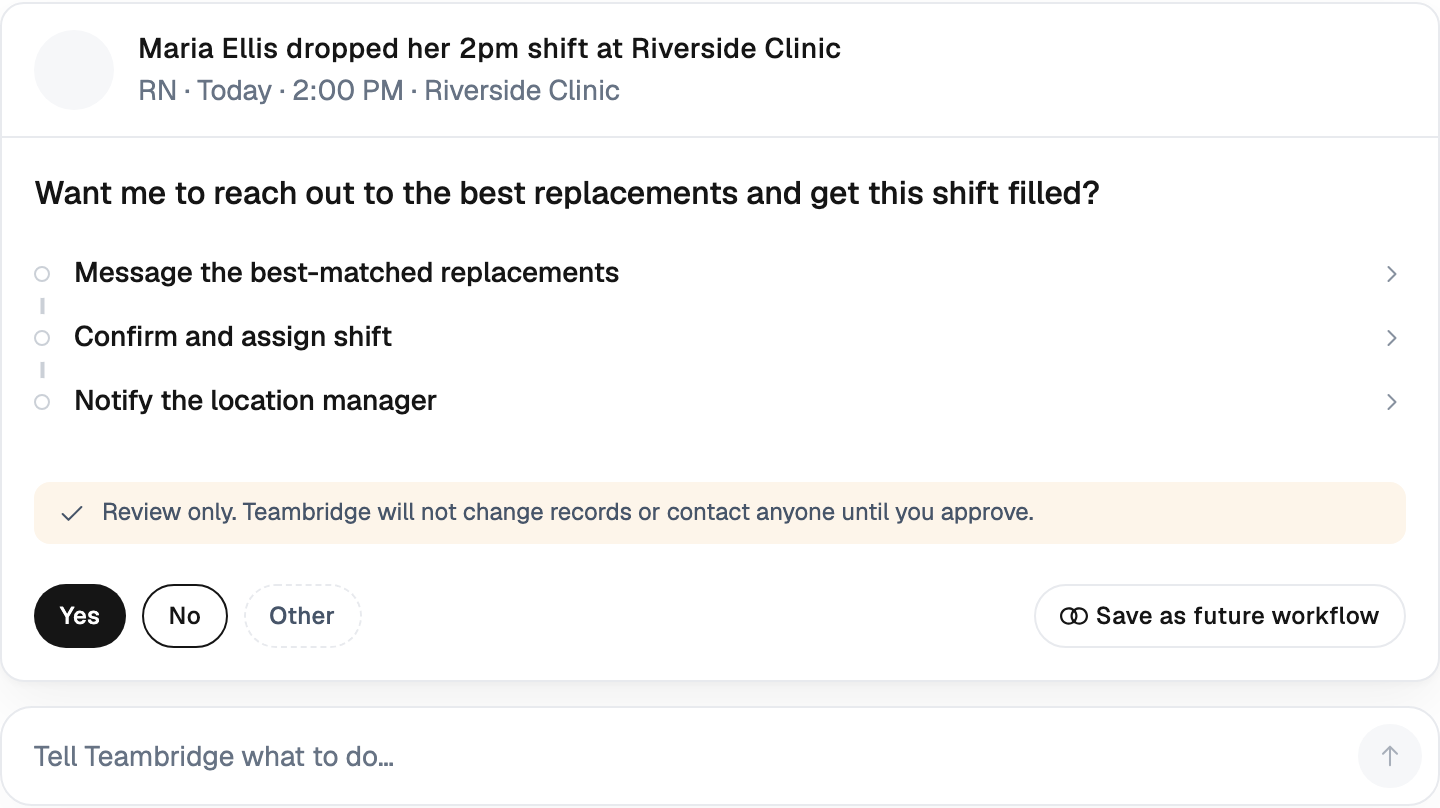
The operators who manage this well have done two things: built a separate float or per-diem pool that exists outside the 4-crew rotation, and configured automated shift-fill to hit qualified workers in priority order rather than mass-texting everyone. Mass texts don't fill shifts; they teach people to ignore the texts.

Industries Running 4-Crew 12-Hour Rotations
The pattern shows up wherever the cost of going dark exceeds the cost of paying overtime. A short survey:
- Healthcare — Hospital floors, ICUs, long-term care, and dialysis centers run Pitman or 2-2-3 variants almost universally. Patient care doesn't pause, and 12-hour nursing shifts have been the standard for two decades. Healthcare staffing operators add per-diem pools on top of the 4-crew baseline to handle census swings.
- Public safety — Police, fire, and EMS use Pitman and 4-on-4-off variants. Coverage is non-negotiable and union contracts often dictate the pattern.
- Manufacturing and continuous-process — Refineries, chemical plants, paper mills, and food processing. This is where DuPont was invented and where it still fits best. Light industrial operations with shift-based staffing run these patterns to keep production lines moving.
- Security — Guard posts, command centers, executive protection details. Security staffing operations typically run Pitman or 4-on-4-off with credential and post-order enforcement at clock-in.
- Live events and venues — Stadiums, casinos, and 24/7 venues run modified versions for permanent posts. Live events operators usually overlay event-day surges on top of the 4-crew baseline.
None of these industries chose 12-hour rotations because they're fun. They chose them because the alternative — three 8-hour shifts with three handoffs per day — generates more handoff errors and more total commute time per worker.
Running the Schedule Without Running Your Team Into the Ground
A 4-crew 12-hour rotation works in production when three things are true: the math is modeled before launch, the exception handling is automated, and the team has a real voice in pattern selection.
A short operator checklist before committing to any pattern:
- Run the pattern for a full cycle on paper. A DuPont needs 28 days, a Pitman needs 14. Build schedules well in advance. Give your team at least four to six weeks of notice before the new schedule kicks in.
- Model the overtime cost. 8 hours of OT every other week is roughly 4-5% on top of base wages. Confirm that's in the budget.
- Build the handoff overlap. 15 paid minutes per shift change beats one missed dose, one production fault, or one missed incident report.
- Define the float pool. Who covers the no-show on day 3 of a 7-day break? Answer that question before it happens, not after.
- Test for a full 20–30 day cycle. Patterns feel different in week 3 than they do in week 1. Don't judge the rotation until you've lived a full cycle.
- Build credential enforcement into clock-in. Not into the schedule. Not into the manager's spreadsheet. Into the clock.
The operators who get this right are usually running scheduling software that lets them save the pattern once and reuse it instead of rebuilding every two weeks, plus admin tools that surface exceptions before they become payroll disputes. The full platform view matters here because scheduling, credentials, time tracking, and pay are the same problem viewed from different angles — and 12-hour rotations are where that becomes obvious.
Warning
Do not roll out a new 12-hour rotation in the same quarter as a payroll system change, a new union contract, or a major credential audit. The compounding exceptions will get blamed on the rotation, and you'll lose buy-in on a pattern that might have worked.
The pattern is a tool. The operation around it is what makes it work. Pick the right one for your industry, build the math and the exception handling underneath it, and the 4-crew 12-hour rotation will hold up — for the team and the budget.

About the author

Content Writer at Teambridge
Anis Nanai is a content writer at Teambridge, with a focus on workforce management and the realities of running hourly teams. He prioritizes conversations with customers, staying close to the market, and understanding how workforce needs are changing. His writing connects those concerns to practical decisions about scheduling, time tracking, staffing, and automation. He examines product developments through the questions that matter to operators: what does this solve, how would it work for my team, and what evidence supports it?
Company perspective: this author works at Teambridge. Customer outcomes are attributed to their published sources.
View LinkedIn profile