

This isn't a reporting problem. It's a data-aggregation problem masquerading as a reporting problem — and the IRS has spent the last two filing seasons getting much faster at finding it.
The 226-J Letter Nobody Saw Coming: Why Staffing Agencies Get Hit Hardest
When a contingent worker shows up at three different client worksites in a quarter, the client doesn't owe them coverage. The agency does. For staffing agencies, ACA compliance is particularly complex because the agency, not the client, is typically the employer of record for placed workers, which means the agency carries the coverage obligation.
That single fact is what makes staffing agencies the IRS's favorite 226-J target. The agency books the hours, signs the W-2, and inherits every minute of service across every client engagement under the same EIN — even when those hours flow through three different client portals and never roll up to a single worker record.
When the IRS thinks you owe a penalty, you find out by letter. The IRS uses Letter 226-J to inform ALEs of their potential liability under Code § 4980H. A response form (Form 14764) is included with Letter 226-J so that an ALE can inform the IRS whether it agrees with the proposed penalty. For proposed assessments issued on or after January 1, 2025, the employer has at least 90 days from the date of Letter 226-J to respond.
90 days sounds like room to breathe. It isn't. The data the IRS used to build that assessment lives across your time system, your payroll provider, your benefits admin platform, and every client-specific portal you've ever logged into. Pulling that together under pressure — for a measurement period that ended 18 months ago — is where agencies bleed.
And the (a) penalty is the one that punishes you for a paperwork miss like a payroll miss. If the employer fails to offer MEC to at least 95% (or all but 5, if greater) of full-time employees and their dependent children in any given month, a penalty will apply if any full-time employee enrolls through a public Marketplace and qualifies for a premium tax credit (or tax subsidy). The penalty is multiplied by the total full-time employee count minus the first 30, regardless of how many employees were offered coverage.
Read that again. Miss the offer on one worker and the math runs against your entire full-time headcount minus 30. One per-diem nurse can light up the whole book.
2026 Penalty Math: What One Misclassified Per-Diem Nurse Actually Costs
The dollar figures moved up sharply for 2026. For plan years beginning after December 31, 2025, Penalty A will be $3,340 per year ($278.33 per month) multiplied by the number of full-time employees employed by the employer less 30. Penalty B will be $5,010 per year ($417.50 per month) multiplied by the number of full-time employees who obtain subsidized coverage through Covered California. These penalty amounts for 2026 are higher than the amounts currently in place for 2025 ($2,900 per year for Penalty A and $4,350 per year for Penalty B).
Here's what that actually looks like for a mid-sized agency. Assume an 800-worker book where 600 average 30+ hours during the measurement period and qualify as full-time. One per-diem RN was juggled across three hospital clients, hit 31 hours/week on aggregate, and was never offered coverage. She enrolls on the exchange and pulls a premium tax credit.
The 4980H(a) cascade
| Scenario | Calculation | Annual exposure |
|---|---|---|
| One missed offer, agency drops below 95% threshold | (600 FT − 30) × $3,340 | $1,903,800 |
| Same miss, 4980H(b) only (if 95% threshold held) | 1 × $5,010 | $5,010 |
| Add reporting failures: 600 incorrect + 600 not furnished | 1,200 × $340 (approx.) | $408,000 |
The (a) penalty is 380x the (b) penalty in this scenario. Same worker. Same missed offer. The difference is whether your agency cleared the 95% "substantially all" bar that month.
Warning
The (a) penalty is calculated on your entire full-time headcount minus the first 30 — not just the worker who triggered the gap. This is the math that turns a single classification error into a seven-figure event.
For a high-churn agency with 800 placed workers, the line between a $5,010 problem and a $1.9M problem is whether one offer of coverage cleared the threshold in one month of one measurement period 18 months ago. That's the operational reality the platform has to solve for.

Where Cross-Site Hour Aggregation Breaks Down
The root cause is almost never malice or negligence. It's data fragmentation.
Client A runs its own VMS. Client B has a custom portal. Client C emails you a CSV every other Friday. Your contingent worker — same SSN, same EIN on your end — shows up as three different records that never reconcile until someone manually pulls them together for 1095-C generation in January.
By then, the measurement period has closed. The administrative period has closed. The stability period has begun. You can't go back and offer coverage retroactively for a period that's already ended.
The three overlapping periods that break under fragmentation
The look-back measurement method is the primary tool staffing agencies use to determine which variable-hour workers are full-time employees. Under this method, agencies define a standard measurement period (typically 12 months), a stability period (typically another 12 months), and an administrative period (up to 90 days) during which coverage is offered and becomes effective. If a worker averages 30 or more hours per week during the measurement period, they must be offered coverage for the entire stability period, regardless of how many hours they work during it.
Three clocks running simultaneously, often offset by hire date for variable-hour workers (the initial measurement period, or IMP). When a worker bounces between three clients, the question "which measurement bucket is this person in right now?" is not always answerable from a single screen.
Three data streams have to reconcile cleanly:
- Time and attendance — every hour of service, including paid leave, across every client site under your EIN
- HR and payroll — hire dates, termination dates, rehire flags, classification changes
- Benefits administration — offers extended, declined, accepted, COBRA elections
If any of those three is fed by a per-client export instead of a unified worker record, the gap shows up at 1095-C generation — never in time to fix.
The Rehire Trap: Break-in-Service Rules That Wreck High-Churn Books
This is the single most common place staffing agencies trip up.
Under the look-back method, if a worker has a break in service of at least 13 consecutive weeks (26 for educational organizations), you can treat them as a new hire when they return — meaning their IMP starts over. If the gap is shorter, prior hours must be counted toward eligibility, and the worker may already be in a stability period that obligates you to offer coverage on day one of their return.
For a per-diem nurse who works heavy in Q1, takes a 10-week gap, and comes back in Q2, the wrong rehire flag turns a clean re-onboarding into a missed offer. Multiply that across a thousand-worker book during warehouse peak season or summer event staffing and the surface area for error gets ugly.
Where the trap closes
- Worker hits full-time average in their initial measurement period
- Stability period triggers an offer obligation
- Worker stops picking up shifts before the offer is administered
- Recruiter re-engages them 11 weeks later — under 13 — and classifies as new hire
- No offer extended; prior service hours never counted
- Worker enrolls on exchange with PTC
- 226-J letter arrives 14 months later
The recruiter wasn't wrong about anything except the calendar. And calendars are exactly the kind of thing a single worker record should be doing automatically.
This is why agencies running Teambridge for staffing treat the rehire decision as a system-enforced check rather than a recruiter judgment call. The 13-week clock either resets or it doesn't — and the platform knows the answer before the offer letter goes out.
Real-Time Threshold Monitoring vs. Year-End Reconciliation
The shift that matters for 2026 is from January panic to in-period prevention.
The IRS isn't getting easier to satisfy. Penalty amounts went up. An ALE's health coverage is considered affordable for FTEs if their required contribution for self-only coverage does not exceed 9.96% of their household income for the year (up from 9.02% for 2025); Pay-or-play penalty amounts significantly increase. Affordability moved too, which sounds like room but means your old margin-of-safety calculations need to be redone.
And the IRS validation engine reaches the underlying data faster than the paper trail does. Reconciling in Excel in January means your errors surface during IRS validation, not during finance close. That's a several-month gap where you can't fix what you can't see.
What in-period monitoring actually looks like
- Rolling 30-hour averages calculated across all worksites under one EIN, refreshed daily
- Alerts when any variable-hour worker is trending toward the threshold within a measurement period
- Automatic flags on rehires inside the 13-week window
- Audit trail for every offer-of-coverage decision, with Line 14 and Line 16 codes pre-populated from verified time records
- Monthly Line 14/16 code validation — not annual
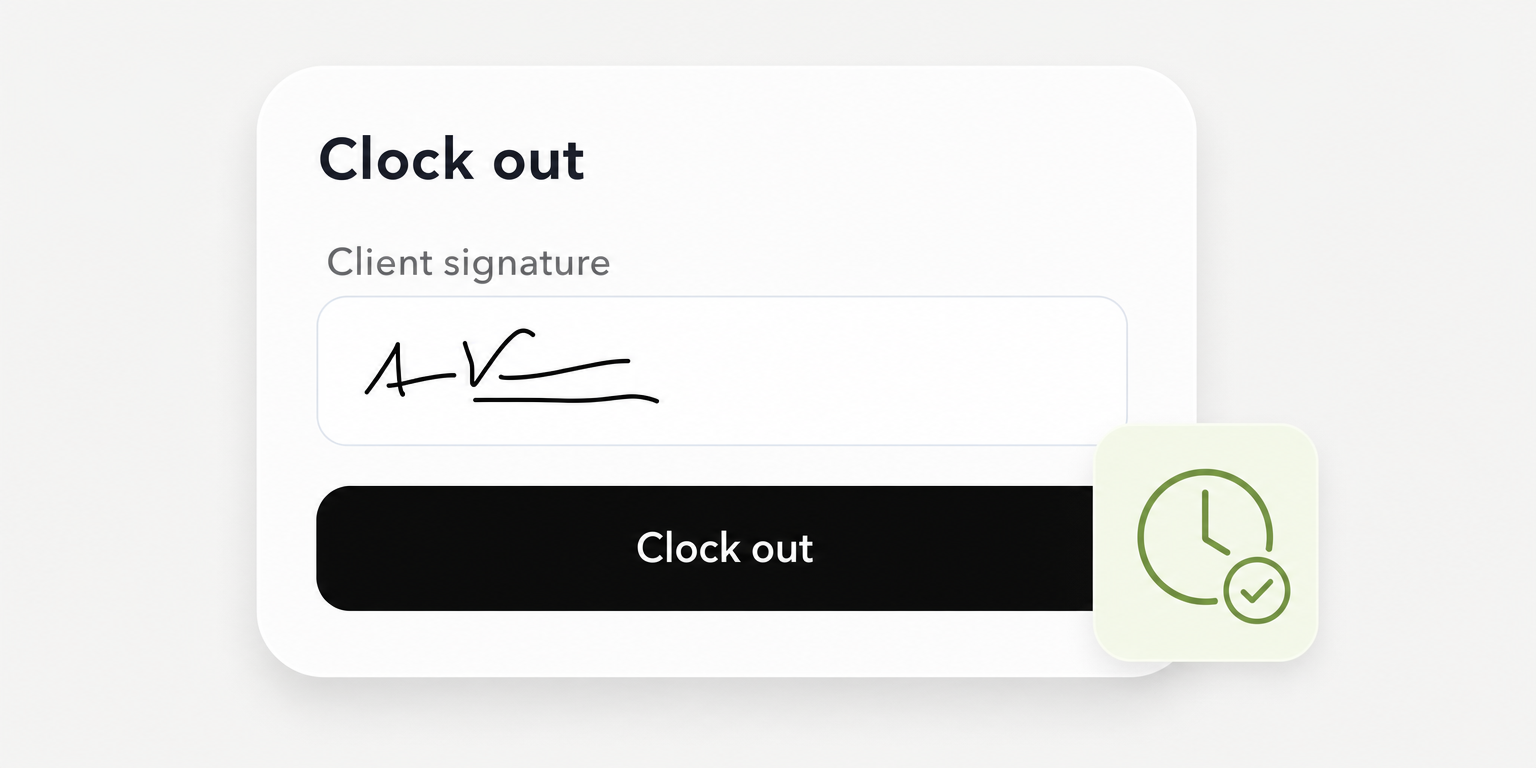
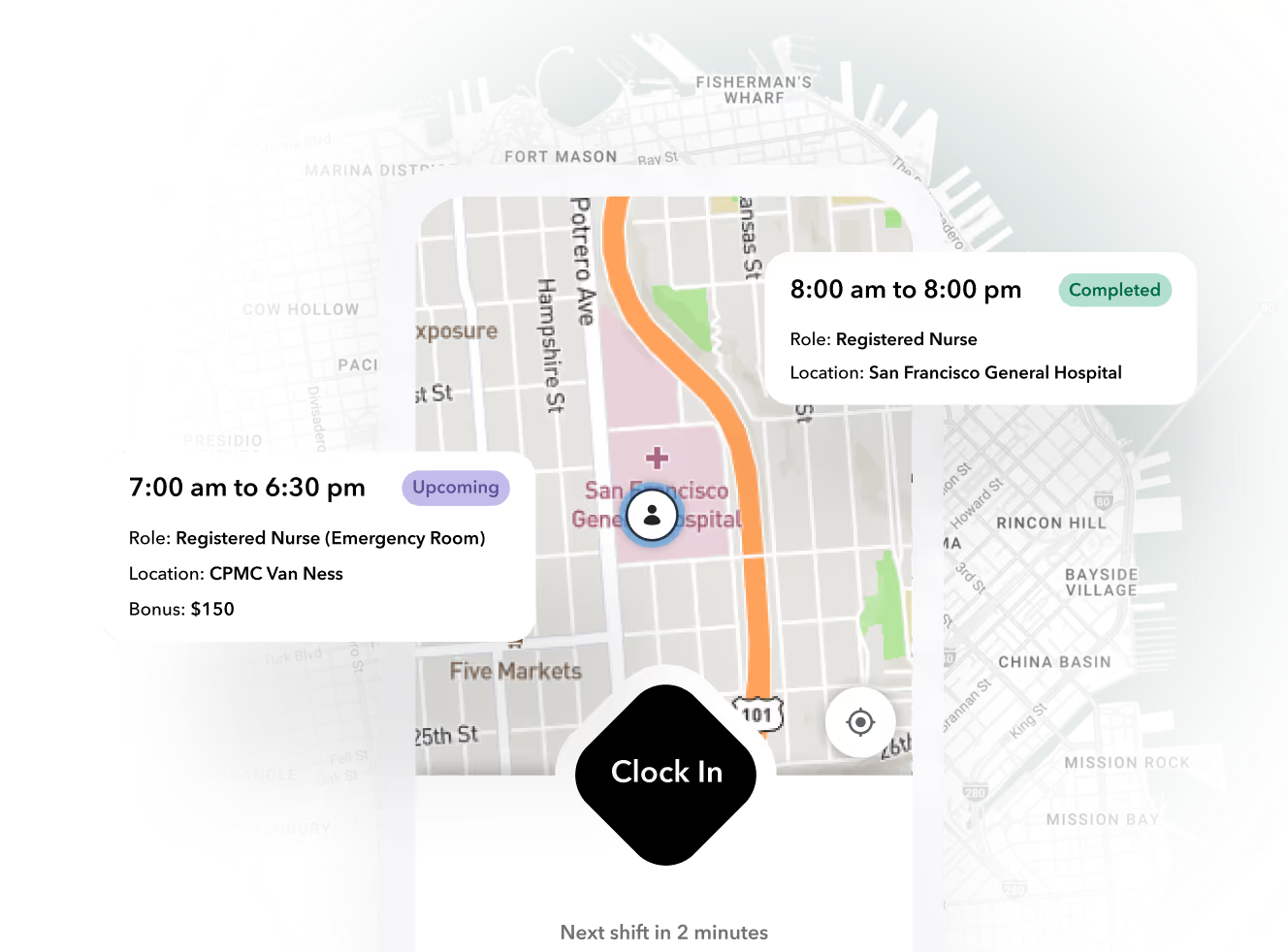
This is what Teambridge's time tracking was built around: every hour of service, every engagement, one worker record, GPS-verified at the point of capture. The 1095-C is a downstream byproduct, not a January scramble.
The Operator's Checklist: Closing the Gap Before Q4
The measurement period for most calendar-year plans closes in Q4. If you're going to fix anything for the 2026 plan year, it happens now.
Six things to do before Q4 closes
- Consolidate worker records across client portals into a single source of truth. If your time data still lives in three VMS systems, that's the first fix. Nothing else works until this works.
- Document your measurement method choices in writing. Standard measurement period, stability period, administrative period, IMP rules for variable-hour hires. Same document, available to auditors and to the team running rehires.
- Track every hour of service across all engagements under the same EIN — including paid leave. Hours of service is broader than hours worked.
- Validate Line 14 and Line 16 codes monthly, not in January. Using the correct ACA reporting codes is essential for IRS compliance and avoiding penalties under sections 4980H(a) and 4980H(b). When it comes to ACA 1095 codes, most of the action happens in Lines 14, 15, and 16 on IRS Form 1095-C. These three fields tell the full story of your health coverage offer: who got it, what it cost, and why you may or may not be subject to a penalty.
- Confirm affordability against the 2026 9.96% threshold. Run the math on your lowest-cost self-only premium against each safe harbor (FPL, rate of pay, W-2) and pick the one that holds for your variable-hour population.
- Build a 226-J response binder before you ever need it. Worker rosters by month, offer-of-coverage documentation, measurement period definitions, rehire history. If the letter shows up, you have 90 days — and most of that gets eaten by gathering the underlying data.
Tip
The agencies that handle 226-J letters well don't have better lawyers. They have better data. Specifically: a single worker record that already knows the answer to every question the IRS is going to ask.
How Teambridge Handles Cross-Site Aggregation Under One Worker Record
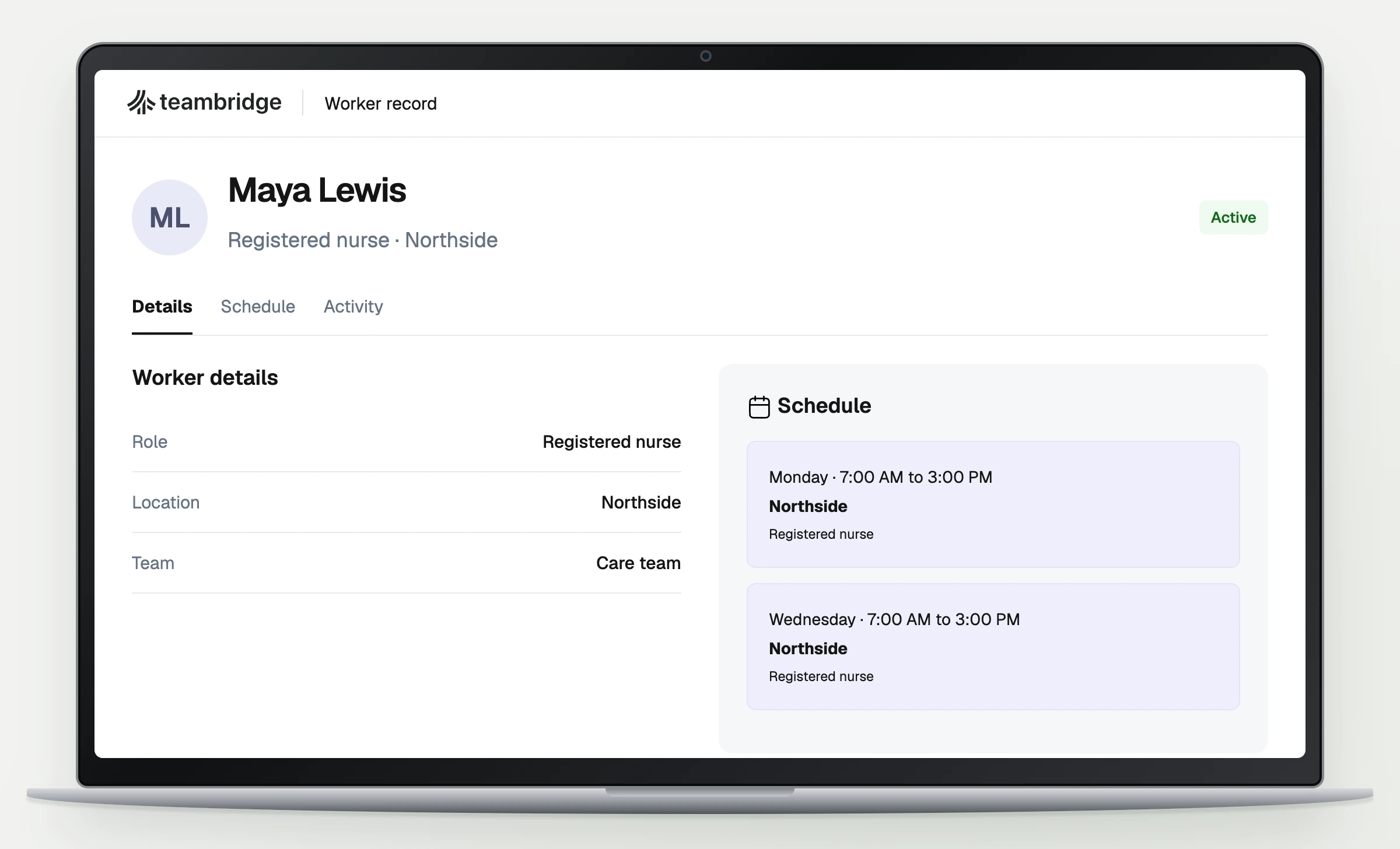
The operational answer to ACA 1095-C staffing compliance isn't a separate ACA tool bolted onto a fragmented stack. It's a single worker record that rolls up hours from every client site and every engagement under the same EIN, then surfaces threshold risk in real time instead of in January.
With the Teambridge platform, that record is the source of truth for time, scheduling, credentials, pay, and compliance. The agency stops asking "which system has the right hours for this worker?" because there is only one system, and it knows.
For healthcare staffing operations running per-diem nurses across multiple hospital systems, the platform aggregates hours across every facility, flags 30-hour threshold approach before the worker crosses it, surfaces rehire-window risk before the 13-week clock resets the wrong way, and generates clean 1095-C data straight from verified time records.
For light industrial and warehouse books moving through peak season, admin tools handle bulk classification updates, exception flags on missed offers, and audit-ready compliance reports without anyone reconciling spreadsheets at midnight.
The (a) penalty doesn't care whether your hours were fragmented across three systems or one. It only cares whether the offer of coverage was on file before the stability period began. Closing that gap mid-measurement is the only version of this problem worth solving — and it's the version that ends the January 1095-C panic for good.
For more on the underlying penalty mechanics, see the IRS guidance on information reporting by applicable large employers and the Thomson Reuters summary of the 2026 employer shared responsibility adjustments.

About the author

Content Writer at Teambridge
Anis Nanai is a content writer at Teambridge, with a focus on workforce management and the realities of running hourly teams. He prioritizes conversations with customers, staying close to the market, and understanding how workforce needs are changing. His writing connects those concerns to practical decisions about scheduling, time tracking, staffing, and automation. He examines product developments through the questions that matter to operators: what does this solve, how would it work for my team, and what evidence supports it?
Company perspective: this author works at Teambridge. Customer outcomes are attributed to their published sources.
View LinkedIn profile