

The expensive violations rarely come from bad intent. They come from a forklift operator whose certification expired on Tuesday, a CNA who worked through her meal break because the unit was short, and a security guard who got moved between three sites and quietly cleared 47 hours. No human supervisor can watch all of that in real time. Software can.
This is what automated labor compliance actually does — not Friday's timecard cleanup, but real-time enforcement during the shift. Here's where it pays for itself.
The Real Cost of a Labor Violation in 2025
The federal penalty floor moved up again this year. To maintain their deterrent effect, the DOL adjusts these penalties for inflation annually, with increases effective January 15, 2025, and the increased penalties apply to violations assessed after this date for violations occurring after November 2, 2015.
The headline numbers operators need to know:
| Violation Type | 2024 Penalty | 2025 Penalty |
|---|---|---|
| Repeated/willful FLSA minimum wage or overtime | $2,451 | $2,515 per violation |
| FLSA tip provisions | $1,373 | $1,409 |
| Oppressive child labor | $15,629 | $16,035 |
| Child labor causing serious injury or death | $71,031 | $72,876 |
| Willful child labor causing serious injury or death | $142,062 | $145,752 |
The maximum penalty for violations of federal minimum wage or overtime requirements increases from $2,451 to $2,515 per violation. The 2025 child labor penalty amounts are: $16,035, up from $15,629, for oppressive child labor; $72,876, up from $71,031, if the child labor violations cause serious injury or death; and $145,752, up from $142,062, for repeated or willful child labor violations that cause serious injury or death.
Federal penalties are the floor, not the ceiling. Stack a state action on top — New York, California, Massachusetts, Illinois — and the exposure grows fast. Low-wage industries with high turnover catch most of the random audits: staffing, hospitality, home care, janitorial, light industrial.
Warning
A DOL Wage and Hour Division investigation is almost always triggered by a single employee complaint. One disgruntled worker can put your entire payroll history under the microscope for the past two to three years.
The penalties above are per violation, per worker, per pay period. A scheduling pattern that misses meal breaks for 30 workers across 26 pay periods is not one violation. It's potentially hundreds. That's how a routine wage-and-hour case becomes a six-figure problem.
1. Real-Time Break and Meal Period Enforcement
Most break violations aren't found during the shift. They're found weeks later when a manager reviews timecards, or years later when a lawyer pulls records. By then, the liability is baked in.
Automated compliance watches the clock while the work is happening. The mechanics are simple:
- The worker's phone prompts them when a break is due, with a forced break punch.
- The supervisor gets an alert when a worker approaches the fifth hour without a meal punch.
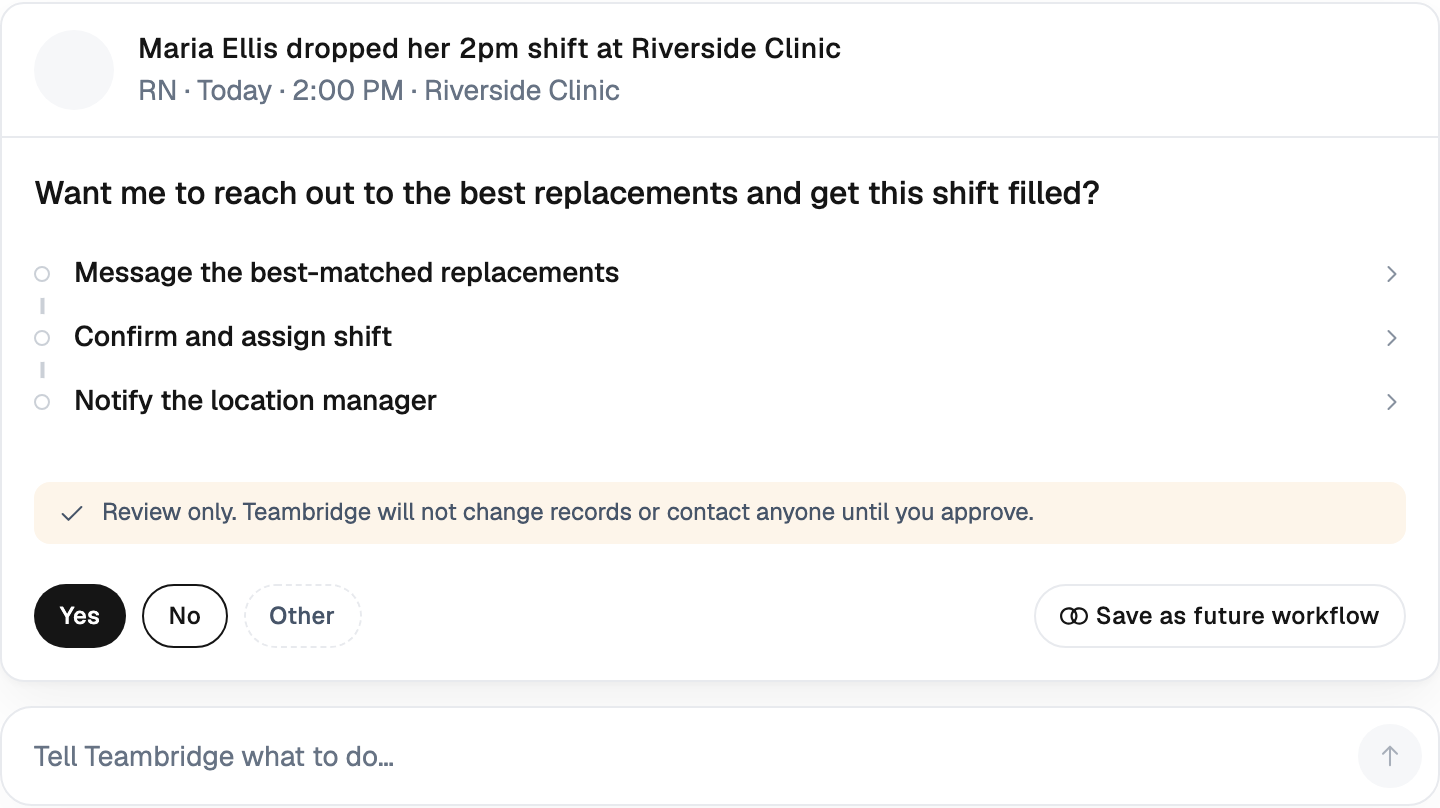
- Missed breaks auto-flag for premium pay before payroll exports.
- Geofenced clock-in confirms the worker was actually on-site (or off-site, for an unpaid meal).

This matters most in states with aggressive private rights of action. In New York, if the commissioner determines that an employer has violated section one hundred sixty-two (meal periods), the commissioner shall issue an order directing compliance, and in no case shall the order direct payment of an amount less than the total wages found to be due, plus liquidated damages in the amount of one hundred percent of unpaid wages, the appropriate civil penalty, and interest from the date of the underpayment to the date of payment.
In plain English: the worker recovers the wages, plus the same amount again as liquidated damages, plus interest, plus penalties, plus attorney's fees. Across a workforce, the math gets ugly fast.
Teambridge's time tracking handles break enforcement at the punch level — GPS-verified clock-in, automatic break compliance flags, and exception routing before timecards close.
2. Overtime Limits and Predictive Cap Alerts
The expensive overtime mistake isn't paying time-and-a-half. It's discovering on payroll day that three workers blew past 40 hours because a manager moved them between sites — or, worse, a CBA shift differential kicked in that nobody calculated.
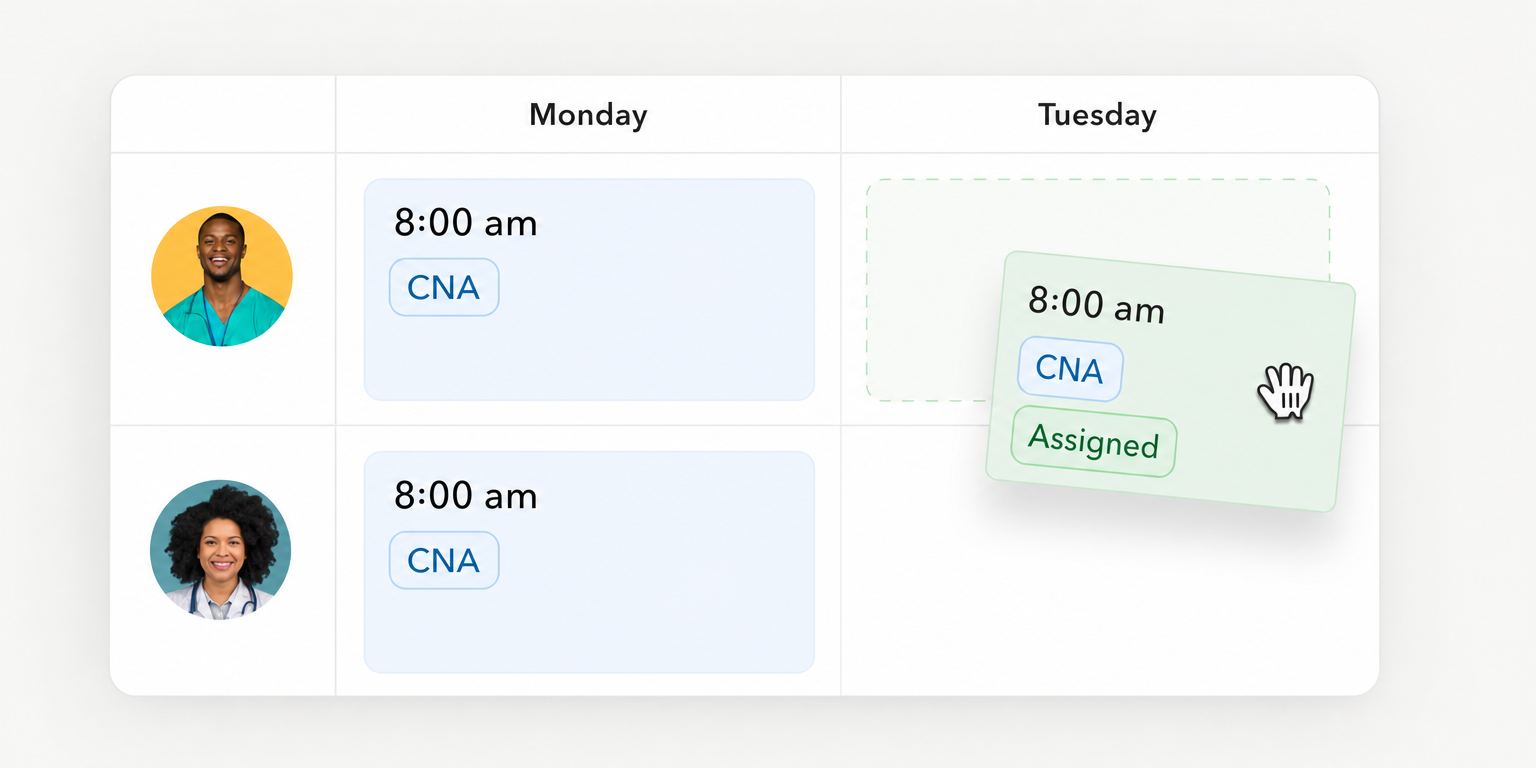
Manual scheduling can't model this. The dispatcher sees one site, not the worker's whole week. Compliance automation models projected hours across the week, across sites, and across employers in a co-employment scenario. When a scheduling action would push someone over a federal, state, or contract OT threshold, the system blocks the action and surfaces the cap before the shift is assigned.
What the cap engine should watch
- Federal: 40 hours per workweek.
- State daily OT: California's 8-hour daily threshold, Colorado's 12-hour rule, Alaska's 8-hour threshold.
- Spread-of-hours: New York's 10-hour rule triggering extra hour at minimum wage.
- CBA caps: union contract limits on consecutive shifts, mandatory rest, seniority bumps.
- Doubletime triggers: California's 12-hour daily and 7th consecutive day rules.
Failing to follow the minimum wage and overtime provisions of the Fair Labor Standards Act (FLSA) has become more costly. The max amount for repeated or willful violations had been $2,451. It's now $2,515 per violation — and that's before you add back wages owed, liquidated damages, and class-action exposure if the pattern is systemic.
Tip
The most expensive OT cases aren't single-worker disputes. They're class actions where a scheduling pattern affected hundreds of workers identically. Automated caps make those patterns impossible to create in the first place.
Teambridge's scheduling engine enforces OT thresholds at the assignment step, not the payroll step. The cap is the gate.
3. Credential, License, and Certification Expiry Tracking
A nurse working with a lapsed license isn't just a clinical risk. It's a billable hour you can't bill, plus a regulatory violation, plus malpractice exposure if anything goes wrong. Same logic for a forklift operator past their OSHA cert date, a security guard with an expired guard card, or a home health aide whose EVV verification hasn't been renewed.
The problem isn't that operators don't care about credentials. It's that credentials expire on different days for different workers across different jurisdictions, and the only person who reliably tracks them is the worker — who has zero incentive to tell you the day before a renewal lapses.
What a working credential workflow looks like
- Auto-block scheduling of any worker whose credential expires before the shift end time.
- Push renewal reminders 30, 14, and 7 days before expiry, escalating to the worker's manager.
- Quarantine assigned shifts until updated documentation is uploaded and verified.
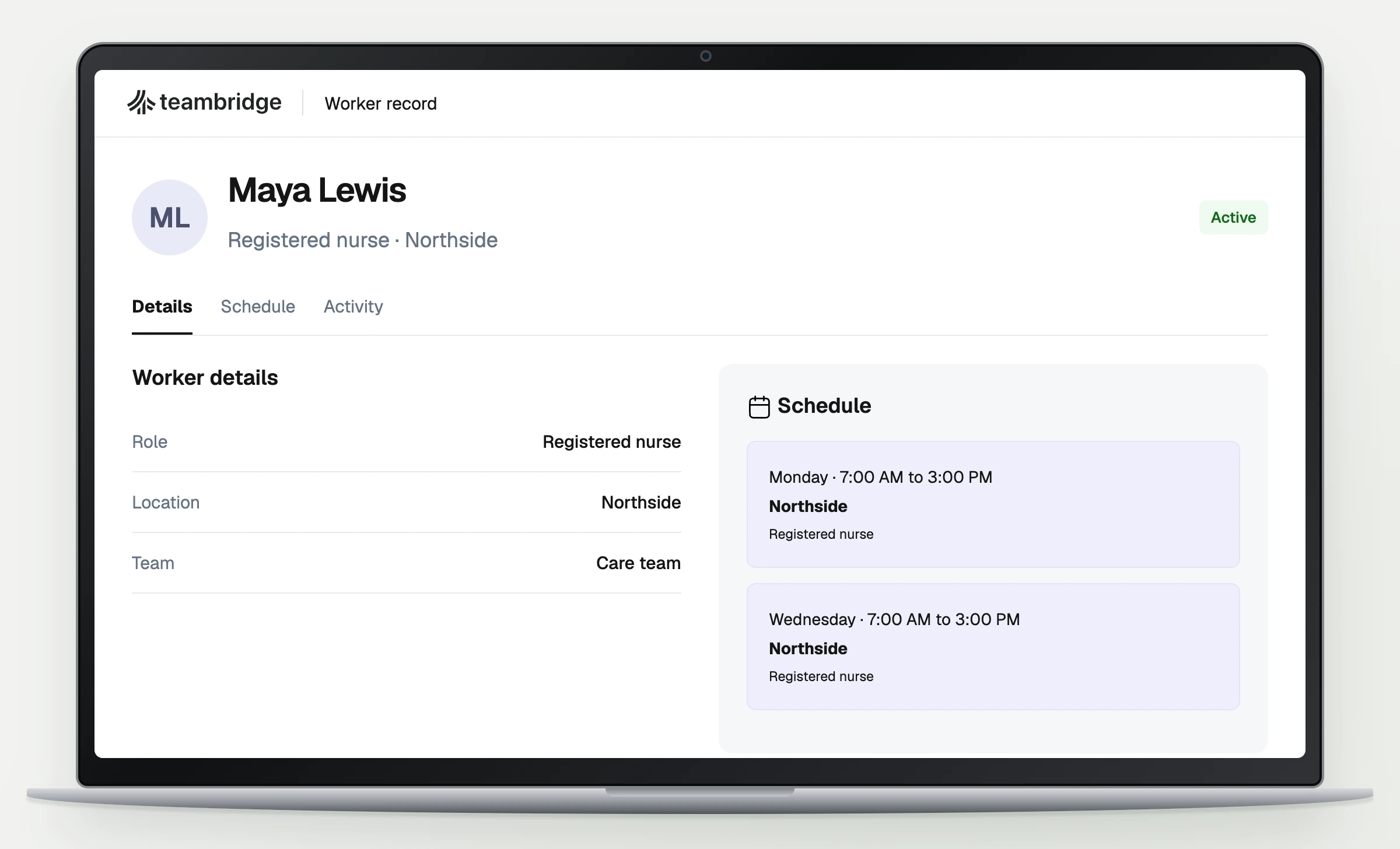
- Maintain an immutable record of who verified what and when.
This applies across industries: DEA licenses and RN renewals in healthcare, OSHA forklift and lockout/tagout training in light industrial, food handler cards in hospitality, guard cards in security, EVV in home care. The pattern is the same — automated credential gates, manual followup.

Automations let you build the renewal logic once and run it for every credential type across every worker without anyone watching a spreadsheet.
4. Multi-State and Union Rule Configuration
Operators running crews across state lines fight a patchwork. California has daily OT and meal premium rules. New York has spread-of-hours and call-in pay. Oregon, Seattle, Chicago, NYC, Philadelphia, and a growing list of cities have predictive scheduling ordinances that fine employers for last-minute schedule changes. Massachusetts has the PFML.
Layer union CBAs on top: steward notification rules, shift differentials, seniority bumps, mandatory rest periods between shifts, premium pay for working a holiday. Each contract is different. Each is enforceable.
Manual compliance teams typically pick one or two rules to enforce well and let the rest slide. That's the gap class-action firms target.
Encoded rules vs. manual rules
| Dimension | Manual Approach | Encoded Compliance Rules |
|---|---|---|
| Multi-state OT | Spreadsheet lookups by manager | Auto-applied per worker location |
| CBA differentials | Payroll catches it (sometimes) | Calculated at shift assignment |
| Predictive scheduling penalties | Discovered after a complaint | Blocked at schedule change |
| Spread-of-hours | Often missed | Auto-added to pay calc |
| Mandatory rest between shifts | Manager discretion | Hard block on assignment |
The cost saving isn't theoretical. Incorrect wage calculations across states are the single largest driver of wage-and-hour class actions and a top reason the DOL opens a corporate-wide investigation off a single worker complaint.
Encode each jurisdiction and contract once. Apply the right rule per worker, per shift, automatically. That's the only way this scales past about 50 workers.
5. Audit-Ready Records Without the Scramble
When the DOL or a plaintiff's attorney shows up with a records request, the question is whether you can produce timecards, break logs, schedule changes, signed acknowledgments, and credential documents going back several years. Manual systems usually can't — not because the records don't exist, but because they're scattered across email, spreadsheets, paper signups, and three former managers' laptops.
This matters because the statute of limitations is six years under New York state law and three years under the FLSA. Six years of records, per worker, organized enough that you can produce them in a 30-day audit window.
A real example of the math: a recent New York Industrial Board of Appeals matter assessed 100% liquidated damages of $107,449.00 and a 100% civil penalty, with the total amount due in the order at $407,661.46. That's a single-claimant case. Multiply by a class.
What an automated audit trail captures
- Every clock-in and clock-out with geolocation timestamp.
- Every break punch — missed, taken, interrupted, or waived.
- Every schedule change with the user who made it and the reason code.
- Every credential upload, verification, and expiry event.
- Every acknowledgment of policy, signed digitally with a timestamp.
- Every exception note from a supervisor — why the punch was edited, why the worker was paid through lunch.
Admin tools generate this trail by default. There's no "turn on compliance mode" because it's always on. When a records request hits, the report is an export, not a six-week archaeology project.
Doing the Math: What Automation Actually Saves
Let's run the numbers on a 500-worker operation. These are conservative estimates, not worst case.
| Exposure Category | Annual Estimate |
|---|---|
| Missed meal breaks (5% of shifts, NY-rate liquidated damages) | $180,000 |
| Unbilled OT from cross-site scheduling errors | $95,000 |
| Credential lapses (rebilled hours + remediation) | $40,000 |
| Single DOL audit response (legal + back wages + penalty) | $250,000 |
| Predictive scheduling fines (per ordinance, urban operations) | $35,000 |
| Total annual exposure | ~$600,000 |
The cost of an automated workforce compliance platform for a 500-worker operation runs a fraction of that — and that's before counting the operational cost of the manager hours currently spent on timecard cleanup, credential chasing, and audit prep.
Note
The point isn't that every operator gets hit with $600K in violations every year. The point is that the exposure is real, the trigger is random (one employee complaint), and the cost of prevention is a small fraction of the cost of response.
The federal floor keeps moving up. The DOL has signaled it will continue annual inflation adjustments, which means the $2,515 figure is a 2025 number that gets higher every January. State laws keep expanding worker remedies. Union contracts keep getting more specific.
Meanwhile, the operational reality on the ground hasn't changed. Workers still miss breaks because the shift is short-staffed. Managers still move people between sites without checking the OT projection. Credentials still expire on Tuesday and nobody notices until Friday.
The fix isn't more compliance training or another quarterly audit. It's a platform that catches the violation while there's still time to fix it — before it becomes a back-wage calculation, a settlement letter, or a class action.
For more on the 2025 penalty schedule, see the U.S. Department of Labor and the DOL's 2025 civil penalty adjustments summary.

About the author

Content Writer at Teambridge
Anis Nanai is a content writer at Teambridge, with a focus on workforce management and the realities of running hourly teams. He prioritizes conversations with customers, staying close to the market, and understanding how workforce needs are changing. His writing connects those concerns to practical decisions about scheduling, time tracking, staffing, and automation. He examines product developments through the questions that matter to operators: what does this solve, how would it work for my team, and what evidence supports it?
Company perspective: this author works at Teambridge. Customer outcomes are attributed to their published sources.
View LinkedIn profile