

The November 2025 McKinsey survey put hard numbers on it. 88 percent of organizations report regular AI use in at least one business function, compared with 78 percent a year ago. But adoption isn't the story anymore. The story is the gap between adoption and value — and for staffing, healthcare, janitorial, security, and hotel operators, that gap is both the warning and the opening.
The Pilot-Loop Problem: Adoption Is Near-Universal, Value Isn't
Everyone is "using AI." Almost no one has rewired the operation around it. At the enterprise level, the majority are still in the experimenting or piloting stages, with approximately one-third reporting that their companies have begun to scale their AI programs.
For a workforce ops leader, this shows up in a specific, frustrating way. You have an ATS with an AI screener bolted on. Your scheduling tool ships an AI autofill button. A notetaker joins your client calls. None of it closes a shift gap end-to-end. None of it chases a lapsed credential without a human reminder. None of it meaningfully changes the hour-by-hour reality of your coordinators.
That's the pilot loop. Tools added, workflows unchanged.
The cost of staying there is real. AI adoption without transformation capability produces expenses without corresponding returns. Experimenting indefinitely in pilot phases burns resources and time while competitors who crack the scaling challenge build durable advantages.
The winning narrative for frontline-heavy industries isn't "AI replaces workers." It's blunter: AI agents redesign the workflows humans were stuck managing manually. The schedulers and compliance leads stay. The spreadsheet triage, the credential chase, the 2 a.m. call-off scramble — those go.
What 23% Scaling Agents Actually Means for Shift-Based Industries
Agents are different from chatbots, and the data treats them differently. Organizations are also beginning to explore opportunities with AI agents—systems based on foundation models capable of acting in the real world, planning and executing multiple steps in a workflow. Twenty-three percent of respondents report their organizations are scaling an agentic AI system somewhere in their enterprises, and an additional 39 percent say they have begun experimenting with AI agents.
Read that carefully. 23% scaling in at least one function. 39% experimenting. That's 62% of the market in motion. But look at where the motion is concentrated.
When you zoom into specific functions — IT, software engineering, knowledge management, customer service, marketing — no more than roughly 10% of organizations report agents as scaled or fully scaled in any one area. The early adopters are bounded, data-rich domains: service desks, internal knowledge retrieval, engineering copilots.
Frontline workforce ops — staffing agencies filling 2,000 shifts a week, healthcare coordinators managing per-diem nurses, security firms rotating guards across dozens of sites — are underrepresented in that data. That's both the warning and the opening. The ops functions carrying the most manual toil are the least saturated with agentic tooling.
| Function | Where agents live today | Where agents earn their keep for frontline ops |
|---|---|---|
| IT service desk | Triage tickets, reset access | Triage timecard exceptions, reset schedule conflicts |
| Knowledge management | Internal doc retrieval | Credential expiry lookup, policy grounding for shift rules |
| Customer service | Tier-0 resolution | Worker and client messaging, shift confirmation, no-show recovery |
| Software engineering | Code copilots | Automation builders for rules and exceptions |
The pattern that worked in IT — agents handling deterministic, repetitive decisions while humans own edge cases — is the exact pattern that scheduling and compliance need.
Augmentation, Not Replacement: Why the Frontline Story Is Different
There's a reason the "AI takes your job" framing lands differently on a warehouse floor than in a marketing team. Most of the global workforce was never digitized in the first place.
The WEF Future of Jobs Report 2025 frames it directly. 80% plan to upskill workers with AI training and two-thirds plan to hire talent with specific AI skills, while only 40% plan to reduce their workforce as AI automates certain tasks. The majority posture among employers isn't headcount cuts. It's augmentation.
The macro math backs it up. Job disruption will equate to 22% of jobs by 2030, with 170 million new roles set to be created and 92 million displaced, resulting in a net increase of 78 million jobs. And specifically on AI: trends observed in the increased development and uptake of AI and information processing are expected to create around 11 million jobs, and displace another 9 million — more than any other technology.
For a staffing COO or healthcare scheduling director, the realistic outcome isn't a smaller team. It's a differently deployed team. The scheduler who spent 70% of her week chasing call-offs spends 70% of her week on client relationships. The compliance manager who audited expiry reports line-by-line reviews agent decisions on the edge cases. The recruiter who copy-pasted job descriptions spends time on candidate judgment calls.
Note
The augmentation model isn't a PR softener. It's the shape the data actually supports: AI creating more frontline-adjacent jobs than it displaces, with the human work shifting toward exceptions, relationships, and judgment.
The Three Roles Emerging in an Agentic Ops Team
When agents become first-class operators in the workflow, the shape of the team changes. Three roles emerge in workforce ops:
- M-shaped supervisors. Orchestrate agents across scheduling, compliance, and pay. They set the rules, watch the dashboards, and step in when agents escalate. Think operations managers who used to manage schedulers and now also manage a fleet of AI Specialists.
- T-shaped specialists. Own quality and edge cases. A compliance lead who handles credential edge cases an agent can't resolve. A payroll specialist who triages the 3% of timecards that don't clean up automatically.
- AI-augmented frontline coordinators. Spend less time in systems, more time with workers and clients. The scheduler who stopped chasing call-offs. The recruiter who stopped manually screening.
Concretely: a scheduler at a healthcare staffing agency goes from triaging 40 call-offs a week to reviewing 3 agent escalations. The other 37 got filled while she slept. The compliance manager stops running weekly expiry reports; she reviews the queue of credentials the agent couldn't auto-renew.
That's not replacement. That's the job getting better.
Where Agents Actually Earn Their Keep in Workforce Operations
Abstract framing only goes so far. Here are the specific workflows where agentic AI removes real toil in shift-based operations:
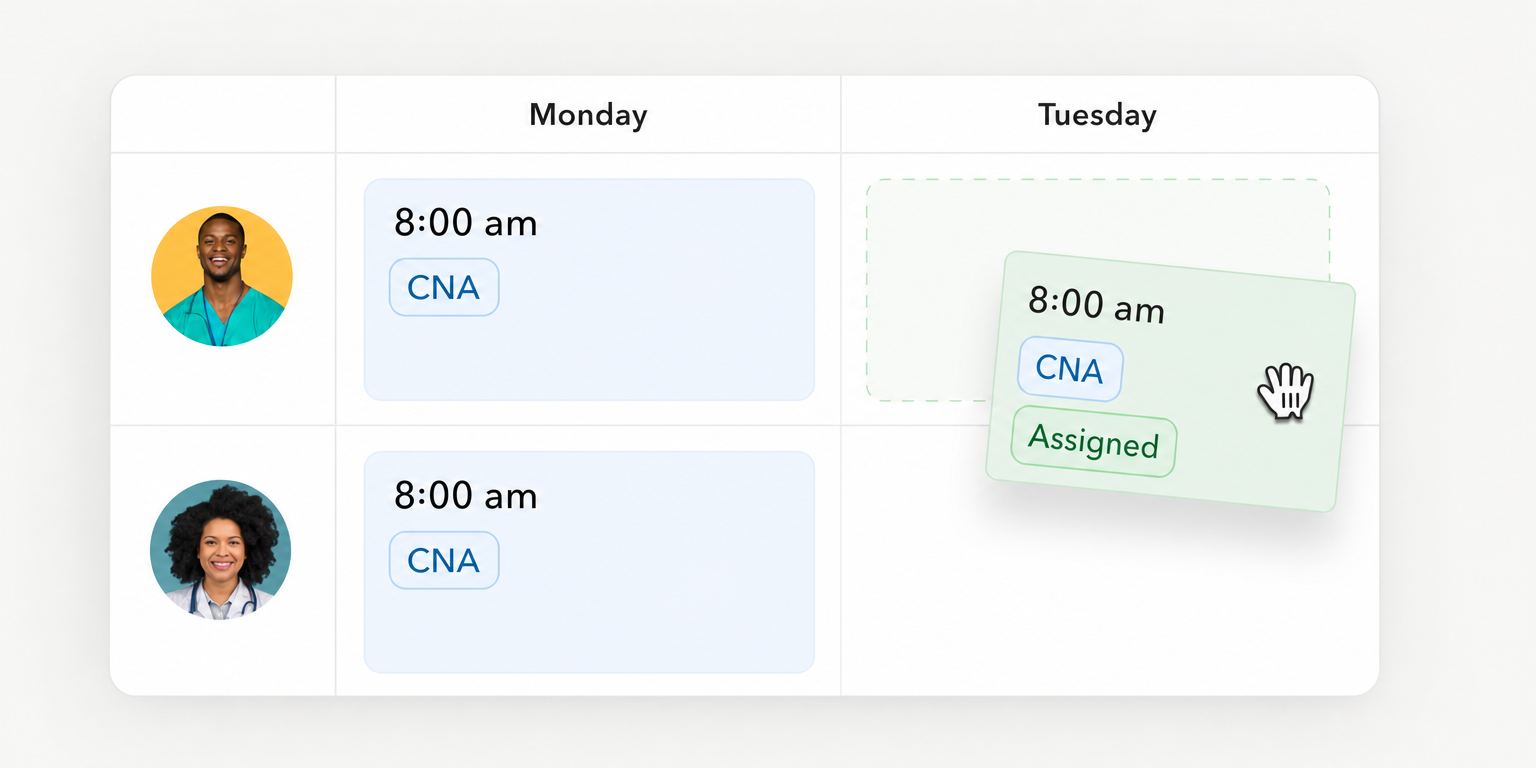
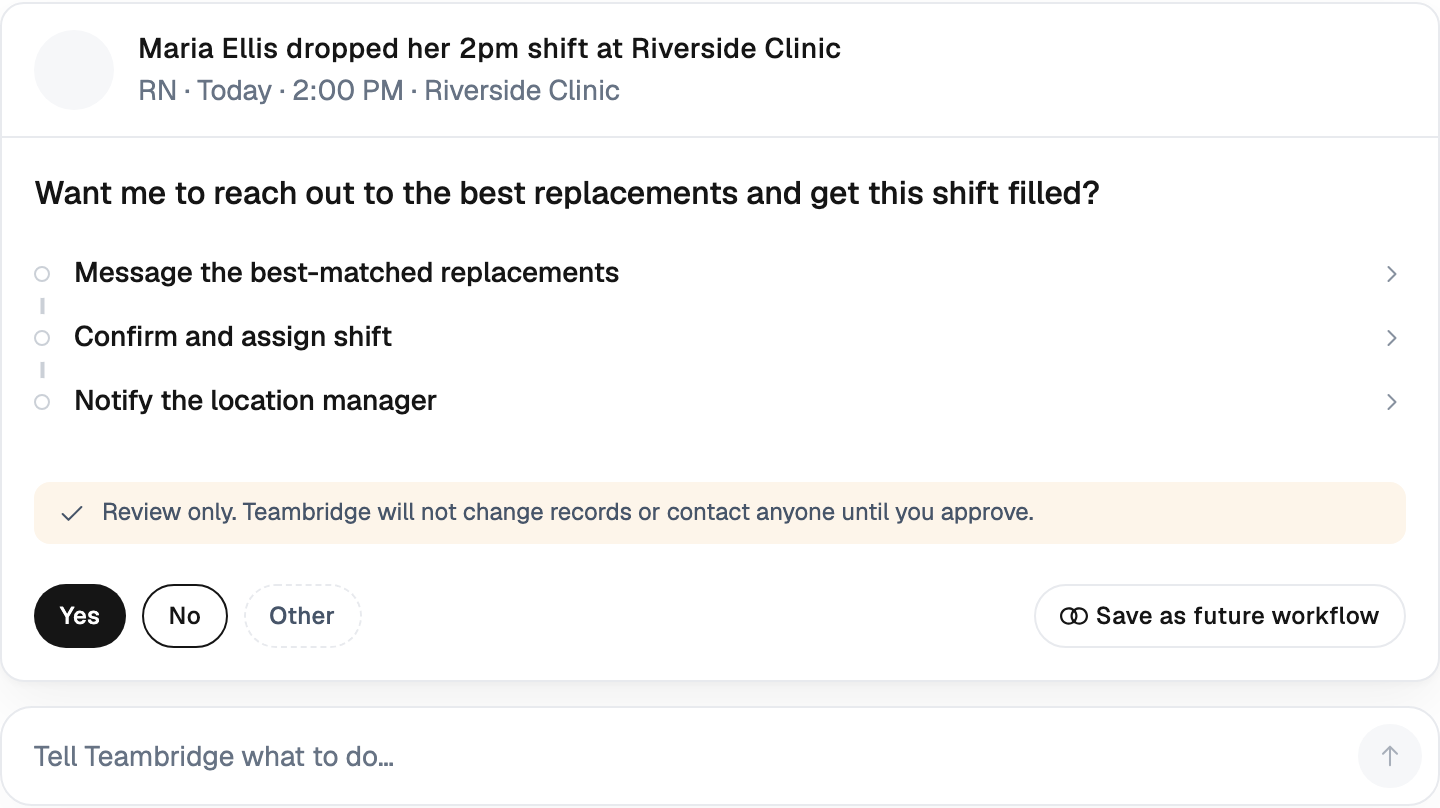
- Shift fill automation. Match open shifts to credentialed, available workers. Message candidates. Confirm fills. Update the schedule. No human touch on the happy path. Scheduling is where this lives.
- Credential monitoring and renewal chase. Watch every license, certification, and required training. Start the renewal conversation 60 days out. Block assignments when something lapses. Escalate only the stuck cases.
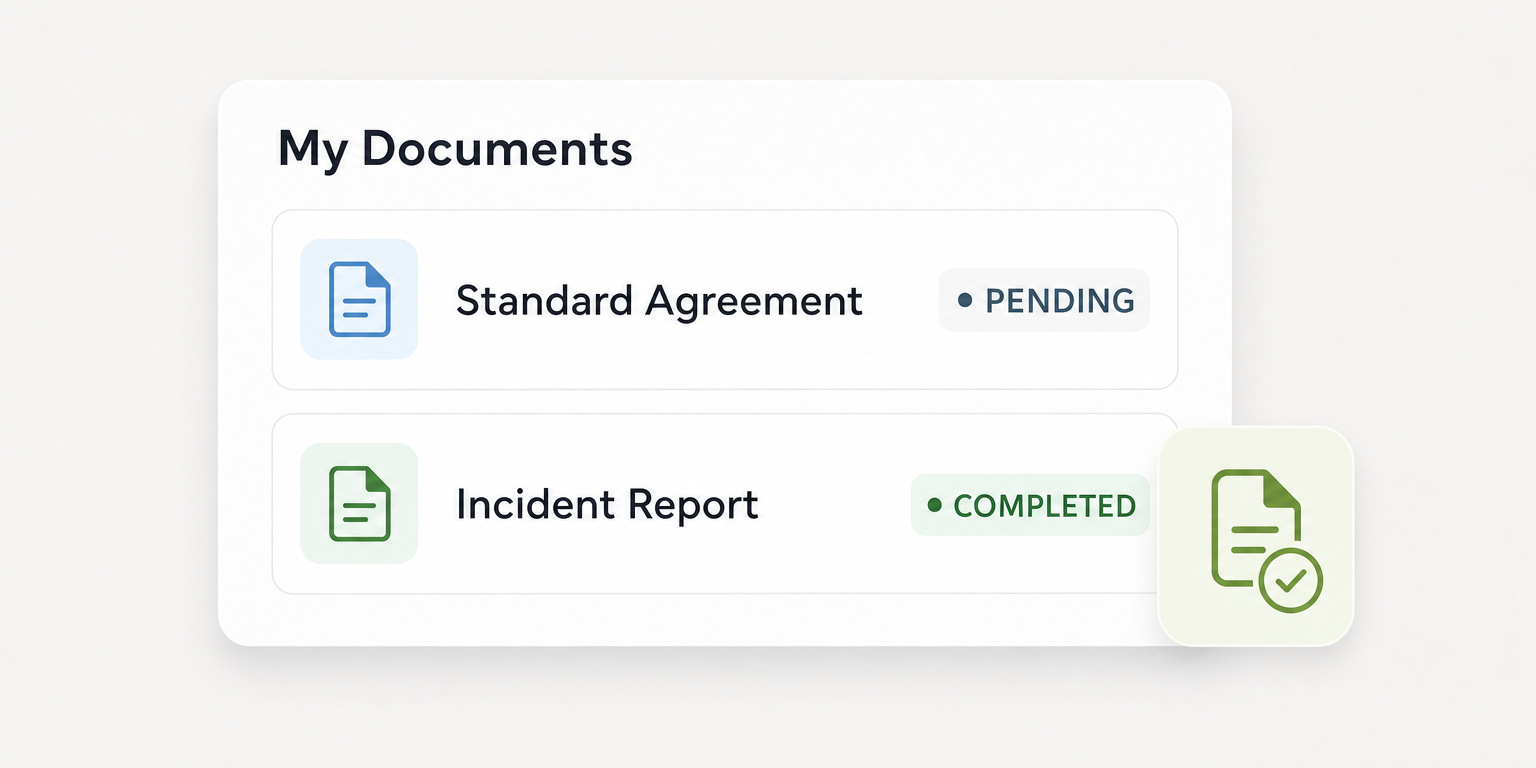
- Onboarding orchestration. Documents, I-9, training modules, background checks, badge photos — all completed before day one. Onboarding built around agents means coordinators stop being document chasers.
- Timecard exception triage. Missed punches, overtime flags, break violations. Most are deterministic. An agent can resolve or surface them with context, so your payroll lead reviews 20 cases instead of 200.
- No-show recovery. Worker didn't clock in. Agent reaches out, confirms status, triggers the backfill flow, notifies the client. Minutes, not hours.
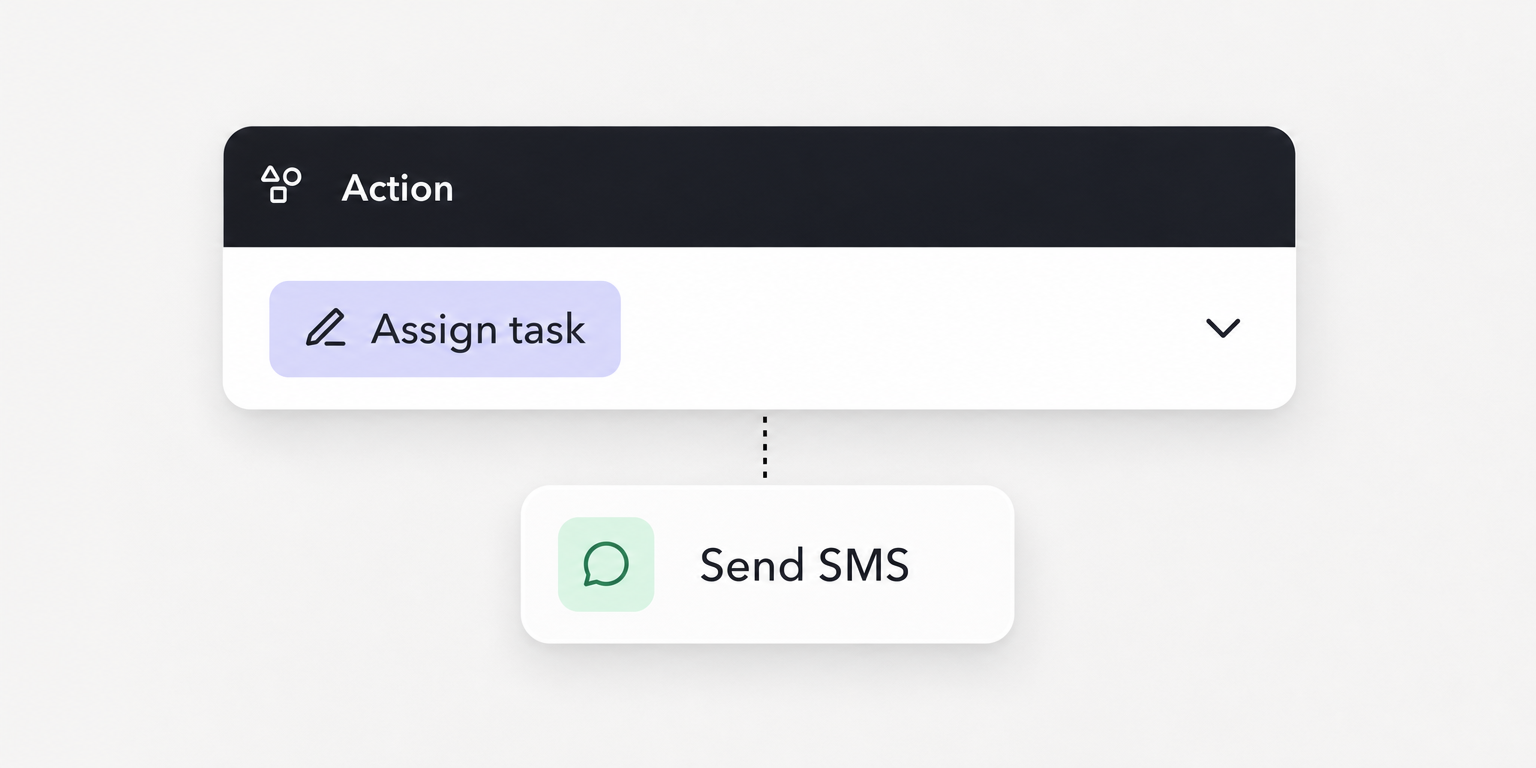
This is the pattern: take a workflow with a deterministic core and a long tail of exceptions. Give the agent the core. Give the human the tail. Build the handoff explicitly. That's what Automations are for.
The High-Performer Playbook: Workflow Redesign Beats Tool Stacking
If you only remember one data point from the McKinsey research, make it this one.
McKinsey reports that AI high performers are 2.8x more likely to report fundamental workflow redesign (55% vs 20% of others). And in most business functions, AI high performers are at least three times more likely than peers to report scaling their use of agents rather than remaining in pilot phases.
The 6% who are actually capturing EBIT impact from AI aren't winning on better models. They're winning on redesigned workflows.
The organizations that win will not be the ones with the most pilots. They will be the ones that redesign the work, validate with humans where it matters, and make trust measurable.
For a staffing or healthcare operator, that translates to something specific. Don't drop an "AI module" on top of a broken scheduling process. Redesign the end-to-end flow:
- Request comes in (from client, internal department, or a standing pattern).
- Agent matches against the qualified pool.
- Agent verifies credentials and compliance rules.
- Agent messages candidates, handles confirmation.
- Worker clocks in; agent monitors.
- Exception (no-show, overtime, credential flag) → human escalation with full context.
Agents as first-class operators. Humans owning escalation. That's the redesign. Bolting an AI button onto step 2 of a process still designed for humans doing all six steps is how you end up in the pilot loop.
Governance, Human Oversight, and Why Operators Should Care
Agents running continuously in production environments aren't like quarterly reporting. They need real-time, embedded governance.
High performers are more likely than others are to say their organizations have defined processes to determine how and when model outputs need human validation to ensure accuracy. For regulated industries — healthcare, security, construction, anything touching wage and hour law — that validation layer is the whole game.
The practical question is which decisions an agent can make autonomously and which require human sign-off. A workable default:
| Decision | Agent autonomous | Human required |
|---|---|---|
| Fill shift with credentialed, available worker | Yes | — |
| Send credential renewal reminder | Yes | — |
| Approve overtime override | — | Yes |
| Onboard flagged candidate (background check exception) | — | Yes |
| Close timecard with minor variance inside policy | Yes | — |
| Adjust pay rate mid-shift | — | Yes |
Warning
Agents without explicit escalation rules fail loudly in regulated industries. Before you scale a shift-fill agent, write down — in plain language — what it cannot decide alone. That list is your governance layer.
This is the operator-level POV behind Teambridge's AI Strategy: autonomous where the rules are deterministic, human where judgment is required, auditable everywhere.
The Operator's Move: Pick One Workflow, Redesign It End-to-End
The bifurcation is real. Adoption is table stakes. Transformation is the gap. These organizations stand out for thinking beyond incremental efficiency gains: They treat AI as a catalyst to transform their organizations, redesigning workflows and accelerating innovation.
Don't try to "do AI" across the whole operation. That's how you end up with six pilots and no scale.
Do this instead:
- Pick the workflow bleeding the most hours. For most staffing and healthcare ops, it's shift fill or credential chase. Measure the current cost in coordinator hours, fill rate, and missed-shift revenue.
- Map the deterministic vs. judgment steps. Most of the workflow is deterministic. Be honest about which steps genuinely require a human.
- Give agents the deterministic steps. Shift matching, messaging, confirmations, credential checks, renewal chases — these are agent work.
- Design the escalation explicitly. When does the agent hand off? What context comes with the handoff? Who owns it?
- Measure against the baseline. Coordinator hours reclaimed, fill rate, time-to-fill, compliance exception volume.
- Expand only after the first one works. Then move to the next workflow — onboarding, timecard exceptions, no-show recovery.
This is the shape of the Teambridge Platform and the AI Platform: infrastructure built for operators who want to redesign the workflow, not shop for another point tool.
The 88% number is loud. The 23% number is louder. The 6% number — the high performers who actually moved EBIT — is the one worth building toward. None of them got there by buying the newest AI feature. They got there by picking a workflow and rewiring it end-to-end.
Start with one. Measure it. Then do the next.

About the author

Content Writer at Teambridge
Anis Nanai is a content writer at Teambridge, with a focus on workforce management and the realities of running hourly teams. He prioritizes conversations with customers, staying close to the market, and understanding how workforce needs are changing. His writing connects those concerns to practical decisions about scheduling, time tracking, staffing, and automation. He examines product developments through the questions that matter to operators: what does this solve, how would it work for my team, and what evidence supports it?
Company perspective: this author works at Teambridge. Customer outcomes are attributed to their published sources.
View LinkedIn profile