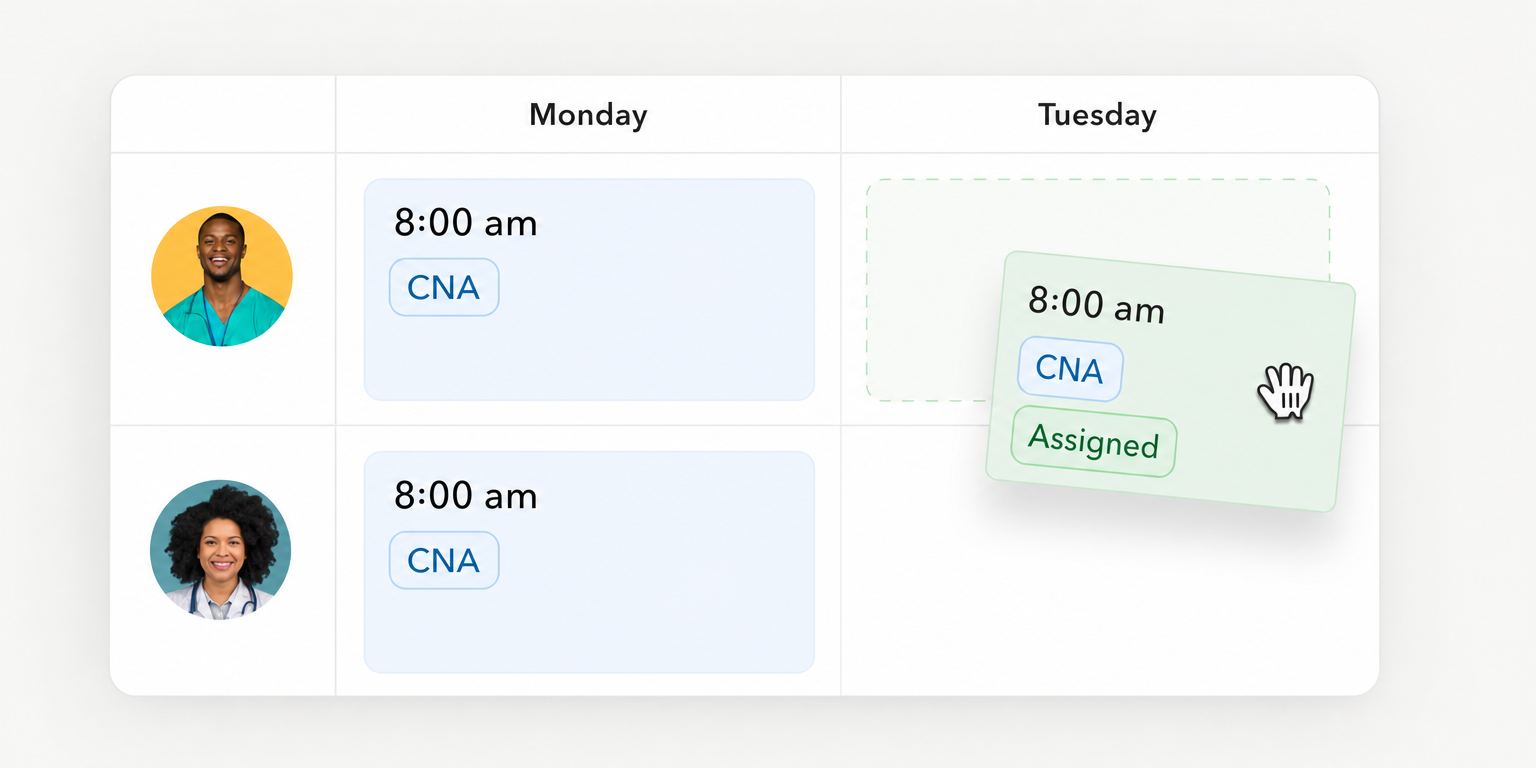


That workflow is breaking down. Demand is more volatile, compliance is more aggressive, and hourly workers expect more predictability than the spreadsheet method can deliver. AI shift scheduling is showing up in operator stacks because the math has gotten too hard to do by hand — not because anyone is trying to replace the manager.
The Hidden Cost of Manual Scheduling for Hourly Teams
Manual scheduling looks cheap until you count the hours. Manual scheduling wastes 5-10 hours/week per manager, and that's before the day-of chaos starts. Multiply that across a multi-site operation and you're paying a senior operator's salary just to keep a grid populated.
The downstream cost is worse. Average hard costs — separation, replacement and training — to replace hourly staff now sit at $2,305 in restaurants, and other industries land in the same $1,500–$4,500 band depending on how technical the role is. When schedules are unfair, unstable, or built around favoritism, workers leave, and that turnover bill compounds fast.
The "no say in schedule" problem is structural, not anecdotal. More than 8 million retail and food service workers have unpredictable schedules, and 42% have no say in scheduling at all. That number is a retention forecast disguised as a stat.
AI doesn't fix any of this by being another dashboard. It fixes it by absorbing the combinatorial work — who's available, who's qualified, who's near overtime, who has a credential that expires next Tuesday — so the manager can spend their time on the parts of the job that require judgment.
Forecasting Demand Before the Week Starts
Most bad schedules start with bad assumptions about demand. The classic move is to copy last week's template, adjust for one or two known events, and ship it. That works until the weather shifts, a competitor closes, or a flu wave fills the ED.
AI forecasting pulls from signals the spreadsheet was never going to handle:
- Retail and restaurants: POS history, foot traffic, weather, local events, and promo calendars
- Healthcare: EHR census, admissions trends, acuity scores, and discharge patterns
- Hospitality: Occupancy, RSVPs, banquet event orders, and group bookings
- Logistics and light industrial: Inbound truck schedules, order volume, and dock throughput
- Field service: Open work orders, SLA windows, and route density
The goal isn't a perfect forecast. It's a forecast specific enough that downstream decisions — coverage levels, skill mix, OT budget — start from reality instead of guesswork. Aligning staffing levels precisely with customer demand patterns down to 15-minute increments eliminates wasted labor hours, which is where the easy savings live.
Note
Forecasting is the upstream lever. If you skip it, every other AI scheduling feature is just rearranging a bad baseline.
Closing Coverage Gaps in Minutes, Not Hours
The chaotic 20% of the week is where managers actually need help. Call-outs, no-shows, surge demand, an overrun route — the schedule that was perfect on Sunday is in pieces by Tuesday at 10 a.m.
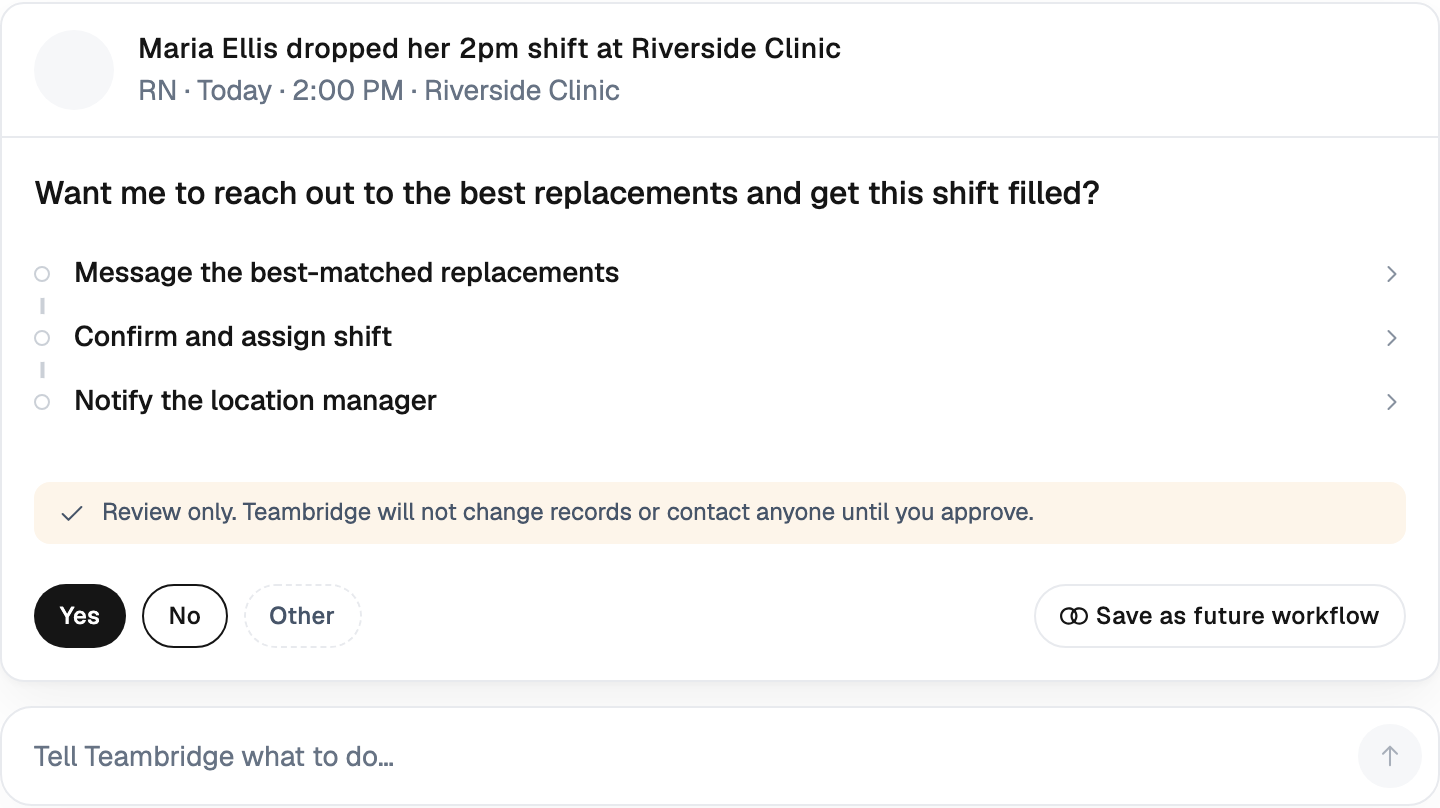
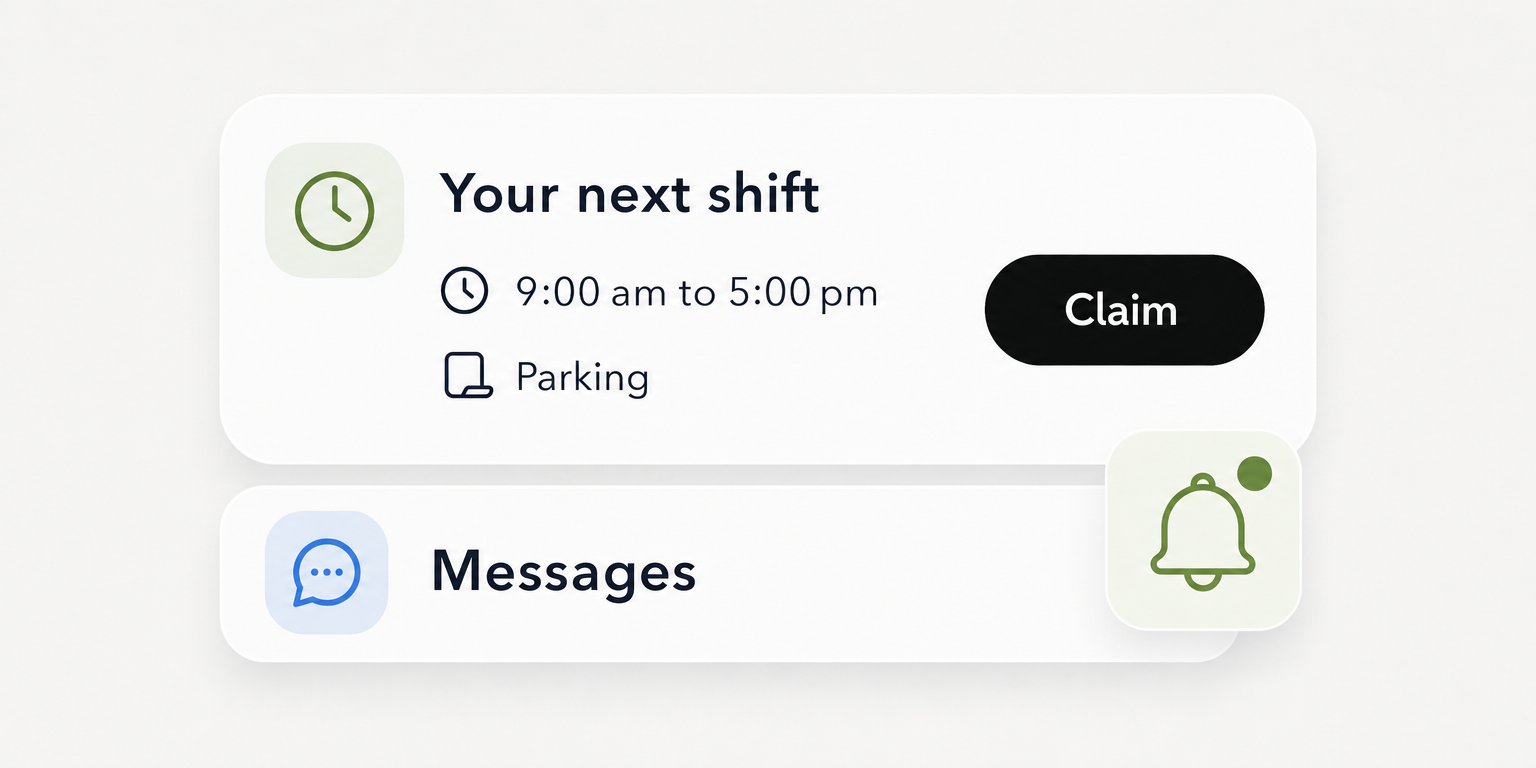
Here's where AI earns its keep. Instead of a manager texting twelve people in priority order, the system instantly surfaces qualified, available, non-OT workers and notifies them with a tap-to-claim shift. Average U.S. absenteeism is now running above 3.1%, with roughly 1 in 10 employees absent on any given day — that volume of disruption isn't survivable on text threads.
The pattern looks different by industry but the mechanic is the same:
- Home care: A caregiver cancels a visit. The system filters by client preference, geography, and certifications, then offers the shift to the top three matches.
- Logistics: A driver's route runs long. AI flags the impact on the next shift's dock crew and proposes a reassignment before the gap becomes a service failure.
- Field service: A tech's job overruns. The system reroutes the next stop to a nearby tech with the right skill stamp and SLA headroom.
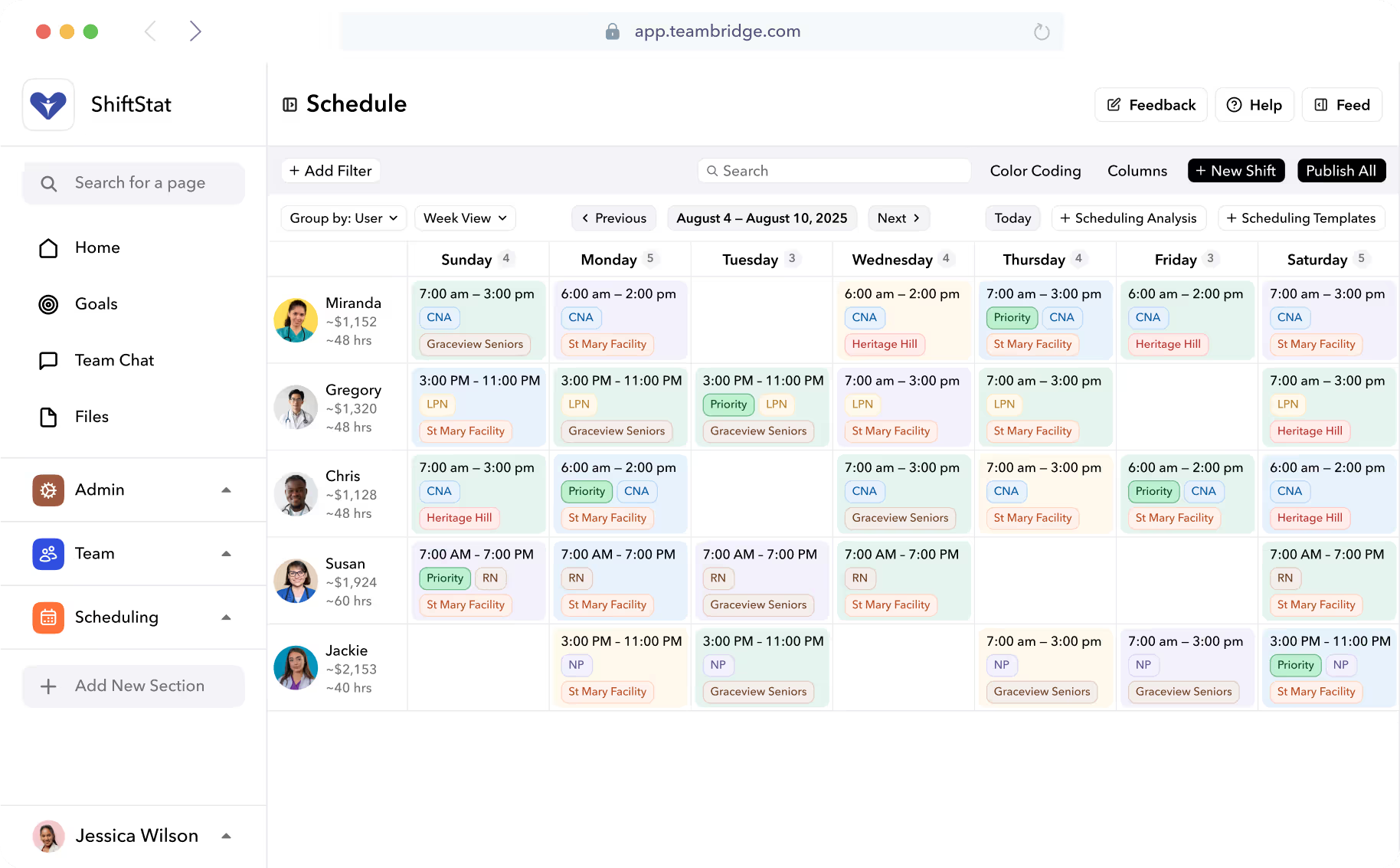
Teambridge's Scheduling product is built around this kind of real-time backfill — auto-filling gaps, enforcing credentials, and predicting no-shows before they happen.

Reducing Overtime Without Underserving the Floor
Every manager has eyeballed the same trade-off: pull someone in at 1.5x, or leave the gap and hope. AI does the math you've been doing in your head, except it has the running weekly hours of every worker on hand.
The system tracks predicted OT thresholds, skill substitutability, and shift differentials to surface the lowest-cost qualified fill. AI reduces unnecessary overtime, overstaffing, and last-minute scheduling gaps, and organizations that implement AI-based workforce management tools report up to a 12% reduction in labor costs due to better shift alignment and reduced overtime. Other operators report cutting idle labor costs by 15–25% once forecasting and fill logic are working together.
Here's the comparison most operators actually care about:
| Scenario | Manual approach | AI-assisted approach |
|---|---|---|
| Tuesday call-out | Manager texts 8 people, picks first yes | System filters by qualification, OT status, fairness, sends to top 3 |
| Saturday surge | Best guess based on last week | Forecast from POS/traffic/weather, pre-staged on-call pool |
| Mid-shift overrun | Reactive scramble, often OT | Real-time reassignment within budget guardrails |
| Credential expiry | Caught at audit | Blocked at assignment, renewal queued via Automations |
Warning
Optimizing only for cost is the failure mode. The well-publicized LanguageLine-style backlash — fragmented schedules, attrition, and union friction — happens when the algorithm cares about labor percentage and nothing else. Fairness, retention, and worker preference have to be in the objective function, not bolted on.
Building Fairness Into the Algorithm, Not Around It
Workers don't object to AI scheduling because it's AI. They object when it produces schedules that feel arbitrary, punishing, or rigged. That's a configuration problem more often than a technology problem.
A well-configured system can:
- Rotate desirable and undesirable shifts (weekends, closings, holidays) across the eligible pool
- Honor stated availability and time-off requests by default, not by exception
- Surface favoritism patterns when one manager consistently routes premium shifts to the same names
- Give workers self-service swap and pickup so they're not pleading with a supervisor at 9 p.m.
Fairness is also where compliance lives. New York City, Chicago, Philadelphia, Seattle, Los Angeles, Emeryville, San Francisco, and Oregon have implemented predictable scheduling laws that generally require covered employers to provide at least 14 days' advance notice of schedules, obtain written consent from employees when adding shifts, pay premiums when schedules change, provide at least 10 or 11 hours of rest between shifts, allow employees to have input into their schedules, and notify and allow existing employees to work additional hours before hiring new employees.
The penalties are not theoretical. Each ordinance includes penalties ranging from $300–$1,000 per violation per employee per day, paid both to the employee and to the city/county/state. A schedule built without those rules baked in is a liability waiting to be audited. Read more in Greenberg Traurig's overview of the patchwork.
The operator-level point: fairness is a retention lever, and retention is cheaper than recruiting.
AI as Manager Support, Not Manager Replacement
The philosophical core of the shift: AI handles the combinatorial math, the manager owns the call. Who's qualified, who's available, who's near OT, whose credential expires mid-shift — that's not judgment work. That's bookkeeping at scale.
What the manager keeps:
- Coaching the workers who are showing up late
- Escalating with the client when an SLA is at risk
- Building the team — hiring, developing, deciding who's ready for the harder assignment
- Making the call when the AI's top recommendation isn't right for reasons no algorithm can see
The "robots taking over" framing oversells the threat. In a 2025 EisnerAmper survey, 80% of employees reported a net positive experience using AI at work, and a 2024 survey of more than 9,000 workers across nine countries found that more workers report potential benefits from new technologies like robots and AI for their safety and comfort at work, their pay, and their autonomy on the job than report potential costs. The workforce mostly wants the busywork gone. So do the managers.
The practical test: if AI is good, the manager stops doing the 11 p.m. spreadsheet and starts doing the work they were actually hired for.
What AI Scheduling Looks Like Across Five Industries
The pattern generalizes, but the inputs and constraints vary. A few quick vignettes.
Healthcare
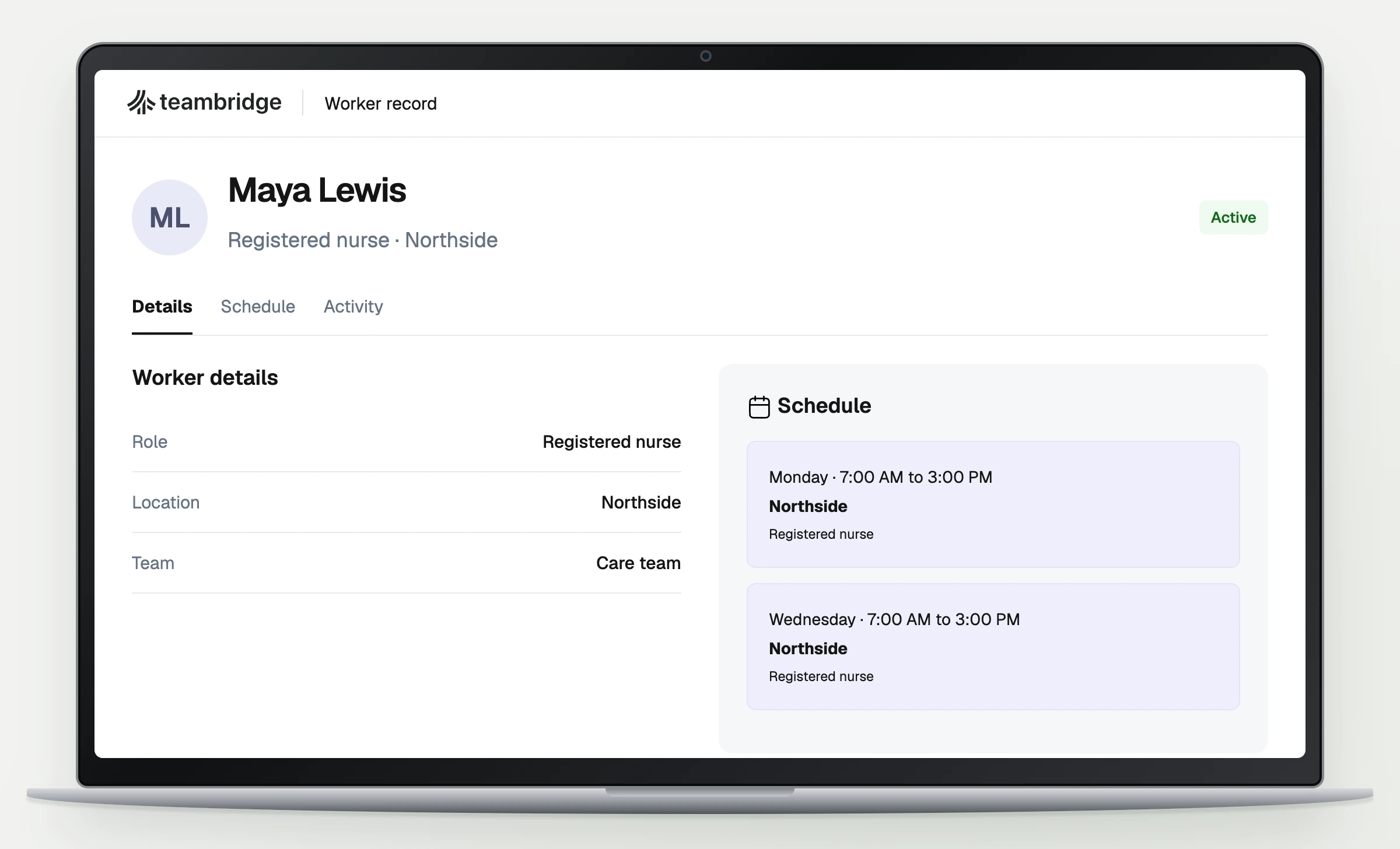
AI matches RN/LPN/CNA ratios to predicted acuity and census, blocks assignment when a license is within 30 days of expiry, and enforces minimum rest between shifts. The Healthcare Staffing workflow combines credential tracking with shift differentials and per-diem pools so a charge nurse doesn't end up calling agency at 2 a.m.
Retail
The system aligns floor coverage to predicted traffic and locks in Fair Workweek notice rules — 14 days advance, predictability pay if changes happen inside that window. Promo events get pre-staffed instead of triaged.
Hospitality
Banquet, housekeeping, and F&B flex to occupancy and event load. A 200-person wedding on Saturday triggers prep coverage on Friday and breakdown on Sunday automatically. RSVPs feed headcount instead of "how many did we have last year."
Logistics and Light Industrial
Forklift-certified workers get matched to dock volume; the system enforces HOS limits on drivers and credential checks on operators. See the Light Industrial workflow for how OSHA training and shift-based staffing get wired together.
Field Service
Technicians get routed by skill, geography, and SLA. When a job overruns, the next stop is reassigned in real time, not after the customer calls.
In each case the underlying capability is the same: forecast demand, match qualified people, enforce credentials and fairness rules, and notify the worker. The industry just changes which signals matter most.
Where to Start: A 30-Day AI Scheduling Pilot
Don't try to roll out AI scheduling across the whole network in one quarter. The teams that get value pick one location or one shift type, prove it, and scale from there.
A workable 30-day pilot:
- Pick a scope. One location, one department, or one shift type with enough volume to learn from.
- Connect demand-signal data. POS, EHR census, ticket sales, route volume — whatever drives staffing for that scope.
- Set guardrails. Max OT %, minimum advance notice, fairness rules (rotation of weekends and closings), credential enforcement.
- Run AI-suggested schedules in parallel with the manual one for two weeks. Don't switch over yet.
- Measure. Fill rate, OT %, manager hours saved, predictability-pay incidents, voluntary attrition signal.
- Decide. If the AI version is meaningfully better on three of those metrics, cut over and scale.
The point of the pilot isn't to prove the AI is smart. It's to prove the guardrails are configured for your business.
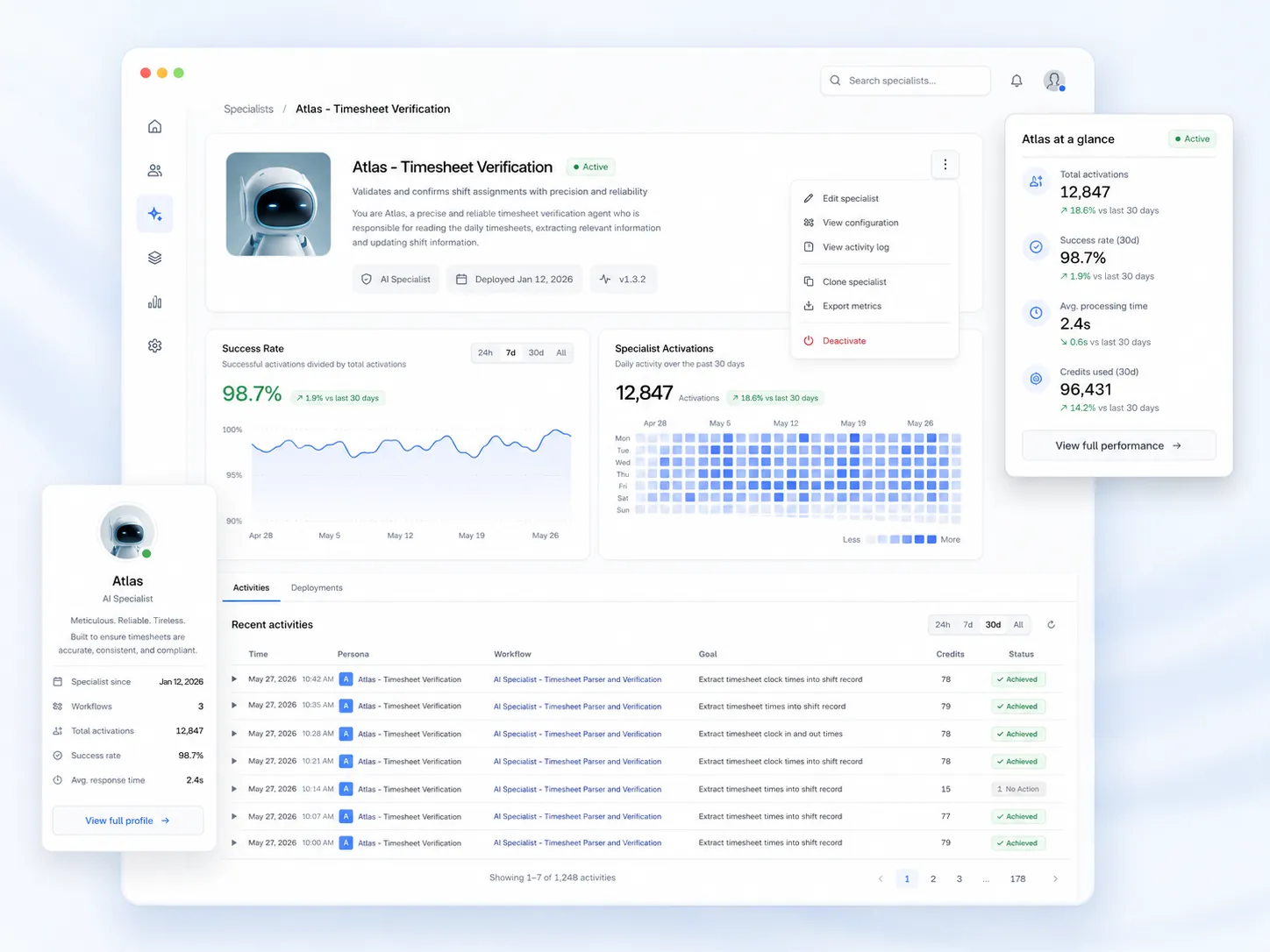
The operators getting the most out of this aren't the ones with the fanciest model. They're the ones who connected real demand data, set honest fairness rules, and gave the manager a clean override path. Teambridge's AI Platform runs the autonomous specialists in the background; the Scheduling and Automations layers handle the coverage logic and follow-ups.
The spreadsheet had a long run. It's not coming back.

About the author

Content Writer at Teambridge
Anis Nanai is a content writer at Teambridge, with a focus on workforce management and the realities of running hourly teams. He prioritizes conversations with customers, staying close to the market, and understanding how workforce needs are changing. His writing connects those concerns to practical decisions about scheduling, time tracking, staffing, and automation. He examines product developments through the questions that matter to operators: what does this solve, how would it work for my team, and what evidence supports it?
Company perspective: this author works at Teambridge. Customer outcomes are attributed to their published sources.
View LinkedIn profile