

This is the operator's version. If you run a continuous-production line and you are evaluating a Panama rotation, here is what actually has to happen between the org chart and go-live.
Why Manufacturing Plants Default to the 2-2-3 Panama Rotation
Continuous production lines do not tolerate gaps. A bottling line, an injection molder, a paper machine, a chemical reactor — none of these can sit idle between shifts without scrap, rework, or a full restart procedure. The traditional answer was three 8-hour shifts across five or six crews with daily handoffs. Each handoff is a risk: missed information, half-finished work orders, undocumented equipment quirks.
The Panama pattern compresses that. It is a rotating shift schedule where employees work two consecutive 12-hour shifts, have two days off, work three consecutive 12-hour shifts, have two days off, work two shifts, then have three days off, repeating on a 28-day cycle, with four separate teams alternating between day shifts (typically 6 AM–6 PM) and night shifts (6 PM–6 AM) to provide continuous 24/7 coverage.
Two shifts per day instead of three. Half the handoffs. With a 2-2-3 schedule, each employee works 12-hour shifts, with four different teams working varying hours (e.g., 6 am – 6 pm versus 6 pm – 6 am), and unlike other models that may require an additional team to report mid-shift, the Panama schedule requires no overlap.
That is the operational case. The workforce case is just as strong: benefits include every other weekend off, more days off annually (182 vs. 104 for standard schedules), reduced commuting costs, and extended rest periods between rotations. For a tight labor market in a manufacturing town, that matters.
Building the Four Crews: Headcount Math and Skill Balancing
The staffing math is straightforward. The skill math is where rollouts fail.
The headcount calculation
Start with minimum coverage per shift — the headcount required to safely run the line, not the wish-list number. Multiply by four crews. Add a relief buffer of 10-15% for PTO, training, and predictable absence. That is your Panama headcount floor.
For a 24/7 line that needs 8 operators on the floor per shift:
| Role | Per shift | Crews | Subtotal | +12% relief | Total FTE |
|---|---|---|---|---|---|
| Line operators | 6 | 4 | 24 | 3 | 27 |
| Lead operator | 1 | 4 | 4 | 1 | 5 |
| Maintenance tech | 1 | 4 | 4 | 1 | 5 |
| QA | 0.5 (floats) | 4 | 2 | 0 | 2 |
| Total | 8.5 | 34 | 5 | 39 |
That 39 FTE number is what your finance partner needs to model — not the 32 you get from naive math.
Skill balancing across A/B/C/D
The number one reason Panama rollouts stall in week three is uneven skill distribution. If Crew A has both senior maintenance techs and Crew C has neither, then Crew C's first equipment fault during a night shift turns into a 90-minute downtime event while a supervisor wakes someone up.
Balance these across every crew before you publish the roster:
- Lead operator certification
- Lockout/tagout authorization
- Forklift / powered industrial truck license
- Confined-space entry qualification
- Respirator fit (current within 12 months)
- QA sign-off authority
- Cross-training on adjacent stations
If a single crew is missing one of these, the rotation has a hole that will surface the first time a certified person calls out.
Warning
Do not build crews around friend groups or shift preferences. Build them around certifications first, then let people request swaps within the constraints. Crews built on social affinity create skill gaps that take three months to detect and six months to fix.
Mapping the 28-Day Template: Day/Night Rotation and Weekend Coverage
The 14-day base pattern is 2-on, 2-off, 3-on, 2-off, 2-on, 3-off. Run it twice — once on days, once on nights — and you have the 28-day rotation. The Panama (2-2-3) shift schedule uses a slow rotation system with four teams around two 12-hour shifts over the course of 28 days.
Here is the simplest readable version for a plant manager's whiteboard. D = day shift, N = night shift, blank = off:
| Day | Crew A | Crew B | Crew C | Crew D |
|---|---|---|---|---|
| 1 Mon | D | D | N | N |
| 2 Tue | D | D | N | N |
| 3 Wed | D | N | ||
| 4 Thu | D | N | ||
| 5 Fri | D | D | N | N |
| 6 Sat | D | D | N | N |
| 7 Sun | D | D | N | N |
| 8 Mon | D | N | ||
| 9 Tue | D | N | ||
| 10 Wed | D | D | N | N |
| 11 Thu | D | D | N | N |
| 12 Fri | D | N | ||
| 13 Sat | D | N | ||
| 14 Sun | D | N |
Days 15-28 flip: A and B move to nights, C and D move to days. You get every other weekend off on a 2-2-3 schedule. In a 28-day rotation, you have 2 full weekends (Saturday and Sunday) completely free. The other 2 weekends on the 2-2-3 schedule, you work 12-hour shifts.
Publish this template at least four weeks in advance, every cycle. Crews need it for childcare, transportation, second jobs, and medical appointments. The single biggest morale complaint about rotating shifts is not the hours — it is unpredictable hours. The Panama pattern's whole advantage is predictability. Throw that away with last-minute changes and you lose the retention case.

Payroll Reality: The 36-Hour and 48-Hour Week Problem
This is where finance discovers the math the recruiting team did not mention.
Week 1 is 36 hours (3 shifts × 12 hours). Week 2 is 48 hours (4 shifts × 12 hours). The schedule naturally builds in 2 hours of overtime weekly. Over the 14-day cycle that is 84 hours total, or an average of 42 hours per week.
Here is the breakdown for a non-exempt operator at $25/hour:
| Week 1 | Week 2 | 2-week total | |
|---|---|---|---|
| Hours worked | 36 | 48 | 84 |
| Regular hours | 36 | 40 | 76 |
| Overtime hours | 0 | 8 | 8 |
| Regular pay | $900 | $1,000 | $1,900 |
| OT pay (1.5×) | $0 | $300 | $300 |
| Total | $900 | $1,300 | $2,200 |
Across a year, that operator banks roughly 104 hours of overtime baked into the rotation. At $25/hr regular, that is about $3,900 in overtime per FTE, every year, before anyone calls out. Multiply by your headcount.
Important
You cannot fix this by averaging the two weeks. The Act applies on a workweek basis. An employee's workweek is a fixed and regularly recurring period of 168 hours — seven consecutive 24-hour periods. It need not coincide with the calendar week, but may begin on any day and at any hour of the day. Different workweeks may be established for different employees or groups of employees. Averaging of hours over two or more weeks is not permitted. The 48-hour week triggers FLSA overtime no matter what the 36-hour week looks like.
The practical implication: budget the OT into your standard cost model from day one. If your CFO sees a 4-5% labor variance every payroll, you have a credibility problem you did not need to create.
FLSA, State Overtime, and the Alternative Workweek Trap
Federal law is the floor, not the ceiling.
The FLSA baseline
Unless specifically exempted, employees covered by the Act must receive overtime pay for hours worked in excess of 40 in a workweek at a rate not less than time and one-half their regular rates of pay. For more detail, see the U.S. Department of Labor's Fact Sheet #23 on FLSA overtime pay.
Define your workweek deliberately. If your day-to-night flip happens at the start of week 3, you can accidentally end up with a workweek that captures the tail end of the day rotation and the front of the night rotation in a way that double-counts a single 12-hour shift if your time system is not configured correctly.
The state landmines
Federal rules do not preempt state rules that are more favorable to employees. The big one is California, which has daily overtime after 8 hours unless you adopt a properly elected Alternative Workweek Schedule (AWS).
Getting that election right is non-trivial. Only members of the work unit can vote in the AWS election, and the election must be by secret ballot. If at least 2/3 of affected employees vote in favor of the AWS, it passes. According to the DLSE, a member of the work unit who does not vote is considered to have voted "no." The employer must report the results to the Department of Industrial Relations within 30 days. Employers must wait at least 30 days after announcing the final results of the election and must make reasonable efforts to find an 8-hour/day schedule for an employee eligible to vote in the election who can't work the AWS, before employees work the AWS.
Miss any of those steps and the entire Panama economics flip. Under a properly adopted AWS, the threshold for daily overtime shifts from eight hours to the agreed-upon number of regularly scheduled daily hours. Double time pay (twice the regular rate) is required for all hours worked over 12 hours in any single workday, regardless of the AWS in place.
A few other state thresholds worth flagging with counsel before go-live:
- Alaska, Nevada, Colorado: daily overtime after 8 (Colorado) or 12 (Alaska, Nevada) hours, with various exceptions
- Kentucky: OT after seven consecutive workdays
- Massachusetts and Rhode Island: Sunday/holiday premium pay rules in some industries
Caution
Loop in employment counsel before you publish the first roster, not after the first wage complaint. The cost of a properly run AWS election is rounding error compared to a wage-and-hour class action.
Handling Call-Outs Without Collapsing the Rotation
Here is the scenario every plant manager has lived through. It is 5:30 AM. Crew B's lead operator calls out for the 6 AM shift. Crews A and D are mid-rest cycle — they just finished a 3-day stretch yesterday. Crew C is on the back half of their off days but starting a 3-day run tomorrow at 6 PM.
Who do you call?
The wrong answer
Call the most experienced operator on the off-duty crew and ask nicely. They show up, run a 12-hour shift on no warning, and now they are on day 1 of what is effectively a 4-day consecutive stretch (their shift, plus three scheduled shifts starting tomorrow). Fatigue risk goes up. Quality goes down. And depending on when their workweek resets, you just created consecutive-day overtime in addition to the structural OT.
The playbook
Build your call-out hierarchy before you need it:
- Voluntary pickup pool first. Workers who have opted in to extra shifts get notified before anyone else. They self-select for available capacity.
- Cross-trained floaters second. A small team of relief operators who are not assigned to a fixed crew, paid for availability windows.
- Adjacent off-crew, with eligibility rules. Only operators who are at least 24 hours into their off-cycle, not coming off a 3-day stretch, and not approaching weekly OT thresholds you do not want to hit.
- Mandatory holdover last. Asking the outgoing shift's operator to stay for the first 4-6 hours while you cover the back half from another source. This is a fatigue red zone — use sparingly.
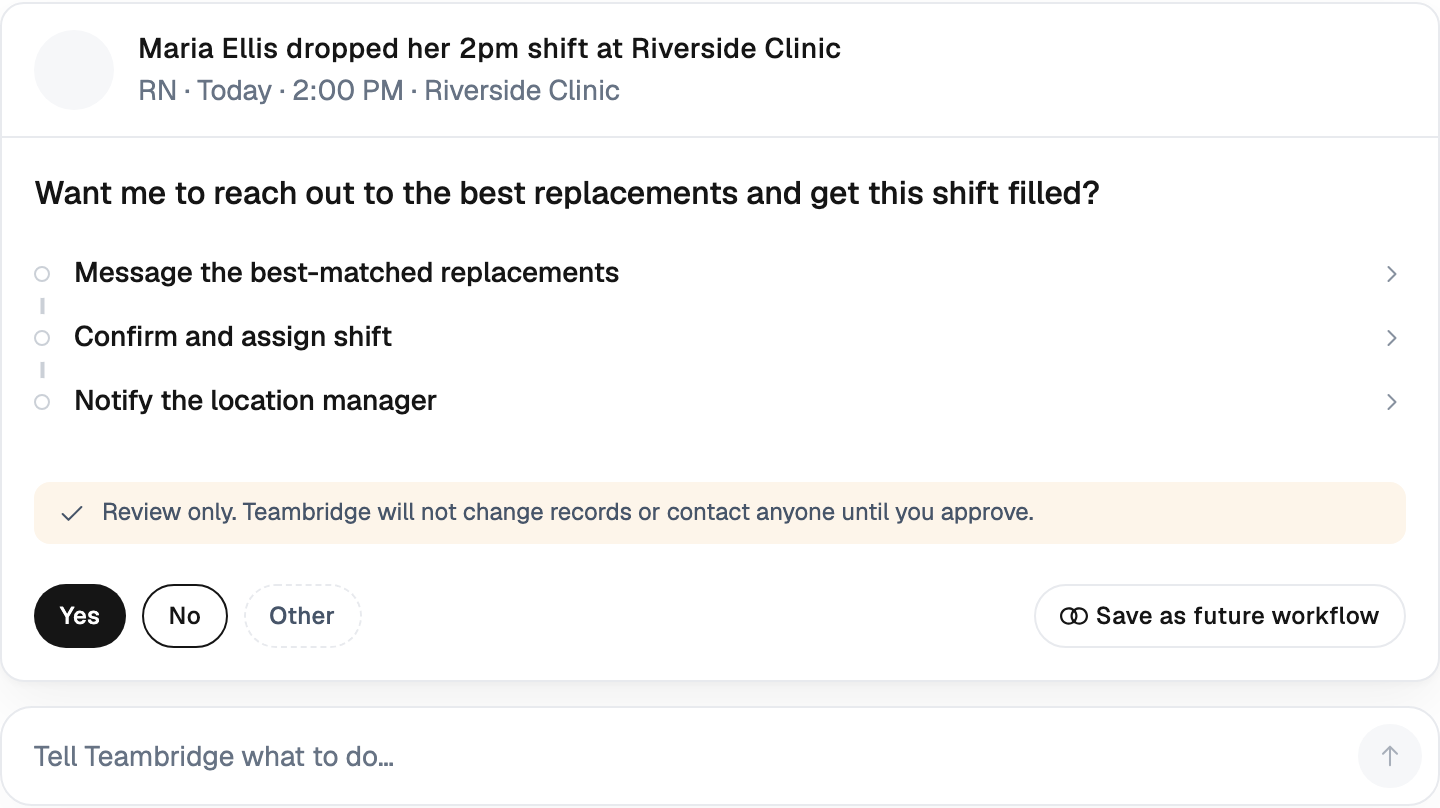
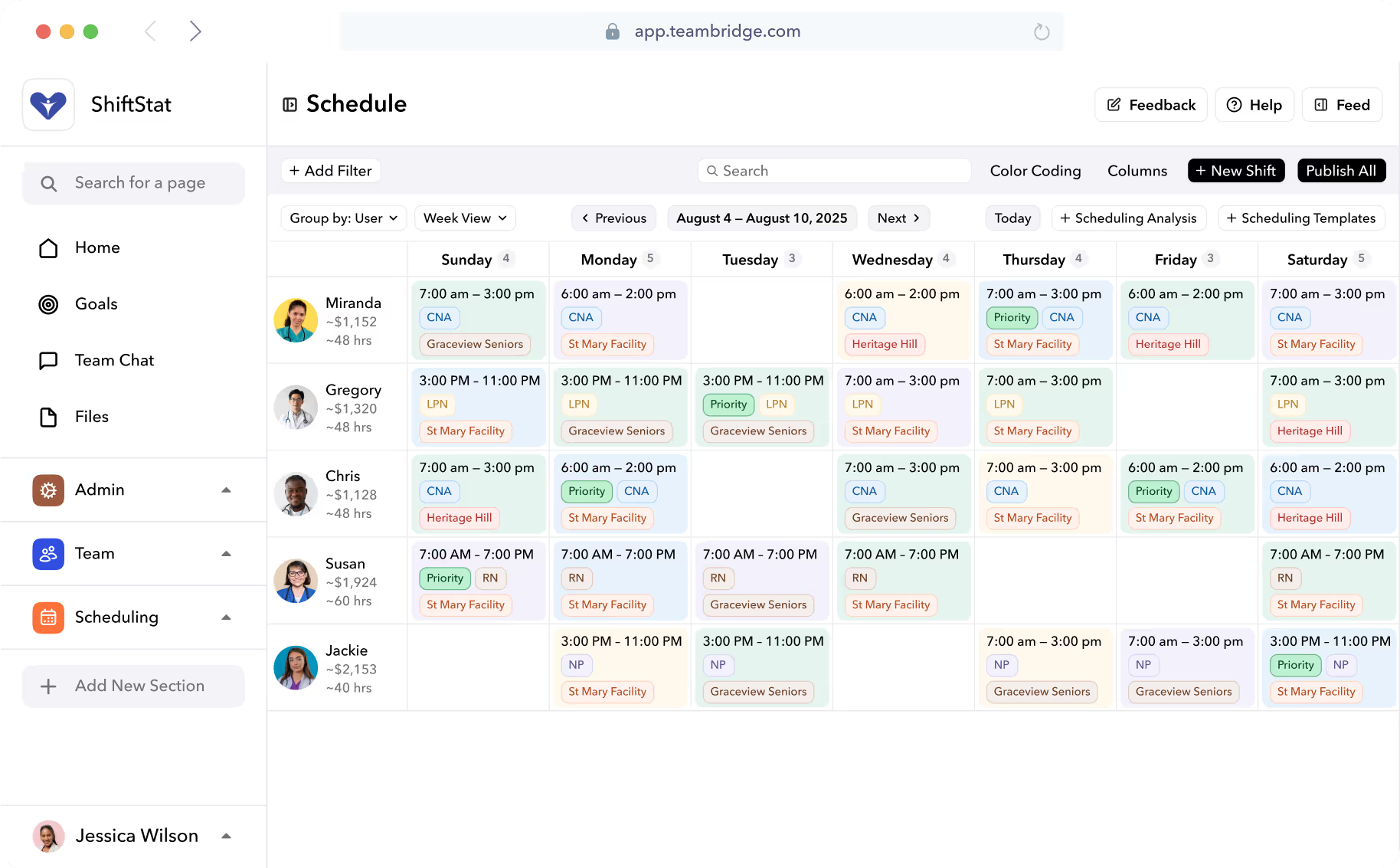
Running this manually means a supervisor with a phone tree at 5:35 AM. AI-driven scheduling collapses that to seconds: rank every eligible worker by OT exposure for the current workweek, hours since last shift, certifications required at the open station, and proximity to the plant. Send the offer in tiered waves with an auto-accept window. Teambridge's Scheduling product handles this exact flow, and the Light Industrial industry page covers the manufacturing-specific rules.
Automating the Template in a Workforce Operations Platform
A Panama rotation is too complex to run in a spreadsheet for long. The template itself is fine in Excel; the exceptions are not.
What the system needs to do:
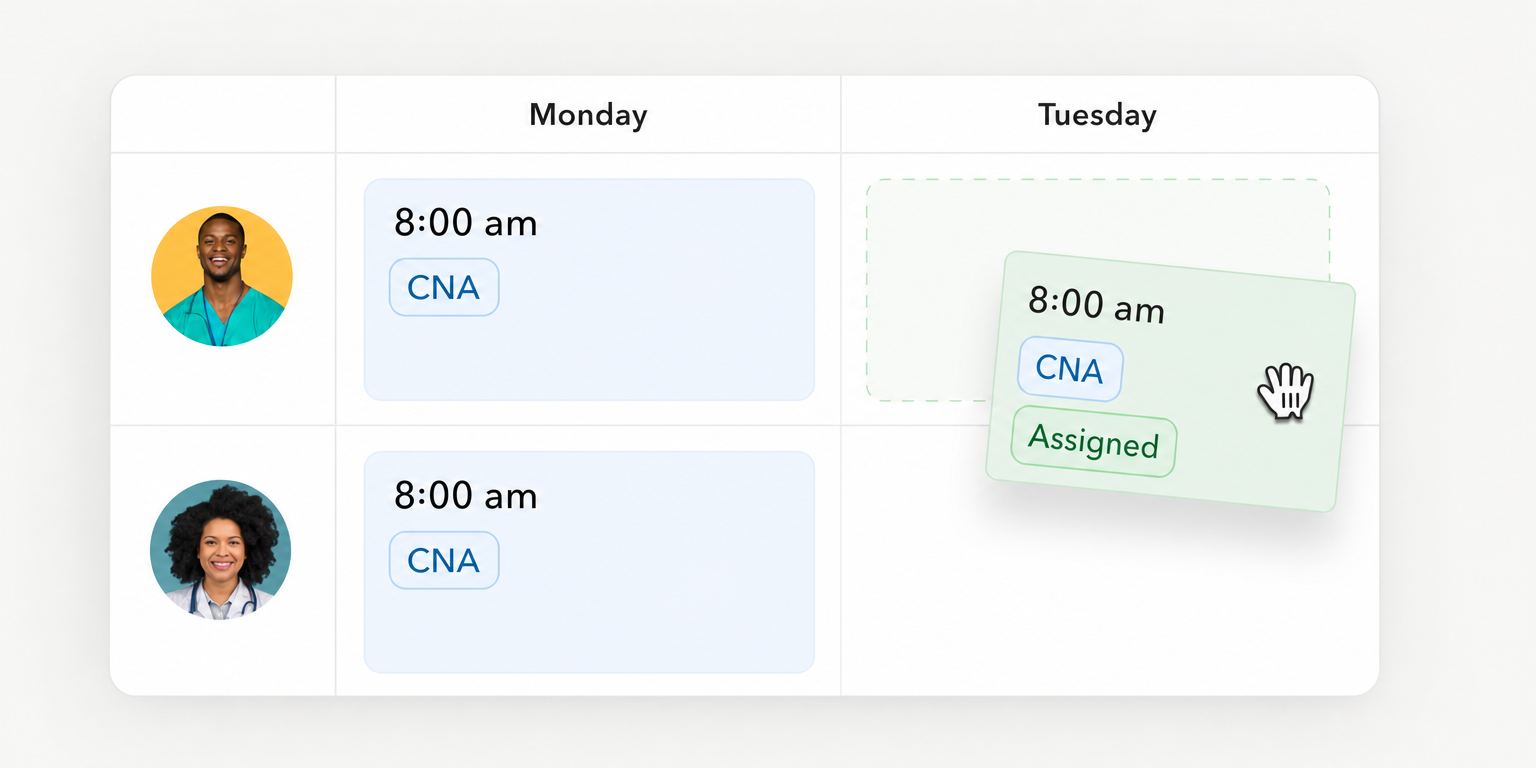
- Build the 28-day rotation as a reusable template. Drop in the crews, assign the pattern, and let it generate every cycle for the next 12 months.
- Enforce rest rules. Configurable minimum hours between shifts (commonly 10-11), maximum consecutive shifts (3 for a true Panama), and weekly hour caps for fatigue management.
- Check credentials before assignment. Forklift expiring next week? Lockout/tagout cert lapsed? Respirator fit out of date? The system flags it before the worker is scheduled into a station that requires it.
- Mobile shift pickup for open slots. When a call-out hits, eligible workers see the open shift on their phone and accept with one tap.
- Timecard exception flagging on the OT-heavy week. Approaching 48 hours mid-week 2? Flag it. Worker punched in early three days in a row? Flag it. Missed meal break in a state that requires premium pay for missed breaks? Flag it before payroll closes.
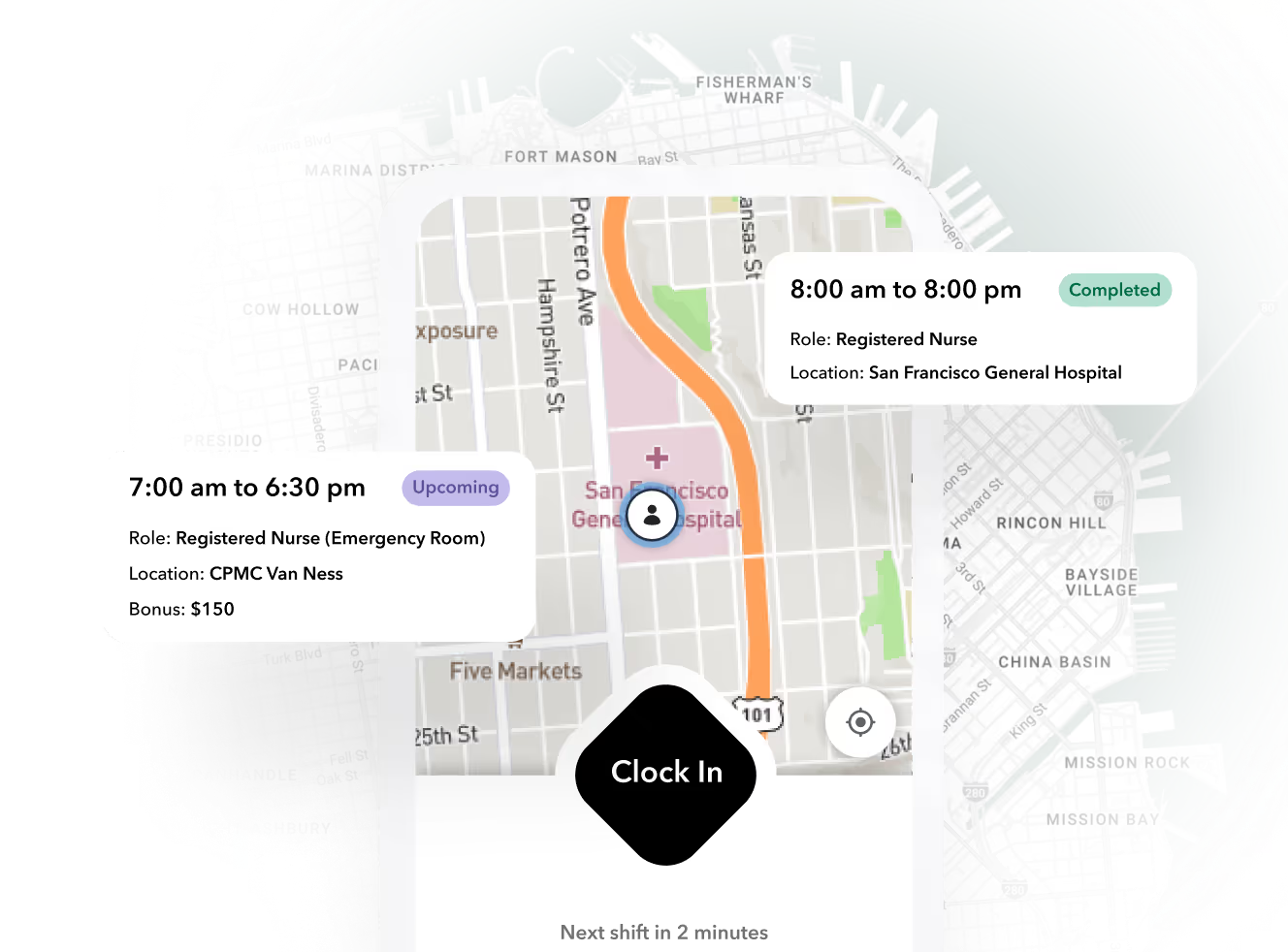
Accurate punch data feeds the OT calculation automatically. The Time Tracking product handles GPS-verified clock-in, timecard exceptions, and the automatic OT math that the 48-hour week requires.
Plants that automate the rotation typically cut scheduling admin time by 6-10 hours per week and reduce unplanned overtime by 15-25% within the first quarter.
That is not because the schedule changes. It is because the exceptions get handled faster and with better data.
Pilot, Measure, Then Scale Plant-Wide
Do not flip the entire plant on day one. The risk is too concentrated and the lessons are too expensive.
The 60-90 day pilot
Pick one line. Ideally one with a self-contained crew structure — not the line that shares maintenance with three others. Run a 60-90 day pilot. Use the pre-period baseline to set your comparison numbers.
The three metrics that matter
- Unplanned overtime as a percentage of total hours. Structural OT (the 8 hours/cycle from the 48-hour week) is fixed. Unplanned OT — call-outs, holdovers, mandatory pickups — is the leakage you can fix. Aim to push it below 3% of total hours.
- Call-out coverage time. Median minutes from call-out to filled shift. A good number is under 15 minutes. A bad number is over an hour and rising.
- Voluntary turnover, 90-day and 180-day. This is the lagging indicator. If turnover holds or improves versus the pre-Panama baseline, the schedule is working for your crews. If it spikes at 90 days, you have a fatigue problem.
Also survey the crew on childcare friction, sleep quality, and commute impact. Anonymously. The 12-hour shift suits some workers and not others, and you want to know early.
When to scale
If the pilot line hits the metrics for two full cycles (8 weeks), you have enough signal to plan the broader rollout. Sequence the remaining lines by readiness — staffing levels, certification depth, supervisor capacity — not by which plant manager is loudest. Each new line should re-run the same metrics for at least one cycle before you call the rollout complete.
The 2-2-3 Panama schedule is one of the best tools for running a continuous operation with a sane workforce. The pattern is simple. The execution — crews, certifications, payroll math, FLSA exposure, call-out coverage — is where the work is. Get those right and the schedule largely runs itself.

About the author

Content Writer at Teambridge
Anis Nanai is a content writer at Teambridge, with a focus on workforce management and the realities of running hourly teams. He prioritizes conversations with customers, staying close to the market, and understanding how workforce needs are changing. His writing connects those concerns to practical decisions about scheduling, time tracking, staffing, and automation. He examines product developments through the questions that matter to operators: what does this solve, how would it work for my team, and what evidence supports it?
Company perspective: this author works at Teambridge. Customer outcomes are attributed to their published sources.
View LinkedIn profile