

Every 24/7 operator eventually ends up in the same meeting. Coverage is slipping, overtime is creeping, and someone asks the question: should we be on DuPont or Panama?
On paper, the two patterns look almost identical. Four crews, 12-hour shifts, a 28-day cycle, and an average of 42 hours per week. The difference shows up in how fatigue lands on your workforce, how predictable your payroll is, and how hard the template is to actually run when a Tuesday call-out blows up the rotation.
This is a working operator's comparison, not a textbook.
Why 24/7 Operators Keep Re-Litigating the 12-Hour Schedule Decision
If you run continuous operations — a refinery, an ED, a security contract, a distribution center that never sleeps — you have to cover 168 hours a week with a finite headcount. The math forces you toward 12-hour shifts and four crews. After that, you have hundreds of variations to choose from, and most operators default to one of two patterns.
DuPont and Panama dominate the conversation for a reason. Both deliver true 24/7 coverage. Both average roughly two hours of weekly overtime under federal rules. Both have decades of operational history behind them. The 2-2-3, Pitman, and DuPont schedules are all examples of common 12-hour shift schedules.
The wrong pick produces three predictable failures: missed shifts when crews can't absorb the fatigue pattern, uncontrolled overtime when the math runs through a daily-OT state, and turnover when the weekend cadence doesn't fit your workforce's life. This article uses four criteria to compare them — fatigue load, weekend coverage, overtime math, and operational complexity — and ends with a five-question decision framework.
How the DuPont Schedule Actually Works (4 Crews, 28-Day Cycle)
The DuPont schedule is a 28-day rotating pattern with four crews and two 12-hour shifts per day. During a 4-week cycle, each team works 4 consecutive night shifts, followed by 3 days off duty, works 3 consecutive day shifts, followed by 1 day off duty, works 3 consecutive night shifts, followed by 3 days off duty, works 4 consecutive day shift, then have 7 consecutive days off duty.
The signature feature is the seven-day break at the end of every cycle. The DuPont schedule's unique advantage is the 7-day break. No other common 12-hour rotation offers a full week off within the cycle. That full week off is the recruiting line every operator running DuPont uses, and it works.
The signature risk is the four consecutive night shifts and the brutal day-to-night transition that happens mid-cycle. In Week 2, you finish 3 day shifts, get a single day off, then start 3 night shifts. Flipping your sleep schedule in 24 hours is rough. The Sleep Foundation notes that your body's circadian rhythm does not adjust that fast.
Origin and Intended Environment
The schedule was developed by the DuPont chemical company for continuous-process manufacturing — a context where workers operate climate-controlled equipment, not heavy physical loads, and where a full reset week between cycles is genuinely valuable for both maintenance windows and worker recovery. The DuPont shift schedule was developed in the early 1900s by the E. I. DuPont de Nemours company as a more humane solution to consistent night shift work in industrial plants. At the time, many companies used consistent schedules where workers would stay on either day shifts or night shifts for extended periods of time.
It was built for chemical plants. That heritage matters when you're deciding whether it fits your operation.

How the Panama (2-2-3) Schedule Actually Works
Panama — also called the 2-2-3 — is a slower, more rhythmic 14-day rotation per team, repeating cleanly across a 28-day cycle. A Panama shift pattern (or 2-2-3 shift pattern) is a rotating work schedule where employees work two days on, two days off, then three days on, followed by two days off, two days on, and three days off.
Four crews split into day and night sides, two crews are working at any given moment, and two are off. The 2-2-3 shift pattern cycle repeats, covering a total of 28 days, at which point the night and day teams will usually swap over.
Three structural wins make Panama feel humane compared to DuPont:
- Never more than three consecutive 12-hour shifts. The longest work block is three days.
- Every other weekend off, as a full three-day weekend. You get every other weekend off on a 2-2-3 schedule. In a 28-day rotation, you have 2 full weekends (Saturday and Sunday) completely free.
- Predictable 36/48-hour alternating weeks that average 42 — easy to budget, easy to staff against.
Origin
The name comes from the Panama Canal Zone, though the exact story is debated. The 2 2 3 shift pattern is often called the Panama schedule because it was reportedly first adopted by employees at a Panama-based petrochemical plant in the 1980s. Other accounts trace it to U.S. forces stationed in the Canal Zone needing round-the-clock coverage. Either way, Panama spread into healthcare, public safety, security, and 24/7 light industrial because the day-to-day cadence is easier on staff than DuPont's four-night blocks.
Fatigue and Recovery: Where the Two Schedules Diverge Hardest
This is the comparison that matters most to the people on the floor.
DuPont front-loads strain. Four consecutive 12-hour night shifts is a heavy ask, particularly for older workers or anyone in a physically demanding role. Each repeat cycle includes a 72-hour long work week, which can be exhausting for workers. Not all employees perform best with rotating shift patterns that require them to work several consecutive twelve hour shifts. Depending on the employee and the nature of the work, these longer shifts may lead to physical and mental exhaustion. According to Circadian, twelve hour shifts may be more challenging for older workers than for younger ones.
The payoff is real recovery. A full week off gives workers time to genuinely reset their sleep cycle, knock out medical appointments, see family in another state. That kind of recovery doesn't exist anywhere in Panama's rotation.
Panama trades depth of recovery for evenness of load. You're never more than three shifts deep, which keeps cumulative fatigue lower on any given day. But two-day breaks aren't enough to fully reset, and the third consecutive 12-hour shift is where most operators see fatigue spike — late call-outs, timecard exceptions, safety incidents.
Warning
Sleep data on 12-hour rotations is unforgiving regardless of pattern. Among 12-hour workers on a day shift schedule, 48% get less than 6 hours of sleep. In contrast, only 38% of 8-hour workers get less than 6 hours of sleep. Choosing between DuPont and Panama doesn't make this problem go away — it just changes how the deficit is distributed.
Translation for Operators
- Pick DuPont when your roles tolerate four-night blocks (control rooms, dispatch, climate-controlled industrial) and you genuinely value the seven-day reset for deep maintenance windows or worker recovery.
- Pick Panama when shift-to-shift cognitive load matters more than cumulative load — ED nursing, ICU, security patrols, dispatch — and four consecutive nights would produce unacceptable error rates.
Weekend Coverage and Overtime Math: The CFO's View
Both schedules average 42 hours per week. Over the full 28-day cycle, each crew works 168 hours — an average of 42 hours per week. The 42-hour weekly average is higher than the standard 40-hour week, which has overtime implications. Under federal FLSA rules, that's roughly two hours of weekly overtime baked in.
The distribution is what diverges.
| Factor | DuPont | Panama (2-2-3) |
|---|---|---|
| Cycle length | 28 days | 14 days (28-day day/night swap) |
| Average hours/week | 42 | 42 |
| Weekly hour variance | 0, 36, 48, 60, 72 | 36 or 48 |
| Max consecutive 12-hr shifts | 4 (nights) | 3 |
| Longest break in cycle | 7 days | 3 days |
| Weekends off | Irregular | Every other, as 3-day weekend |
| Payroll forecasting | Complex (variable weeks) | Clean (36/48 alternating) |
That variance is the budgeting headache. Some weeks the crew works 48 or even 72 hours (Week 2), while Week 4 is entirely off. The averaging period and how you define FLSA workweeks determines your overtime obligations.
The Daily-OT State Problem
If you operate in California, Alaska, Nevada, or Colorado, the FLSA weekly threshold isn't your only worry. California, Alaska, Nevada, and Colorado have daily overtime laws that require overtime pay when an employee exceeds a set number of hours in a single workday — regardless of total weekly hours. California has the most comprehensive rules, requiring 1.5× pay after 8 hours and 2× pay after 12 hours per day.
That matters for 12-hour rotations. A standard 12-hour shift in California sits right at the double-time line. According to the California Department of Industrial Relations, employment beyond eight hours in any workday or more than six days in any workweek requires the employee to be compensated for the overtime at not less than: One and one-half times the employee's regular rate of pay for all hours worked in excess of eight hours up to and including 12 hours in any workday, and for the first eight hours worked on the seventh consecutive day of work — and double time kicks in past 12 hours.
For California operators, an alternative workweek schedule (AWS) is usually the only way to make 12-hour rotations work without bleeding cash on daily OT. Panama's cleaner 36/48 pattern is easier to slot into an AWS than DuPont's irregular weeks, and the every-other-weekend-off rhythm is a measurable retention lever.
Which Schedule Fits Which Industry
The industry match isn't religious — both patterns run in healthcare, manufacturing, and security. But the lean is clear.
DuPont leans toward continuous-process industrial. Chemical, refining, utilities, power generation, offshore. The seven-day break aligns with maintenance turnaround windows, four-night blocks are tolerable in seated control-room work, and the workforce often skews older with kids old enough that the irregular weekend cadence isn't a deal-breaker.
Panama leans toward healthcare, public safety, security, and 24/7 light industrial. EDs and ICUs run on three-shift blocks. Security contracts need predictable site coverage with low handoff error. Warehouses and fulfillment centers benefit from the every-other-weekend-off rhythm for retention.
If you run any of those operations, our Healthcare Staffing and Light Industrial pages walk through the credential, OT, and shift-coverage problems specific to each.
Tip
Some operators run a fifth crew layered on top of either DuPont or Panama to absorb PTO, training, and call-outs without pushing the core four into overtime. It costs headcount but dramatically reduces the per-shift firefighting load and is often the cleanest fix for sites that chronically run hot on OT.
Why Spreadsheets Break Both Schedules — and What AI Workforce Software Does Instead
A spreadsheet can hold the template. It cannot run the template.
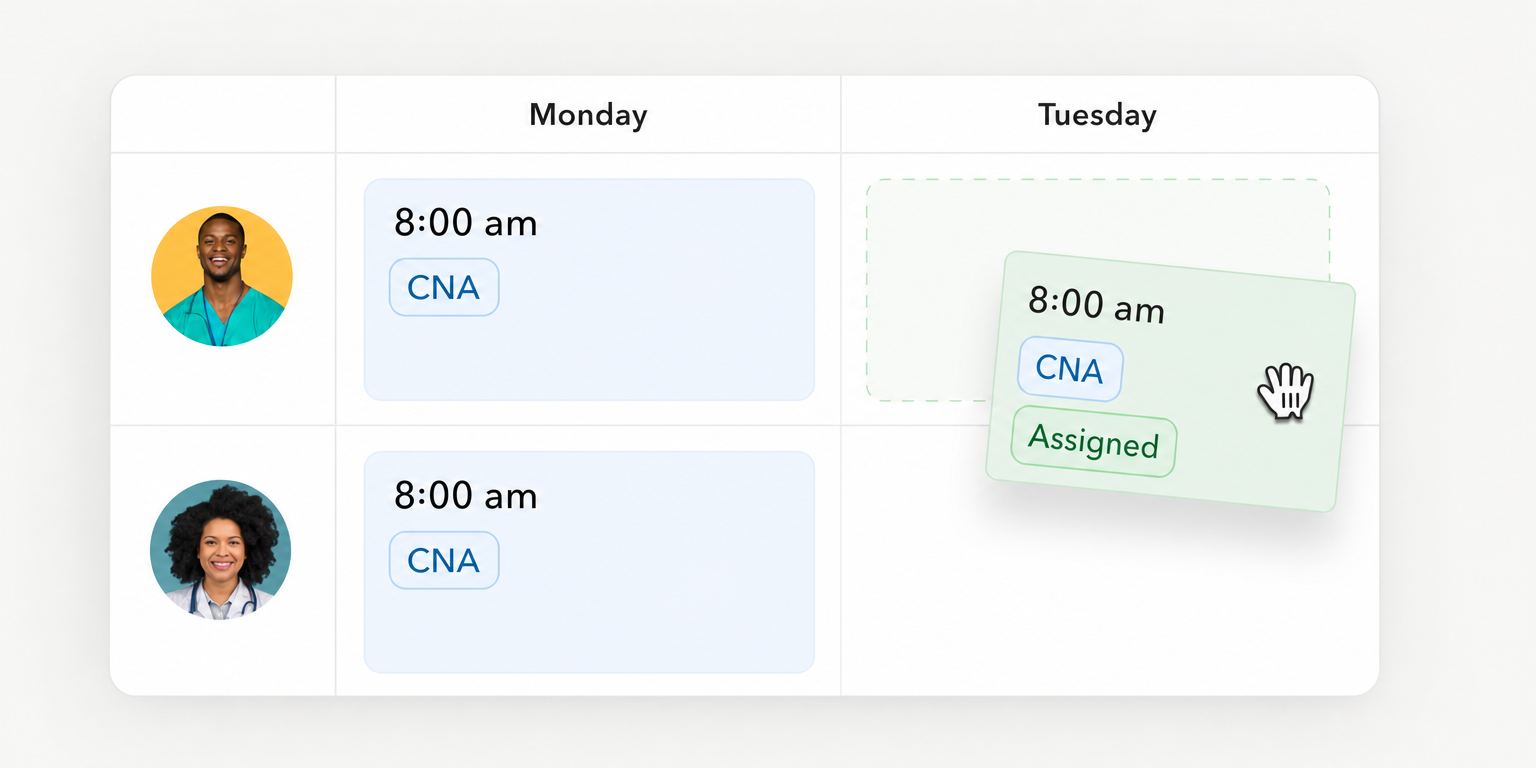
The failure modes are predictable. A single call-out on a DuPont night block cascades across the 28-day cycle because the schedule offers no slack — you can't pull from a crew that's working, and the off-crew is mid-recovery. A swap request between two Panama crews that ignores the 2-2-3 sequence silently creates a 60-hour week and a compliance problem you discover on payroll Friday.
The deeper problem is that operators are managing three things simultaneously — coverage, credentials, and overtime — and spreadsheets only show one.
An AI-driven workforce platform handles this differently:
- Auto-generates the rotation for the chosen pattern across all four (or five) crews and projects it forward as far as you need.
- Enforces credential and rest-period rules at assignment time, not after the fact. If a swap would create a 60-hour week or a rest gap below your threshold, it never publishes.
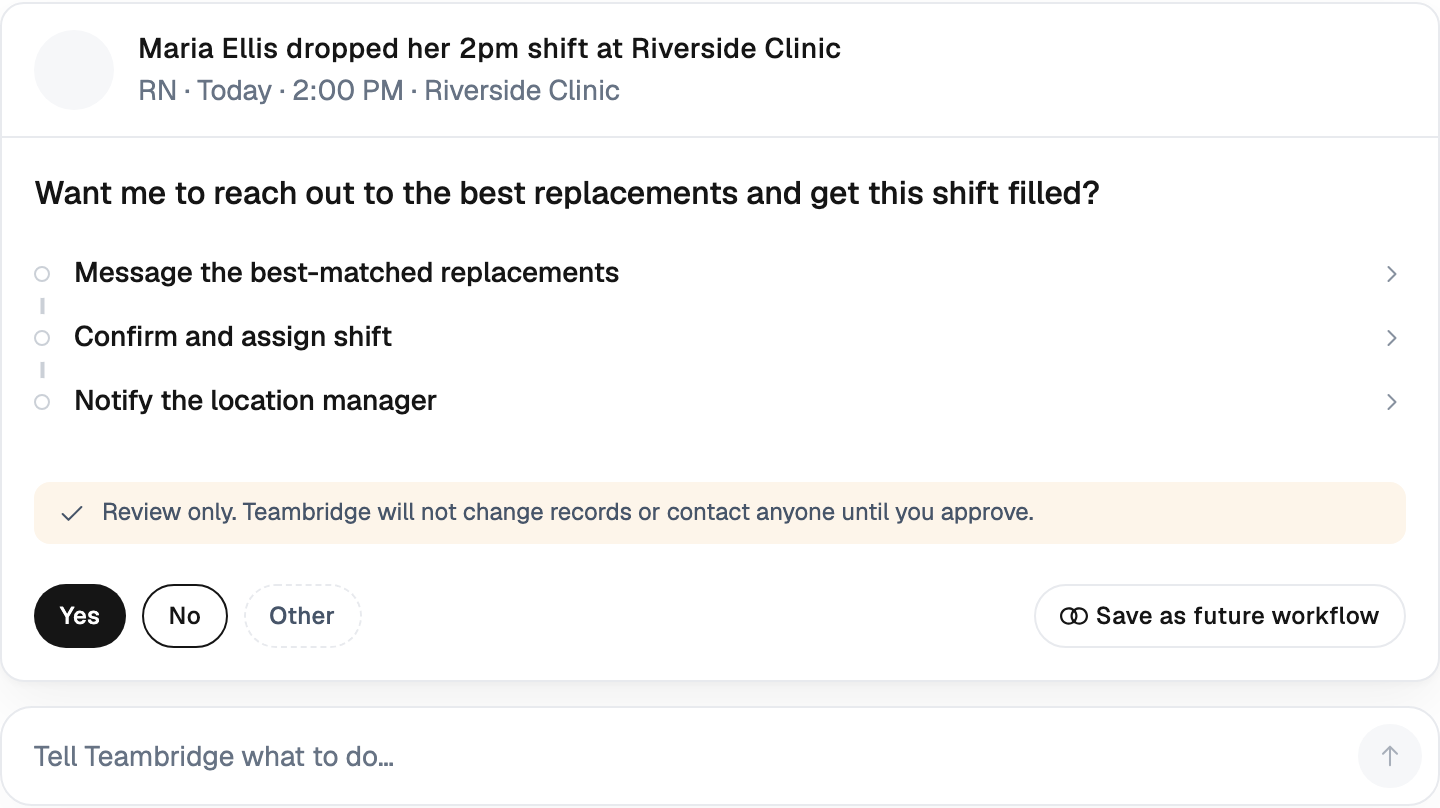
- Predicts no-shows based on historical patterns and surfaces qualified backfills from the same crew before the shift starts.
- Flags overtime before publish, not after payroll runs.
- Calculates OT against the right thresholds, including daily OT in California and any AWS you've registered.
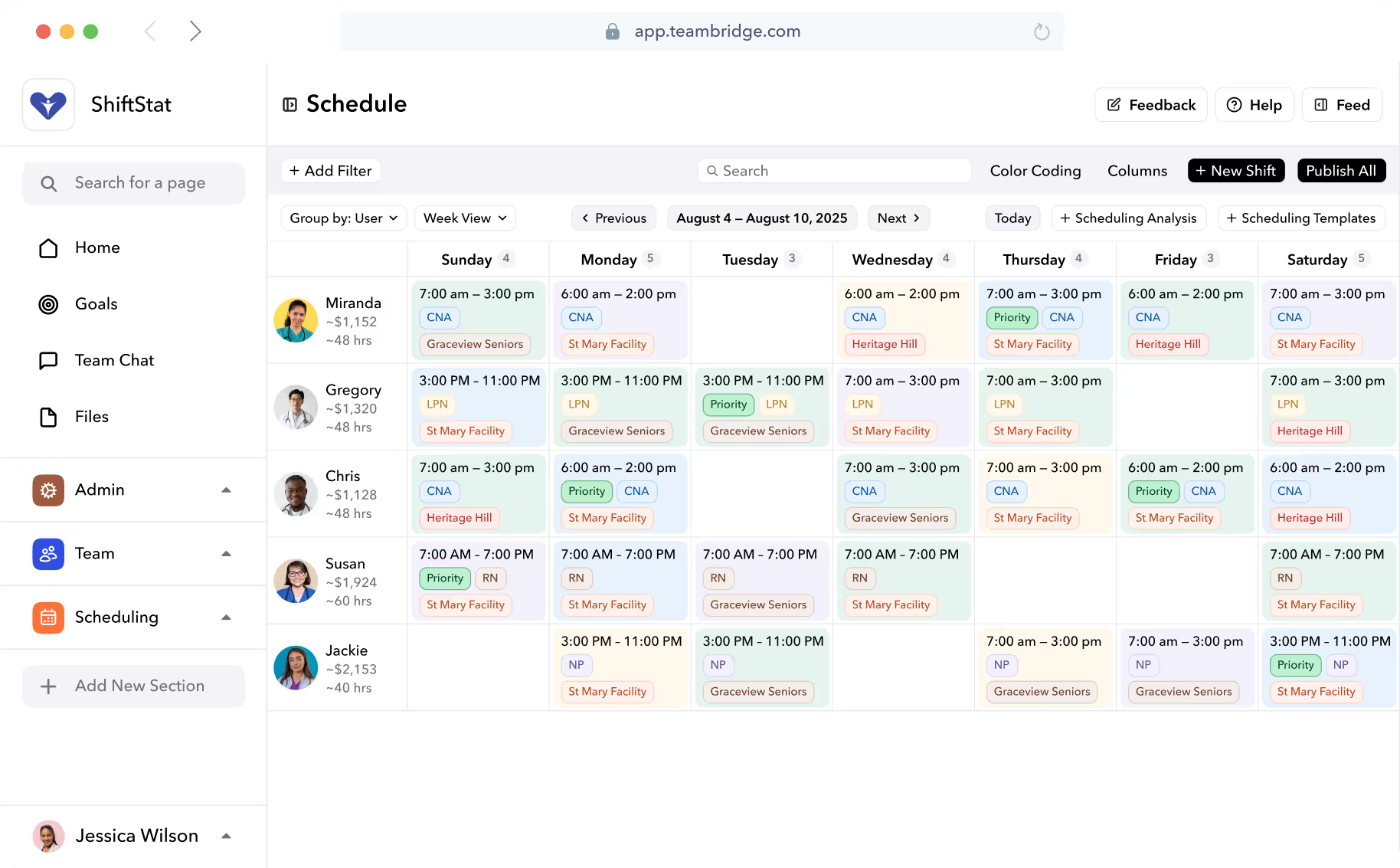
This is what Teambridge's Scheduling and Time Tracking products are built to do, with AI Specialists that run in the background to catch the issues a human scheduler misses on a Friday afternoon. The point isn't to replace the operator. It's to take the 80% of the work that's deterministic — applying the pattern, checking the rules, finding backfills — off their plate so they can spend time on the 20% that actually requires judgment.
Picking Your Pattern: A Short Decision Framework
If you're choosing on Monday morning, run these five questions:
- Can your workforce tolerate four consecutive night shifts? If no, Panama. This is the single biggest filter and the one most operators underweight until they're three months into a failed rollout.
- Do you need a full reset week for deep maintenance, turnaround work, or worker recovery? If yes, DuPont. The seven-day break is genuinely unique and hard to replicate.
- Is predictable every-other-weekend-off a retention requirement in your labor market? Panama. Healthcare and security operations in tight labor markets often answer yes immediately.
- Are you in a daily-OT state — California, Alaska, Nevada, or Colorado? Panama's cleaner 36/48 math fits an AWS more easily and is less likely to produce nasty payroll surprises.
- Do you have the scheduling system to actually run either pattern without manual rework? If not, fix that first. The wrong tooling will make either schedule fail.
There's no universally correct answer. There's only the pattern your operation can actually absorb — and the system you'll use to run it without bleeding overtime, missing coverage, or burning out the crews.
If you're rebuilding your rotation and want to see how Teambridge automates 12-hour patterns, credential enforcement, and OT controls in one system, take a look at the Teambridge Platform.

About the author

Content Writer at Teambridge
Anis Nanai is a content writer at Teambridge, with a focus on workforce management and the realities of running hourly teams. He prioritizes conversations with customers, staying close to the market, and understanding how workforce needs are changing. His writing connects those concerns to practical decisions about scheduling, time tracking, staffing, and automation. He examines product developments through the questions that matter to operators: what does this solve, how would it work for my team, and what evidence supports it?
Company perspective: this author works at Teambridge. Customer outcomes are attributed to their published sources.
View LinkedIn profile