

The reason is almost never the model. It's the architecture around the model. Specifically: whether the AI runs as a closed loop against live operational data, or as a one-shot recommendation engine that hands work back to a human and forgets what happened.
This piece is about the difference. What operators actually mean by an AI loop, why open-loop pilots are failing at industry-wide rates, what a working loop looks like on a real shift, and how to instrument yours so you can tell if it's closing.
What Operators Actually Mean by "AI Loop"
Strip the marketing off and an AI loop is a control loop wrapped around a language model. The model reasons. The loop supplies the memory, the tools, the observations, and the stopping rule.
An AI agent loop is a control loop wrapped around a large language model. A single LLM call is stateless and cannot finish a multi-step task; the loop supplies the missing pieces — memory, tool use, and a stopping rule. At each iteration the agent assembles context from available inputs, calls the LLM to reason and pick an action, executes that action against an environment, captures the observation, and feeds it back into the next iteration. The loop continues until the goal is met, a metric is reached, or a guardrail halts it.
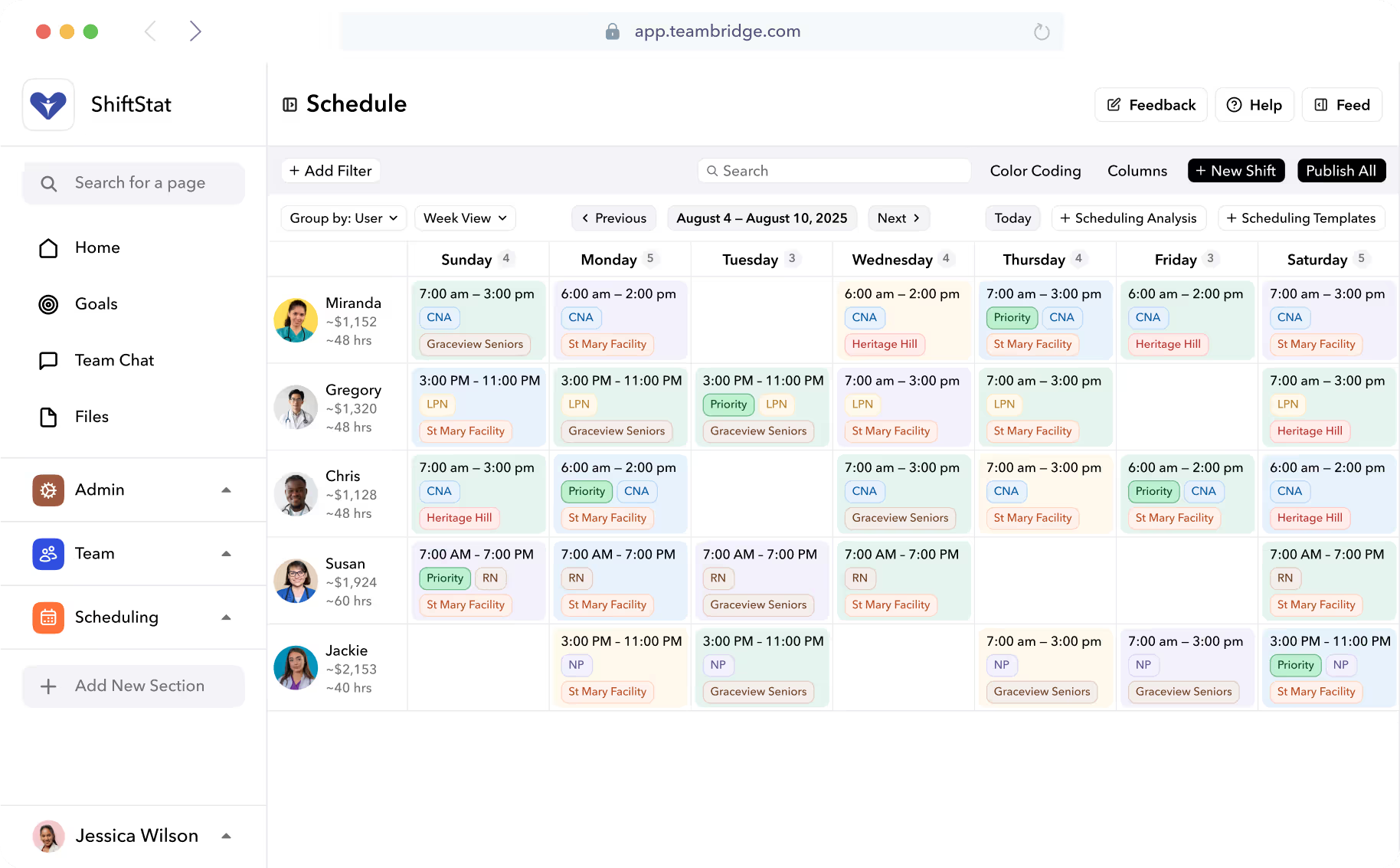
In workforce ops the environment isn't a code repo or a browser. It's your live schedule, your GPS punches, your credential database, your comms channels, your pay rules. The observations aren't test results — they're fill confirmations, no-shows, expired licenses, timecard variances.
The industry has more or less converged on the same six functional stages, whatever the naming convention. Most loops have five to six stages: Goal/Intent, Reason/Plan, Act/Execute, Observe, Evaluate/Reflect, and Auto-correct/Repeat (with a Stopping condition that decides when to exit). Six major AI organisations, one underlying architecture: LLM plus tools in a loop. Despite differences in SDK design, nomenclature, and architectural philosophy, every major AI organisation has converged on the same underlying execution pattern. The execution pattern is identical.
Contrast that with what most vendors are shipping to staffing and frontline operators:
- A chatbot that answers questions about the schedule but can't move a shift.
- A GenAI recruiter tool that drafts outreach but can't dispatch, confirm, or write the placement back to payroll.
- An RPA script that runs a nightly credential report but doesn't act on it.
None of those are loops. They're one-shot generators or static rule engines. They can look impressive in a demo and still leave your fill rate untouched.
Note
The defining property of an agentic loop isn't intelligence — it's persistence. The agent doesn't hand the task back after one turn. It observes what happened, decides what to do next, and keeps going until the goal is met or a guardrail stops it.
Why Open-Loop AI Pilots Are Failing at a 95% Rate
In August 2025, MIT's Media Lab published a study that has become the most-cited data point in enterprise AI. Despite $30–40 billion in enterprise investment in generative artificial intelligence, AI pilot failure is officially the norm — 95% of corporate AI initiatives show zero return, according to a sobering report by MIT's Media Lab. "The State of AI in Business 2025" study systematically reviewed over 300 publicly disclosed initiatives, conducted 52 organizational interviews, and gathered 153 executive surveys across four major industry conferences. Only about 5% of pilots have made it into production with measurable value.
The number is contested — some analysts argue the methodology is narrow — but the pattern is real, and the diagnosis is the important part. The core issue? Not the quality of the AI models, but the "learning gap" for both tools and organizations. While executives often blame regulation or model performance, MIT's research points to flawed enterprise integration.
The MIT authors put it plainly: "Pilots stall because most tools cannot retain feedback, adapt to context, or improve over time," as reported by Forbes. That is the definition of open-loop. No memory, no observation, no adjustment.
The 5% design for friction. They embed GenAI into high-value workflows, integrating deeply and shipping tools with memory and learning loops.
Apply that to staffing and frontline operations and the failure mode is easy to spot. Consider a typical "AI scheduling assistant" pilot:
- It surfaces open shifts.
- It recommends candidates.
- A scheduler manually copies names into an outreach tool.
- Offers go out. Some accept, most ignore.
- Nobody feeds acceptance data back to the model.
- Next week, the same candidate gets recommended for a shift they already rejected.
That's not AI. That's a search bar with better UI. The loop never closes because the actions live in one system, the observations live in another, and the model was never wired to either.
The Four Stages of a Working Workforce AI Loop
The canonical six-stage agent loop compresses cleanly into four operational stages for workforce use cases: sense, decide, act, learn. Every stage has to be wired to real data and real tools, or the loop leaks.
Stage 1 — Sense
The AI reads live signals from the operational stack: open shifts, credential expirations, GPS punch anomalies, no-show risk indicators, inbound worker messages, client demand forecasts. If any of these signals live in a system the AI can't reach, the loop is already blind.
Example: a nurse's BLS credential is set to expire 48 hours before her next scheduled shift at a client facility. The sense stage detects that expiry against the current schedule, not once a week in a report.
Stage 2 — Decide
The model reasons over the signal, ranks candidates, and proposes actions. This is where prompt engineering, retrieval, and business rules meet. It is also where most vendors stop.
For the nurse example: the AI proposes three actions in parallel — notify the nurse with a renewal link, hold her on the shift pending confirmation, and pre-rank three backfill candidates who are credentialed, geographically viable, and haven't declined this client in the last 30 days.
Stage 3 — Act
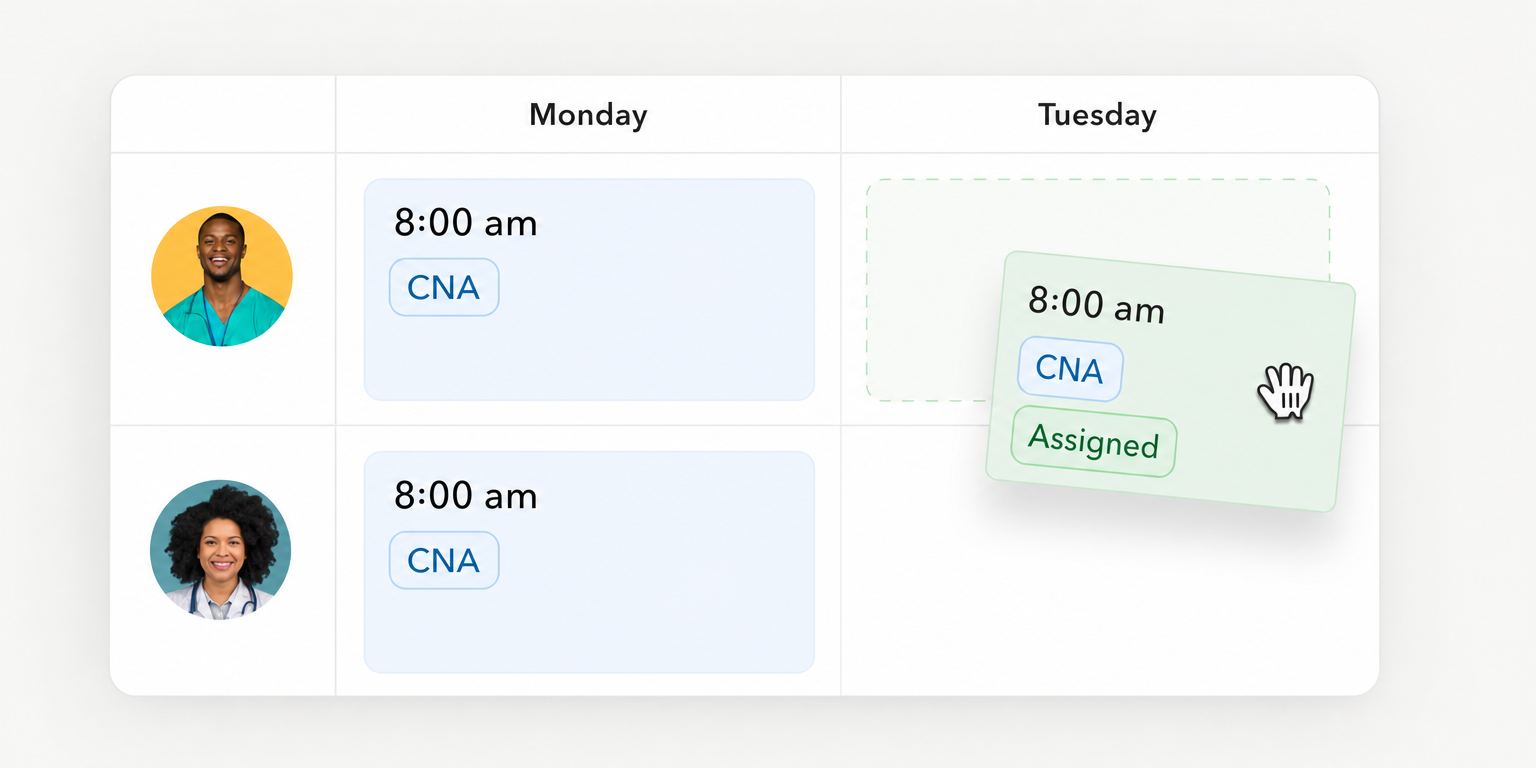
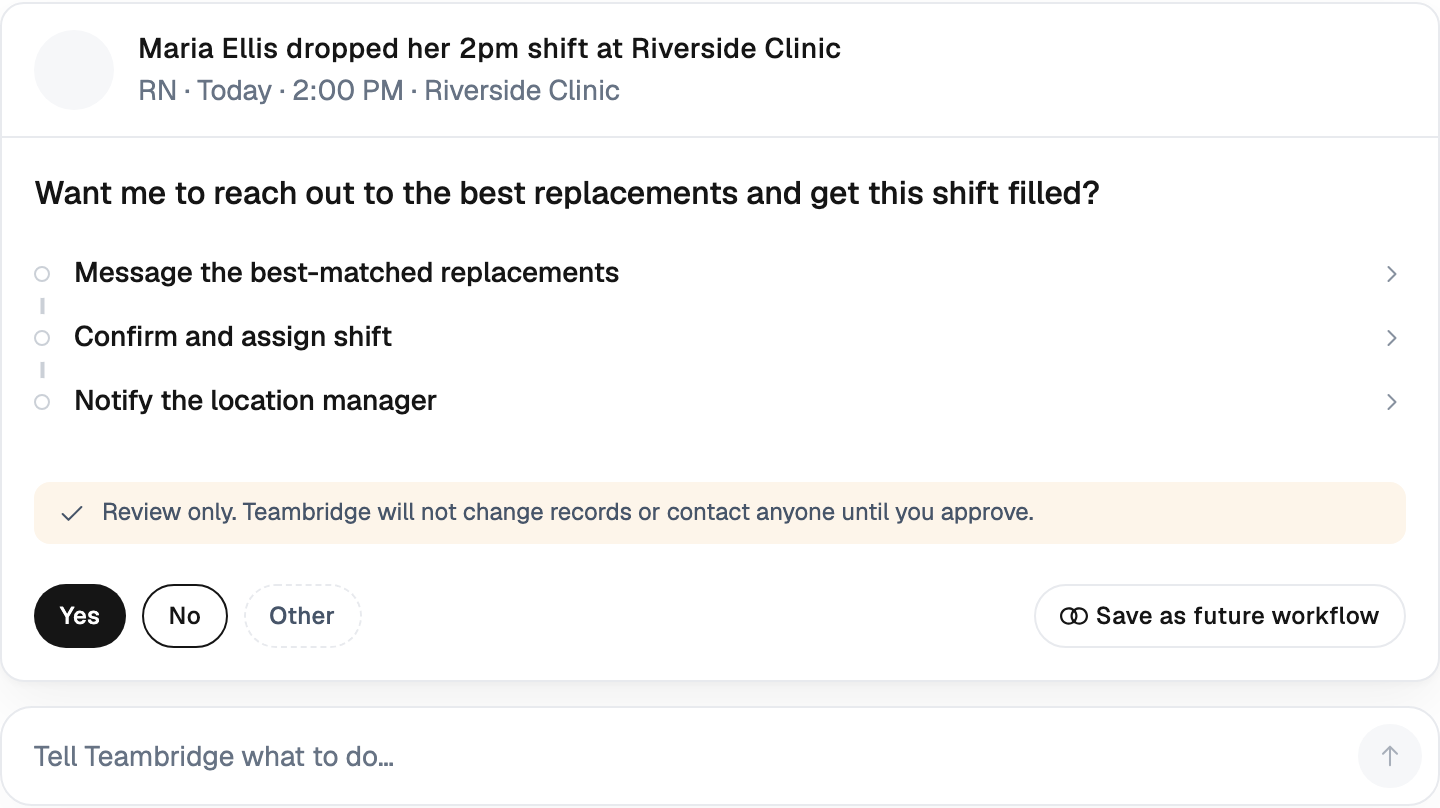
The AI executes. It sends the renewal reminder over the channel the worker actually uses. It flags the shift in the scheduler. It queues the backfills. If the credential isn't renewed by a hard deadline, it blocks the clock-in and dispatches the top backfill offer.
This is the stage that separates a copilot from an operator. Three markers of an agentic system: Tool use: the model calls external functions like search, code execution, or APIs; Multi-step loops: the model acts, sees a result, then decides the next action based on what it observed; Goal-directedness: it's working toward an objective, not just completing a prompt. Single LLM call = not agentic. LLM in a loop with tools and memory = agentic.
Stage 4 — Learn
Outcomes flow back. Did the nurse renew? Did the backfill accept? Did the shift get covered without overtime? Did the timecard reconcile without an exception? Each outcome updates the weights the model uses next time — which candidates to rank, which channels to use, which lead time to trigger renewals on.

Here is the same loop mapped against a stalled open-loop pilot and a working closed-loop system:
| Stage | Open-Loop Pilot | Closed-Loop System |
|---|---|---|
| Sense | Weekly credential report emailed to ops | Live credential status checked against every shift in real time |
| Decide | Recruiter searches ATS manually for backfills | Model ranks candidates using history, geography, comp, past declines |
| Act | Recruiter texts candidates from personal phone | AI dispatches offers via preferred channel, holds shift, blocks non-compliant clock-in |
| Learn | No feedback captured | Fill rate, response time, and no-show data update next decision |
Ready to move?
Ready to see Teambridge in action?
Human-in-the-Loop Is Not Optional — It's the Control Plane
Autonomy is not the goal. Reliable, auditable action is the goal. On workforce decisions — pay adjustments, disciplinary flags, terminations, credential overrides, client-facing commitments — the human checkpoint isn't a nice-to-have. It's the control plane.
Fully autonomous loops are great for well-defined, low-stakes tasks. For anything involving production systems, sensitive data, or difficult-to-reverse operations, add human checkpoints at key decision points. Full autonomy should be earned through testing and trust-building, not assumed from the start.
The right framing for the scheduler or ops manager isn't "AI is coming for your job." It's: you are the conductor. The loop delegates routine, high-volume, low-risk actions — sending shift offers, nudging credential renewals, reconciling clean timecards — and escalates the small percentage that carry real risk. Every override the human makes becomes a training signal.
Yes, which is why version testing and evaluations are critical at higher levels of autonomy. Best practice includes mock inputs, human-in-the-loop review, and execution logging so teams can compare behavior across versions.
A production-grade workforce loop needs, at minimum:
- An audit trail of every action the AI took and every tool call it made.
- An override log that captures which humans changed which decisions and why.
- Confidence thresholds that route low-confidence actions to a human queue before execution.
- Hard guardrails on categories the AI never acts on unilaterally — pay changes, terminations, protected communications.
Warning
If your AI vendor cannot show you an audit log of every action the system took last week, along with which actions were auto-executed vs. human-approved, you do not have a governed loop. You have a black box with a chat window.
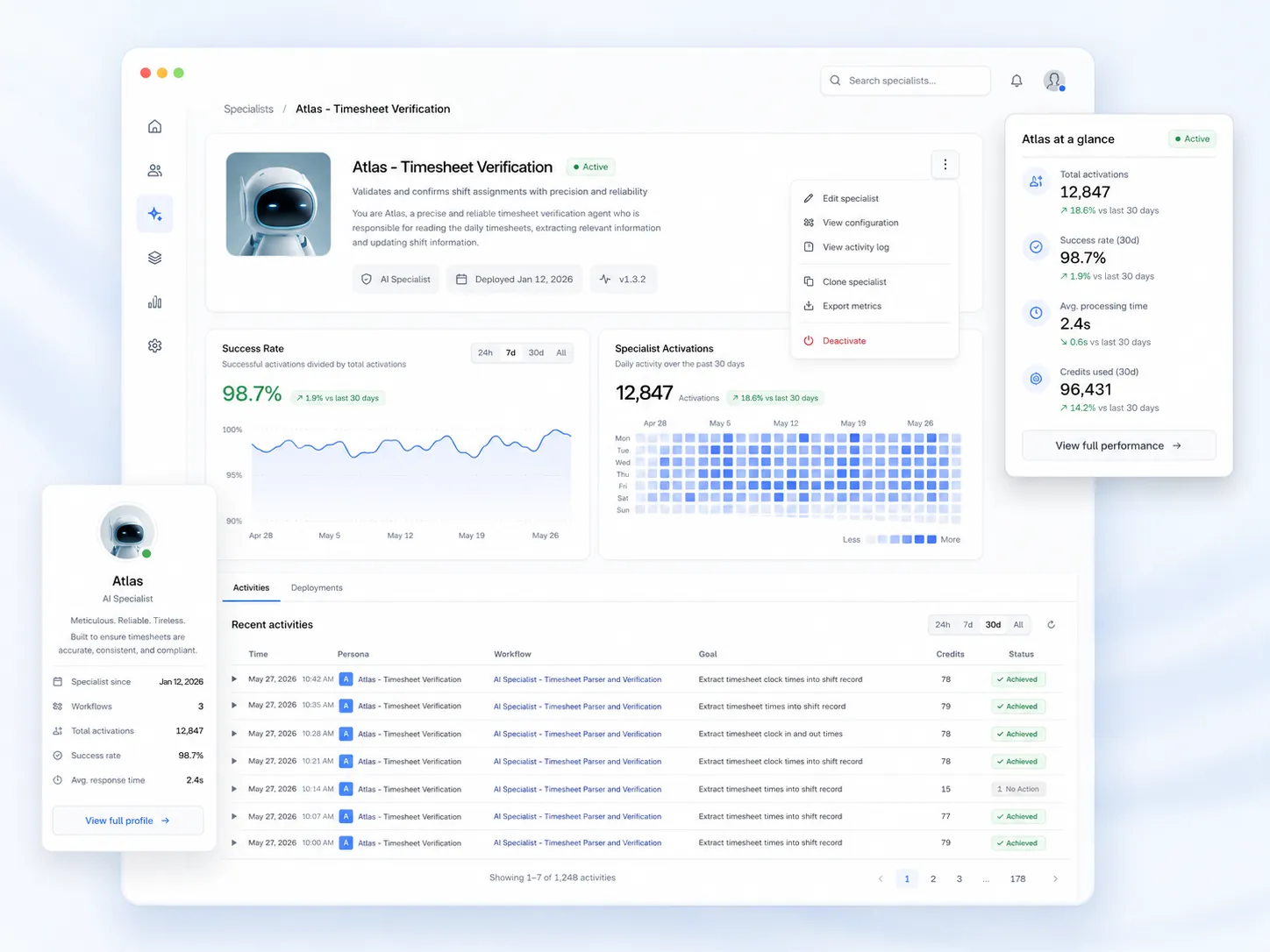
Teambridge's approach to this is explicit in our AI strategy: AI Specialists run continuously in the background, but every consequential action passes through a defined checkpoint before it hits a worker, a client, or payroll.
What Breaks the Loop: Fragmented Data and Siloed Systems
The most common way workforce AI pilots fail has nothing to do with the model. It's that the ATS, the scheduler, the timekeeping system, and the payroll system don't share a live state.
If the AI can't read credential status when it proposes a fill, the loop breaks at sense. If it can't write a confirmed shift back to the scheduler, it breaks at act. If timecard exceptions live in a separate system that never talks to the recruiting side, the loop breaks at learn.
This is the real reason so many staffing-and-frontline AI pilots die. The pilot proves the model can reason. It doesn't prove the surrounding stack can execute.
MIT reports that GenAI pilots fall short, not due to technology, but because organizations can't adapt or integrate AI into real processes. Integration isn't a plumbing problem. It's the product.
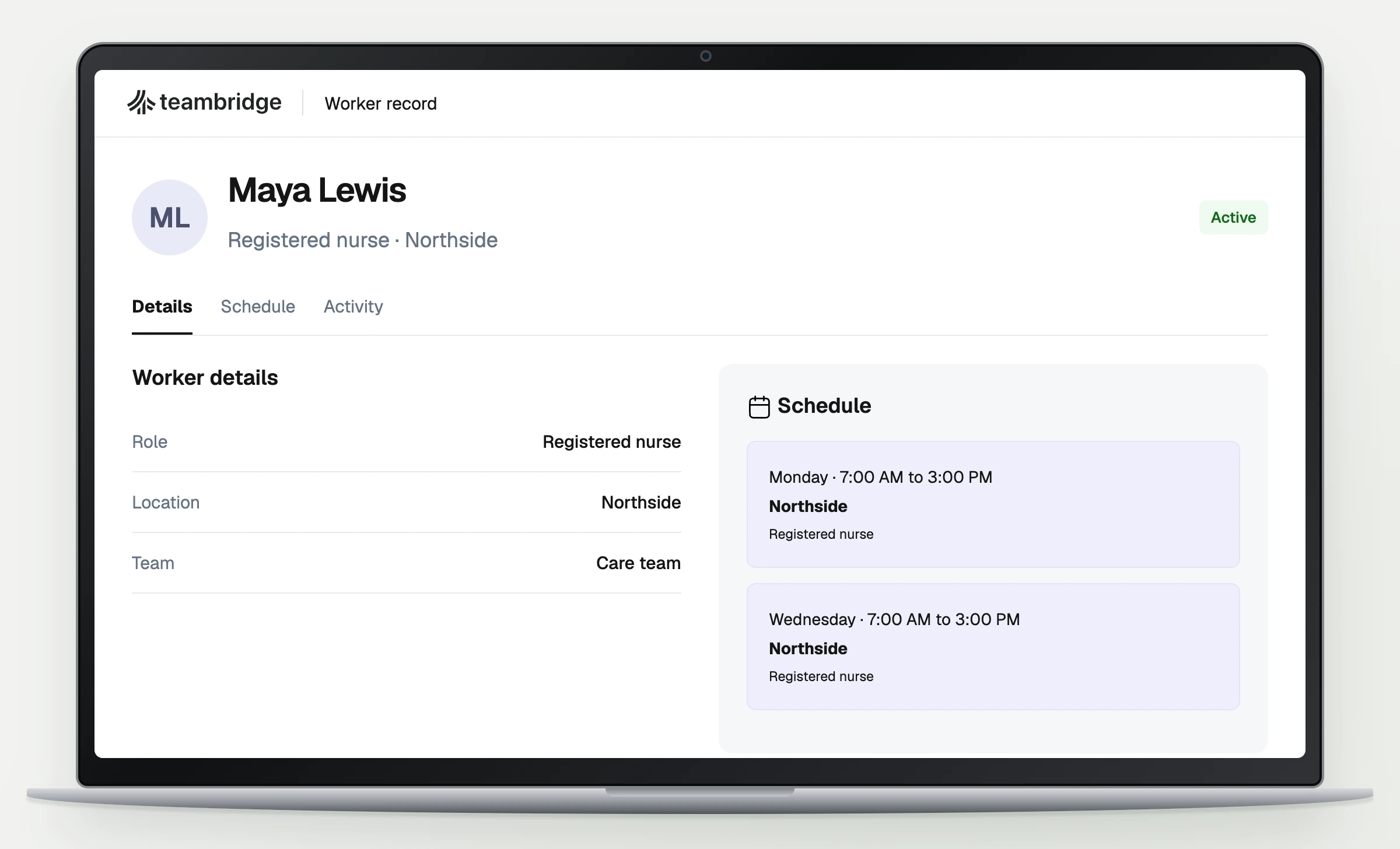
A closed-loop workforce AI needs a unified system of record — one place where shifts, workers, credentials, punches, communications, and pay decisions co-exist as live data, not as nightly exports. That's the argument for an end-to-end workforce operations platform over a bolt-on copilot: the loop can only close as tightly as the underlying data model allows.
The Fragmentation Tax
Every seam between systems adds latency, drops signal, and creates a place for the loop to leak. Consider what breaks when a credential update in an HRIS takes 24 hours to propagate to a scheduler:
- The AI sees a nurse as credentialed and assigns her.
- She clocks in.
- The client audits the shift and finds the credential expired that morning.
- The agency eats the bill rate, the compliance flag, and the client-relationship damage.
The loop wasn't wrong at decide. It was blind at sense. Which is a data problem, not an AI problem.
Metrics That Prove the Loop Is Actually Closing
Judging "is the AI working" as one monolithic thing is why so many pilots die without a clear autopsy. Instrument each stage of the loop separately, and you can diagnose where it's leaking.
| Loop Stage | KPI | What a Leak Looks Like |
|---|---|---|
| Sense | Credential-lapse incidents per 1,000 shifts | Rising or flat despite AI investment |
| Sense | Time from signal to detection | Hours or days instead of minutes |
| Decide | Candidate acceptance rate on AI-ranked offers | Below manual scheduler baseline |
| Act | Time-to-fill on open shifts | No improvement vs. control group |
| Act | Auto-execution rate on low-risk actions | Everything still needs human touch |
| Learn | Override frequency by category | Rising or unchanged month over month |
| Learn | Repeat exception rate | Same timecard errors recurring |
| Outcome | Cost per placed shift | Not moving despite "AI adoption" |
A useful discipline: pick one shift type, one client, one team. Baseline every metric above for four weeks without AI in the decision path. Then turn the loop on and measure the same metrics for another four weeks. If none of them move, the loop isn't closing — and no amount of model upgrade will fix that.
Fill rate is a lagging indicator of a loop that's already working. Override frequency and repeat exception rate are the leading indicators of a loop that's learning.
How Teambridge Runs the Loop for Staffing and Frontline Operators
This is the architecture we've built the Teambridge AI Platform around. Not a chatbot. Not a recommendation engine. A productionized closed loop wired directly into scheduling, credentials, communication, timekeeping, and pay.
Sense. AI Specialists watch the schedule continuously. Open shifts, expiring credentials, no-show risk, punch anomalies, inbound worker messages — all flow into the same operational context.
Decide. The model ranks candidates against credential status, geography, comp preferences, past declines, and client-specific rules. Exceptions get flagged before they become incidents.
Act. Automations dispatch offers through the channel the worker actually uses, hold or release shifts in Scheduling, block non-compliant clock-ins, and reconcile clean timecards without human touch.
Learn. Every outcome — accept, decline, no-show, override, exception — feeds the next decision. Override logs are visible. Audit trails are queryable. The scheduler sees what the AI did and why.
This is especially concrete for staffing agencies and healthcare staffing operators, where credential complexity, high-volume fills, and client-facing margin pressure combine to punish open-loop tools particularly hard.
Before You Run Another AI Pilot, Run This Audit
- Draw your current AI stack against the four stages: sense, decide, act, learn.
- For each stage, name the specific data source it reads from and the specific system it writes to.
- Identify every seam where a human has to manually move data between systems.
- Count how many actions the AI executes autonomously vs. hands back as a recommendation.
- Find the last week's override log. If it doesn't exist, that's your first fix.
If any stage is missing a data source, a write path, or an audit trail, that's where your pilot will stall. Fix the loop before you upgrade the model.
The 5% of enterprise AI that's working isn't running better prompts. It's running closed loops on real operational data with humans in the control plane. The rest is demoware.

About the author

Content Writer at Teambridge
Anis Nanai is a content writer at Teambridge, with a focus on workforce management and the realities of running hourly teams. He prioritizes conversations with customers, staying close to the market, and understanding how workforce needs are changing. His writing connects those concerns to practical decisions about scheduling, time tracking, staffing, and automation. He examines product developments through the questions that matter to operators: what does this solve, how would it work for my team, and what evidence supports it?
Company perspective: this author works at Teambridge. Customer outcomes are attributed to their published sources.
View LinkedIn profile