

The gap between "AI scheduling" as marketing and AI scheduling as an operational system is wide. This piece walks through what actually moves the needle on the shift floor — and where to push vendors past the auto-fill demo.
The Real Scheduling Problem AI Has to Solve
Walk into any staffing agency, healthcare operator, or light industrial scheduler's morning, and the failure modes look the same. Managers texting backups before sunrise. Overstaffed slow shifts bleeding margin. Understaffed peaks where the client calls to complain. Credential gaps caught after the shift was already worked.
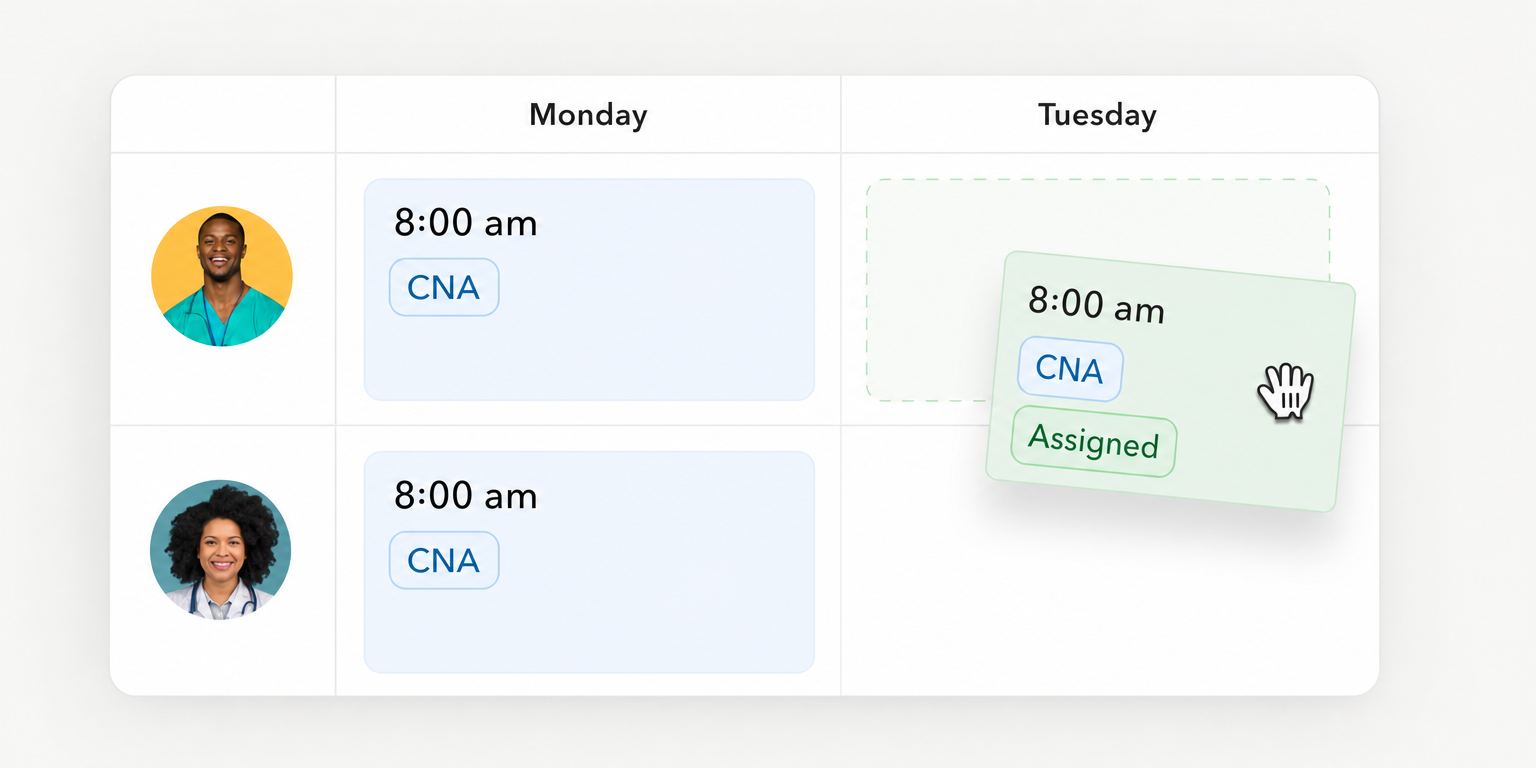
The root cause isn't laziness or bad managers. It's that traditional rostering can't keep up with the number of variables in play. Managers end up burning hours on spreadsheets and last-minute adjustments, often landing on costly overstaffing or chaotic understaffing as the only way to absorb uncertainty.
AI scheduling, done honestly, is a response to that pain. Not a buzzword. Not a replacement for the scheduler. A way to compress the decision loop so the operator can spend time on judgment calls instead of data entry.
What AI Scheduling Actually Does (Beyond Auto-Fill)
The category has gotten muddy. "AI scheduling" gets slapped on everything from rules-based auto-schedulers to genuinely predictive systems. Three tiers are worth separating:
- Rules-based auto-schedulers. Static constraints — availability, max hours, role match. Useful, but no learning.
- Predictive demand modeling. Forecasts labor need from historical and external signals.
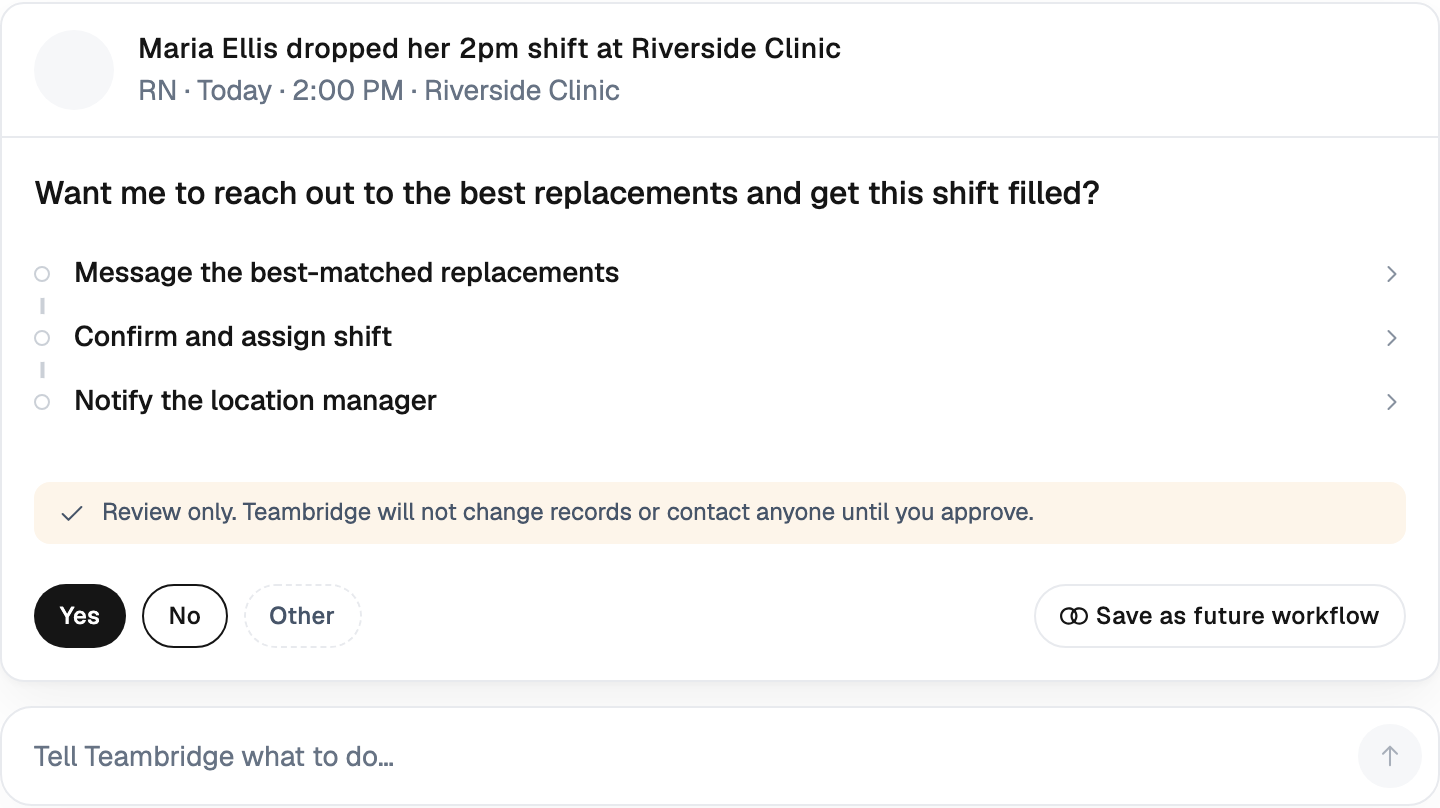
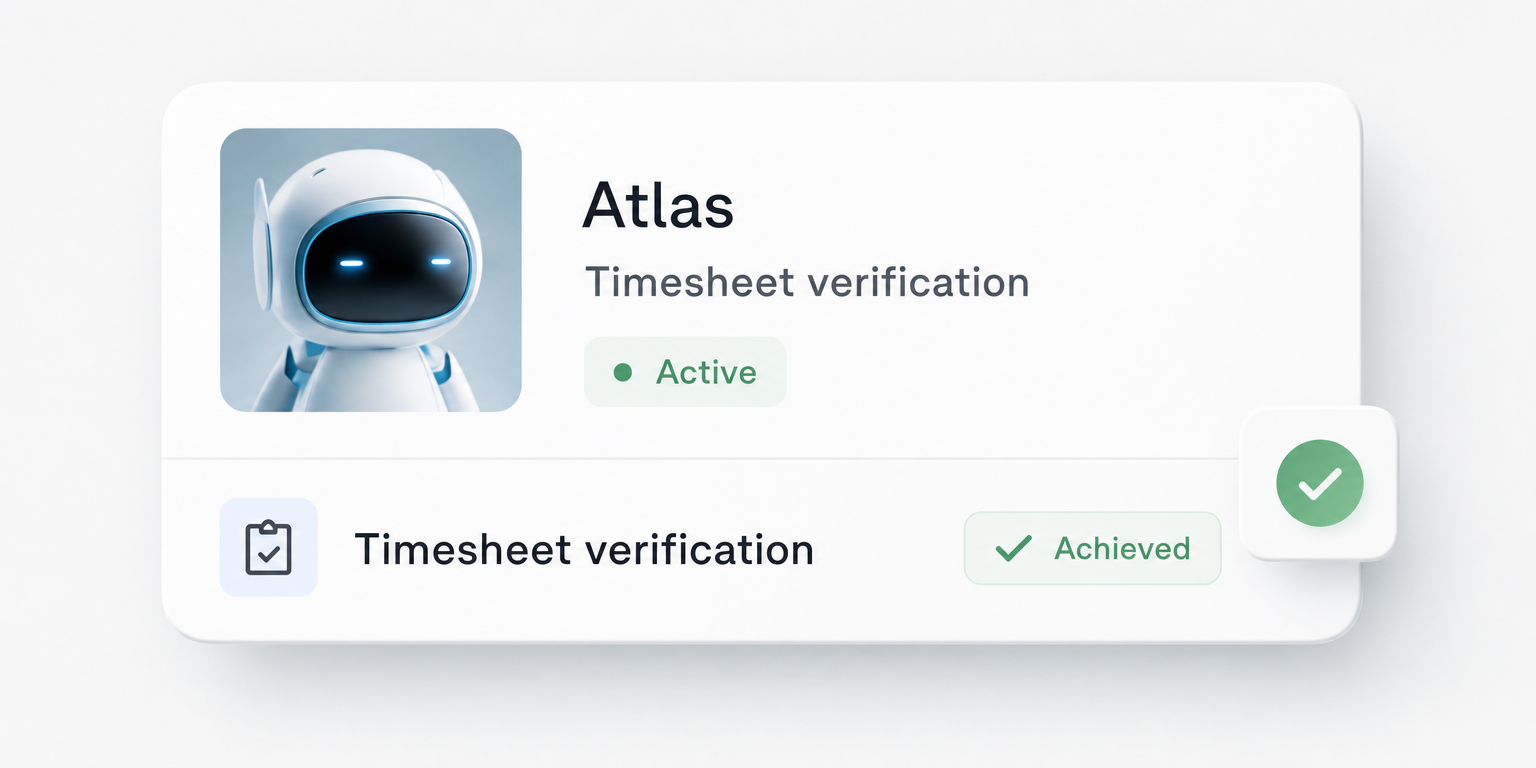
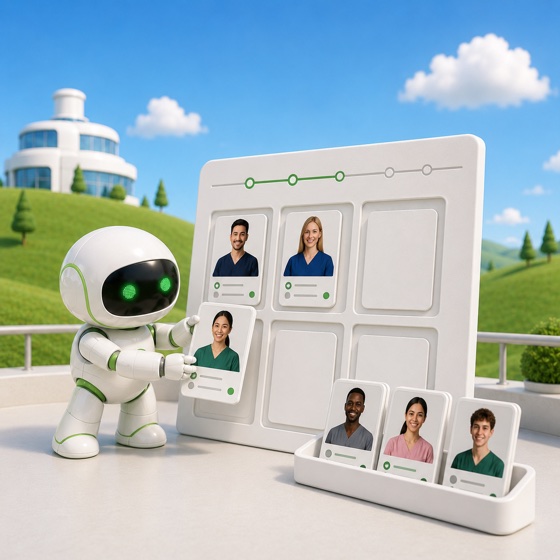
- Agentic systems. Software agents that act on their own — validating credentials, flagging at-risk shifts, suggesting swaps, escalating to a human when judgment is needed.
A real AI scheduling stack pulls signal from many directions at once. Integration of artificial intelligence and machine learning in workforce scheduling software is enhancing predictive analytics capabilities, enabling organizations to make data-driven decisions and optimize their workforce management processes. The point isn't to remove humans. It's to remove the busywork that keeps humans from doing the work that matters.
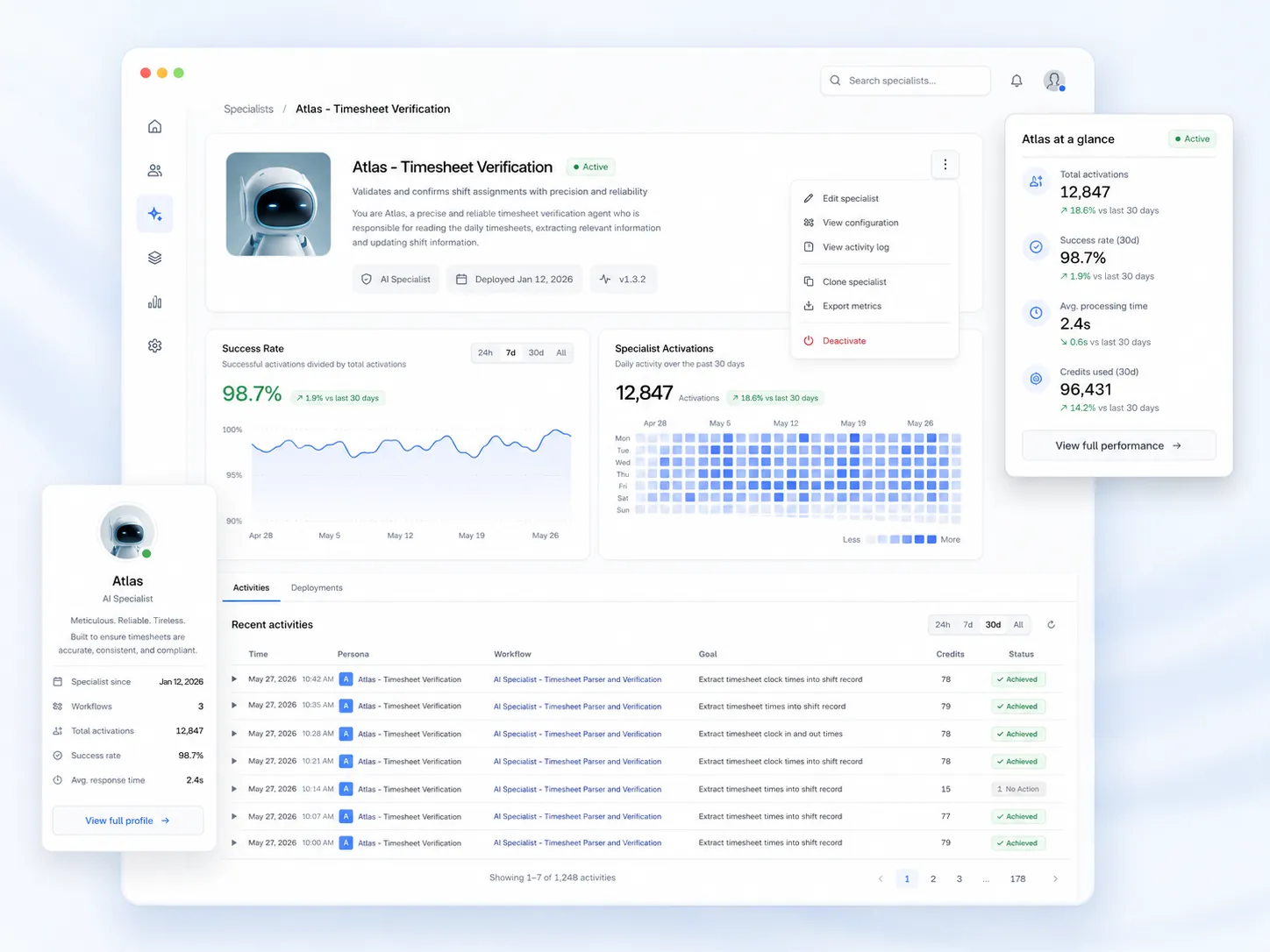
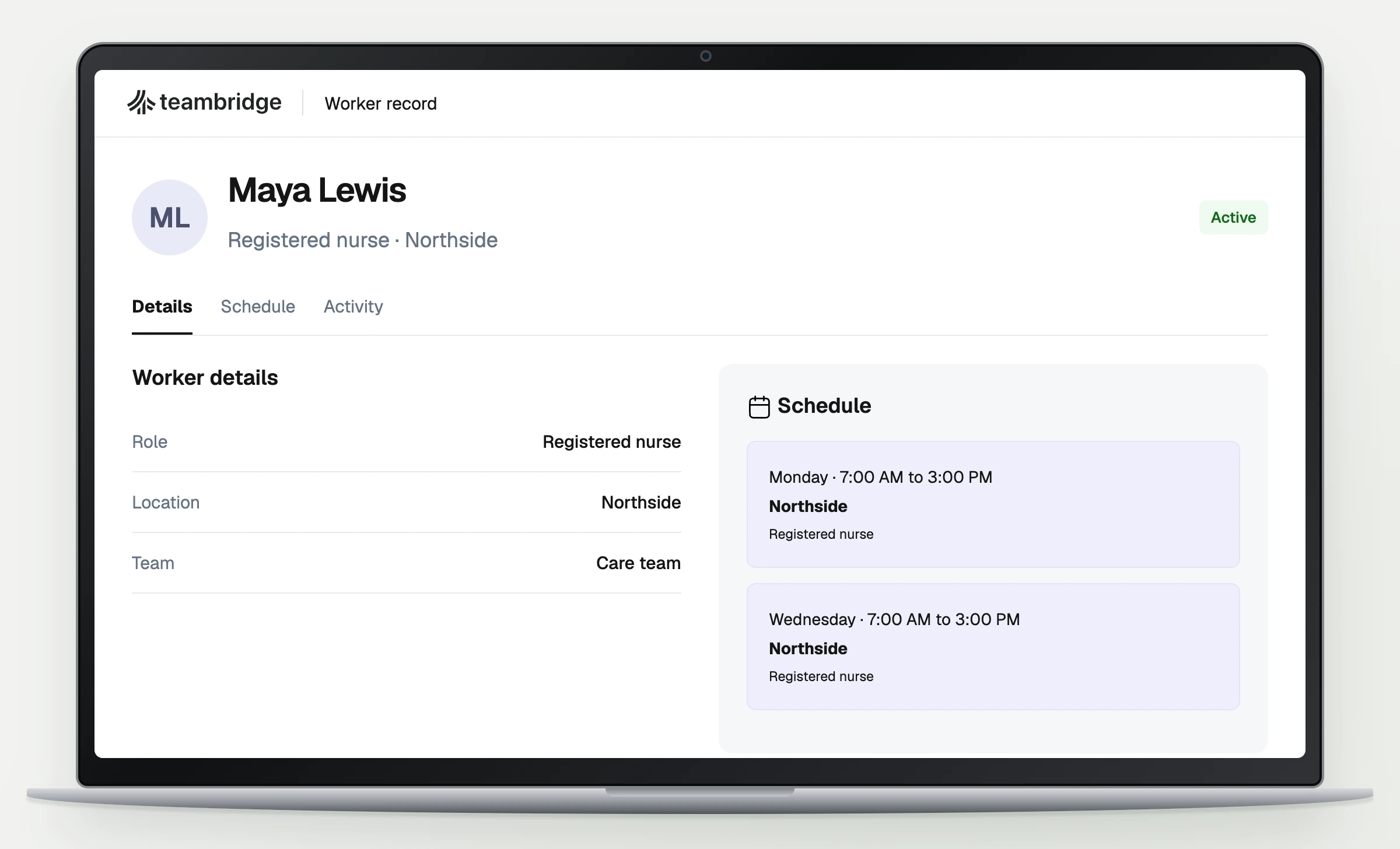
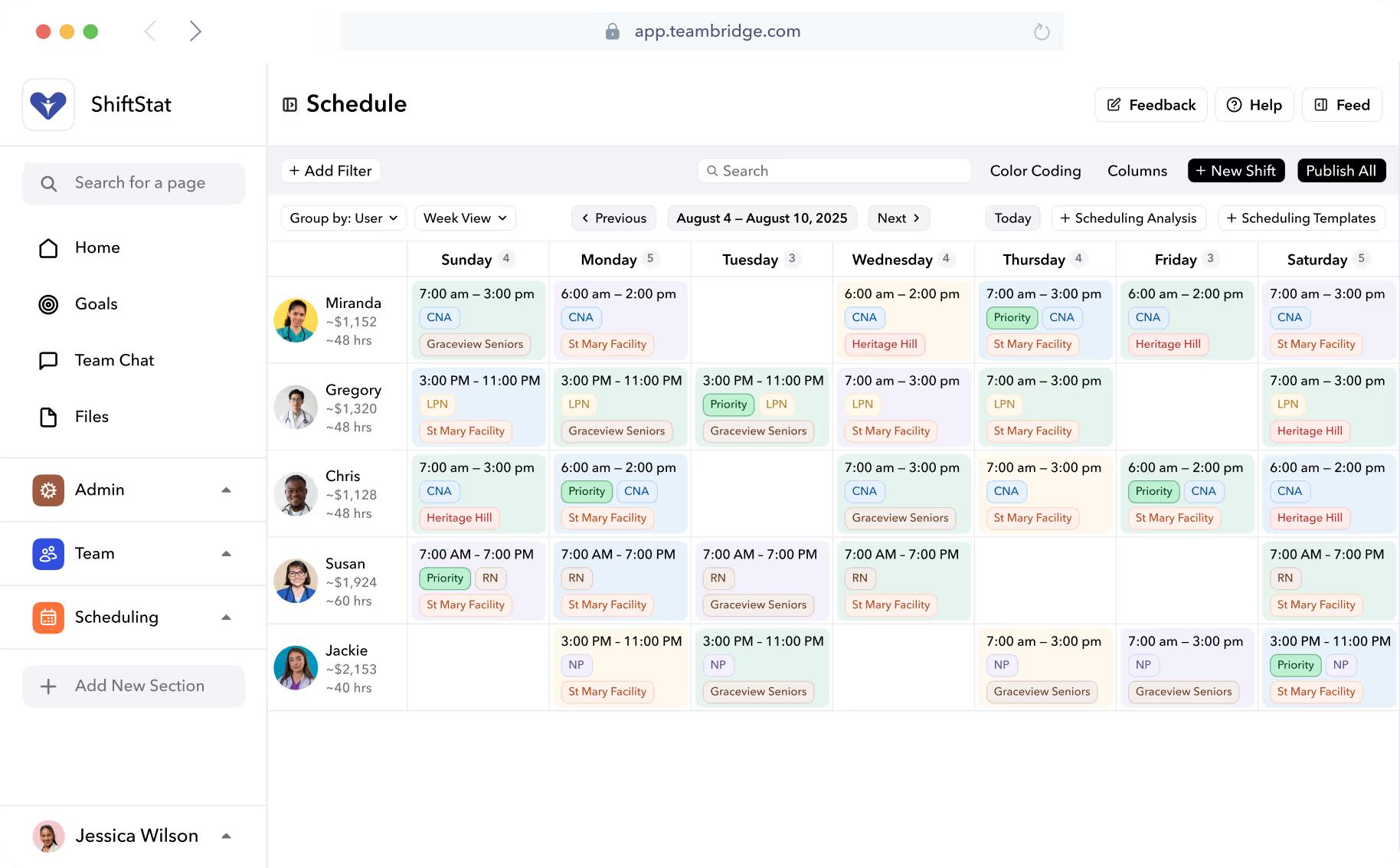
Teambridge splits this across two products: the Scheduling module for the roster itself, and the AI Platform for the autonomous agents that work in the background — credential checks, no-show prediction, budget validation, swap matching.
Rules-based vs. predictive vs. agentic — at a glance
| Capability | Rules-Based Auto-Scheduler | Predictive Demand Model | Agentic AI System |
|---|---|---|---|
| Fills open shifts | Yes, against static rules | Yes, weighted by forecast | Yes, with credential + budget guardrails |
| Learns from history | No | Yes | Yes |
| Predicts no-shows | No | Limited | Yes, per worker per shift |
| Validates credentials at publish | Manual | Manual | Automatic, blocks publish |
| Flags budget overrun | After the fact | At forecast | Before publish |
| Acts without prompting | No | No | Yes, within guardrails |
Demand Forecasting: The Input That Makes or Breaks the Schedule
The optimizer is only as good as the demand signal feeding it. A clever solver on a bad forecast still produces a bad schedule — just faster.
Good forecasting pulls from more than last quarter's headcount. For hospitality and retail, that means sales velocity, weather, bookings, foot traffic, minimum staff requirements, and opening hours. For staffing agencies and light industrial, the analogues are client order volume, seasonal ramps, historical fill rates by client, and lead time on requisitions.
Note
If your scheduling vendor can't tell you which inputs feed their forecast and how often they retrain, treat "AI-powered" as marketing copy.
The market is moving fast in this direction. The labor demand forecasting AI segment alone reached USD 2.1 billion in 2024 and is projected to grow at a 28.6% CAGR through 2033 (Growth Market Reports). That growth is being pulled by buyers who realized the forecast — not the optimizer — was the real bottleneck.

Compliance and Credentials Baked Into the Roster, Not Bolted On
A schedule that breaks labor law or sends an expired-credential nurse to a shift isn't "efficient." It's a liability with a delayed invoice.
This is where most legacy scheduling tools fall over. Compliance lives in a separate spreadsheet, owned by a separate person, checked on a separate cadence. The schedule gets built first, then someone tries to validate it later — usually after publish, usually under time pressure.
The better pattern is to embed cost and compliance checks directly inside the rostering workflow. Shifts get optimized against budget while being automatically validated against rules like breaks, fatigue, qualifications, and award conditions — before they're published, not after.
That matters more every year because the rules keep multiplying. Breaks, overtime, predictive scheduling ordinances, paid leave — they vary by city, state, and federal level. Leading platforms now incorporate automated compliance engines that monitor every shift in real time, instead of relying on a manager to remember a city ordinance at 5am.
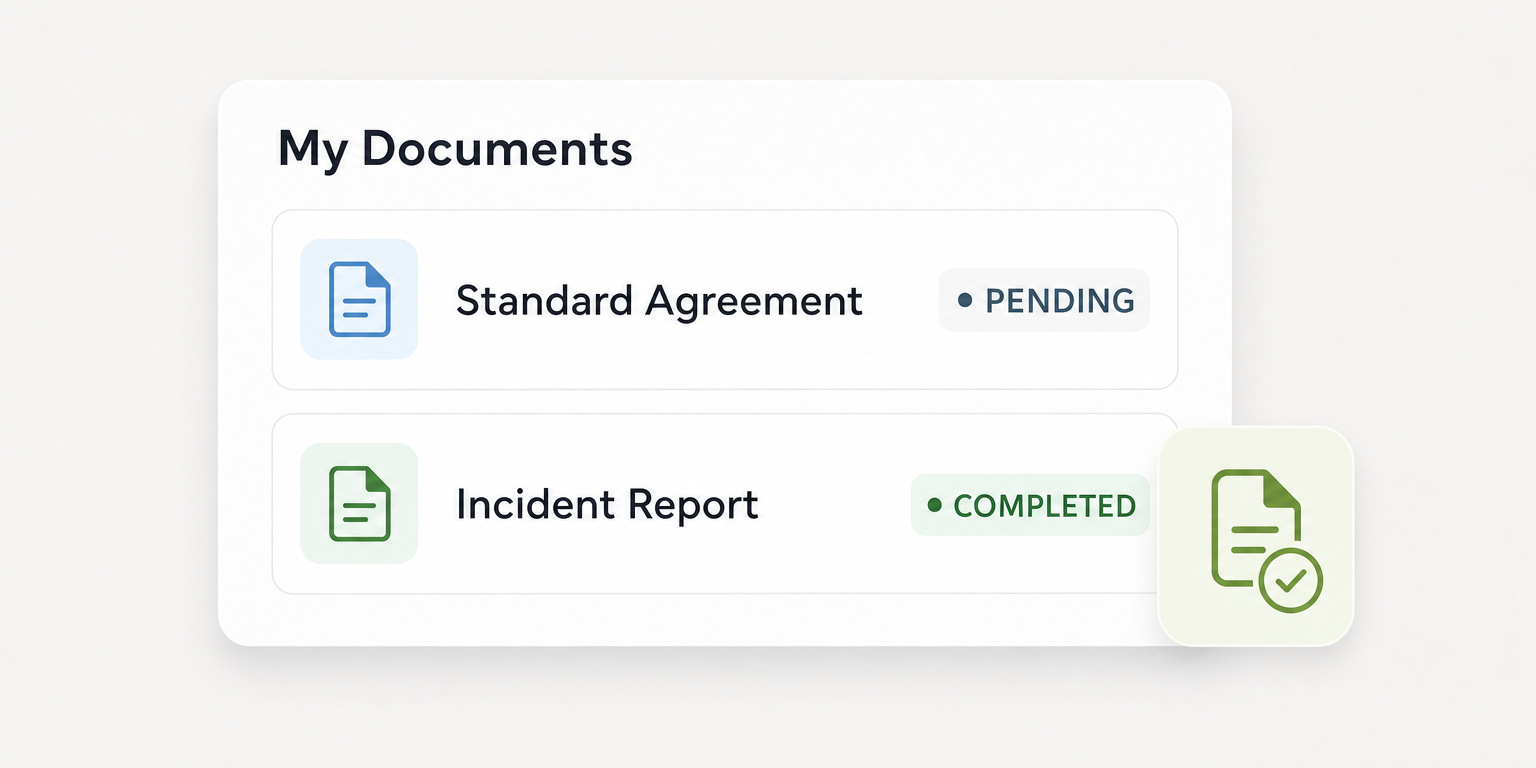
Credential capture is the upstream half of this. If you wait until publish to discover a worker's CPR certification expired last week, you've already lost. That work belongs in Onboarding — pre-day-one — and in Document Studio for renewals. The scheduler should never be the place credentials get noticed.
Preference-Aware Scheduling and the Retention Math
Reliability and retention live or die on whether workers feel the schedule respects them. This is the soft side of AI scheduling that operators tend to underweight until turnover spikes.
If the roster feels opaque or inflexible, people disengage and managers end up firefighting. Preference-aware scheduling — capturing availability, shift preferences, location radius, role flexibility — makes work easier to commit to. That's where reliability and retention actually start.
Surveys consistently show schedule autonomy ranking alongside compensation in employee priorities, particularly among younger workers. The modern platforms that handle this well empower workers through self-service portals for shift preferences, availability updates, and peer swaps — without requiring a manager to broker every change.
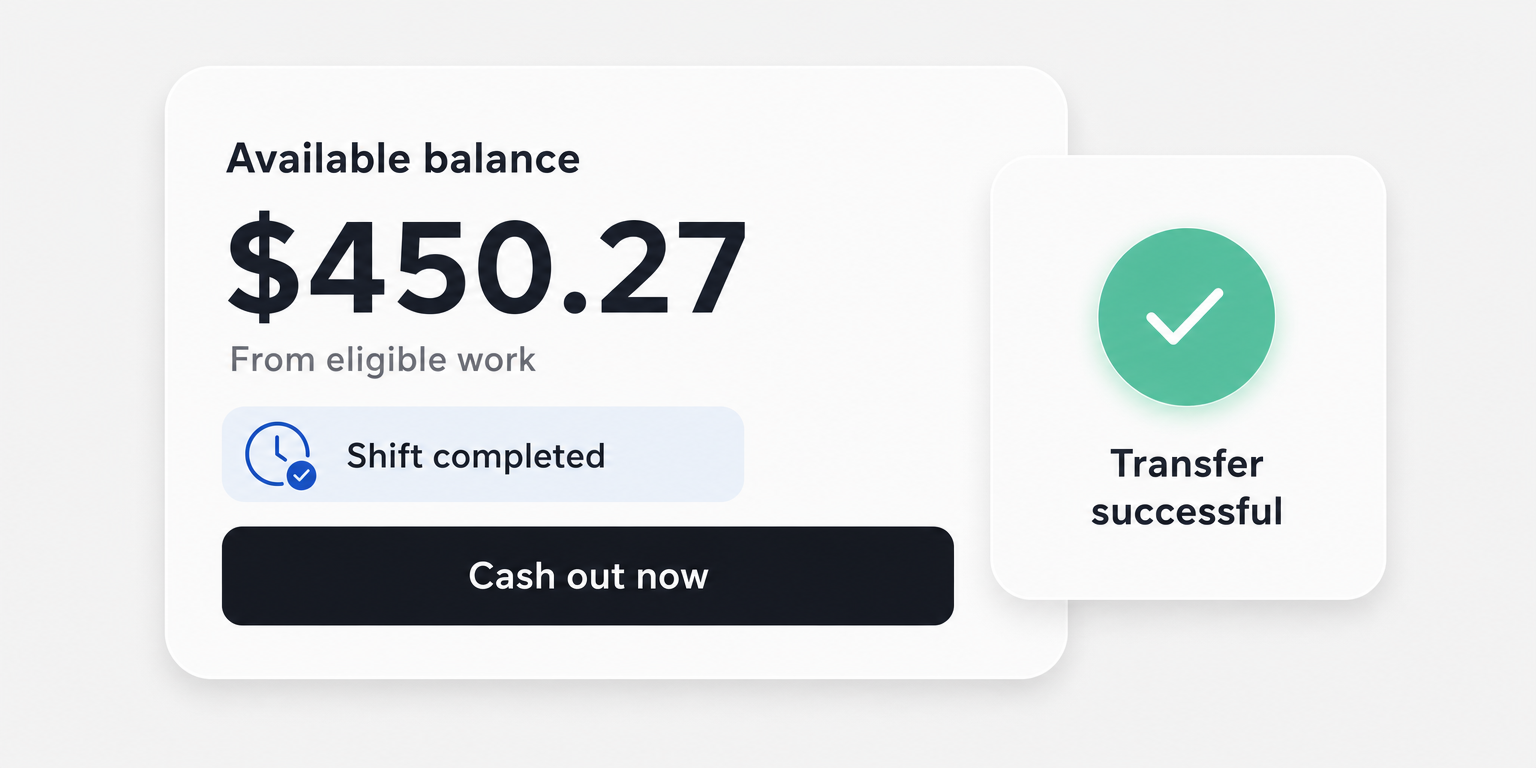
For staffing agencies in particular, this is where margin is made or lost. A worker who picks up an extra shift through self-service is a worker you didn't have to chase. Teambridge bundles this into the Staffing Agencies workflow alongside Instant Pay, because preference and pay speed are the two retention levers that actually move numbers.
Workers don't quit because of one bad shift. They quit because the system feels like it was built without them in mind.
Keeping Humans in the Loop (And Why That's Not a Cop-Out)
There's a tempting narrative that AI replaces schedulers. It doesn't, and the operators making it work know it.
AI should take paperwork off managers' plates, not take people out of people processes. Give the team speed and precision, keep humans in the loop on the decisions that need judgment. That's the durable model.
Regulatory pressure is making this explicit. Under the EU AI Act, AI systems used in employment decisions fall into the high-risk category — covering recruitment, selection, targeted job advertising, candidate evaluation, performance monitoring, and certain decisions about compliance, contract terms or termination. Starting 2 August 2026, those tools will need mandatory risk assessments, technical documentation, bias testing, human oversight, transparency disclosures, and continuous monitoring (EU AI Act for Staffing Businesses).
Workforce scheduling tools that allocate shifts based on productivity metrics fall within scope. Translation for operators: if your scheduler is making allocation calls that affect who gets hours, you need a documented human-in-the-loop process. Not a policy document. A real workflow.
Important
The penalties are not symbolic. Fines can reach up to EUR 15 million or 3% of global annual turnover for deployers who fail their high-risk system obligations. If you operate or hire into the EU, the deployer obligation sits on you, not the vendor.
In practice, the guardrails are straightforward:
- Who approves auto-generated shifts before publish (and is that documented).
- Who can override a credential block and what gets logged when they do.
- What audit trail exists for every AI-suggested swap, fill, or rejection.
- How workers are notified when AI is in the loop on their schedule.
The operators who treat these as features, not chores, will spend the next two years building muscle. The ones who treat them as legal-team problems will spend the next two years catching up.
The Market Signal: Where Adoption Is Going Next
If you're still wondering whether you're early on this, you're not. The numbers stopped supporting that read about eighteen months ago.
One analysis values the global AI-driven workforce scheduling market at USD 2.67 billion in 2024, forecasting growth to USD 18.3 billion by 2033 at a 21.3% CAGR — driven by AI integration in workforce management, demand for operational efficiency, and cloud-based platforms (Growth Market Reports). The broader AI in workforce management category is sized at USD 14.2 billion by 2033 on a similar trajectory (Market.us).
Adoption started in hospitality, retail, and grocery — high-volume, high-variance, low-margin sectors where bad scheduling shows up immediately on a P&L. It's moving fast into healthcare, staffing, and light industrial. UNC Health's deployment of an AI-enabled workforce scheduling solution is a useful data point: float nurses doubled their monthly shift commitments in the first three months, going from an average of four to eight claimed shifts per nurse (Grand View Research).

For staffing agencies and healthcare operators, the implication is operational: your competitors are either already running on agentic scheduling or in the procurement cycle for it. The window where this was a "nice to have" closed somewhere between 2023 and 2025.
What to Look for in an AI Scheduling System (Operator Checklist)
If you're evaluating, skip the demo theatrics. Ask vendors to walk through specific failure modes against your data. Here's the checklist that separates real systems from auto-fill with a sticker on it.
Demand and forecasting
- What inputs feed the forecast? Sales, weather, bookings, client requisition history — be specific.
- How often does the model retrain? Weekly minimum for high-variance operations.
- What's the forecast error on data like yours? If they can't quantify it, they don't know.
Compliance and credentials
- Are credential checks blocking before publish, or warnings after? Blocking is the only correct answer.
- How are local labor rules — predictive scheduling, breaks, overtime — encoded and updated?
- What audit trail exists for every override?
Worker experience
- Can workers update availability and preferences in self-service without a manager touch?
- Are peer swaps supported with automatic credential and budget revalidation?
- Does the worker get notified when AI is involved in a decision affecting their shift?
Operator controls
- Where are the human-in-the-loop gates? Publish, override, no-show prediction, budget breach.
- What gets logged, for how long, and who can audit it?
- How does the system surface budget risk before publish, not after?
Tip
Bring your worst week of data to the demo. Not your average week — your worst. If the system can't reason about a real bad day on your actual numbers, the polished demo is selling you a story.
The pieces have to connect end-to-end. Scheduling without Time Tracking and Automations feeding back into it is half a system. Credentials owned outside the scheduler — in a separate HRIS, on a shared drive, in someone's inbox — will betray you on the first bad week. The Teambridge Platform was built to keep these stitched together so the AI agents have something coherent to act on.
The operators who win the next three years aren't the ones with the flashiest auto-fill. They're the ones whose scheduling system can be trusted to publish a roster that's already legal, already credentialed, already within budget, and already respectful of the people working it. Everything else is demo polish.

About the author

Content Writer at Teambridge
Anis Nanai is a content writer at Teambridge, with a focus on workforce management and the realities of running hourly teams. He prioritizes conversations with customers, staying close to the market, and understanding how workforce needs are changing. His writing connects those concerns to practical decisions about scheduling, time tracking, staffing, and automation. He examines product developments through the questions that matter to operators: what does this solve, how would it work for my team, and what evidence supports it?
Company perspective: this author works at Teambridge. Customer outcomes are attributed to their published sources.
View LinkedIn profile