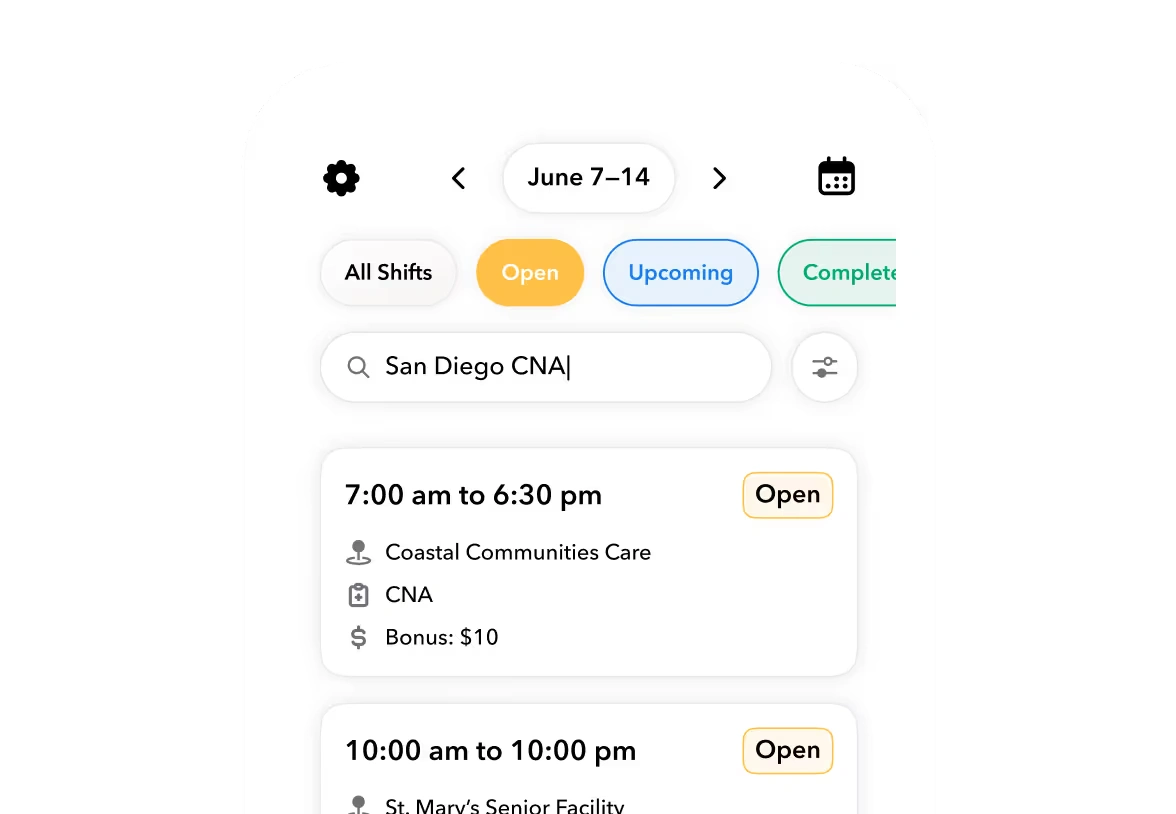
The healthcare staffing buyer's market in 2026 is full of demos that look great and platforms that quietly bleed margin once they hit production. Pretty dashboards have become table stakes. What separates the operators who hit their margin targets from the ones who don't is unglamorous: a credential engine that actually blocks a non-compliant worker, a fill engine that doesn't burn the worker base on every open shift, and a path from clock-in to invoice that doesn't require a human to reconcile every timecard by hand.
This is a buyer's guide for the people running the operation, not the people pitching the board deck. If you are an agency owner, a VP of operations, or a director of workforce management at a health system, the questions below are the ones that decide whether you keep gross profit or give it back.
The 2026 staffing reality: shortages aren't going away, and spreadsheets aren't catching up
The macro picture has not improved. The RN vacancy rate sat at 9.6% nationally in 2024, down only 0.3% from the year prior, as hospitals hired approximately 98,000 RNs for a 2024 add rate of 5.6%. Demand still outpaces supply, and the people filling the gap are travelers, per diem nurses, and locums booked through agencies.
That dependency is structural, not cyclical. According to the AAMC, the United States could see an estimated shortage of between 37,800 and 124,000 physicians by 2034, including shortfalls in both primary and specialty care. Locum tenens is no longer a stop-gap line item — it is a budget category. The locum tenens market is positioned for steady growth through 2026, rising from $9.1B in 2024 to $9.9B projected in 2026, according to SIA's September 2025 US Staffing Industry Forecast.
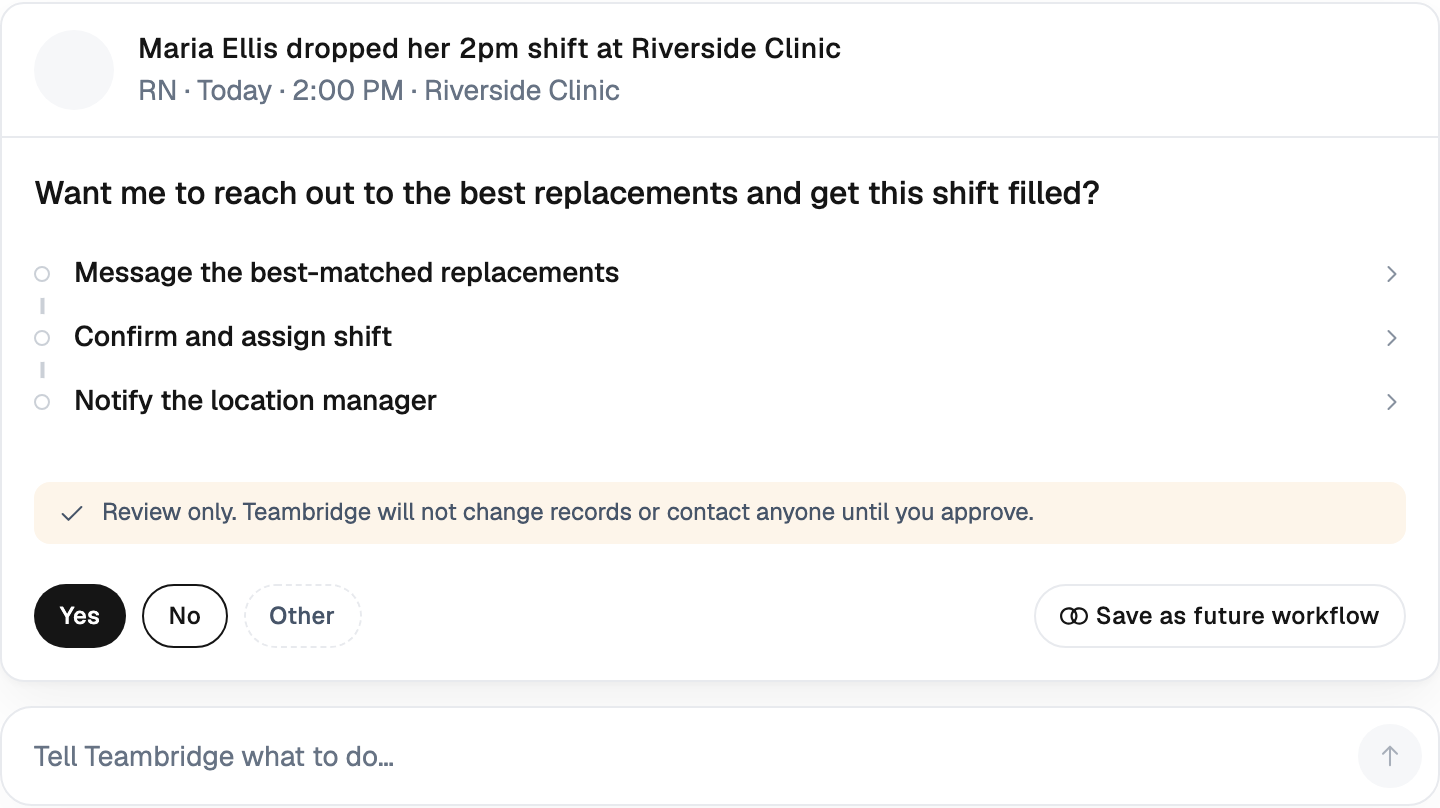
The operational consequence is mundane and brutal. Open shifts at 4 a.m. that nobody noticed because the on-call coordinator's phone died. Recruiters dialing through a list of nurses whose BLS expired last week. Ops managers reconciling 600 timecards on a Sunday because the differentials didn't apply correctly. None of that gets solved with another KPI dashboard.
The agencies winning right now treat software as infrastructure — the same way a hospital treats its EHR. It is the system of record. When it fails, money leaks.
Note
Hospitals already absorb significant cost from labor disruption. The average cost of turnover for a staff RN increased by 8.6% in the past year to $61,110, with a range of $49,500 to $72,700. Every percentage point your software shaves off rework, no-shows, or credential incidents shows up directly in margin.
What 'healthcare staffing software' actually has to do
The category gets sold as scheduling. That is a fraction of the job. A real platform has to run five workflows end-to-end, and the seams between them are where most agencies lose money.
- Credentialing. Licenses, BLS, ACLS, TB tests, N95 fit tests, facility orientations, vaccination records — tracked per worker and per facility, with hard blocks at the schedule layer.
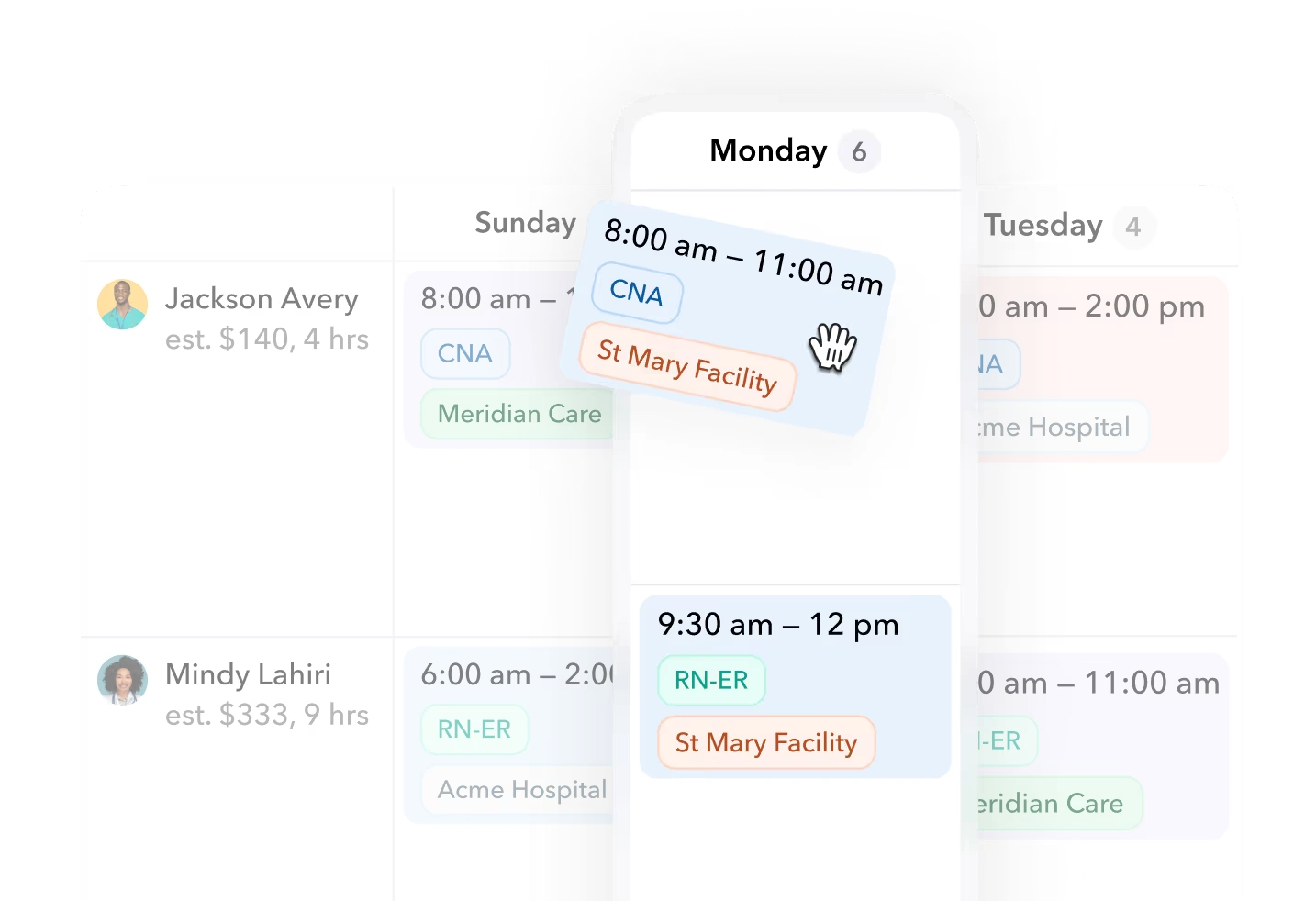
- Shift fill. Broadcast, claim, confirm. Ranked by match quality, not blasted to the entire worker pool.
- Time capture. Clock-in verified at the facility, exception handling for missed punches and skipped breaks, differential rules applied automatically.
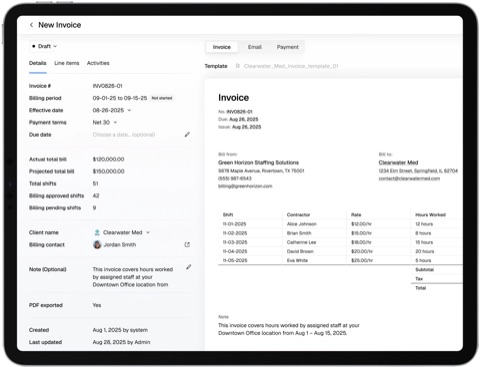
- Pay and bill. Bill rates, burden, spread, OT, holiday and weekend differentials — calculated once, exported to payroll and the client invoice in one pass.
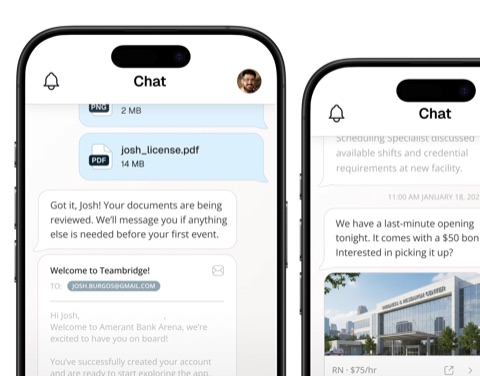
- Worker comms. A single channel for shift offers, schedule confirmations, document requests, and pay questions.
Most agencies run this on a Frankenstein stack: a VMS for the client side, Excel for the schedule, group texts for fill, a separate timecard tool, and QuickBooks for billing. Every seam between those systems is a place where a credential lapses without anyone noticing, or a differential gets applied wrong, or a timecard becomes a bill 11 days late.
What good looks like in one screen
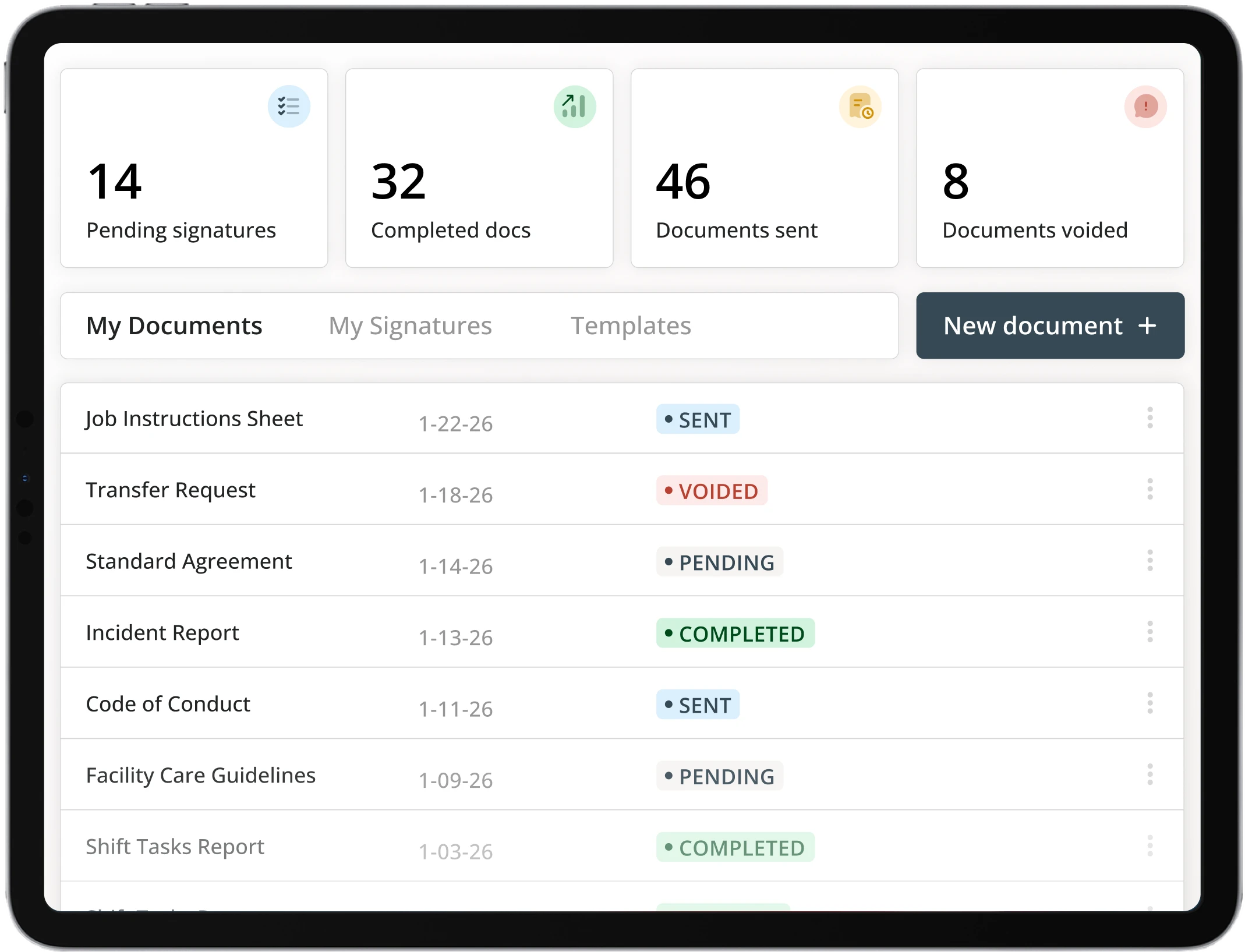
A recruiter or coordinator should be able to see — for any worker — open shifts they qualify for, credentials about to expire, last three timecards with any exceptions, and current pay rate. If your team is alt-tabbing between three tabs to assemble that picture, the software is the bottleneck.

Credential enforcement is the feature most buyers underweight
This is the feature that quietly determines whether you keep contracts. A nurse with an expired license takes a shift. The facility audits the timecard. The hours get clawed back, the agency eats the cost, and the contract goes on a watch list. Do that twice with the same client and the MSP starts looking for a replacement.
Good credential enforcement is not a spreadsheet of expiration dates with email reminders. It is three layers working together:
- Document parsing on intake. When the worker uploads a license PDF, the system extracts the expiration date, state, and license number. No coordinator retyping data.
- Automatic expiry alerts at multiple intervals. 60, 30, 14, and 7 days out, with escalating tone and an automatic block at zero.
- Hard blocks at the schedule layer. The worker simply cannot claim a shift they aren't credentialed for at that specific facility. Not a warning. Not a soft flag. A block.
The per-facility piece is where most legacy tools fall over. A hospital may require N95 fit testing within the last 12 months. A SNF may not. A surgical center may require a fresh PPD. A home health agency may require a clean MVR. The same nurse may be compliant at three facilities and non-compliant at the fourth. The system has to model that.
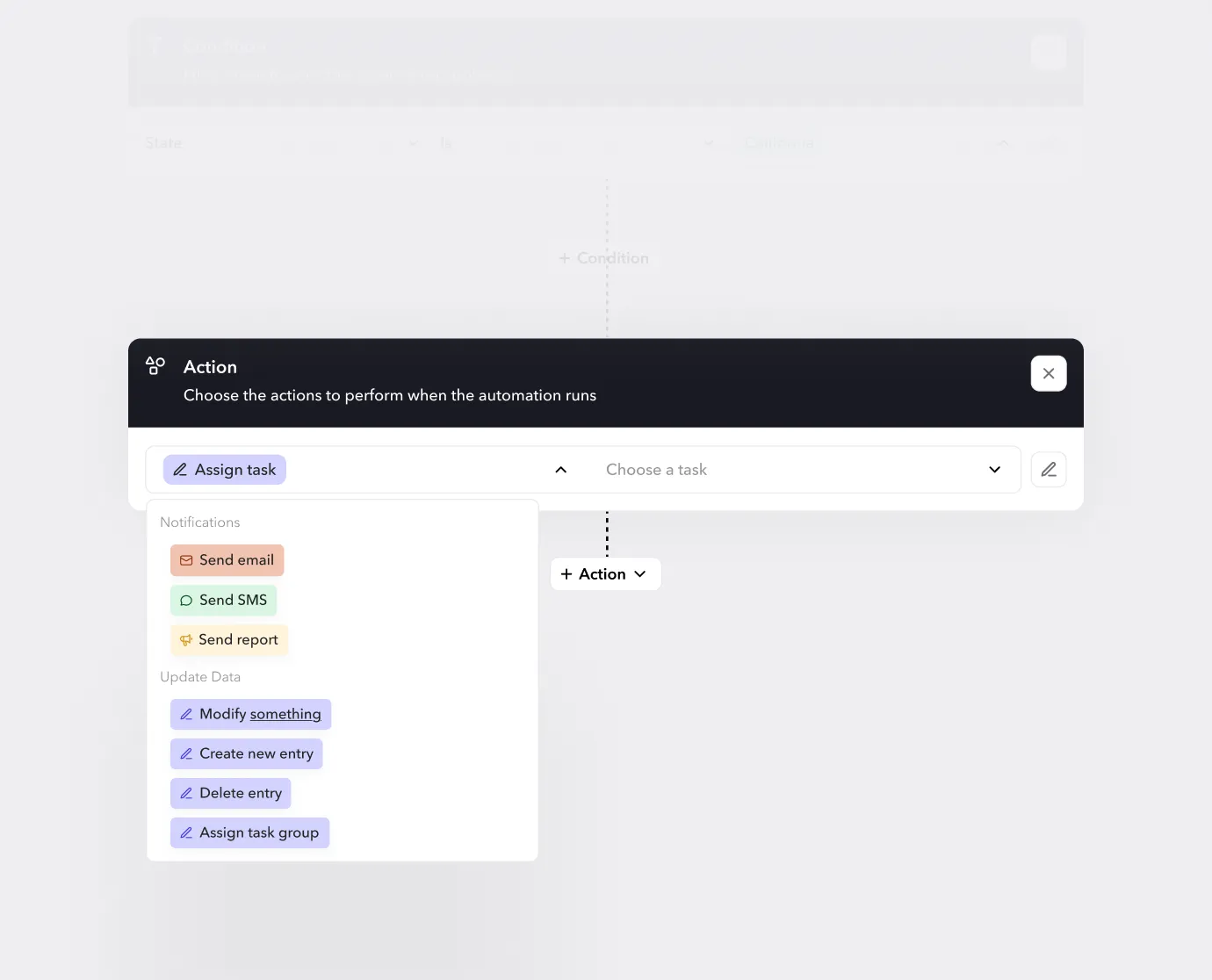
This is exactly the kind of rules-engine work that should run in the background without a human babysitting it — which is why teams handle it through workflow automation rather than manual checklists. Teambridge customers in healthcare staffing configure these rule sets at the facility level and let Automations handle the renewals, the document requests, and the suspensions.
Warning
If your current platform requires a coordinator to manually verify credentials before each shift assignment, you are one bad Friday from a clawback. Verification has to be a property of the schedule, not a step in a checklist.
Shift fill speed: why AI matching beats blast texting
Do the math on a blast-text fill strategy. You have 200 open shifts across 14 facilities this weekend, and a worker pool of 3,000. You text everyone. The first 40 workers to respond claim the shifts that pay best or are closest to home. The other 2,960 workers get a notification that says "Sorry, shift filled." Repeat that pattern weekly and your worker engagement collapses inside a quarter.
The shift-fill problem is a ranking problem, not a broadcast problem. The platform should know, for each open shift:
- Which workers are credentialed for that facility and role
- Which workers are within a reasonable commute
- Which workers have a reliability score that earns them first look
- Which workers have historically accepted similar shifts
- Which workers are at risk of overtime and should be deprioritized
Then it notifies in waves — top tier first, then expanding the radius if nobody claims. The market knows this is where the value is. Major trends during the forecast period include advancements in mobile staffing platforms, innovations in credentialing and onboarding tools, development of AI-driven recruitment systems, progress in real-time shift matching applications, and innovations in telelocum placement solutions.
Fill rate is not a vanity metric. It is the single biggest determinant of agency margin in a market where bill rates are compressing. If you fill 92% of shifts instead of 84%, your top-line revenue moves a lot more than any rate negotiation will. Platforms like Teambridge Scheduling bake this ranking into the offer engine so coordinators are not building it by hand each shift.
Blast vs. ranked fill, side by side
| Dimension | Blast text approach | Ranked AI matching |
|---|---|---|
| Workers notified per shift | Entire pool | Top-tier first, then expanding waves |
| Credential checks | After acceptance, manually | Before notification, automatically |
| Worker fatigue | High — most notifications end in "shift filled" | Low — workers see relevant offers |
| Race conditions | Frequent | Eliminated by ranking + claim windows |
| Fill rate trend | Degrades as pool burns out | Improves as data trains the model |
| Margin impact | Volatile | Predictable |
Ready to move?
Ready to see Teambridge in action?
Timecards, exceptions, and the path from clock-in to invoice
This is where the money quietly leaves the building. Most agencies can tell you their bill rate and their pay rate. Far fewer can tell you, in real time, how many timecards from last week have an unresolved exception that is delaying an invoice.
A functional time-to-invoice workflow looks like this:
- Worker clocks in at the facility. GPS or geofence verifies they are actually on site.
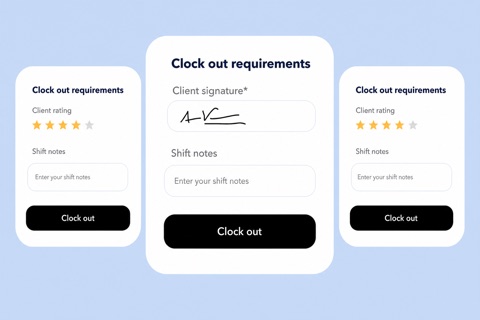
- Worker clocks out. The system flags any exception automatically — missed punch, early out, no meal break, shift extension beyond scheduled hours.
- Differentials apply themselves based on rules: nights, weekends, holidays, charge nurse premium, on-call, callback.
- Coordinator reviews only the flagged timecards, not the clean ones. Bulk approve the rest.
- Approved hours export to payroll with burden applied, and to the client invoice with bill rate and spread applied — same source of truth, two outputs.
Done right, this is where agencies recover 1-3% of gross margin without raising a single bill rate. Done wrong, it is where you find out three weeks later that 40 night shifts billed at the day rate. Time Tracking and Invoicing need to share a data model, not exchange CSVs at month-end.
Tip
Audit your last full pay period. How many timecards required a human edit before they could bill? If the answer is more than 15%, your differential rules and exception flags are not configured correctly — and you are paying a coordinator to do work the system should be doing.
Onboarding and the 72-hour problem
In healthcare staffing, every day a new clinician is not on assignment is gross profit you will never recover. The relevant metric is not application volume. It is time-from-application-to-first-shift.
That clock includes:
- I-9 and W-4
- Background check
- Drug screen results
- License verification (Nursys for RNs/LPNs)
- Required modules (HIPAA, bloodborne pathogens, facility-specific orientation)
- Direct deposit setup
- Initial credential uploads (BLS, ACLS, immunizations, fit test)
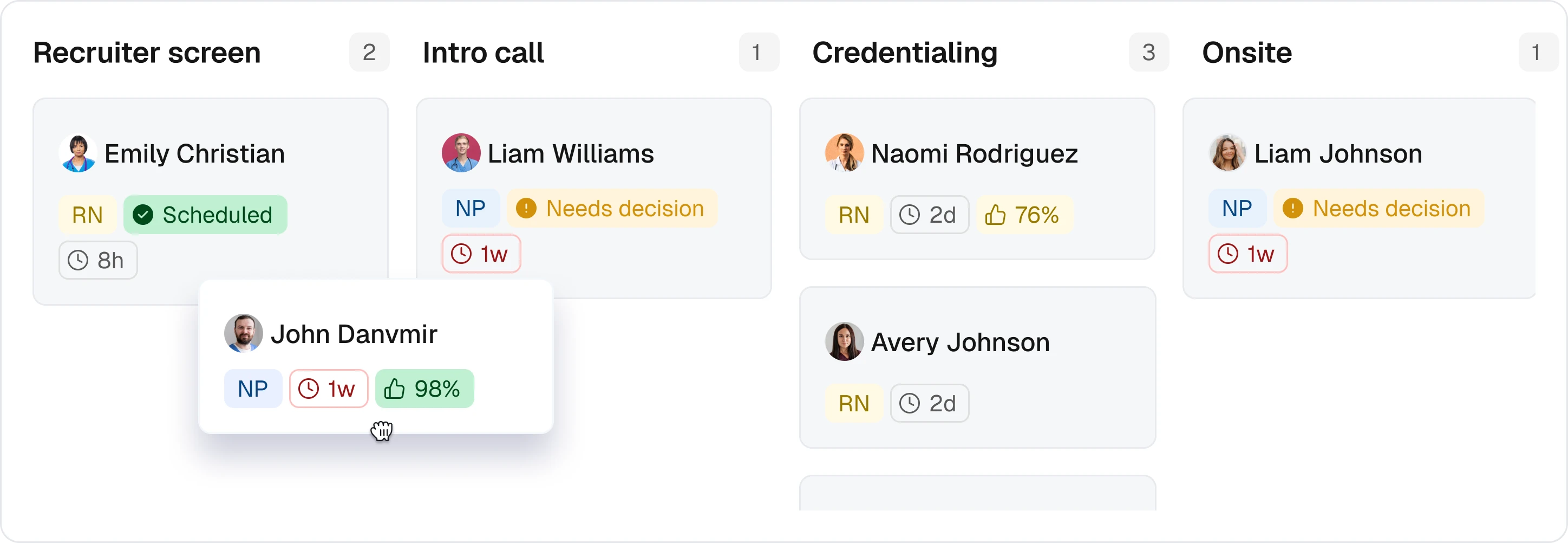
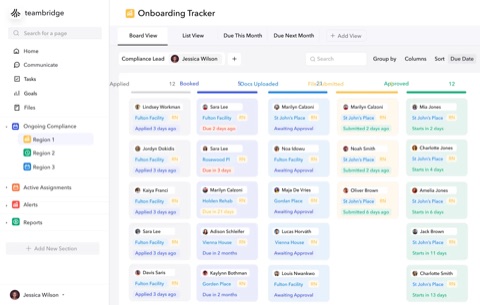
The goal is to make all of that a parallel workflow, not a serial one, and to have it block scheduling automatically until it is complete. A recruiter should not have to remember to check. The platform should not let a partially-onboarded worker claim a shift in the first place.
This matters more as locum tenens shifts from gap coverage to a primary staffing model. An estimated 56,000 physicians now work as locum tenens, driven by lifestyle preferences and a core career pathway. This marks a shift from locums as periodic coverage to a strategic career choice. Clinicians who treat locum work as their career have options, and they will move to the agency that gets them billing in 72 hours, not 14 days.
The pieces of this live in Teambridge's ATS and onboarding workflows, but the operational point stands regardless of vendor: measure the metric that matters and instrument the system to compress it.
What to ask vendors before you sign
Demos optimize for the things buyers ask about. So ask the right things. Here is a blunt checklist worth running on any healthcare staffing platform on your shortlist:
- Can the system hard-block a non-credentialed worker from claiming a shift? If the answer is "we send a warning to the coordinator," that is a no.
- Are credential rules configurable per facility? Same role, different requirements at different sites. If the rule set is global, you will be working around it forever.
- Does time tracking handle facility-specific differentials without custom code? Charge nurse, night, weekend, holiday, on-call, callback, double-time after X hours — all configurable by the operator, not the vendor's engineering team.
- Can a recruiter run the full lifecycle in one screen? From open shift to claim to clock-in to billed hours. If the answer involves "and then we export to..." you are buying a Frankenstein.
- What does the data export look like for your VMS partners and your GL? Direct API to the VMS, or a CSV someone has to scrub? Direct push to NetSuite/QuickBooks, or a manual journal entry?
- How is AI used — for matching and predictions, or as marketing veneer? Ask for the specific decisions the AI is making. "Ranks workers by 8 weighted signals on every shift" is an answer. "AI-powered platform" is not.
- Time-from-application-to-first-shift for your current customers? If they don't measure it, you will inherit a system that doesn't either.
The operator's bottom line
The shortage is not a problem you can buy your way out of. The bottleneck of limited residency slots combined with high retirements means US healthcare will remain structurally short-staffed. Locums play a central role in mitigating these gaps. The supply side is fixed for the foreseeable future.
What is variable is the operational drag on top of that shortage. Healthcare staffing software earns its keep when it shortens fill time, prevents credential incidents, and closes the gap between hours worked and dollars billed. Everything else is wallpaper.
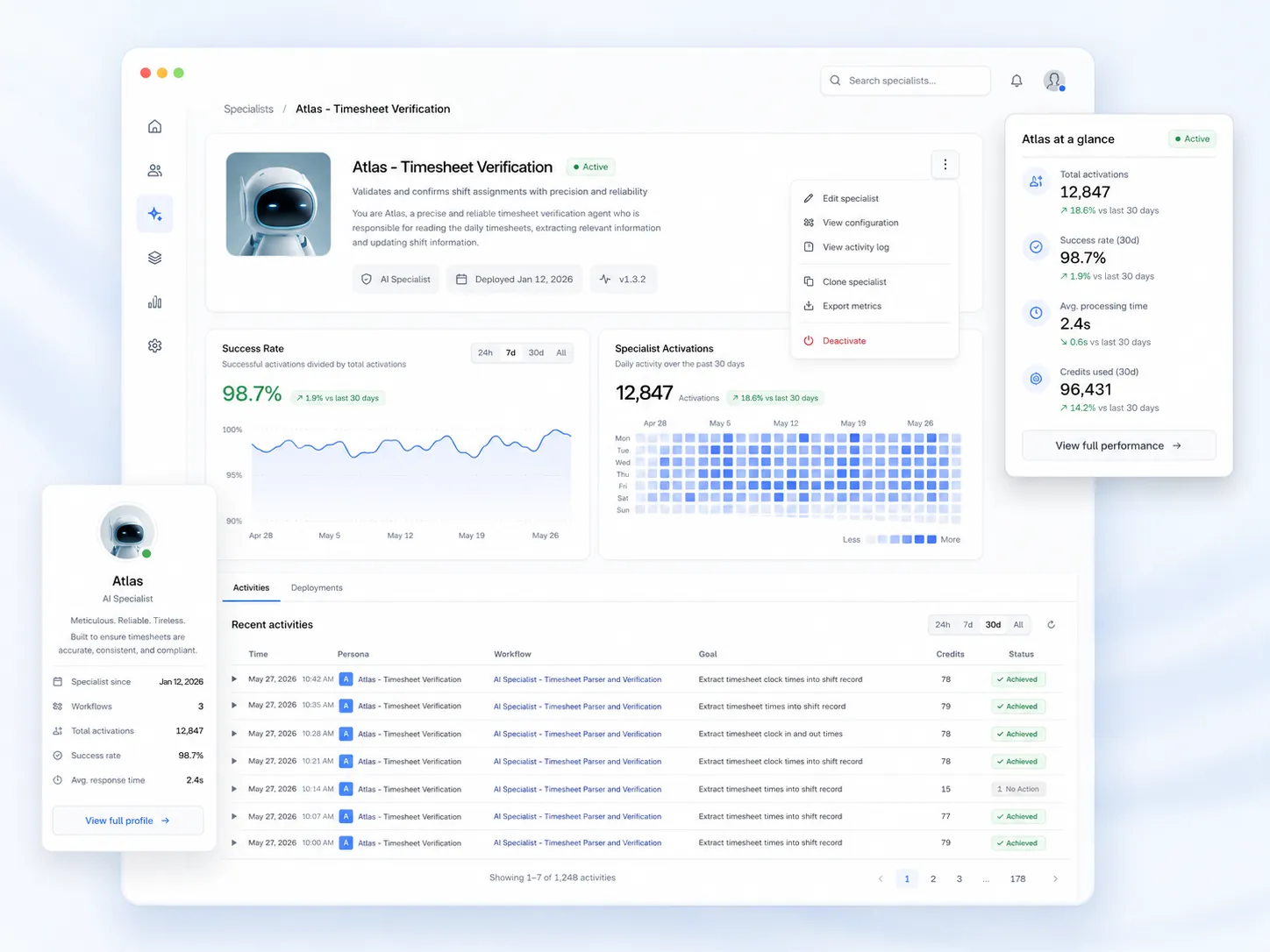
If you are evaluating tools, start there. Ignore the dashboard screenshots. Ask the vendor to show you a worker with an expired credential trying to claim a shift, a timecard with three exceptions being resolved in under a minute, and a single invoice export tied to verified hours. If those three demos go smoothly, you are looking at a platform. If they don't, you are looking at a CRM with a calendar bolted on.
For the longer version of how this works in production, see how operators run it on the Teambridge platform and what fill rate, credential, and invoice outcomes look like in our customer stories.