

That's the loop that quietly eats per-diem margin at healthcare staffing agencies. Not the bill rate. Not the markup. The two hours between confirmation and clock-in — where the facility has all the leverage, the clinician has all the expectation, and the agency has almost no data.
This piece is about instrumenting that window. Not renegotiating your MSA (though we'll cover that). Not blaming procurement. Building the operational infrastructure to make per diem cancellation fees actually billable, and to reposition a cancelled clinician onto another shift before payroll obligations kick in.
Why the 2-Hour Window Is Where Margin Dies
Per-diem staffing runs on a shorter clock than travel. A hospital calls at noon for a night shift. Your coordinator confirms a clinician by 4:00 PM. The shift starts at 7:00 PM. Somewhere in that final 120 minutes, the facility runs its next census check — and if the numbers move, so does your revenue.
This isn't a rare event. ShiftMed reports less than 10% of shifts picked up by nurses through its platform are canceled, while CareRev had a cancellation rate of 8%. On an agency doing 800 per-diem shifts a month, an 8% cancel rate is 64 shifts. If even half of those breach the fee window and go unbilled, you're writing off five figures a month in fee revenue alone — before you count the payroll guarantees you still have to pay.
The asymmetry is structural. "Standard" MSAs often shift financial risk to staffing agencies, and while you're focused on sourcing, screening, and placing talent, those "standard" agreements are quietly transferring risk, extending payment terms, and inserting language that can turn a profitable placement into a financial liability. Cancellation clauses are usually the softest part of the contract. They exist. They're rarely enforced.
Warning
If your ops team can't produce a timestamped facility confirmation for every cancelled shift in the last 90 days, your cancel fees are unbillable regardless of what your MSA says.
The Real Cost of a Cancelled Per-Diem Shift
Operators tend to price a cancel as "the bill rate we didn't collect." That's the wrong number. The real P&L hit stacks four ways.
1. The guaranteed-hour payout. If your worker policy pays a two- or four-hour minimum on late cancels — and most agencies with any retention discipline do — that's cash out the door with zero corresponding invoice.
2. Coordinator time. A senior scheduler spending 20-40 minutes rebooking a clinician, notifying the facility, updating the timesheet system, and re-forecasting the day is a real cost. At $35/hour fully loaded, that's another $10-20 per event.
3. Forecast distortion. Every cancel that gets logged as "completed" or "no-show" instead of "facility cancel" corrupts your fill-rate analytics and hides the client's real reliability.
4. Clinician churn. If your schedule is full, the math can look strong. If your shifts get canceled, seasonal demand slows, or your preferred units stop calling, your income changes immediately. When a nurse eats three cancels in a month with no compensation, they open a different app.
Here's what a single sub-2-hour cancel actually costs on a standard ICU per-diem shift. A per diem RN working a 12-hour shift will cost your facility approximately $65–$80/hr all-in, and agencies typically run a 22-30% margin on that bill rate.
| Line item | Amount |
|---|---|
| Lost bill rate (12 hrs × $75) | $900 |
| Guaranteed 4-hr payout to clinician | $180 |
| Coordinator rebooking time | $15 |
| Cancel fee not billed | $300 |
| Net margin hit per event | ~$495 |
| Shifts of completed margin needed to recover | 3–4 |
One unbilled sub-2-hour cancel wipes the profit from three to four completed shifts. That's the math your CFO doesn't see because it's buried across payroll, invoicing, and scheduler payroll.
Contract Language That Actually Holds Up Inside the 2-Hour Window
Most cancellation clauses fail one of two tests: they're not tiered, or they're not evidentiable. Fix both before you renegotiate anything else.
Tiered cancellation fees
A single "24-hour notice" cancel policy is useless for per-diem. Facilities never cancel 24 hours out — they cancel two hours out. You need three tiers on the rate sheet:
- >4 hours before start: no fee, shift released.
- 2–4 hours before start: 4-hour minimum billed at full bill rate.
- <2 hours or no-show cancel: full shift billed at full bill rate.
Guaranteed-minimum billing when the clinician is dispatched
Once your clinician clocks in — or arrives on-site and is turned away — the shift bills at a minimum of four hours regardless of whether the facility uses them. This is the single line that catches "cancelled-at-the-door" scenarios where census dropped between confirmation and arrival.
Census-triggered call-off caps
A quiet but powerful clause: no more than X call-offs per client, per month, before fee tiers step up. If a facility cancels more than 10% of its confirmed per-diem shifts in a month, tier-two fees convert to tier-one (full-shift billing) automatically.
Documented acknowledgment at confirmation
The clause enforceability question is not "is it in the contract." It's "can you prove the facility confirmed." You need a timestamped digital handshake — email, portal acceptance, or SMS confirmation — logged against the shift record. Without that artifact, a facility disputing a cancel fee wins.
Cancellation or early-termination terms, re-engagement fees, rate adjustments if the scope of work changes, and the process for billing disputes or timesheet discrepancies — every one of these needs to be spelled out in writing and, more importantly, systematically captured in your ops system.

Ready to move?
Ready to see Teambridge in action?
Instrumenting the Confirmation-to-Clock-In Window
This is the operational core. Contracts don't collect fees. Data does. Here's the audit trail every per-diem shift needs, captured automatically:
- Shift confirmation timestamp (when the facility accepted the clinician).
- Facility contact who confirmed (name, role, method — portal, SMS, email).
- Cancel timestamp (the moment the cancel notice was received).
- Reason code (census, patient discharge, staff return, no reason given).
- Unit and charge nurse on record for the cancelled shift.
- Time delta between confirmation and cancel (this is your billing tier).
- Clinician dispatch status (accepted, en route, on-site).
If any of those fields are captured on paper, in email, or in a scheduler's head, you can't bill for them at scale. The whole point is that the moment a facility hits "cancel" in your portal — or sends a cancel text your system parses — the cancel fee line item auto-generates on the next invoice, tied to the tier the timestamp puts it in.
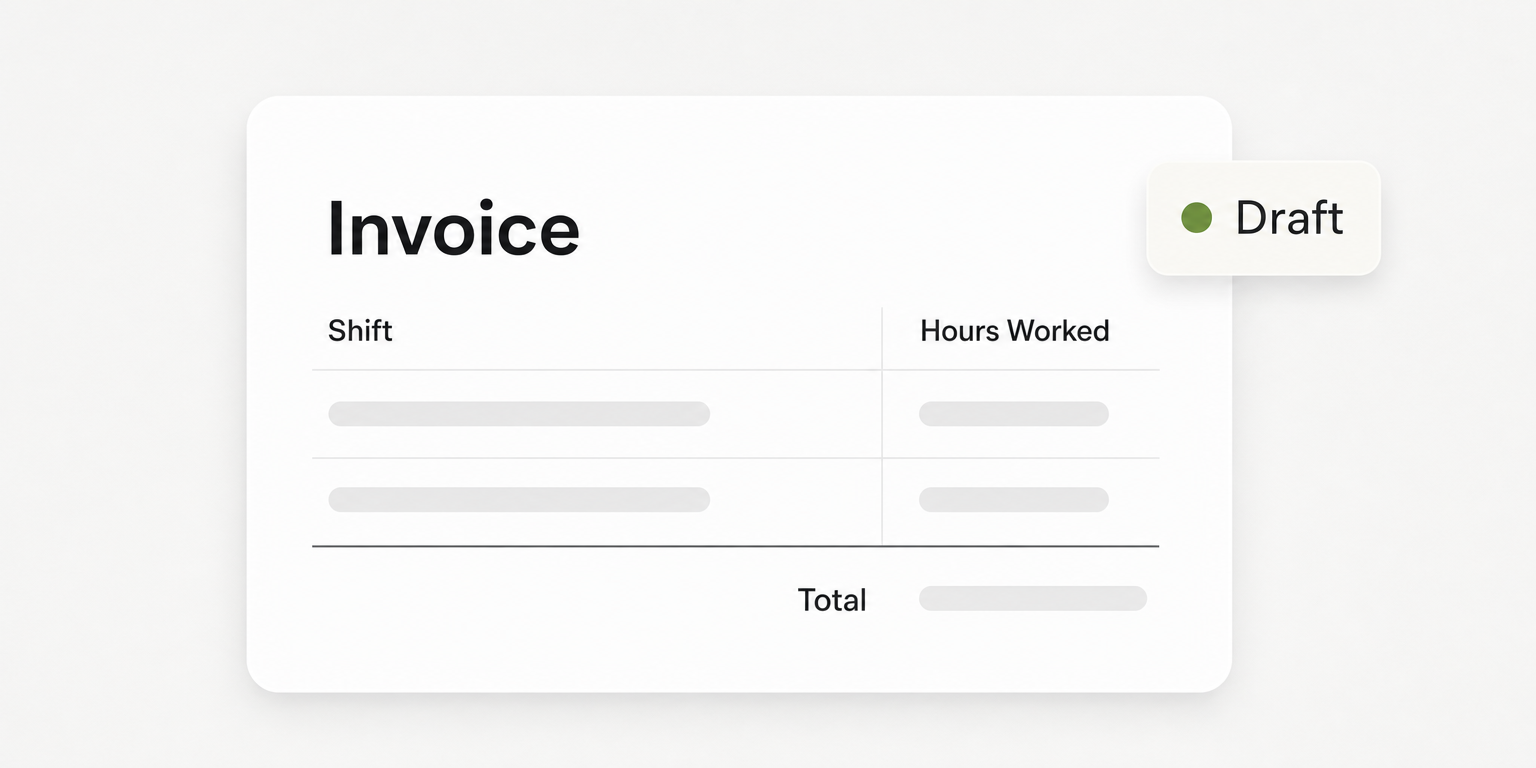
That requires the scheduling system, the time-tracking system, and the invoicing system to be the same system. Bolted-together stacks lose the artifact somewhere between the coordinator's inbox and the billing spreadsheet. This is why Teambridge's scheduling module enforces a confirmation handshake with a timestamp, and invoicing reads directly off the same shift record — the cancel fee is a queryable event, not a manual line item a scheduler has to remember to add.
Tip
Run the 90-day audit before you touch the MSA. Pull every cancelled per-diem shift from the last quarter, tag which ones would have qualified for a fee under your existing contract, and see how many were actually invoiced. The gap is your baseline.
The confirmation handshake, in practice
Two to four hours before shift start, the system auto-sends a re-confirmation prompt to the designated facility contact — "Confirming [Clinician Name] for [Unit] at [Time]. Reply Y to confirm." The reply, or portal click, gets logged with a timestamp. Now every party has an auditable record of when the shift was locked in.
If the cancel comes after that lock, the fee tier is deterministic. No coordinator judgment, no client argument about whether the shift was "really confirmed."
Rebooking Fast Enough to Turn a Cancel Into a Repositioned Shift
The best cancel fee is the one you don't need to charge because you moved the clinician to another billable shift. That preserves the client relationship, honors the clinician's guarantee, and keeps the day's revenue whole.
Repositioning inside the 2-hour window requires four things running in parallel:
- Real-time visibility into open orders across every client facility, not just the one that cancelled.
- Automatic credential match — is the clinician's license, ACLS, unit-specific competency, and facility-specific onboarding valid for the alternative shift?
- Drive-time filter — the replacement shift has to be reachable before its own confirmation window closes.
- One-tap offer to the clinician's phone — no phone tree, no "let me call around," just an accept/decline on the worker app.
This is where modern per-diem platforms have pulled ahead. Per diem roles are becoming increasingly popular with nurses looking to have more power over their schedules and for employers looking to save on labor costs — and the platforms winning that market are the ones that treat rebooking as an automated event, not a phone-call scramble.
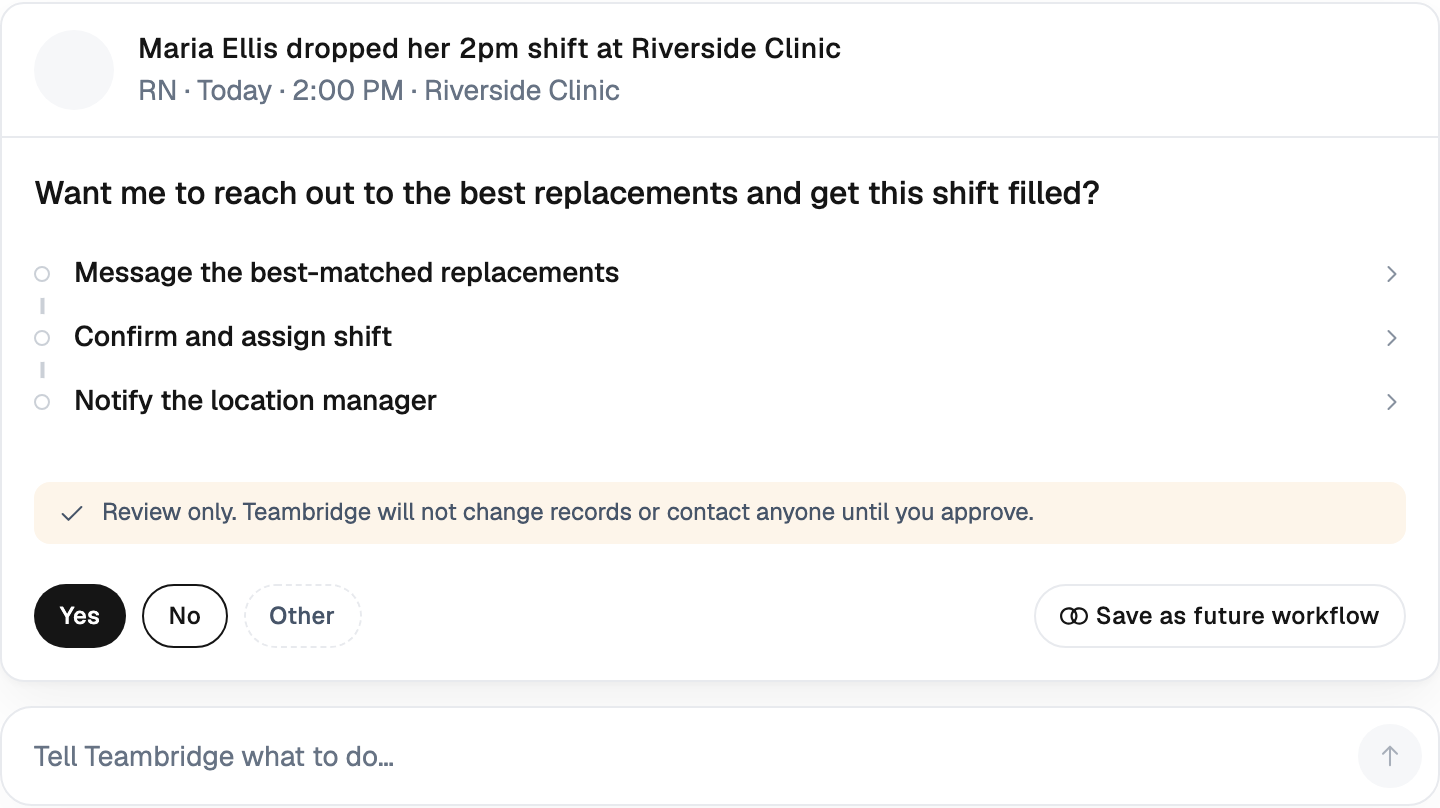
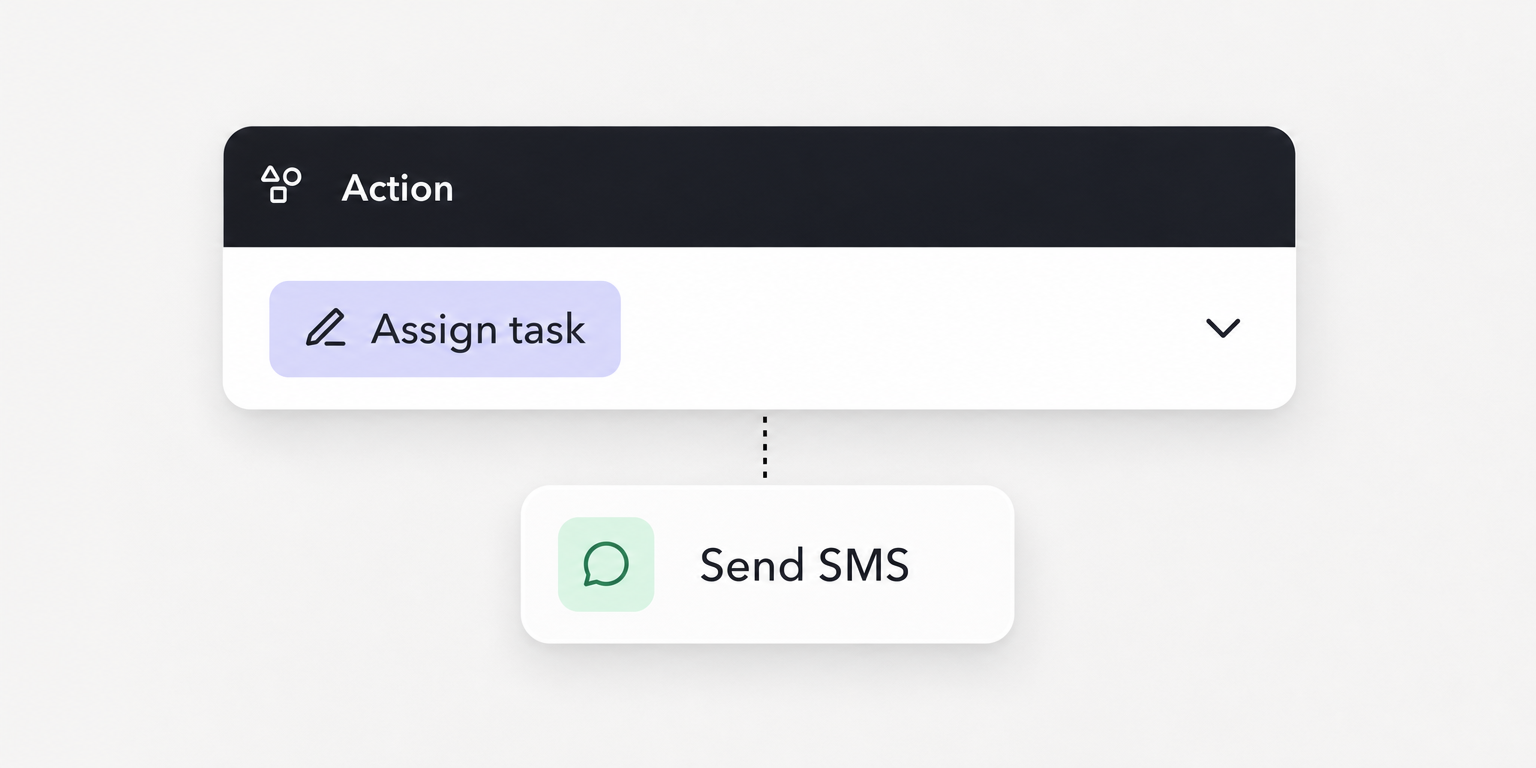
A well-instrumented ops system turns a cancel into three parallel actions in the same 30 seconds: (1) generate the cancel fee line item, (2) query open reqs matching the clinician's credentials and location, (3) push the top match to the clinician's phone with a countdown to accept. If the clinician accepts, you bill both shifts (the cancel fee and the repositioned shift). If they decline, you still have the fee.

Client Scorecarding: Making Chronic Late-Cancellers Pay or Go
Once the data pipeline exists, the second-order play is client segmentation. Not every facility cancels at the same rate, and not every cancel comes from the same unit. The data tells you where to lean in and where to walk away.
Build a monthly scorecard segmenting by:
- Cancel rate by facility (total cancels / total confirmed).
- Cancel rate by unit within facility (ICU vs. med-surg vs. ED).
- Cancel rate by charge nurse or scheduling manager.
- Cancel rate by day-of-week and shift-type (nights are usually worse).
- Fee-collection rate by facility (did the invoiced fees get paid?).
Segment clients into three tiers:
| Tier | Definition | Action |
|---|---|---|
| Green | <5% cancel rate, fees paid on time | Prioritize premium clinician availability |
| Yellow | 5–12% cancel rate, fees mostly collected | Formal review, tier-two fee enforcement |
| Red | >12% cancel rate, or disputes >30% of cancels | Deprioritize, raise bill rate, or exit |
The operator move is to steer your best clinicians toward green-tier clients. Your "favorites" list — the ICU nurses who pick up on 90 minutes' notice — should never be dispatched to a red-tier facility. Let the red-tier facilities eat the fill-rate consequences of their own behavior, or let them pay a reliability premium.
This is also how you avoid the concentration trap: termination-for-convenience language increases revenue volatility, and one big red-tier client with a 15% cancel rate and net-90 terms can crater a quarter. Diversifying across green-tier clients is a margin play, not just a risk play. See how other agencies structure this in the Teambridge customer stories.
Protecting the Clinician Relationship When the Facility Cancels
Here's the retention lever most agencies miss. When a facility cancels a shift, the clinician's next decision is not "do I work for this agency again." It's "which app do I open tomorrow morning to pick up a shift." Per diem roles are becoming increasingly popular with nurses looking to have more power over their schedules, and that power extends to which platform they use.
Three moves that hold clinicians:
Pay the guarantee, transparently
If your policy is a 4-hour minimum on sub-2-hour cancels, pay it same-day or next-day. Don't make the clinician chase it. Show the payment on their app the same day the cancel happens, tagged clearly as "facility cancellation guarantee." Same-day pay on cancel guarantees is a retention differentiator, not a nice-to-have.
Priority booking for cancelled workers
A clinician whose shift got cancelled today gets first offer on tomorrow's premium open reqs. Bake this into the auto-dispatch logic so it's not a coordinator favor — it's a system rule.
Communicate the cancel reason
Send the clinician the actual reason: "Census dropped from 24 to 18 on 5 South." Not "shift no longer needed." Clinicians who understand the operational reality accept the volatility. Clinicians who get vague notices assume the agency is disorganized.
The single biggest killer of per-diem programs isn't pay rate — it's cancellation experience. Fix the experience and the retention math gets easier than the recruiting math.
What to Build, Buy, or Renegotiate This Quarter
Here's the four-step operator playbook for the next 90 days.
1. Audit the last 90 days of cancels. Pull every cancelled per-diem shift. Tag each one with (a) time-to-start when the cancel came in, (b) whether it would have qualified for a fee under your current MSA, and (c) whether the fee was actually invoiced. The delta between (b) and (c) is the revenue you're leaving on the table right now with no contract changes required. Most agencies find $50-200K annually in this audit alone.
2. Rewrite the confirmation workflow. Every shift confirmed by a facility must generate a timestamped artifact that lives inside your ops system, not in email. Two-to-four-hour re-confirmation prompts, logged responses, cancel timestamps auto-captured. This is the infrastructure that makes step three enforceable.
3. Push tiered cancellation language into MSA renewals. Not into new MSAs — into renewals of your top 20 clients by volume. Bring the 90-day audit data with you. "You cancelled 47 confirmed shifts inside the two-hour window last quarter. Under our updated rate sheet, those events carry a tiered fee." That conversation is different from a cold contract negotiation.
4. Instrument rebooking inside the 2-hour window. Real-time open-req visibility, credential-matched auto-dispatch, one-tap clinician offers. This is the difference between a cancel being a 100% margin loss and a cancel being a repositioned shift plus a fee.
Agencies that run all four steps consistently see cancel-driven margin erosion drop by half within two quarters. Not because they renegotiated better contracts — because they built the data infrastructure that makes existing contracts enforceable and existing clinician relationships defensible.
Operators who want to see how the full loop runs inside a single system can look at how Teambridge handles healthcare staffing end-to-end, from shift confirmation to cancel-fee invoicing to clinician retention pay. The 2-hour window doesn't fix itself. It gets instrumented, or it keeps eating your margin.

About the author

Content Writer at Teambridge
Anis Nanai is a content writer at Teambridge, with a focus on workforce management and the realities of running hourly teams. He prioritizes conversations with customers, staying close to the market, and understanding how workforce needs are changing. His writing connects those concerns to practical decisions about scheduling, time tracking, staffing, and automation. He examines product developments through the questions that matter to operators: what does this solve, how would it work for my team, and what evidence supports it?
Company perspective: this author works at Teambridge. Customer outcomes are attributed to their published sources.
View LinkedIn profile