Symplr started as a credentialing and GRC suite and bolted workforce management on through acquisition. That stitched-together footprint is showing its age — and the recent Smart Square deal made the picture even messier for buyers. If you run scheduling, credentialing, or labor analytics for a hospital, health system, or healthcare staffing agency, you have probably sat through a Symplr renewal conversation and wondered whether to wait it out or shop.
This is a working operator's guide to the alternatives. No vendor scorecards, no AI buzzwords without substance. Just where each competitor actually fits, where it breaks, and how to decide.
Why Healthcare Ops Teams Are Shopping Symplr Alternatives
The complaints are consistent across review sites. Symplr Workforce is very complex for new users, especially when navigating the different modules, and some features are not as intuitive as they could be, which means there can be a learning curve when getting started. Some users find the interface to be clunky and outdated, leading to a steeper learning curve. Reports are another sore spot — some of the reports are tricky to pull up and cumbersome to read.
Then there is the market-level signal. In July 2025, software company symplr picked up AMN Healthcare's Smart Square AI-based scheduling software in a $75 million deal as it builds out its healthcare workforce capabilities. The structure of the transaction is worth reading carefully — the total purchase price was $75 million with $65 million paid at closing and a $10 million note due at the end of 2026, and AMN said it also entered into a partnership with symplr to ensure customers can have both symplr's operational technology and AMN's healthcare workforce solutions.
Translation: the workforce side of Symplr is being rebuilt mid-flight. Two scheduling engines (legacy Symplr Workforce plus Smart Square) now live under one roof, and Symplr's CEO has openly stated the goal is to integrate Smart Square's engine into the broader Symplr Operations Platform (Fierce Healthcare). Operators have a right to ask what gets sunset, what gets re-platformed, and who is paying for the migration.
If you are shopping now, the buyer's criteria most ops teams converge on look like this:
- Credential enforcement at the point of scheduling — not after the fact
- Mobile-first frontline UX that nurses and per-diem clinicians will actually use
- Real-time shift fill with rules that understand float pools and agency workers
- Reporting that finance will sign off on without exporting to a spreadsheet
- Configurability without a six-month implementation
What Symplr Actually Does (And Where the Gaps Show Up)
Symplr is a healthcare-only suite organized around four pillars: provider data management, workforce management, talent management, and governance, risk, and compliance. Symplr currently offers one of the most comprehensive people management systems for all roles in healthcare, including provider credentialing, provider directory, physician scheduling, timekeeping, clinical communication, and quality management solutions.
The credentialing piece — Symplr Provider, the former Cactus product — is genuinely strong. The workforce piece is where the seams show. Symplr Workforce is a comprehensive workforce management solution tailored for the healthcare sector, offering integrated timekeeping, scheduling, and workforce analytics to enhance collaboration and manage productivity, and aims to combat the inefficiencies of disconnected systems. The ambition is right. The execution lags.
Note
Symplr's Time and Attendance has won Best in KLAS for timekeeping for over two decades. Where it struggles is scheduling, mobile UX, and cross-module navigation — not pay rules.

The common gap pattern: credentialing data lives in one module, scheduling lives in another, time lives in a third, and operators end up reconciling exceptions by hand. That is the gap every competitor below is targeting.
QGenda: Best for Provider-Heavy Specialty Scheduling
QGenda is the strongest pure alternative for physician and provider scheduling — anesthesia, ED, radiology, hospitalist, on-call. It combines physician scheduling, credentialing management, time and attendance tracking, and workforce analytics into a single system rather than requiring separate tools for each function, and the platform launched in 2006 with a specific focus on physician scheduling — a problem that generic scheduling tools have historically handled poorly.
The credentialing integration is genuinely native, not a partner integration. As part of ProviderCloud, QGenda Credentialing is connected to QGenda Advanced Scheduling, creating a single database for up-to-date standardized provider data across the enterprise, and QGenda offers the only enterprise software to deliver credentialing and scheduling in a central platform.
Where it fits best: large systems managing hundreds of physicians across multiple departments and locations benefit most from centralised scheduling, rules-based automation, and integrated credentialling, academic medical centres appreciate the ability to handle resident rotations, teaching schedules, and duty hour compliance within the same platform that manages attending physician schedules, and practices operating across multiple locations with 20 or more physicians find QGenda's centralised visibility useful.
The trade-offs are real. Some users have reported that QGenda's auto-generated schedules leave coverage gaps that require manual oversight and correction, and other long-time users have noted that, as the company has grown, its customer service model has shifted to a pooled approach that no longer emphasizes dedicated resources for each account, which requires customers to enter a general support queue when they need help. QGenda is also weak when you need to schedule the rest of the hospital — CNAs, techs, environmental services, per-diem float pools. If your workforce is 80% non-provider, this is the wrong tool.
Smart Square (now under Symplr) and the AMN Partnership Question
This is the section most buyers get wrong. "Smart Square vs Symplr" is no longer a real comparison — it is a migration story.
In July 2025, symplr, backed by Clearlake Capital and Charlesbank, acquired the Smart Square scheduling software from AMN Healthcare, and the acquisition strengthens symplr's position in healthcare workforce and operations management and further bolsters the symplr Operations Platform. Smart Square was a credible product on its own — Smart Square was also awarded 2025 Best in KLAS for Scheduling: Nurse & Staff.
AMN didn't fully walk away. Symplr and AMN entered into a commercial partnership that ensures customers get the best of both worlds: symplr's excellence in operational technology and AMN's leadership in healthcare workforce solutions. Practically, that means AMN keeps WorkWise — advisory, planning, analytics — and Symplr owns the scheduling software. According to Symplr's CEO BJ Schaknowski, a critical way for hospitals and health systems to unlock greater value from their technology is to arm them with intelligent, purpose-built solutions, and bringing Smart Square's AI-driven scheduling engine into the symplr Operations Platform helps us stay ahead of the emerging and dynamic needs of the healthcare workforce.
If you are a current Smart Square customer, you are now a Symplr customer. The questions to ask are about roadmap clarity, support continuity, and which engine survives long-term.
Ready to move?
Ready to see Teambridge in action?
CredentialStream, MedTrainer, and the Credentialing-Only Crowd
If the pain you are solving is purely provider data management — not scheduling, not timekeeping — these are the names that come up.
CredentialStream (HealthStream / Verisys)
CredentialStream is a credentialing platform from HealthStream designed primarily for hospitals and larger health systems with formal medical staff offices and established EHR systems, handles the full provider lifecycle within a single system, including application intake, primary source verification, reappointment, privileging, and provider enrollment, and everything sits under a single connected provider record, making it easier for teams to track status, manage approvals, and keep provider data organized. For health systems that need credentialing data to flow into platforms like Epic and other operational systems, CredentialStream can be a strong fit, and that helps reduce duplicate data entry and keeps provider information more consistent across teams.
MedTrainer
MedTrainer is a healthcare workforce compliance platform that combines credentialing, compliance training, policy management, and incident reporting in a single natively built system, and if you need credentialing software alongside compliance training and workforce education — ambulatory surgery centers, community health centers — the combined platform reduces the number of vendor relationships and creates data continuity between credentialing status and compliance requirements. Reviewer sentiment leans positive: when assessing the two solutions, reviewers found MedTrainer easier to use, set up, and administer, and reviewers also preferred doing business with MedTrainer overall.
Assured
Assured is a modern provider credentialing and compliance platform built to help healthcare organizations automate and scale their onboarding workflows, and focuses on reducing the manual burden of credentialing by centralizing data collection, verification, and monitoring into a single streamlined system.
The trade-off across this group is identical: none of them schedule a shift. None of them clock you in. If your team needs credentialing and workforce ops, you will still buy a second system.
Horizontal Workforce Platforms: Dayforce, UKG, Workday, ADP
Every Symplr Workforce RFP eventually pulls in the enterprise HCM suites. Dayforce (formerly Ceridian), UKG, Workday, and ADP are strong on payroll, core HR, and general time and attendance. They are built for a generic workforce.
Where they break for healthcare:
- Credential enforcement is typically a custom field, not a scheduling gate
- Per-diem and agency float pool logic requires heavy customization
- Nurse-specific rules — self-scheduling, ratios, ANA-compliant rest periods — get bolted on
- Mobile UX is built for desk-adjacent employees, not clinicians on the floor
They can work for hospital systems that want a single HCM of record and are willing to integrate credentialing separately (CredentialStream or Symplr Provider on the side). They are a poor fit for healthcare staffing agencies, per-diem-heavy operations, or any environment where most of the workforce is contingent.
Quick comparison: where each Symplr competitor fits
| Competitor | Best for | Credentialing | Scheduling | Mobile frontline UX | Per-diem / agency fit |
|---|---|---|---|---|---|
| Symplr (current) | Credentialing-led health systems | Strong | Mid (in flux) | Weak | Weak |
| QGenda | Provider-heavy specialty groups | Strong | Strong (provider) | Mid | Weak |
| Smart Square (now Symplr) | Acute nurse scheduling | Via Symplr Provider | Strong | Mid | Weak |
| CredentialStream | Hospital medical staff offices | Strong | None | N/A | N/A |
| MedTrainer | ASCs, CHCs, multi-site clinics | Strong | None | N/A | N/A |
| Dayforce / UKG / Workday | Hospital systems with one HCM mandate | Add-on | Mid | Mid | Weak |
| Teambridge | Staffing agencies, per-diem, multi-site | Enforced at booking | Strong | Strong | Strong |
Teambridge: Configurable Workforce Ops for Healthcare Staffing and Per-Diem
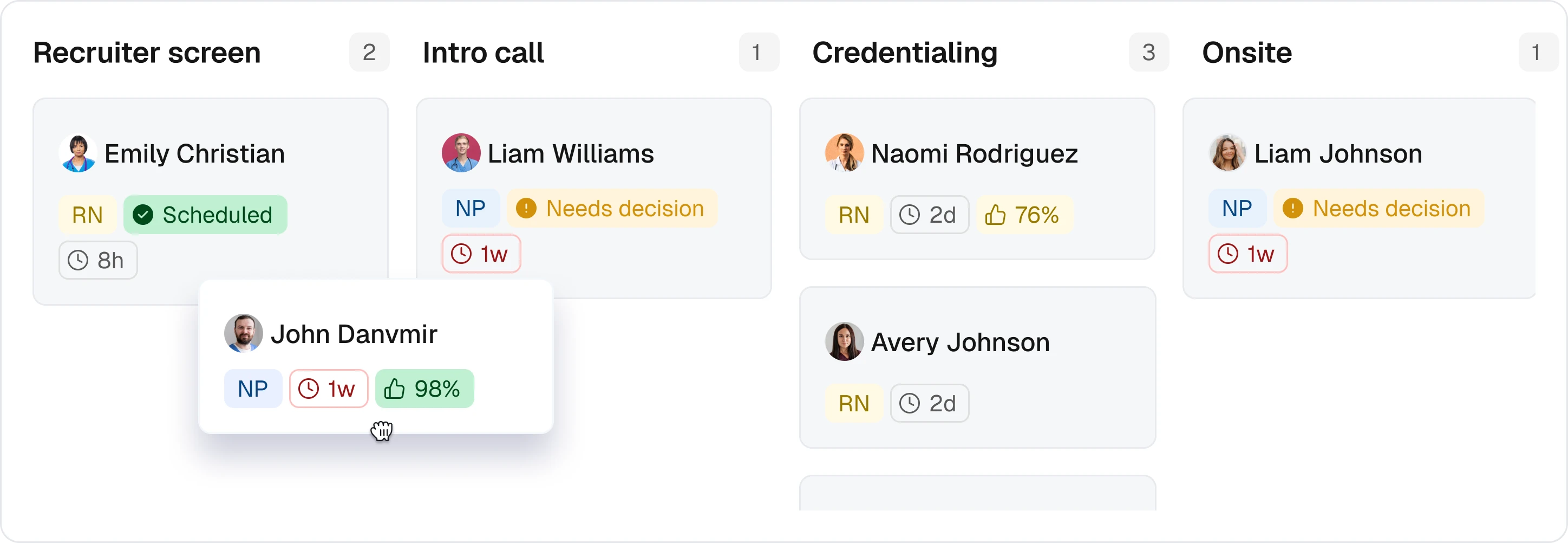
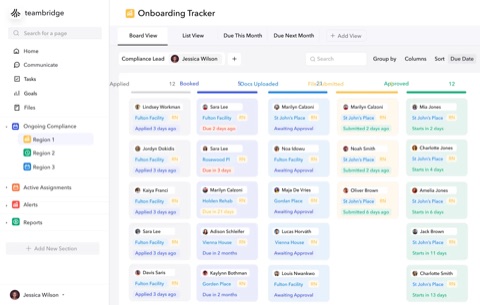
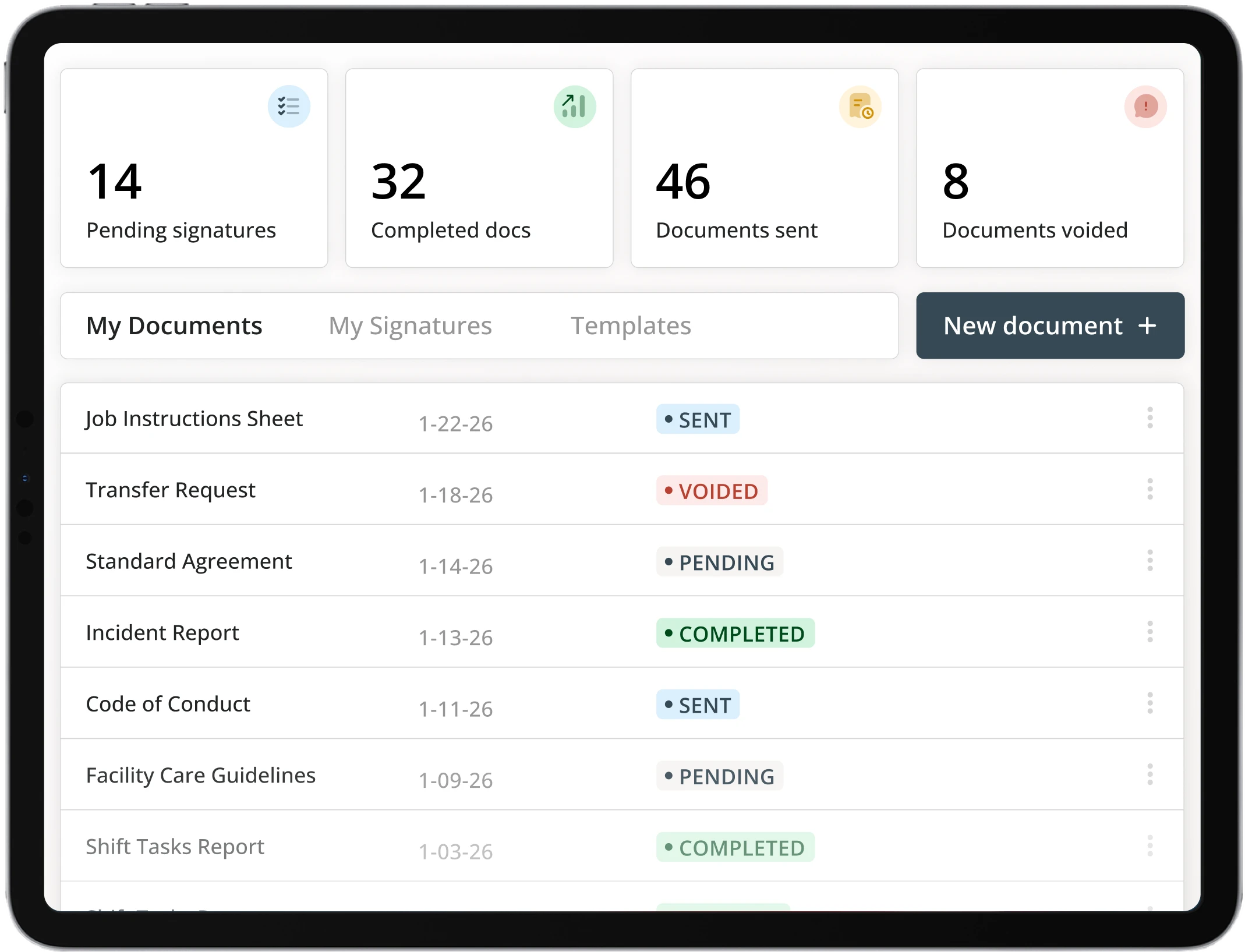
Teambridge is built for healthcare operators who need scheduling, credential tracking, time, pay, and communication in one configurable system — not a stitched-together suite of acquired modules. The Teambridge Platform puts those functions in a single data model, so a credential expiry blocks a shift at the moment of booking instead of generating an exception report after the fact.
Where it fits:
- Healthcare staffing agencies and MSPs filling per-diem and travel roles
- Hospital float pools and IRP (internal resource pool) programs
- Multi-site post-acute, home health, and behavioral health operators
- Anyone whose workforce model doesn't map cleanly to a W-2-only HCM
Concrete differentiators worth flagging:
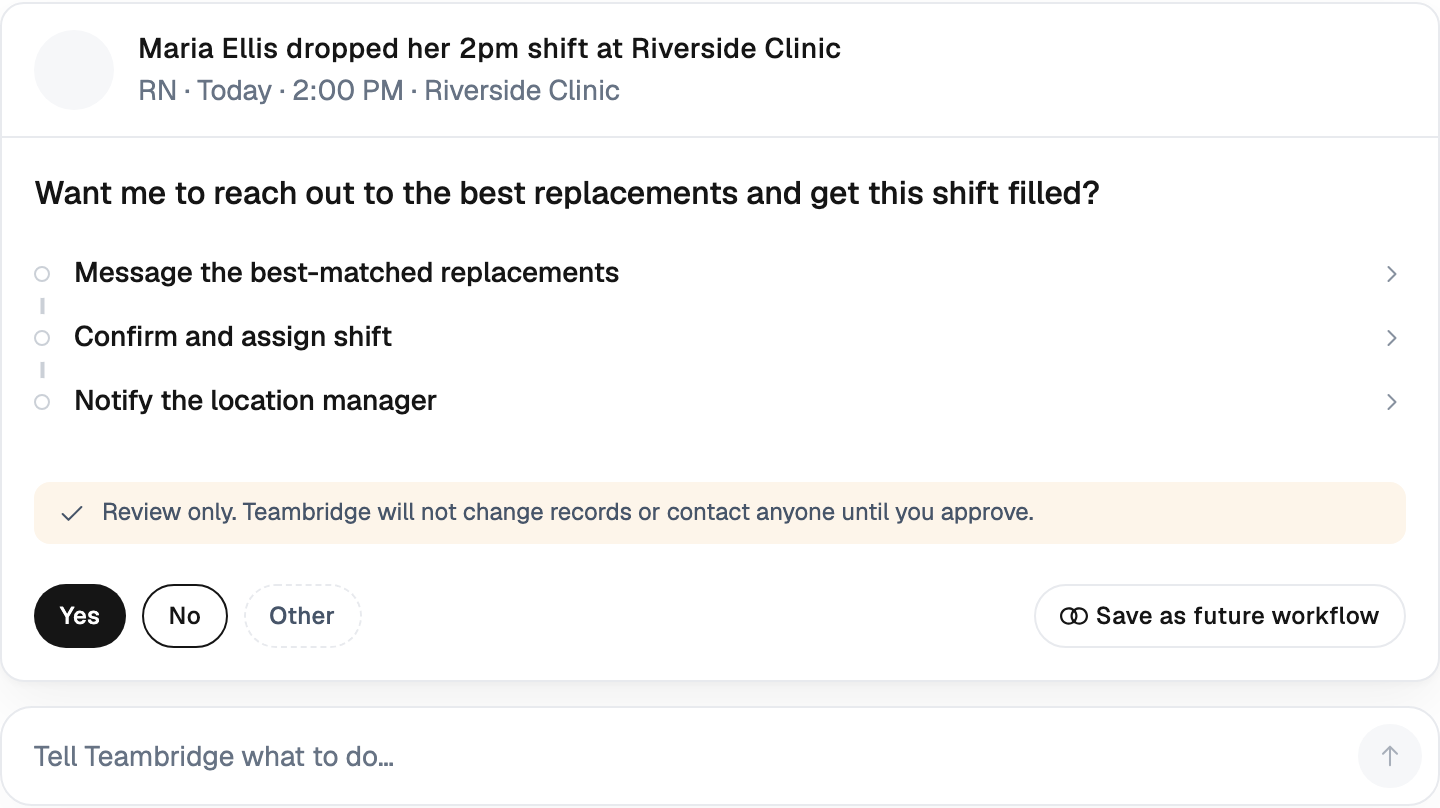
- Credential expiry blocks shifts at booking. Not a notification. Not a flag. The system will not let an expired license get assigned to a shift.
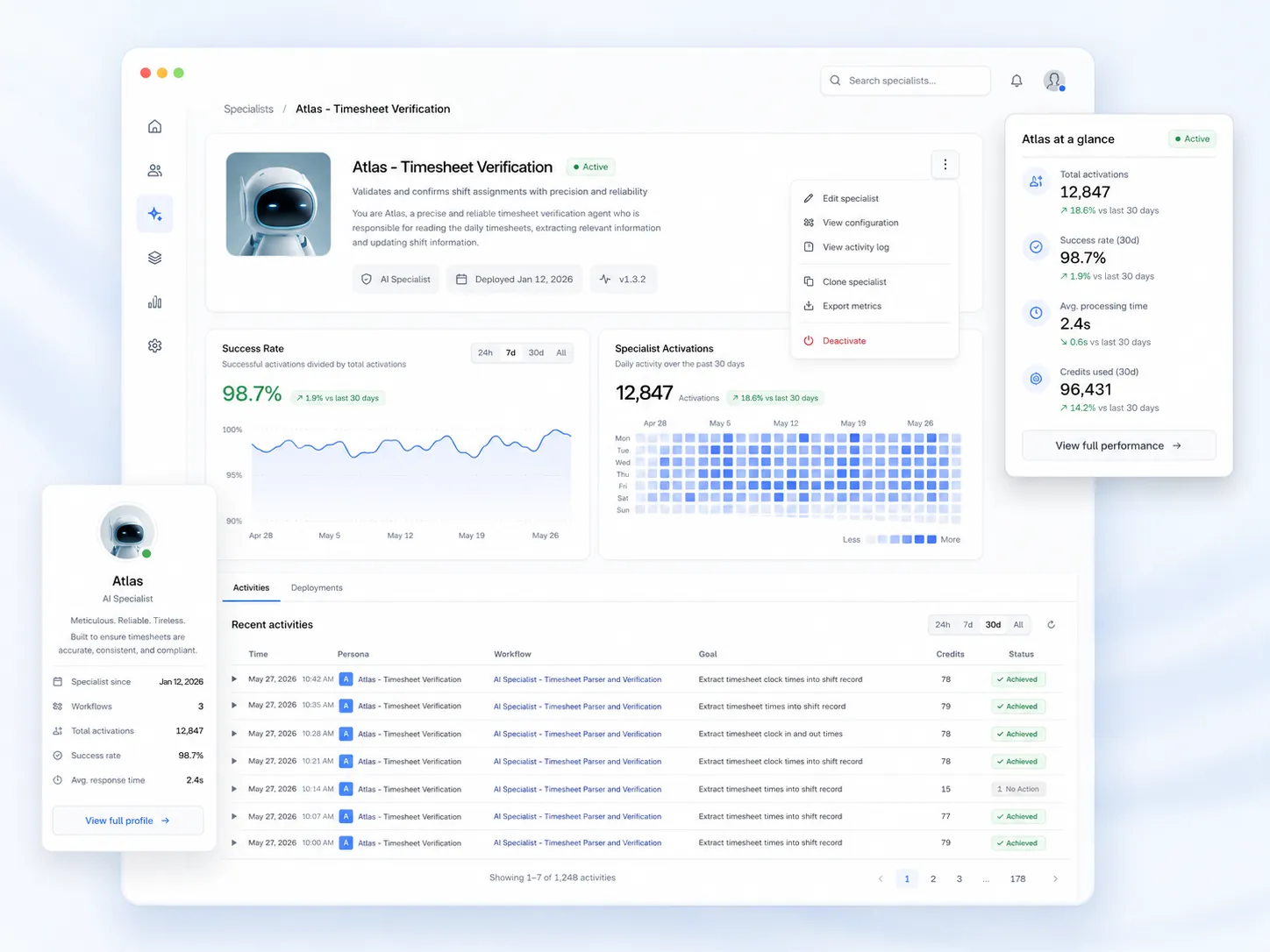
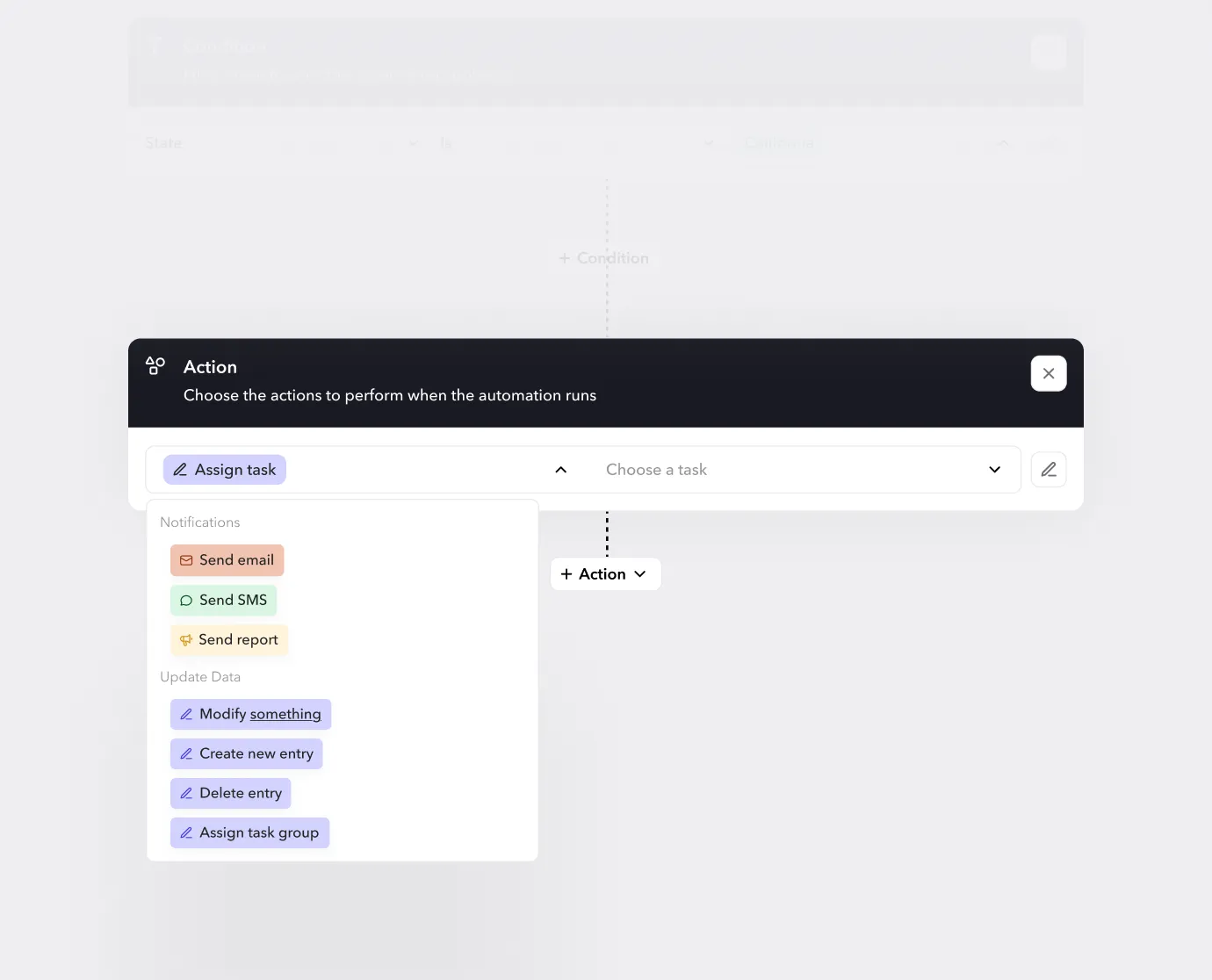
- No-code automations for renewal cycles. Teambridge Automations lets ops teams build the renewal reminder workflow once and run it forever — 90/60/30/7-day cascades, escalations to managers, auto-unassigns when a credential lapses mid-cycle.
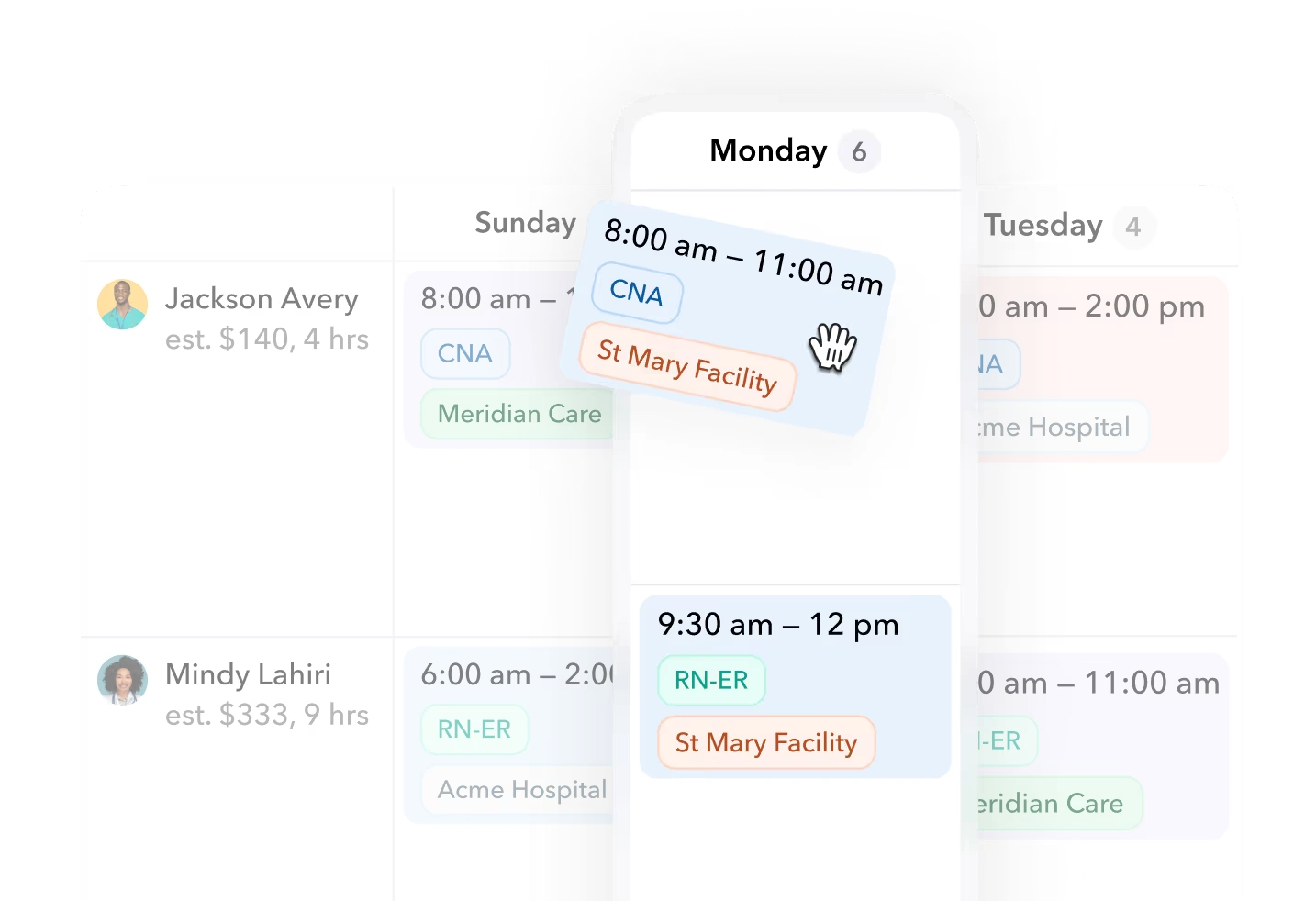
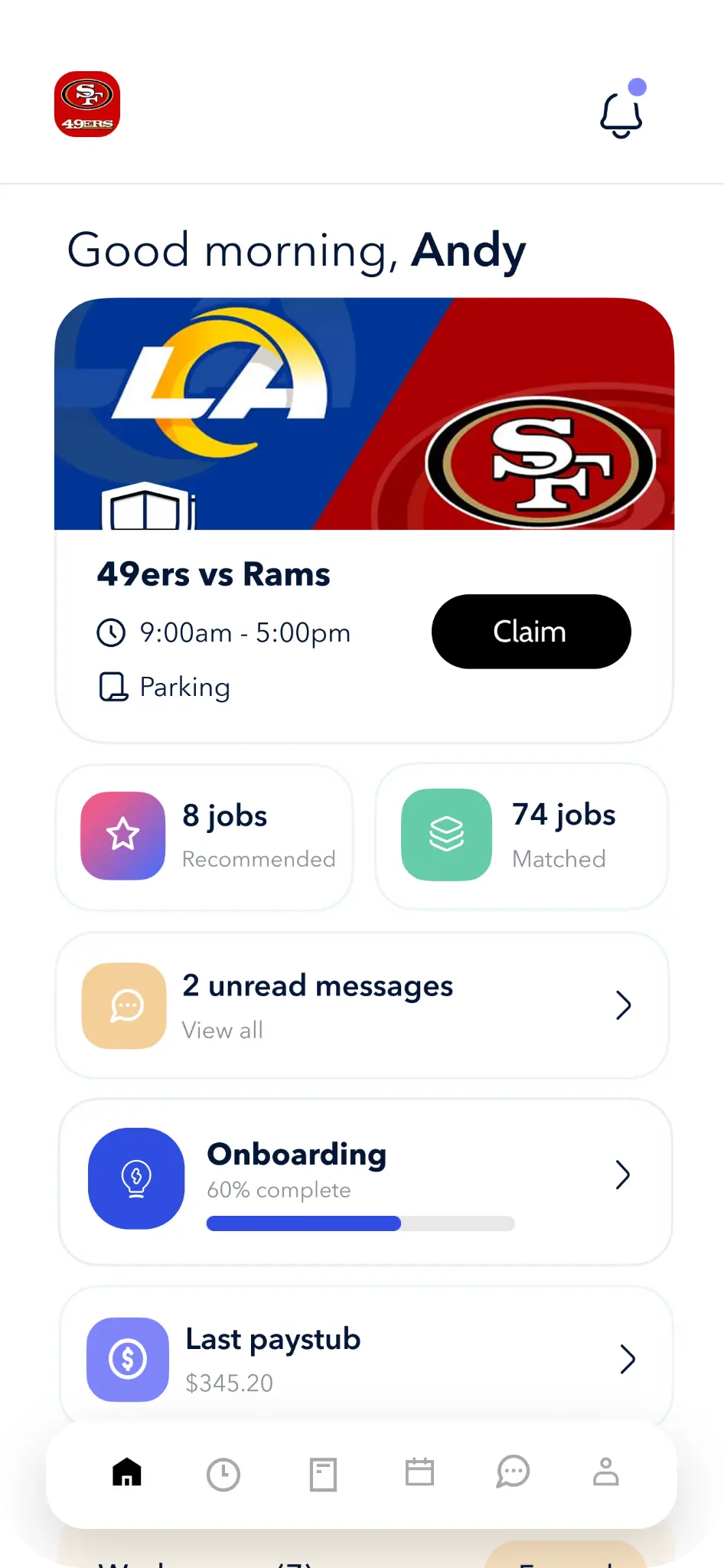
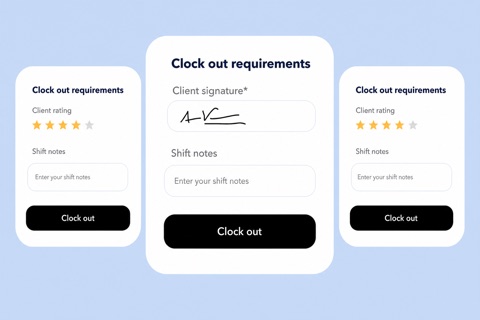
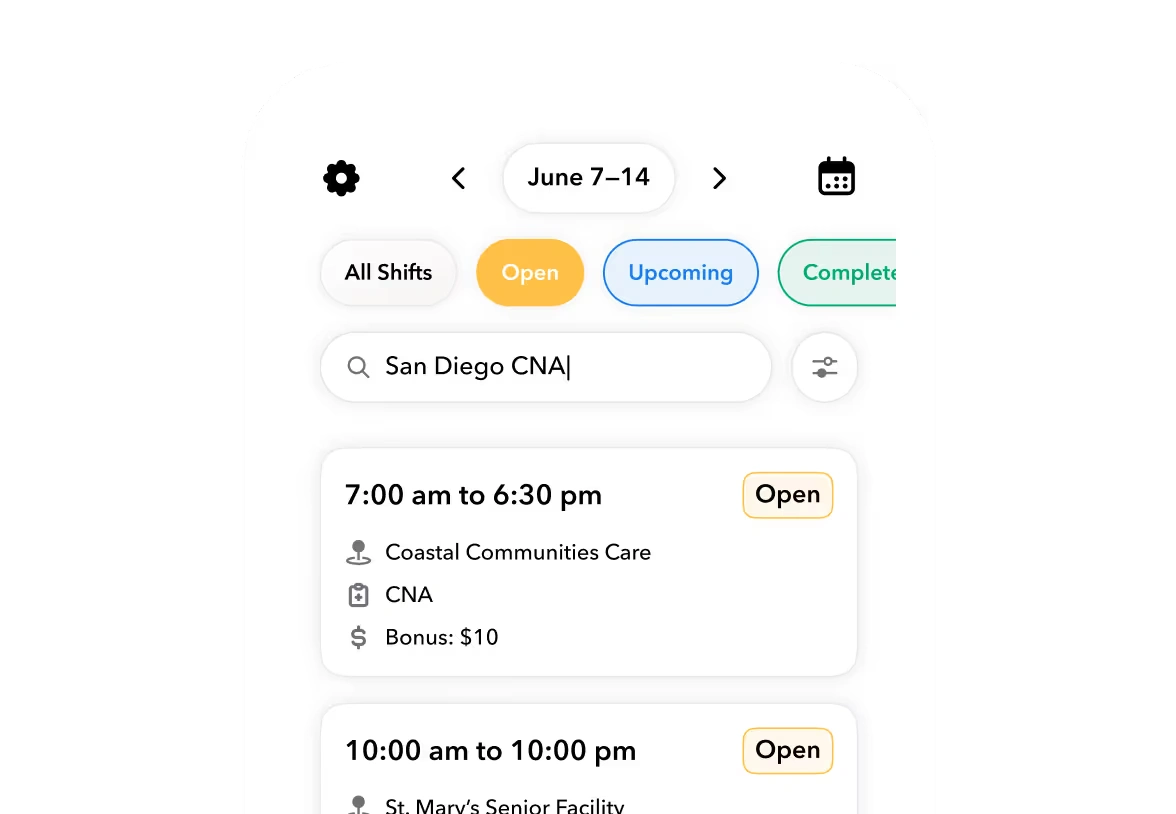
- Mobile-first frontline UX. Nurses, CNAs, allied health staff pick up shifts, swap, and clock in from one app. No desktop fallback required.
- AI-driven scheduling that understands healthcare. Teambridge Scheduling auto-fills gaps, enforces credentials, and predicts no-shows for staffing agencies and healthcare operators.
- Configurable, not custom. Pay rules, shift differentials, and credential types are configured by your team, not waiting on a quarterly product release.
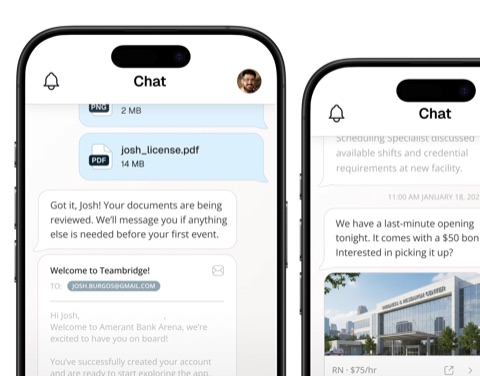
For a fuller picture of how this maps to healthcare staffing — nursing, allied health, per-diem, DEA licenses, shift differentials — see Teambridge for Healthcare. For real-world deployments, customer stories document how staffing agencies and healthcare systems have replaced multi-vendor stacks.
How to Choose: A Decision Framework for Replacing Symplr
The shortlist depends on five questions. Answer them honestly before you book a single demo.
1. Is your core pain credentialing, scheduling, or both?
- Credentialing only → CredentialStream, MedTrainer, Assured, Symplr Provider
- Scheduling only → QGenda (provider) or Teambridge (full workforce)
- Both, tightly enforced → QGenda for provider-heavy; Teambridge for staffing and per-diem
2. Provider-only or full clinical + non-clinical workforce?
If you are scheduling only physicians and APPs, QGenda has the depth. If you need to schedule the nurses, techs, CNAs, schedulers, environmental services, dietary, and a per-diem pool — QGenda gets thin and Teambridge, Smart Square (now Symplr), or a horizontal HCM is the better question.
3. W-2 employees, per-diem, agency contractors, or a mix?
Warning
Most legacy healthcare workforce platforms were designed for W-2-only environments. If more than 20% of your staffed hours come from per-diem or agency, validate the contractor workflow before you sign anything.
W-2-heavy hospital systems can live inside Dayforce, UKG, Workday, or Symplr. Per-diem or agency-heavy operations should evaluate Teambridge first.
4. Do you need configurability, or will templates do?
If your pay rules, credential matrix, and shift differentials look like every other hospital in your region, a template-driven product will work. If you have a union contract with quirky overtime, a state-specific credential, or a custom incentive program — you need configurability. Symplr's older modules and the horizontal HCMs are template-leaning. Teambridge and QGenda lean configurable.
5. What's your frontline mobile usage rate?
If more than 60% of your workforce primarily interacts with your scheduling system from a phone, mobile UX is not a feature — it is the product. This is where Symplr Workforce gets the most consistent criticism, and where mobile-first platforms win on adoption alone.

The honest takeaway
Symplr is not a bad product. It is a credentialing-led suite that grew by acquisition and is now mid-rebuild on the workforce side after the Smart Square deal. That is fine if you are willing to wait out the roadmap and you primarily need provider data management. It is harder to defend if you are a staffing agency, a per-diem-heavy operation, or a system whose frontline lives on their phones.
The seven alternatives in this guide cover the realistic shortlist. Pick by use case, not by vendor noise.