

This is the 41st hour trap, and for high-volume light industrial and clerical desks, it's one of the most consistent silent margin killers in the business. The hours are legally owed. The money is legally collectible. The system just isn't catching it.
Why Overtime on Multi-Client Assignments Quietly Eats Your Spread
The agency is the W-2 employer. That's the starting point and it doesn't change based on which client site the temp physically stood at. Under the FLSA, joint employer provisions exist so that businesses can't split hours across two entities to avoid paying overtime. If two companies are joint employers, hours for both get added together for the week. Work 25 hours for one and 25 for the other, and you've worked 50 hours total — meaning 10 of those hours are overtime, and both employers are on the hook for it.
In a staffing arrangement, your agency is always on the hook. The question is whether the client picks up the bill or whether you absorb the premium silently. Most agencies absorb it, because the on-site supervisor at Client B has no idea the temp worked 24 hours at Client A earlier in the week.
Margins in this business don't have room for that kind of leak. Net profit margins in general staffing services can run from 4 to 10 percent. According to Staffing Industry Analysts, gross margins among staffing firms typically range between 14% and 41%, with an average aggregate gross margin of 21% among temporary staffing firms. Strip OT premium off a few temps per week and a single account turns from a 6% net contributor into a break-even drag.
A handful of unbilled OT hours per temp per week, multiplied across a 200-temp desk, can eliminate the profit on an entire account before the quarter ends.
The FLSA Math Most Schedulers Get Wrong
The rule is straightforward once you stop thinking in client silos. Overtime under the FLSA is calculated on total hours worked for a single employer in a single workweek — not per client, not per assignment, not per site. Under the FLSA, overtime pay is required for all hours worked over 40 in a workweek, at a rate not less than one and one-half times the regular rate of pay. The employee must be paid her regular rate for the first 40 hours and at least 1.5 times her regular rate for the additional hours.
That math runs across every client the agency placed her at. Here's the simple case:
| Day | Client | Hours | Running Total |
|---|---|---|---|
| Mon | Client A | 8 | 8 |
| Tue | Client A | 8 | 16 |
| Wed | Client A | 8 | 24 |
| Thu | Client B | 9 | 33 |
| Fri | Client B | 9 | 42 |
Hours 41 and 42 are owed at 1.5x. Both were physically worked at Client B. The agency owes the premium regardless — the question is whether Client B's MSA obligates them to pay the OT bill rate for those two hours.
The "we didn't know about the other client" defense doesn't hold up either. Even well-intentioned employers can stumble into violations if their systems don't capture hours worked across multiple business units. If the hours are in your system — and they are, because you placed her at both sites — you knew or should have known. The Department of Labor takes the position that the employer is responsible for combining hours across joint employment scenarios. Joint and several liability means that all joint employers are each fully responsible for the entire amount of minimum wages and overtime pay due to the employee in the workweek, and that if one of them is unable or unwilling to pay, the others are responsible for the full amount owed.
Warning
Indemnification clauses in your client MSA do not protect you from a wage claim brought by the temp. The worker comes after the agency. You then have to chase the client under contract — a separate, slower, often losing fight. Build the OT collection into the invoice up front, not into the litigation budget later.
Where the Visibility Breaks: Siloed Timecards and Disconnected Schedules
The operational root cause is almost never malice. It's structure.
Most agencies run a separate schedule per client. Sometimes in separate tools. Sometimes in spreadsheets. Sometimes in three different VMS portals because each client mandates their own. Timecards get approved by the on-site supervisor at each site. Nobody sees the combined weekly total until payroll closes Monday morning. By then the OT is paid but unbilled, and the invoice for Client B already went out at standard rate.
The specific failure points show up in the same places every audit:
- Per-client VMS portals that don't talk to each other or to the agency's back office
- Paper or PDF timesheets faxed or emailed in by Tuesday for Friday-ending weeks
- On-site supervisors approving their site's hours with zero visibility into other assignments
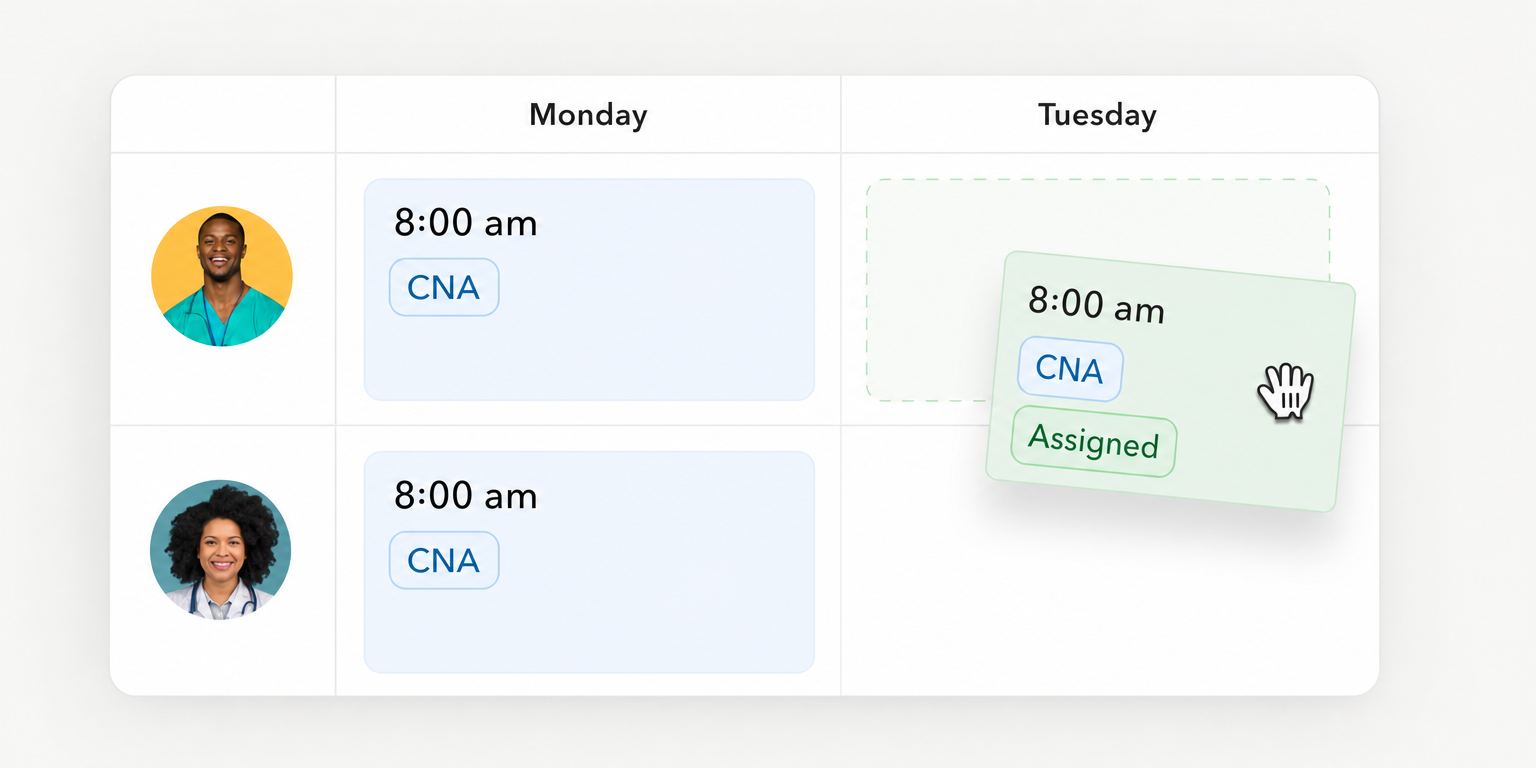
- Dispatch teams in different markets booking the same temp without a unified daily roster
- Payroll batching hours by client rather than by worker, so the 40-hour threshold isn't flagged until it's already crossed

The DOL has been explicit about what's expected. Audit timekeeping systems: ensure that hours worked across entities are tracked and combined accurately. That's not a suggestion. That's the compliance floor. If your stack can't aggregate worker-level hours in real time across every site, you're carrying both the legal risk and the margin loss.
The Bill-Rate Conversation You Should Have Before the Assignment Starts
The single highest-leverage fix happens before the temp ever clocks in. Every client MSA needs three things spelled out explicitly:
- A regular bill rate. Standard. Every contract has this.
- An overtime bill rate. Usually 1.5x the regular bill rate. Many MSAs leave this blank or default to "regular rate" — which is the agency eating the premium.
- An allocation rule for split-week overtime. Who pays the OT when the temp's hours crossed 40 at your site but the earlier hours were at another client?
The three most common allocation rules are chronological, pro-rata, and contract-priority. We'll get into the mechanics in a minute. What matters at the contract stage is that the rule exists in writing and both sides initialed it.
Important
Avoid language that forces the agency to absorb 100% of multi-client OT cost. Beyond the margin damage, a contract that makes wage compliance contingent on the agency eating premium pay can look — to a plaintiff's attorney or a DOL investigator — like a structural incentive to under-report hours. Keep the OT bill rate, and the allocation rule, clearly client-facing.
Language operators can lift into an MSA addendum:
"Where Employee's combined hours worked for Agency across all client assignments in a single workweek exceed forty (40), Agency shall bill overtime hours at the Overtime Bill Rate set forth in Schedule A. Overtime hours shall be allocated to the Client at whose site the hours in excess of forty (40) were physically worked, on a chronological basis."
That one paragraph, dropped into every MSA, closes most of the leak.
Real-Time Hour Aggregation: What the Scheduling System Has to Do
Contracts solve the entitlement question. The scheduling and time-tracking system solves the operational one. "Good" here has a specific shape.
Projected-overtime alerts at scheduling
When a dispatcher tries to book a temp into a third shift this week, the system needs to know — at the moment of booking — how many hours she's already scheduled at every other client. If adding this shift crosses 40, the dispatcher sees the projected OT before the shift is confirmed. Sometimes you take the shift anyway because the temp wants the hours. Sometimes you re-route to a different worker. But you make the call with the math in front of you, not after.
Clock-in warnings to the on-site supervisor
When the temp clocks in at Client B on Thursday morning, the supervisor's view should show: 24 hours already worked this week. The on-site contact gets context they otherwise have no way to see. That's unified time tracking doing its job — every clock-in evaluated against the worker's full weekly footprint, not just this client's schedule.
Automatic OT flagging on the timecard
When hours cross 40, the timecard line items flip. Hours 1–40 stay at the standard bill rate. Hours 41+ get the OT bill rate, allocated to the right client per the contract rule. No manual intervention, no "we'll catch it in payroll," no Monday-morning surprise.
That aggregation is exactly what Teambridge Scheduling and Time Tracking are built around for high-volume desks. Worker-level hours roll up across every client, every site, every shift, in real time.

Allocating Overtime to the Right Client Invoice
Once the hours are flagged, the billing system has to split them clean. Three allocation methods cover almost every MSA pattern:
| Method | How It Works | Best For |
|---|---|---|
| Chronological | The 41st hour and beyond bill to whichever client the temp was physically at when those hours occurred | Clients with predictable end-of-week shifts; simplest to defend |
| Pro-rata by hours | OT premium split between clients proportional to their share of the week's hours | Long-running parallel assignments where temps swing daily |
| Contract-priority | One designated "primary" client never absorbs OT; secondary clients pick up any premium | Anchor accounts with leverage; smaller fill-in clients |
The chronological method is the easiest to explain to a client and the easiest to defend if challenged. It also matches how most temps and supervisors think about the work week intuitively — the late hours of the week are the ones that crossed the line, so the late-week client picks up the premium.
Whatever method you pick, the invoice line items have to be clean: regular hours at regular rate, OT hours at OT rate, both clearly labeled, both tied back to specific timecard entries. That's what Teambridge's invoicing module does — bill rates, burden, and spread mapped directly to the timecard, with clean exports to QuickBooks or NetSuite for audit defense.
Auditing Last Quarter: How to Find OT You Already Lost
If you haven't been catching this, the recoverable revenue is sitting in your data right now. Here's the audit, step by step:
- Pull every temp who worked for more than one client in the same workweek. Last 13 weeks is the right window — long enough to find a pattern, short enough that client conversations stay productive.
- Calculate paid OT hours per worker per week from payroll. This is your liability number.
- Calculate billed OT hours per worker per week from invoices. This is your collection number.
- Compute the delta. Paid OT minus billed OT equals the margin leak.
- Group the delta by client. You'll usually find that 70% of the leak comes from two or three clients with weak MSA language or chaotic shift patterns.
- Renegotiate those MSAs first. You're not asking for a price increase. You're asking them to honor the OT bill rate on hours you already paid out.
The KPI to track from here forward is simple:
OT Bill Ratio = OT hours billed ÷ OT hours paid
Anything under 1.0 is bleed. A ratio of 0.6 means you're collecting 60 cents on every dollar of OT premium you paid. A ratio of 1.0 means every premium hour you paid got billed. Anything over 1.0 means you're billing OT the client didn't actually cause, which is a different problem and will surface in client disputes fast.
Agencies that have never run this audit are routinely surprised by the recoverable number. Light industrial desks running multi-shift, multi-client coverage tend to show the worst ratios. Light industrial operations and warehouse fulfillment desks are the most exposed because the same temp can hit three sites in five days without anyone connecting the dots.
Stop Subsidizing Your Clients' Scheduling Decisions
The legal structure is settled. The agency is the W-2 employer and owes the premium. A finding of joint employment can be costly because it can create liability for unpaid overtime when an employee works a combined total of more than 40 hours for both employers. What's not settled — and what every agency controls — is whether that liability gets passed through to the client invoice or absorbed silently into spread.
When you absorb it, you're subsidizing your client's scheduling flexibility. They get to share your workers across the market with no marginal cost to them. You get the FLSA exposure and the margin damage. That's not a partnership; it's a hidden discount you didn't agree to give.
The fix isn't raising bill rates. It's catching the hours you're already legally owed. That requires three things working together: contracts that name an OT bill rate and an allocation rule, a scheduling and time-tracking system that aggregates worker hours across every client in real time, and an invoicing layer that splits timecards to the right client at the right rate. Run all three and the leak closes.
Teambridge's staffing agency platform was built for exactly this operational shape — unified scheduling, multi-client hour aggregation, and timecard-to-invoice OT allocation in one system, so the 41st hour gets billed instead of buried.
Sources

About the author

Content Writer at Teambridge
Anis Nanai is a content writer at Teambridge, with a focus on workforce management and the realities of running hourly teams. He prioritizes conversations with customers, staying close to the market, and understanding how workforce needs are changing. His writing connects those concerns to practical decisions about scheduling, time tracking, staffing, and automation. He examines product developments through the questions that matter to operators: what does this solve, how would it work for my team, and what evidence supports it?
Company perspective: this author works at Teambridge. Customer outcomes are attributed to their published sources.
View LinkedIn profile