

That gap between generic payroll and construction payroll is where money leaks and compliance risk piles up. This explainer defines what construction payroll software actually does, walks the workflow from clock-in to certified report, contrasts the three ways contractors run payroll today, and closes with an evaluation checklist and a decision framework based on your project mix.
Why generic payroll breaks on construction job sites
The pain shows up in four places every pay period:
- Crews move between sites midweek. Hours have to attach to the right project and cost code at the moment they happen, not when someone reconstructs the week from paper timecards.
- Hours get keyed twice. Once from the field into a spreadsheet, once from the spreadsheet into payroll. Every re-entry is an error waiting to surface as a dispute.
- Prevailing wage rates vary by county and classification. A framer in one county and the same framer twenty miles away can sit under different determinations.
- Certified payroll reports are due weekly. On federal work covered by Davis-Bacon, contractors must submit certified payrolls, typically Form WH-347, within seven days of each pay date.
The compliance math is unforgiving. Davis-Bacon violations can carry civil monetary penalties up to $13,508 per violation, back wages, contract fund withholding, and debarment from federal contracting for up to three years, per published construction payroll compliance guidance. Penalties are assessed per worker per pay period, so one misclassified crew over one quarter compounds fast.
On the accuracy side, unverified clock-ins eat margin quietly. Field workforce surveys estimate roughly 7 percent of labor budget can leak to unverified or inflated time entries. On a $2 million annual labor spend, that is $140,000 gone before you ever touch a compliance issue.
The core problem is structural: payroll, time tracking, and job costing live in separate systems, so every pay run is a manual reconciliation.
Ready to move?
Ready to see Teambridge in action?
What construction payroll software actually does
Construction payroll software is not regular payroll with a hard hat logo. It is payroll built around the realities of field work, and the definition matters because vendors stretch the term. The core capabilities, in operational terms:
Job costing tied to cost codes. Every hour posts to a project, phase, and cost code at capture time, so labor cost reports are current rather than reconstructed after the fact.
Multi-rate pay. One worker, several classifications, several rates in a single week. The system splits hours by classification and applies the right rate to each block, including overtime calculated on the correct regular rate.
Certified payroll generation. The software produces WH-347 or state equivalent reports for covered projects, with the statement of compliance, so weekly submission is an export rather than a rebuild.
Prevailing wage and fringe automation. Rate tables by locality, with the option to pay fringe as cash wages or through bona fide benefit plans, tracked and reported per worker.
Union and CBA wage tables. Configurable per-employee wage schedules, dues, and benefit fund reporting for signatory contractors.
Multi-state tax handling. Withholding follows where the work was performed, not just where the worker lives.
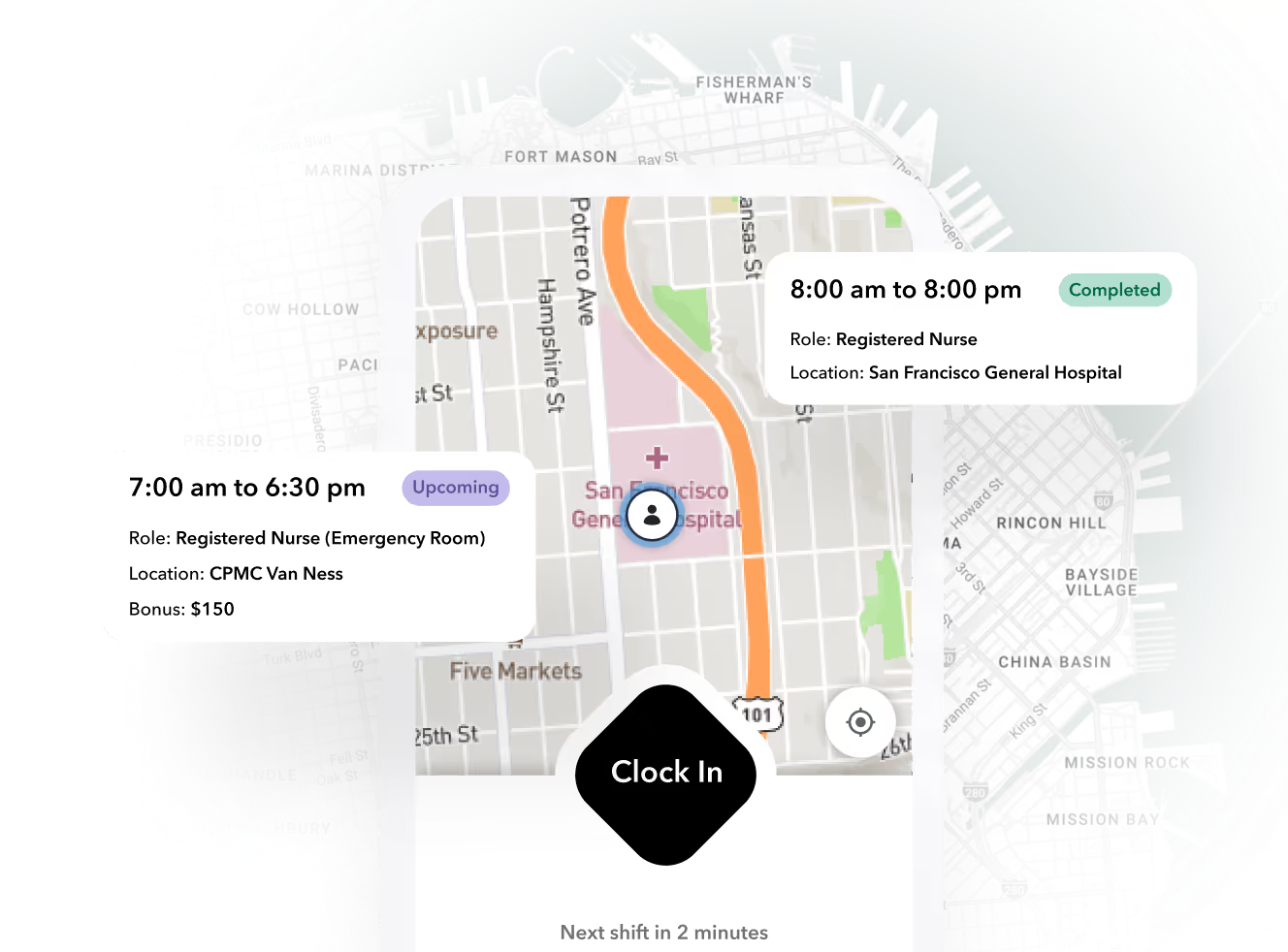
Field time capture with location verification. Mobile or kiosk clock-in with GPS or geofencing that flows directly into payroll-ready hours, with no export step in between. This is where a workforce operations platform like the Teambridge platform differs from a payroll-only tool: scheduling, time capture, and pay rules share one data model.
Important
Software calculates and reports. It does not own your compliance. The contractor still owns worker classification accuracy and must verify rates against the actual wage determinations incorporated into each contract, available through SAM.gov. A tool that applies the wrong determination confidently is worse than no tool.
The workflow from clock-in to certified report
Here is the full sequence, written so you can map each step against your current operation and find where it breaks:
- A worker clocks in on-site via mobile app or kiosk, with GPS or geofence confirming location.
- The hours attach to a project, phase, and cost code at the moment of capture.
- The system applies the correct rate for that classification, site, and shift, including prevailing wage where the project requires it.
- Payroll runs with multi-state withholding based on work location.
- Hours post to job cost reports in real time, so the PM sees labor burn before the pay run closes.
- WH-347 or state certified reports generate automatically for covered projects.
- Data syncs to accounting through integrations like QuickBooks or NetSuite, so the general ledger matches the pay run without journal entry gymnastics.
The operating sequence
Clock-in to certified report in seven steps
Map each step to your current process. Any step that requires a spreadsheet or an export is your leak point.
- 01CaptureWorker clocks in on mobile or kiosk with location verification.
- 02CodeHours attach to project and cost code at capture time.
- 03RateSystem applies classification, site, and shift rates including prevailing wage.
- 04RunPayroll processes with multi-state withholding by work location.
- 05PostHours flow to job cost reports in real time.
- 06CertifyWH-347 or state certified reports generate for covered projects.
- 07SyncData moves to accounting via QuickBooks or NetSuite integration.
Products discussed
Construction Payroll Software: What It Does and How to Choose tools mentioned
Official marks identify the products materially discussed in this section.
Worked scenario: one worker, three sites, two wage determinations
This is a labeled hypothetical with stated assumptions. Rates are illustrative only. Verify your own determinations on SAM.gov before applying any of this logic to a real project.
Assumptions: A general laborer works one week across three sites. Twelve hours on a private commercial job at $24.00 per hour. Twenty hours on a Davis-Bacon project where the determination lists $48.75 base plus $22.30 fringe, paid as cash wages. Eight hours of overtime on the Davis-Bacon project. Total 40 hours, all overtime attributable to the prevailing wage site.
Worked example, hypothetical rates
One week, three sites, one paycheck
Assumes fringe paid as cash wages, 40-hour overtime threshold, and overtime calculated on the Davis-Bacon base rate for prevailing wage hours.
$288.00
$1,421.00
$763.40
$2,472.40
- 01SplitSystem tags each hour block to its project and classification at capture.
- 02ApplyPrivate hours get $24.00; DBA hours get base plus fringe.
- 03OvertimeOT premium uses the $48.75 base rate; fringe is paid straight time on all DBA hours.
- 04ReportWH-347 line shows classification, hours, rate, fringe, and gross for the covered project.
Two details in this scenario trip up manual processes. First, the fringe decision: fringe can be paid as cash wages (as assumed above) or contributed to bona fide benefit plans, which changes the check amount but not the obligation. Second, overtime: the premium applies to the base rate, while fringe is owed at the straight-time amount on every covered hour including overtime hours. A spreadsheet that treats the blended rate as one number gets both wrong.
The output of that week is a single paycheck and a WH-347 line item showing the laborer classification, 28 hours on the covered project, the rate and fringe split, and gross pay attributable to that project. If your current process cannot produce both from the same underlying hours, you are reconciling by hand.
Three ways contractors run payroll today
| Approach | Best for | Strengths | Weaknesses |
|---|---|---|---|
| Spreadsheets plus generic payroll | Small private-only crews under 15 workers | Lowest cash cost, no new system to learn | No certified payroll, no real job costing, every error lands at pay run |
| Construction-specific payroll service | Contractors with heavy prevailing wage volume | Certified payroll, fringe automation, union tables | Quote-based pricing, setup measured in weeks, time capture is a separate system |
| Unified workforce operations platform | Contractors whose pain starts before payroll | Scheduling, time tracking, and pay rules in one data model; exceptions surface before the pay run | Validate certified payroll depth against your specific project mix |
The first approach fails on any covered project the day it lands. The second handles compliance well but leaves you stitching time capture to payroll with an export, which reintroduces the double-entry problem at the front of the pipeline. The third fixes the upstream problem, missed shifts and timecard exceptions, so payroll starts from clean verified hours.
Teambridge sits in the third row. Scheduling, time tracking, and pay rules share one data model, which is why time-to-pay accuracy is the strongest argument for it. The honest boundary: if your revenue is dominated by federal prevailing wage work, validate certified payroll reporting requirements against your specific project mix before assuming any unified platform replaces a dedicated certified payroll engine.
Evaluation checklist before you sign
Use this as a reusable artifact in vendor demos. Each item is independently verifiable.
- Ask the vendor to generate a WH-347 in the current format during the demo, from sample data, not a screenshot.
- Confirm whether prevailing wage rate tables update automatically or require manual entry when DOL revises a determination.
- Trace one hour from field clock-in to the job cost report. If an export or CSV sits in the middle, that is your error surface.
- Verify multi-state withholding follows work location, with a worked example from the sales engineer.
- Ask how union CBAs are configured per employee and how benefit fund reports are produced.
- Confirm certified payrolls can be produced within the seven-day window after each pay date for covered projects.
- Ask what happens to a midweek classification change: does the worker get a new rate from the hour of the change, or from the next pay period?
Disclosure: deadlines and prime contractor liability
On federal Davis-Bacon projects, certified payrolls are due weekly, within seven days of the regular pay date. Prime contractors carry liability for subcontractor violations, including subcontractor underpayments, which is why primes routinely require subs to submit certified payrolls as a condition of payment. Records must be retained for at least three years after project completion. See the Department of Energy's Davis-Bacon FAQ and DOL construction contracting guidance for the underlying rules.
A decision framework based on your project mix
The right tool depends on where your hours actually go.
Mostly private work, small hourly crews. Prioritize clean time capture with location verification and multi-rate pay. Certified payroll features are irrelevant to you; accuracy at the front of the pipeline is everything.
Government contracts are material to revenue. Certified payroll generation and prevailing wage automation are table stakes, not differentiators. Eliminate any vendor that cannot produce a WH-347 live in a demo. Then evaluate whether their rate tables update automatically, because stale determinations are a silent liability.
The real pain is upstream. If your pay runs fail because of missed shifts, unverified clock-ins, and timecard exceptions, the fix is not a better payroll engine. It is scheduling and time tracking that share data with payroll, which is where a unified platform like Teambridge fits. Fix the inputs and the payroll problem mostly dissolves.
Whatever row you land in, run the worked scenario above through any demo environment before you sign. One worker, three sites, two wage determinations, one week. The tool either handles it natively or it does not. If you want to see how Teambridge handles that flow, book a demo and bring your messiest week.
Frequently asked questions
What is the deadline for submitting certified payroll on federal projects?
Certified payrolls under Davis-Bacon are due weekly, within seven days of the regular pay date for the covered workweek. Late or missing reports can trigger contract fund withholding until the contractor comes into compliance.
Is the prime contractor responsible for subcontractor payroll violations?
Yes. On federal covered projects, the prime contractor carries liability for subcontractor underpayments and compliance failures. This is why most primes require subs to submit certified payrolls as a condition of progress payment.
Can fringe benefits be paid as cash on prevailing wage jobs?
Yes. Contractors can pay the fringe amount as cash wages on top of the base rate, or contribute it to bona fide benefit plans such as health insurance or retirement, or split it between the two. The obligation is the total of base plus fringe regardless of the payment method.
How is overtime calculated on a Davis-Bacon project?
The overtime premium of one and one-half times applies to the base prevailing wage rate for hours over 40 in the workweek. Fringe is owed at the straight-time amount on all covered hours, including overtime hours, with no premium on the fringe portion.
Does construction payroll software replace rate verification on SAM.gov?
No. Software applies the rates it is given, but the contractor owns verifying that the correct determination and current revision are in use for each contract. Wage determinations are revised on a rolling basis, and only the latest revision is in force.

About the author

Content Writer at Teambridge
Anis Nanai is a content writer at Teambridge, with a focus on workforce management and the realities of running hourly teams. He prioritizes conversations with customers, staying close to the market, and understanding how workforce needs are changing. His writing connects those concerns to practical decisions about scheduling, time tracking, staffing, and automation. He examines product developments through the questions that matter to operators: what does this solve, how would it work for my team, and what evidence supports it?
Company perspective: this author works at Teambridge. Customer outcomes are attributed to their published sources.
View LinkedIn profile