

Manufacturing shift handover checklist: record what the next shift inherits
Copy the table below into your shared handover record. It is an original editorial checklist informed by HSE’s shift handover guidance, not an official HSE form. Repeat the relevant stage rows for each unresolved item so a general acknowledgment cannot hide an unanswered question.
| Stage | Situation | Unresolved issue | Responsible owner | Next action | Deadline | Incoming acknowledgment | Review result | Escalation trigger |
|---|---|---|---|---|---|---|---|---|
| Preparation | [Open work, equipment identifier and recorded status, or maintenance reference] | [What remains unresolved] | [Assigned owner] | [Required follow up] | [Date, time and site time zone] | [Pending incoming review] | [Pass or fail] | Missing or conflicting status |
| Transfer | [Item being reviewed together] | [Question or dependency] | [Confirmed owner] | [Agreed action] | [Date and time] | [Incoming person or duty assignment and timestamp] | [Pass or fail] | Missing owner, action or deadline |
| Incoming verification | [Record compared with current information] | [Discrepancy or none] | [Owner of follow up] | [Resolve or escalate] | [Date and time] | [What was checked, by whom and when] | [Pass or fail] | Unanswered question or conflicting information |
Use a specific person or an unambiguous duty assignment for the owner. “Maintenance” is not enough if several people could assume someone else has the item. Likewise, “tomorrow” is not a deadline, and “seen” does not say what the incoming operator checked.
Pass means the information transfer is complete and checked. It does not mean outstanding work is finished or machinery is authorized for use. An open maintenance ticket can remain open after a successful handover if its status, ownership and next update are clear.
Before the outgoing crew leaves, distinguish three kinds of information:
- Open production work: the order reference, unfinished work and any unresolved production record question.
- Equipment status: the equipment identifier, recorded condition and source of that information.
- Outstanding maintenance: the ticket reference, unresolved question, responsible maintenance assignment and promised update.
These can concern the same line, but they should not collapse into one entry such as “Line needs attention.” That leaves the incoming crew to reconstruct both the problem and the responsibility.
Separate equipment status from unfinished maintenance
An equipment status entry answers what is currently recorded about the asset. A maintenance entry answers what work or decision remains outstanding. Neither substitutes for the other.
For an item involving maintenance, include the equipment identifier, recorded status, maintenance reference, unresolved question and responsible maintenance role. If the record does not establish the current disposition, write that explicitly. Do not infer closure from an old message or from the absence of a new update.
HSE’s shift handover guidance identifies preparation, information exchange and incoming checks as elements of handover. It also describes accidents involving failures of handover communication and notes that the majority of those involved planned maintenance. That is a reason to give maintenance dependencies their own attention, not a statistic about all manufacturing accidents.
Operator view
Supporting evidence
These sources provide UK operational guidance, not a US legal standard. The checklist fields and pass or fail rules here are editorial recommendations. Apply them alongside established site procedures, rather than treating this article as an equipment control procedure.
The HSE good practice guidelines also support allowing time for handover. A form submitted as the outgoing operator walks out leaves no reliable opportunity to challenge an unclear entry. Preparation should leave the incoming crew time to ask questions and compare the record with current information.
Illustrative packaging line handover with two unresolved items
Hypothetical example: a packaging line changes shifts at 14:00 on 12 May 2026. One packaging order remains unfinished and one maintenance ticket remains open. All times below are local site time, and the role placeholders represent distinct assigned duties, not a real customer or named employee.
Assume the outgoing crew has supplied the production record and maintenance ticket references. The incoming crew has compared those records with the written handover. The table shows the final verification rows of the same checklist, not a separate form.
| Stage | Situation | Unresolved issue | Responsible owner | Next action | Deadline | Incoming acknowledgment | Review result | Escalation trigger |
|---|---|---|---|---|---|---|---|---|
| Incoming verification | Packaging order PK204 remains unfinished | Remaining quantity awaits reconciliation | [Incoming production supervisor] | Reconcile the production record and record the remaining quantity | 12 May 2026, 14:15 local | [Incoming operator] reviewed the production record at 14:00 and acknowledged that reconciliation remains open | Pass: information transferred; production item open | Quantity records conflict or reconciliation update is overdue |
| Incoming verification | Equipment P2 status is recorded as awaiting maintenance disposition against ticket MT318 | Maintenance disposition is not yet confirmed | [Maintenance lead] | Provide a documented status update against MT318 | 12 May 2026, 14:10 local | [Incoming supervisor] checked the ticket reference at 14:00 and acknowledged the unresolved disposition | Pass: information transferred; maintenance item open | Ticket and handover conflict or the promised update is overdue |
The production row gives the incoming supervisor a specific administrative action: reconcile the record. It does not ask the next operator to guess the remaining quantity. The maintenance row preserves the missing disposition instead of quietly turning uncertainty into a completed status.
Acknowledgment at 14:00 leaves the maintenance issue open. If the update has not arrived by 14:10, the incoming supervisor has a defined trigger for escalation under the site’s existing process. Neither acknowledgment nor the passing information review grants permission to operate equipment.
Put the workflow into practice
See how your team could use this workflow
Fail the handover review when ownership or status remains unclear
Review the stages separately. A prepared record can still fail transfer because nobody has accepted ownership. A conversation can still fail incoming verification because the ticket and the written status disagree.
Use these review signals against the existing checklist:
- Preparation passes when the references and status are present. Open work, relevant equipment status and outstanding maintenance references are recorded clearly enough for the incoming crew to find them. Missing or contradictory information fails preparation and goes to supervisor review.
- Transfer passes when responsibility is explicit. Each unresolved item has a confirmed owner, next action and deadline. An entry such as “office to follow up” fails if it does not identify the responsible assignment or when an update is due.
- Incoming verification passes when the record has been checked. The incoming operator records what was compared, any discrepancy and acknowledgment of the outstanding item. An unanswered handover question or conflicting information fails verification until it is resolved or escalated through the established process.
These are proposed operating checks, not regulatory requirements. Their purpose is to expose gaps while both crews can still clarify them.
A known unresolved task differs from an unanswered handover question. “Maintenance disposition remains pending, the maintenance lead owns the update, and the deadline is 14:10” can be transferred clearly. “Someone might still be working on it” cannot.
Warning
A passing handover review is not equipment release authorization. Keep maintenance completion and permission to use equipment within the site’s established technical and safety procedures.
Written records support conversation; they do not replace it. HSE recommends participation by both parties and both verbal and written communication. Use the record to anchor that exchange, particularly when the incoming operator needs to challenge an assumption.
If the assigned recipient is unavailable, do not record acknowledgment on their behalf. Keep the acknowledgment pending and route the gap to the designated supervisor. Any substitute owner or recipient should be explicit in the record.
Use communication tools to route the record, not authorize equipment use
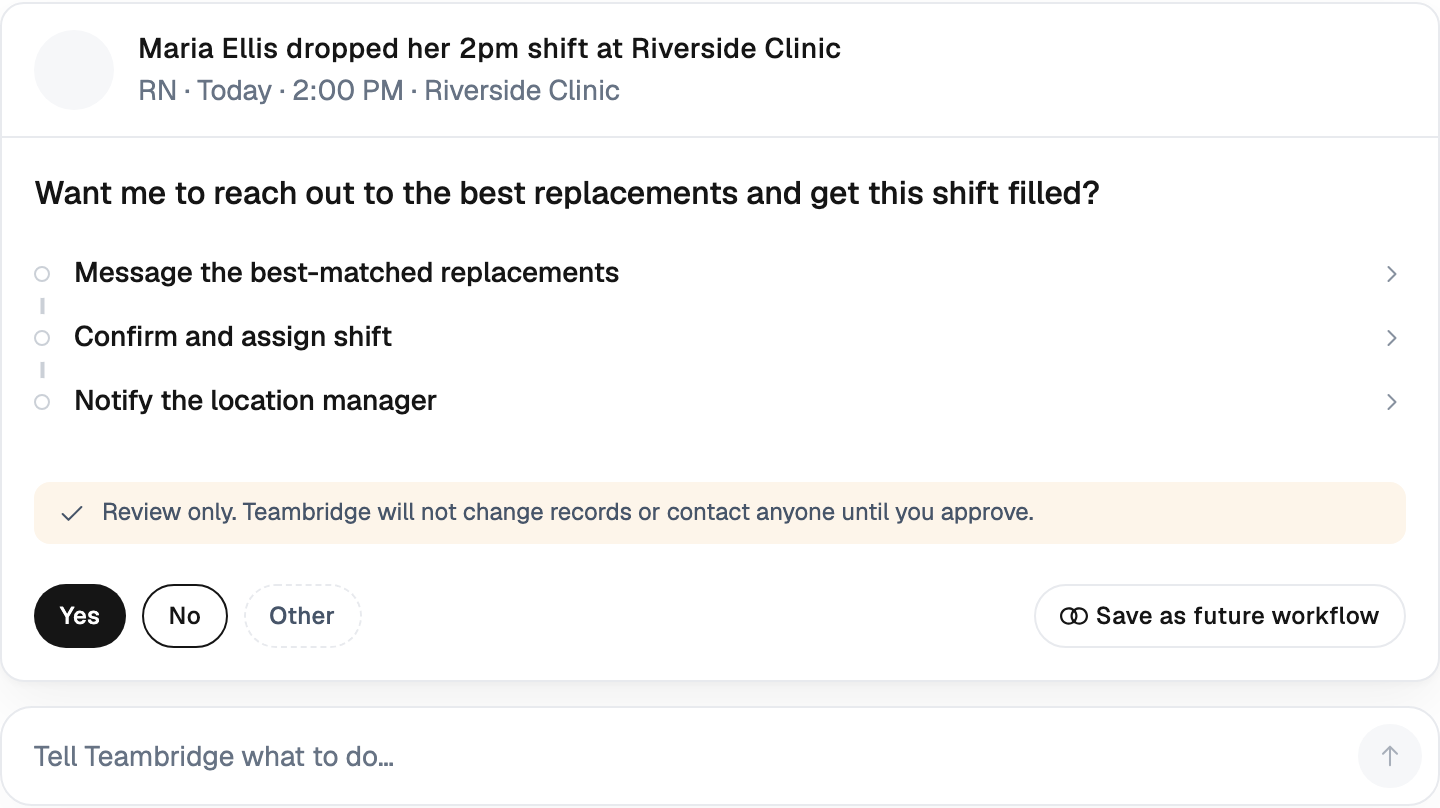
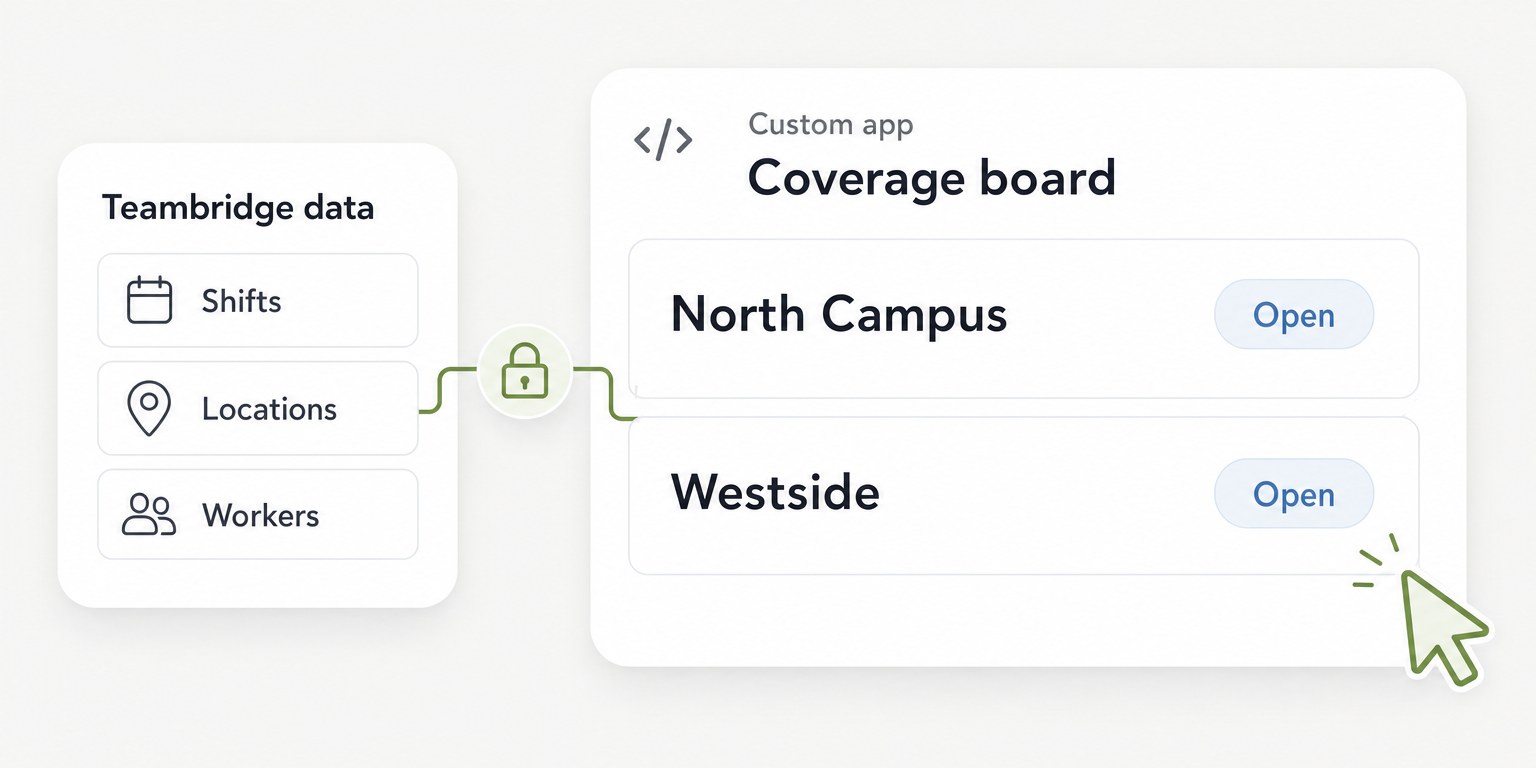
A shared record helps only if the relevant crew can find it and respond. Teambridge Communication is one operational option for sharing handover information with relevant people, roles, locations and assignments. Available targeting depends on the workforce records and workflows configured for the organization.
The product page describes supported communication flows that can expose delivery, read, acknowledgment and reply states. Those states answer different questions. Delivery concerns whether a message reached its destination; a read state is not evidence that the recipient checked the production record or understood an unresolved maintenance dependency.
Keep the handover acknowledgment specific: identify the item reviewed, the information checked and any remaining question. Do not substitute a generic message read state for that record.
According to the communication product page, automated reminders, routing and manager review depend on pairing communication with Teambridge Automations and configuring triggers, timing, conditions and subsequent actions. Do not assume a message automatically creates an escalation when its deadline passes.
The page does not establish exact administrator permissions or setup steps. Before relying on a configured workflow, confirm with the responsible administrator who can access the conversation, what acknowledgment record is retained and where unanswered items go. If that path is unavailable or unconfirmed, use the site’s existing escalation process rather than waiting for an assumed notification.
Teambridge is a workforce communication option here, not a dedicated manufacturing maintenance system. Communication acknowledgment does not establish technical understanding, close a maintenance ticket or authorize equipment use.
The adjacent guard handoff and post order acknowledgment guide covers the distinct security application. It is useful context for communication ownership, not evidence for manufacturing safety decisions.
Finish each handover with an owner and a time for the next update
At the next shift change, use the checklist on the work that actually remains open. Start with the unresolved production items and maintenance dependencies, then inspect every row for an owner, a concrete action and a dated deadline. Ask the incoming crew to identify what they checked and what still needs clarification.
Review failed items before treating the handover as complete. Missing ownership, conflicting equipment information, unanswered questions and overdue updates should enter the site’s established escalation process. A row should show the gap and its responsible reviewer, not disappear because the shift has changed.
Transfer the unresolved work. Do not clear it because a message was read.
Keep acknowledged open items visible until the responsible process records their resolution. When an update changes the status or next action, preserve enough context for the incoming crew to understand what changed and which source supports it. That keeps the handover useful after the initial conversation, when the next deadline arrives and someone needs to know exactly who owns the answer.

About the author

Content Writer at Teambridge
Anis Nanai is a content writer at Teambridge, with a focus on workforce management and the realities of running hourly teams. He prioritizes conversations with customers, staying close to the market, and understanding how workforce needs are changing. His writing connects those concerns to practical decisions about scheduling, time tracking, staffing, and automation. He examines product developments through the questions that matter to operators: what does this solve, how would it work for my team, and what evidence supports it?
Company perspective: this author works at Teambridge. Customer outcomes are attributed to their published sources.
View LinkedIn profile