

Choose recruiting software around hourly hiring decisions
An application count tells you little when nobody owns the next review. An interview wastes time when the candidate cannot work the required hours. An accepted offer does not resolve a missing credential review.
Evaluate software against those decisions, not the number of screens in the demo. Your evidence should show who acts, what they can see, what gets saved, and what happens when the normal process fails.
Define who can advance a candidate before booking demos
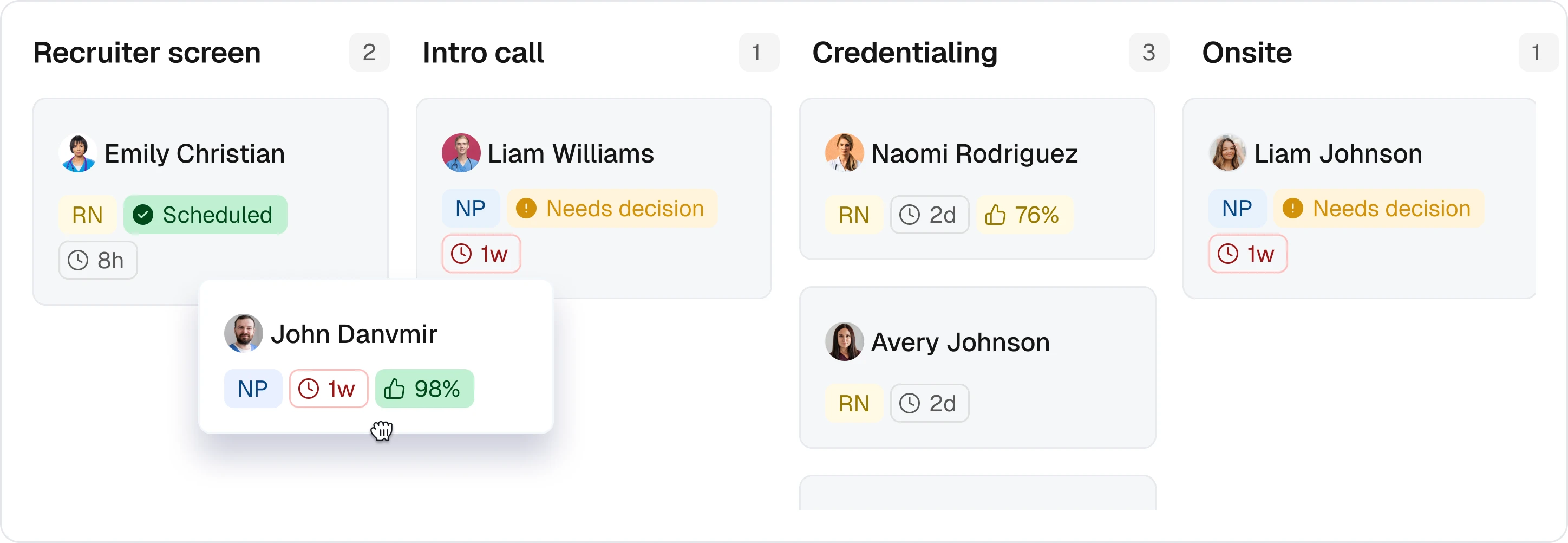
The recruiting lead should define application, screening, interview, hiring, and onboarding stages. Give each transition a decision owner and an exit condition. Branch managers approve location, availability, and role requirements; onboarding owns the distinction between an accepted offer and permission to start.
The Teambridge ATS page presents those hiring stages and buyer questions. Use them as evaluation prompts, not implementation proof. For staffing operations, the immediate task is preserving the recruiting decision through onboarding, not expanding the purchase into every downstream workflow.

Use one acceptance checklist to make vendors show their work
Copy this checklist for each shortlisted vendor. These are proposed buyer tests, not claims that any product passes them.
| Owner | Acceptance criterion | Question to ask the vendor | Evidence to retain | Result |
|---|---|---|---|---|
| Recruiting lead | Every application has an accountable next action | Can you demonstrate an incomplete application and show who handles it next? | Saved action, owner, required access, and unresolved limitation | Pass, Fail, or Unproven |
| Branch manager | Screening reflects the actual hourly role | Can we review location, shift availability, and role requirements before advancing this candidate? | Configured role example and recorded screening decision | Pass, Fail, or Unproven |
| Onboarding owner | Outstanding requirements remain visible after hiring | What happens when an accepted candidate still needs a credential reviewed? | Review state, responsible owner, and escalation path | Pass, Fail, or Unproven |
| Systems owner | Returning applicants retain usable history | Can you demonstrate duplicate handling and show what transfers to our existing systems? | Record comparison, field mapping, and transfer dependencies | Pass, Fail, or Unproven |
| Operations leader | Recruiting delays can be measured | Can we obtain stage timestamps and identify candidates waiting without an owner? | Sample output, field definitions, and reporting boundaries | Pass, Fail, or Unproven |
The Teambridge ATS demonstration scope supplies the topics behind this checklist. It does not establish that a particular configuration passes. Add the demonstration date, evidence location, and defect owner to each completed row.
Require a saved decision, not a convincing presentation
Have the vendor perform each action using the access level your recruiter or branch manager would actually receive. Then reopen the record. An action that appears during a demonstration but does not persist cannot support the next person’s work.
For incomplete applications, ask who receives the follow up task and how it becomes overdue. For candidates awaiting documents, ask whether the current stage distinguishes waiting for a candidate from waiting for an internal reviewer. A broad “pending” status hides two different queues with different owners.
Important
Mark a requirement Unproven when the vendor offers a roadmap promise, a presentation, or an unsupported verbal answer. Reserve Pass for evidence from the proposed configuration, including its exception path.
Screening also needs human scrutiny. The EEOC’s guidance on employment tests and selection procedures explains that selection procedures can violate federal discrimination law through discriminatory treatment or unjustified disproportionate exclusion. Ask what supports each screening criterion for the actual role; software does not make that criterion appropriate by itself.
Include an accessible alternative in the test. The Department of Justice’s hiring technology guidance explains disability risks in hiring technology and reasonable accommodation obligations. Ask how applicants request an alternative, who responds, and how the request reaches that owner without being treated as a failed application.
Completed example: an evening warehouse role
Hypothetical example: Assume one branch is evaluating software for an evening warehouse role. It already has an onboarding system and wants to preserve candidate history when transferring accepted hires. The following results illustrate how to complete the checklist; they are not Teambridge product results.
The recruiting lead records Pass after reopening an incomplete application with a saved owner and follow up action. The branch manager records Pass after the proposed configuration retains the candidate’s evening availability and screening decision. Both entries reference the test record and demonstration date.
The onboarding owner records Unproven because the demonstration never shows an outstanding document review after transfer. The systems owner records Fail because a returning applicant’s earlier history is missing from the destination record. The operations leader records Unproven because the sample export lacks stage timestamps.
The checklist now directs the next meeting. Onboarding needs another demonstration, systems needs a corrected transfer test, and operations needs a defined reporting source. Application volume does not override those unresolved requirements.
Put the workflow into practice
See how your team could use this workflow
Separate recruiting proof from onboarding and workforce scope
The systems owner should classify every checklist requirement by its delivery dependency:
- Demonstrated in the proposed configuration, with evidence retained.
- Dependent on configuration, with an implementation owner and acceptance test.
- Dependent on another system, with transfer requirements and recovery responsibilities.
Ask who controls candidate records, how records can be exported, and what happens when a transfer fails. Establish who detects the failure, who can retry it, and how duplicate creation is prevented or resolved. A statement that systems “integrate” does not answer those questions.
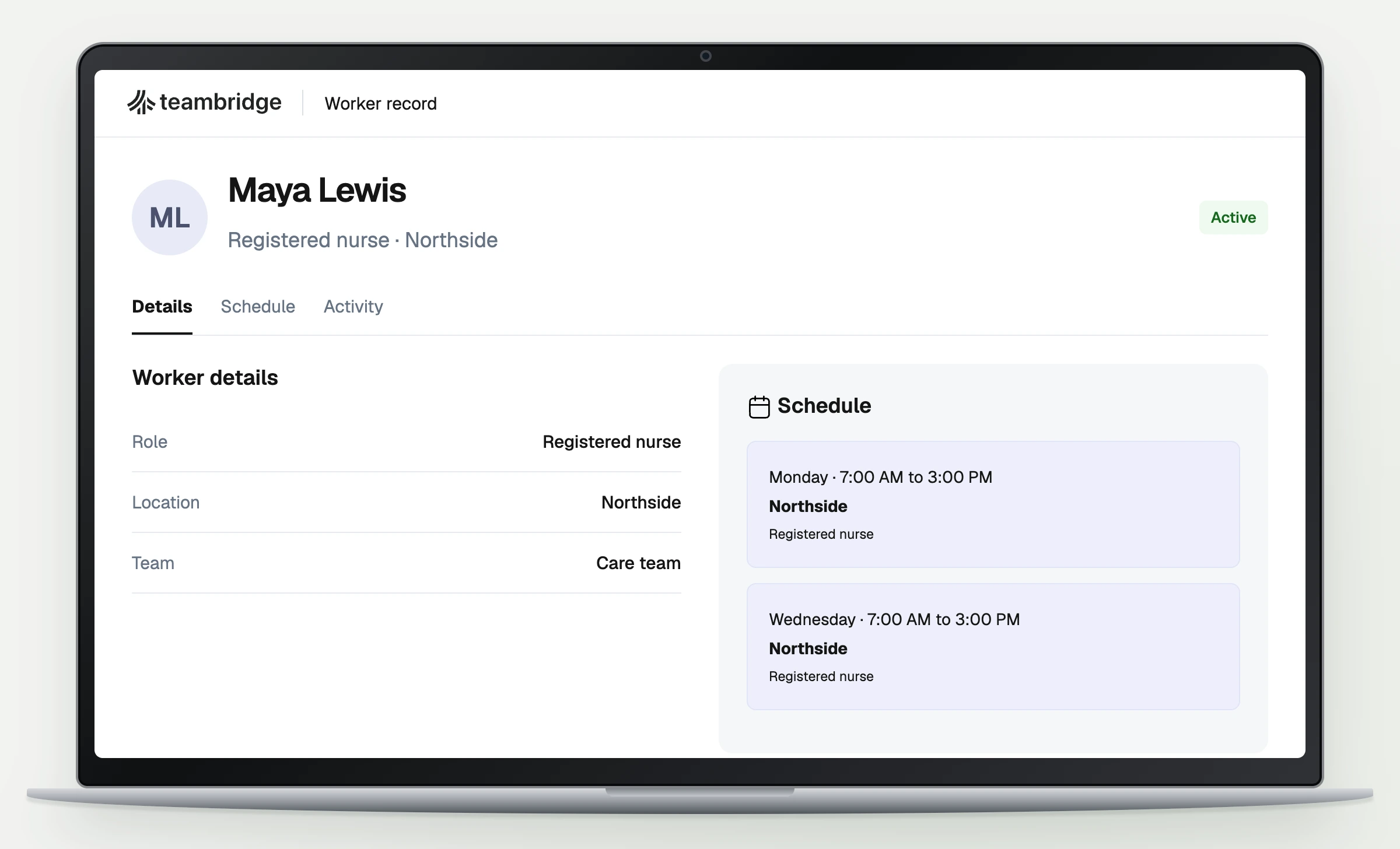
Teambridge is an all in one platform for hourly teams, tailored to each company. Its documented operational scope includes onboarding, credential tracking, scheduling, and workflows. The Teambridge platform page describes forms, credential uploads, review, and missing item follow up connected to workers and roles.
That scope is relevant to preserving a hiring decision through onboarding. It is not proof of sourcing, resume parsing, automated screening, or interview scheduling. Evaluate recruiting requirements separately, and request implementation documentation covering access, saved states, transfer behavior, and recovery before accepting a proposed setup.
Operator view
Decision criteria
Teambridge platform
Teambridge ATS
Teambridge scheduling
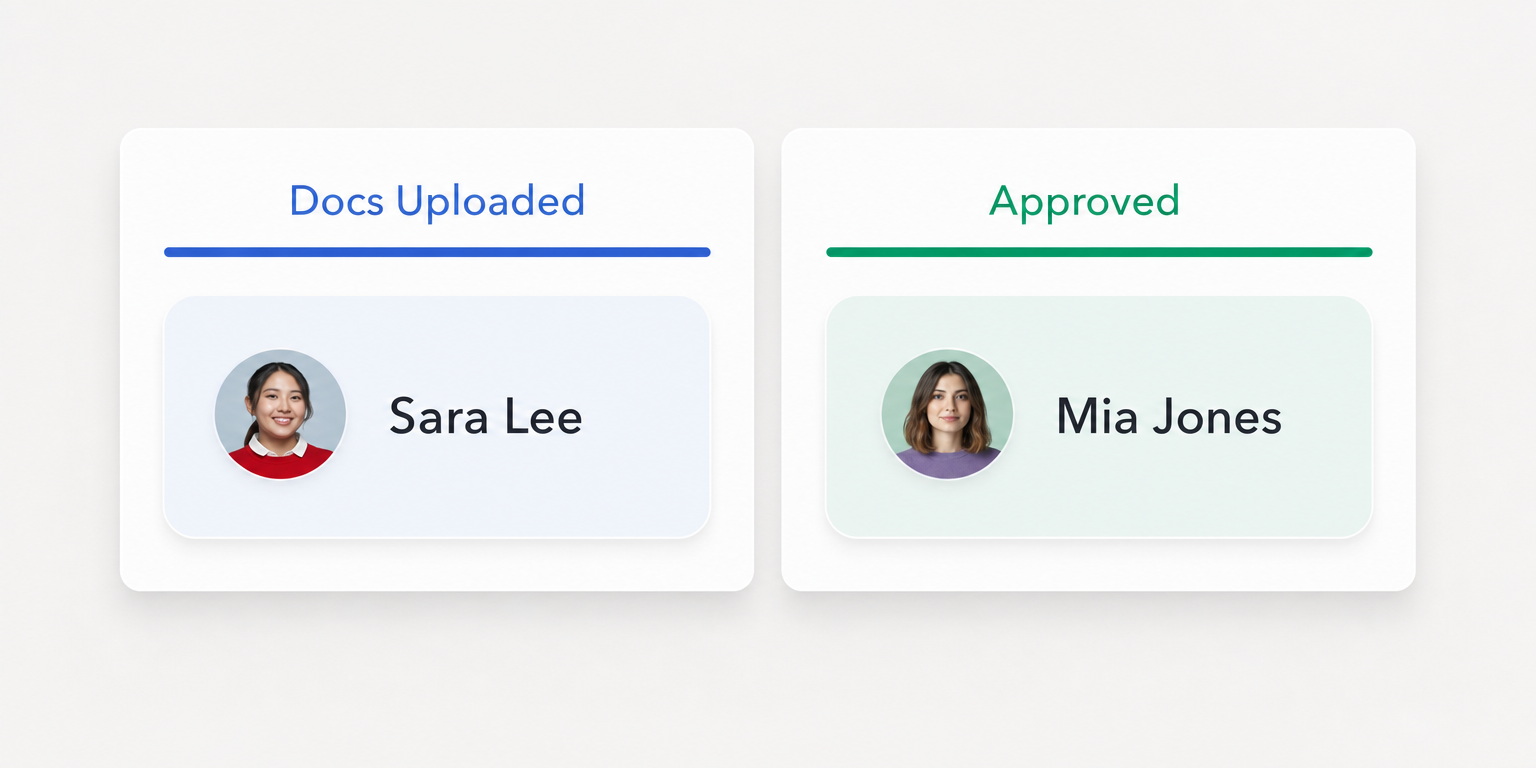
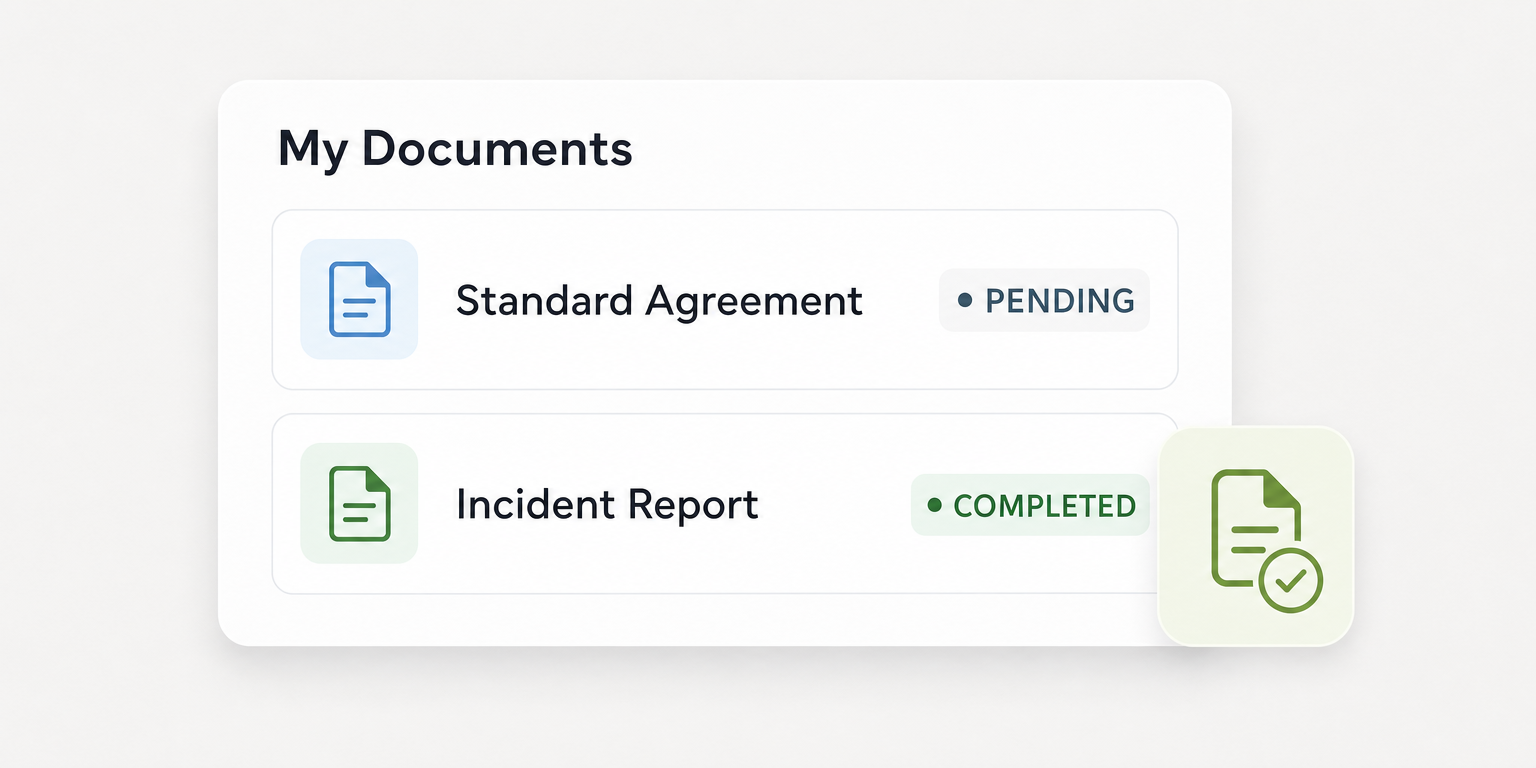
The Teambridge onboarding page distinguishes Accepted, Details, Documents, Review, and Ready. That distinction is useful when evaluating the handoff: an uploaded file and an approved requirement are different states. Ask the onboarding owner to demonstrate the review decision rather than assuming that receiving a document completes it.
An accepted offer records a hiring decision. Readiness requires its own evidence and owner.
Pilot one hourly role without losing candidate history
Keep the pilot narrow enough to inspect every exception. One role at one branch is a useful starting boundary. Use the same acceptance checklist throughout implementation so the purchasing evidence and launch decision remain connected.
- Recruiting configures the stages. Define what enters and exits each stage, who may advance a candidate, and who owns incomplete information. Confirm the saved state after a recruiter takes action and the fallback when that recruiter is unavailable.
- Branch management approves the screening requirements. Use the actual location, hours, and role requirements. Test how availability changes are recorded and who decides whether the candidate remains suitable.
- Systems validates records and transfers. Reconcile candidate counts, duplicate records, stage history, and outstanding actions against the source. Document intentional exclusions rather than treating every difference as harmless.
- Onboarding verifies readiness decisions. Confirm that outstanding reviews remain visible after acceptance. Only then check whether availability and qualifications remain usable for an actual assignment.
These are proposed implementation tests, not customer examples. Run an incomplete application through follow up, then test a candidate who cannot work the required hours. Confirm that each ends with a recorded decision or next action, not an abandoned record.
Next, process a returning applicant. Compare the original and destination records for history, current details, and duplicate handling. Finally, advance an accepted hire awaiting document review and verify who owns the unresolved requirement.
Do not prescribe configuration clicks from a public product page. Request the relevant implementation documentation and have the vendor demonstrate the required permissions, saved state, and exception path in the pilot environment. Record documentation gaps as unresolved dependencies.
Every defect needs an owner and a retest condition. If the pilot cannot support a necessary task, preserve a documented fallback in the current process. Identify which system remains authoritative during that fallback so recruiters do not update two conflicting records.
Review recruiting delays daily and pilot defects weekly
Daily review belongs to the recruiting lead. Inspect unowned candidates, overdue actions, and records waiting for missing information. Separate candidate response delays from internal review delays so the team assigns the right follow up.
Weekly review brings together branch management, onboarding, and systems. Examine screening mismatches, stage delays, and transfer defects. Reopen failed checklist rows and confirm whether fixes actually pass the original test.
Set measurable success criteria before launch. These are recommended operating measures, not claims about native Teambridge reports or promised improvements:
- Application completion: Submitted applications divided by started applications for a defined cohort, where reliable start data exists. Recruiting owns the measure and records the source and exclusions.
- Time to first review: First review timestamp minus submission timestamp. Recruiting defines what counts as review and identifies submitted applications still awaiting it.
- Time awaiting missing information: Elapsed time between the request and receipt of the required information. Onboarding or recruiting owns it according to the requirement, with unresolved cases shown separately.
- First shift completion: Accepted hires who complete their first scheduled shift divided by accepted hires whose first scheduled shift falls in the reporting window. Operations owns this downstream readiness measure and identifies hires with no first shift scheduled separately.
Use one reporting window and stable field definitions. If application starts or historical timestamps are unavailable, mark the measure unavailable rather than reconstructing a misleading baseline. Record the reporting source, denominator where applicable, and accountable owner alongside each local threshold.
First shift completion is not attributable solely to recruiting software. Candidate decisions, onboarding reviews, and site conditions also affect it. Use it to investigate whether hiring decisions survived the handoff, not to claim software caused an improvement.
Approve the purchase only when recruiting can run the process
The operations leader should review the completed checklist with recruiting, branch management, onboarding, and systems. Include unresolved dependencies, implementation workload, and pilot measures. Expand only when mandatory criteria pass and locally agreed thresholds are met.
Buying on application volume alone leaves decision quality untested. Treating acceptance as readiness hides unfinished reviews. Assuming transfers preserve history leaves the systems owner to discover the loss after launch, while undefined exception ownership leaves candidates waiting.
An Unproven result calls for another demonstration or a documented resolution before approval. A failed mandatory requirement calls for a successful retest, not a more persuasive presentation.
Bring the completed checklist to your next vendor demonstration. If Teambridge is on the shortlist, use the platform evaluation to examine onboarding and workforce scope alongside the recruiting requirements you still need demonstrated. The purchase is ready when your team can run the process, explain the exceptions, and retain the evidence.

About the author
Content Writer at Teambridge
Anis Nanai is a content writer at Teambridge, with a focus on workforce management and the realities of running hourly teams. He prioritizes conversations with customers, staying close to the market, and understanding how workforce needs are changing. His writing connects those concerns to practical decisions about scheduling, time tracking, staffing, and automation. He examines product developments through the questions that matter to operators: what does this solve, how would it work for my team, and what evidence supports it?
Company perspective: this author works at Teambridge. Customer outcomes are attributed to their published sources.
View LinkedIn profile