

Editable planning resource
Download an editable employee work schedule
Use this weekly CSV in Excel or Google Sheets. Add the date, worker, site, role, shift times and unpaid break minutes. Confirm availability and required qualifications, then name the person responsible for finding a replacement.
Download weekly schedule templateExample row: Monday, Jordan, Site A, Reception, 09:00 to 17:00, 30 unpaid break minutes, availability confirmed, qualifications checked, replacement owner Casey. This is an illustrative assignment. Verify your own break and pay rules.
Build a four crew schedule and check coverage
Four crews sharing one continuous position work an average of 42 hours each per week. The example below uses two day crews and two night crews, each working seven 12 hour shifts every 14 days. Download the 28 day CSV and edit it in your spreadsheet.
A and B alternate day coverage. C and D alternate night coverage. This example keeps each crew on the same shift. Add your shift start times, worker assignments, site and role requirements before using it.
How many people does coverage require?
6 people needed, rounded up
Calculation: 168 hours × people needed at once ÷ (weekly hours per person × available share of time). Include leave and training in unavailable time. This is a capacity estimate. It does not test individual availability, break coverage, qualifications or overtime rules.
Every scheduling software site offers a free weekly schedule template. Clockify, Homebase, When I Work, and a dozen others will hand you a clean grid of names and dates, and most operators download one, fill it in on Monday, and watch it fall apart by Wednesday. The template was not the problem. The missing operating rules were.
A schedule template is a point-in-time snapshot. Availability changes, call-offs happen, credentials expire, and a static spreadsheet has no way to tell you which rows are still true. The Bureau of Labor Statistics puts the annual absence rate for full-time wage and salary workers at roughly 3 percent, and in light industrial, retail, and healthcare settings, unplanned call-offs run well above that on any given week. The CDC Foundation estimates worker illness and injury costs U.S. employers $225.8 billion a year in lost productivity. Your template has to assume change, not hope for stability.
This guide gives you the template schema, a filled-in example, the fill rules that keep it current, and the math that tells you whether it is working. Steal all of it.
Why downloaded schedule templates break by Wednesday
The failure mode is always the same. A manager builds the week on Monday morning using availability collected the previous Friday. Tuesday night, two workers text that they cannot make Wednesday. A forklift certification nobody tracked lapses mid-shift. By Wednesday afternoon, three rows of the spreadsheet are fiction and nobody knows which three.
The root cause is that most templates capture intent, not state. They record who you planned to work, not who is confirmed, credentialed, and backed up right now. Fixing that is not about better formatting. It is about adding fields that force the template to answer operational questions: Is this person confirmed? When did we last hear from them? Who covers if they drop?
Ready to move?
Ready to see Teambridge in action?
The 12 fields every weekly schedule template needs
Below is the schema. Each field exists because its absence causes a specific, repeatable failure. Add columns to whatever spreadsheet tool you already use.
| # | Field | What it prevents | Validation rule |
|---|---|---|---|
| 1 | Employee name | Ambiguity on shared shifts | Must match payroll record exactly |
| 2 | Role or position | Wrong-skill placement | Must match an approved role list |
| 3 | Credential status | Expired-cert compliance exposure | Expiry date must be after shift end |
| 4 | Availability window | Scheduling workers who cannot show | Refreshed within the last 7 days |
| 5 | Shift start | Late arrivals, gaps | Within confirmed availability window |
| 6 | Shift end | Overtime surprises | Start to end equals planned hours |
| 7 | Break plan | Meal-break violations | Compliant with state rules for shift length |
| 8 | Location or site | Wrong-site no-shows | Valid site code from client list |
| 9 | Pay rate code | Payroll disputes | Matches role and site rate card |
| 10 | Total hours | Overtime bleed | Weekly sum flagged at threshold minus 4 hours |
| 11 | Backup worker | Unfilled call-off gaps | Named backup who is available and not double-booked |
| 12 | Last-confirmed timestamp | Stale rows masquerading as truth | Within 48 hours of shift start |
The two fields competitors skip are 11 and 12. A named backup converts a call-off from a scramble into a substitution. The last-confirmed timestamp tells you which rows you can trust and which ones need a re-confirmation text before you publish.
Important
A row with a last-confirmed timestamp older than 48 hours is not a schedule entry. It is a rumor. Treat it as unconfirmed until you have a fresh yes.
A filled-in week: example schedule for a 40-person light industrial site
The example below is hypothetical and illustrative. It is not a customer result. Assumptions: a fictional light industrial site running two shifts (6:00 to 14:30 and 14:30 to 23:00), 40 active workers, an 8 percent average weekly call-off rate, and a 40-hour weekly overtime threshold.
| Worker | Role | Cred. OK | Shift | Site | Hours | OT flag | Backup | Last confirmed |
|---|---|---|---|---|---|---|---|---|
| A. Rivera | Forklift | Yes, exp. 09/26 | 6:00-14:30 | WH-2 | 40 | No | D. Osei | Tue 07:12 |
| B. Chen | Picker | Yes | 6:00-14:30 | WH-2 | 38 | No | L. Marsh | Tue 18:40 |
| C. Brooks | Forklift | Yes | 14:30-23:00 | WH-2 | 40 | No | A. Rivera | Mon 15:05 |
| D. Osei | Picker | Yes | 14:30-23:00 | WH-1 | 36 | No | B. Chen | Wed 06:02 |
| E. Novak | Loader | Exp. 10/02 | 14:30-23:00 | WH-1 | 32 | No | J. Patel | Tue 09:55 |
Wednesday at 06:02, D. Osei texts that he cannot make his 14:30 shift. Because the template carries a named backup, the coordinator does not start dialing the roster. B. Chen is the listed backup for that row, and her row shows 38 hours, so picking up Osei's 8-hour shift puts her at 46 hours and flips her overtime flag. The coordinator instead checks L. Marsh, Chen's own backup, who is under threshold and confirmed within 48 hours. The swap takes one text thread instead of forty-five minutes of phone calls, and the template's overtime flag kept the fix from creating a payroll problem.
That is the whole argument for the schema. The fields do the thinking before the emergency.
Products discussed
Employee Work Schedule Template: Build One That Survives Call-Offs tools mentioned
Official marks identify the products materially discussed in this section.
Fill rules: how to keep the template accurate between publishes
A template without a cadence decays. Run this sequence every week:
- Collect availability on a fixed day. Same day, same channel, every week. Workers who do not respond are marked unavailable, not assumed available.
- Build the draft 72 hours before the week starts. Assign shifts against confirmed availability and credential status only.
- Confirm 48 hours out. Text every scheduled worker. Stamp each row's last-confirmed field when they reply.
- Re-confirm 24 hours out for stale rows. Any row still older than 48 hours gets a second ping or is swapped to the named backup.
- Log every change with a timestamp. Overwrite nothing. Version history is how you audit what went wrong later.
- Reconcile against actual clock-ins weekly. Compare planned versus actual hours and attendance. This feeds the metrics in the next section.
How often you republish depends on how volatile your workforce is:
| Signal | Daily template | Weekly template | Monthly template |
|---|---|---|---|
| Call-off rate | Above 10% | 4 to 10% | Under 4% |
| Availability changes | Daily | Weekly | Rarely |
| Shift pattern | Variable, on-call | Fixed shifts, rotating days | Fixed, salaried-like |
| Typical fit | Event staffing, per-diem clinical | Light industrial, logistics, security | Office-adjacent, facilities |
Most hourly operations land in the weekly column. If you find yourself republishing daily, that is a signal you have outgrown spreadsheets, covered below.
The math that tells you the template is working
Three numbers tell you whether the template is a tool or a ritual. Using the fictional site's week: 200 scheduled shifts (40 workers, 5 days), 16 call-offs (the 8 percent assumption), 14 of them backfilled same-day, and 3.5 hours of coordinator time to build and publish.
Worked example, hypothetical site
Weekly scheduling scorecard
Formulas applied to the fictional 40-worker site. Assumptions: 200 scheduled shifts, 16 call-offs, 14 same-day backfills, 3.5 hours to publish.
Target: 95% or better
Above 15% means availability data is stale
Above 5 hours means the process needs automation
- 01Count shifts worked as scheduled or covered by the named backup, divide by total scheduled shifts.
- 02Count post-publish changes, divide by total shifts, track weekly for trend.
- 03Time the build-and-publish cycle from availability collection to release.
Before every publish, run this checklist:
- Coverage gaps: every shift has a name, not a TBD
- Overtime: no worker projects past threshold without a flagged approval
- Credentials: every credential expiry date falls after the worker's last scheduled shift of the week
- Double-bookings: no worker appears in overlapping shifts or as their own backup
- Confirmations: no row's last-confirmed timestamp is older than 48 hours
When a spreadsheet stops working and software takes over
Be honest about the boundary. A well-run spreadsheet handles roughly 30 to 50 active workers with weekly availability changes. Past that, or when availability changes daily, the confirmation cadence above becomes a full-time job and step 5 (logging every change) quietly stops happening.
The manual workflow and software solve different parts of the problem:
| Task | Manual template | Scheduling software |
|---|---|---|
| Publish a weekly grid | Yes, cheap | Yes, faster |
| Re-confirm shifts at 48 and 24 hours | Manual texting | Automated, with responses written back |
| Credential checks | Visual scan of expiry dates | Blocks assignment when expired |
| Backfill a call-off | Text the named backup | Broadcast to qualified, available workers |
| Reconcile planned vs. actual | Weekly spreadsheet compare | Automatic against clock-in data |
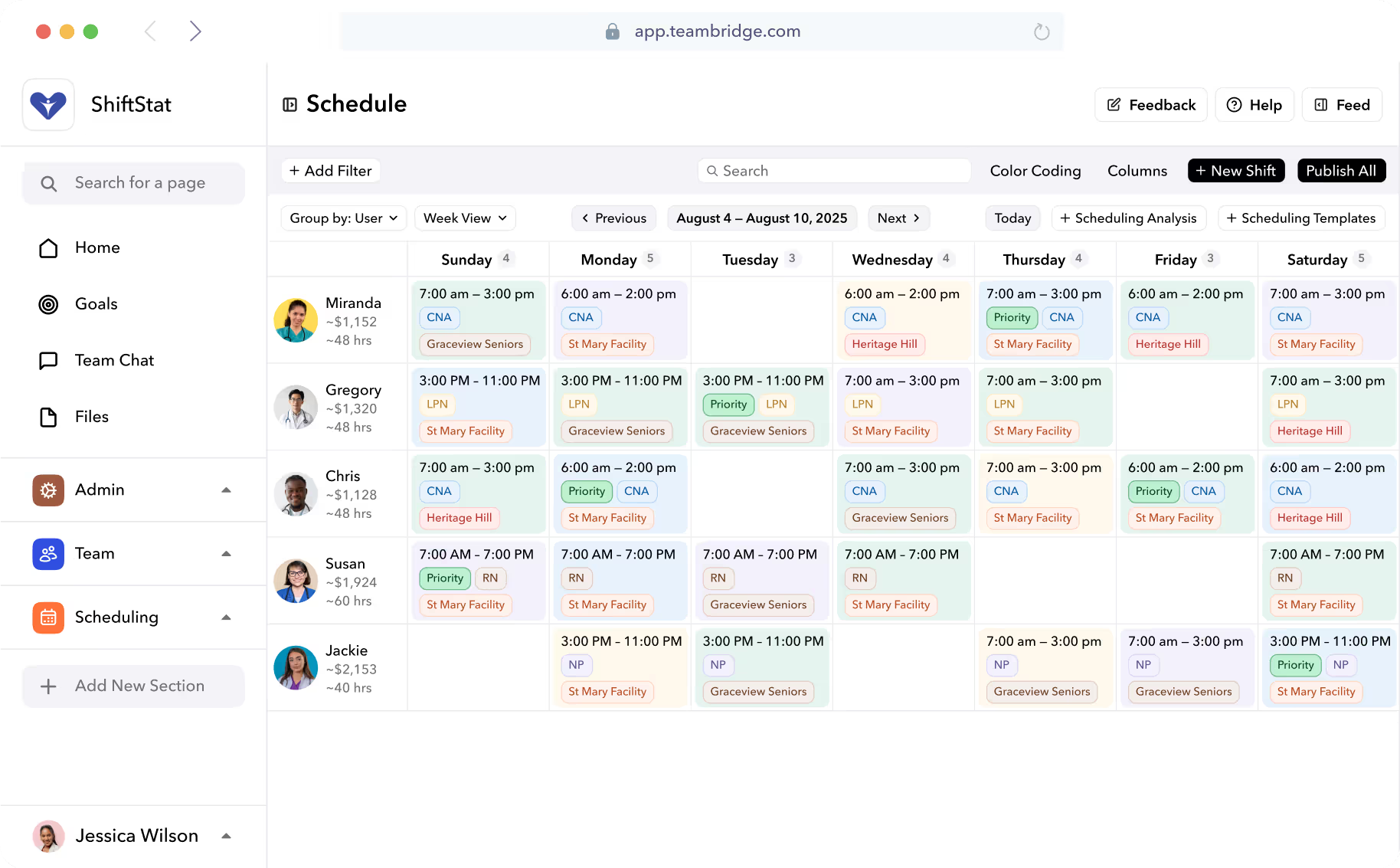
Tools like When I Work handle the small-business end of this well. For staffing agencies, healthcare, and light industrial operations running hundreds of shifts across client sites, the Teambridge scheduling product enforces credentials at assignment, flags overtime before publish, and fills gaps from the qualified pool, all inside the broader Teambridge platform where schedules, time tracking, and pay share one data set.
One boundary worth stating plainly: no software fixes bad availability data or a client who cannot tell you next week's headcount. Software enforces the rules you give it. The fill rules in this article are those rules, whether the system executing them is a spreadsheet or a platform.
Publish the template, then measure it for four weeks
Do not redesign anything yet. Roll out the 12-field template with the fill rules above and track fill rate, schedule-change rate, and hours-to-publish for four consecutive weeks. Four weeks is long enough to smooth out a holiday week or a one-off flu spike and short enough to act on.
Then decide. If fill rate holds above 95 percent and publishing takes under five hours a week, stay manual and bank the discipline. If schedule-change rate climbs past 15 percent or confirmations consume a coordinator's mornings, you have the numbers to justify a system, and you will onboard that system with clean data and proven rules instead of chaos.
Teams already past the spreadsheet threshold can see the workflow end to end on the Teambridge platform page or book a 20-minute walkthrough with the team.

About the author

Content Writer at Teambridge
Anis Nanai is a content writer at Teambridge, with a focus on workforce management and the realities of running hourly teams. He prioritizes conversations with customers, staying close to the market, and understanding how workforce needs are changing. His writing connects those concerns to practical decisions about scheduling, time tracking, staffing, and automation. He examines product developments through the questions that matter to operators: what does this solve, how would it work for my team, and what evidence supports it?
Company perspective: this author works at Teambridge. Customer outcomes are attributed to their published sources.
View LinkedIn profile