

Schedule adherence is 420 divided by 450, or 93.33 percent
Take an 08:00 to 16:00 shift: 480 elapsed minutes. For this example only, reporting policy excludes the scheduled 30 minute lunch, leaving 450 eligible scheduled minutes.
Assume exact activity matching, no grace period, one time zone, and intervals that include their start but exclude their end. Actual activity is known throughout, including confirmed absence at the start. These are example rules, not universal requirements or Teambridge functionality.
Copy this interval reconciliation table and replace the rows with your own planned and actual activity intervals:
| Interval | Planned activity | Actual activity | Eligible minutes | Adherent minutes | Nonadherent minutes |
|---|---|---|---|---|---|
| 08:00 to 08:15 | Work | Absent | 15 | 0 | 15 |
| 08:15 to 12:00 | Work | Work | 225 | 225 | 0 |
| 12:00 to 12:30 | Lunch, excluded | Lunch | 0 | 0 | 0 |
| 12:30 to 12:45 | Work | Lunch | 15 | 0 | 15 |
| 12:45 to 16:00 | Work | Work | 195 | 195 | 0 |
| Total | 450 | 420 | 30 |
The following arithmetic belongs to this hypothetical example. The source supports the definition and eligibility concepts, not the example inputs or result.
Operator view
Schedule adherence in this hypothetical shift
Scheduled lunch excluded
450 minus 30
420 ÷ 450 × 100
Two checks make the table auditable. The intervals account for all 480 elapsed minutes, while the eligible minutes reconcile to 420 adherent plus 30 nonadherent minutes. The lunch row remains visible even though it contributes nothing to the denominator. Excluded time should be explainable, not disappear from the record.
Match planned and actual activity over the same intervals
The calculation depends on a shared timeline. Comparing total scheduled hours with total recorded hours cannot show whether the right activity happened at the right time.
Build the reconciliation from the underlying records:
- Fix the comparison baseline. Identify the schedule version, reporting time zone, eligibility policy, and activity mapping. Keep those references with the completed table so a later edit does not silently replace the baseline.
- Split at every activity change. Create a new interval whenever either planned or actual activity changes. In this example, the actual arrival at 08:15 and return from lunch at 12:45 both create boundaries.
- Classify each interval once. Determine eligibility first, then whether actual activity matches the planned activity. For fully resolved eligible time, adherent and nonadherent minutes must add back to eligible minutes.
At 12:30, scheduled work resumes but actual lunch continues. Those next 15 minutes are nonadherent under the stated rules, even if the worker remains on site. Excluding scheduled lunch does not exclude every minute someone spends at lunch.
Eligibility is a reporting choice that must be explicit. AWS scheduling metrics define scheduled time to include productive and nonproductive activities with adherence enabled. Lunch is therefore not automatically outside the denominator.
Matching rules also vary. AWS adherence documentation describes default classifications and custom mappings between scheduled activities and actual agent statuses. Under custom mapping, any status mapped to the scheduled activity can qualify as adherent. That is a documented vendor approach, not a universal standard or a Teambridge feature.
Warning
Missing actual activity is unresolved evidence, not automatic absence or adherence. Investigate the record before finalizing the calculation. If a provisional report excludes unknown time, disclose that treatment and the omitted minutes rather than silently improving the result.
Put the workflow into practice
See how your team could use this workflow

Excluding a late arrival changes the denominator, not just the label
Now suppose the first 15 minutes receive an approved exception. The approval alone does not tell the analyst how to calculate adherence. It must connect to a reporting rule.
Starting from the original table, consider two independent alternatives:
- Exclude the late arrival interval. Remove its 15 nonadherent minutes from eligibility. Adherent time stays at 420 minutes, eligible time falls to 435 minutes, and 420 ÷ 435 × 100 gives 96.55 percent.
- Count the late arrival interval as adherent. Keep all 450 eligible minutes, but increase adherent time from 420 to 435 minutes. The result is 435 ÷ 450 × 100, or 96.67 percent.
These are hypothetical policies, not documented AWS exception features. Both leave the extended lunch as 15 nonadherent minutes, but they change different inputs. Exclusion says the approved interval is outside the measurement; reclassification says it remains inside and receives adherence credit.
Do not apply both adjustments to the same interval. That would remove the time from eligibility while also adding it to adherent time. The numerator would no longer describe the same set of minutes as the denominator.
A third policy could leave the adherence calculation unchanged. An approval might resolve an attendance exception without changing either eligibility or activity matching. Record whether approval changes the denominator, the numerator, or neither.
Tolerance and schedule corrections need the same discipline. AWS documents configurable adherence thresholds and states that threshold changes apply to future calculations. Its scheduling metrics documentation also describes recalculation after schedule changes within a stated historical window.
For your own reporting, retain the original schedule reference, correction, reason, and resulting calculation. Correcting an inaccurate schedule can be appropriate, but it changes the comparison baseline. It is not the same operation as excluding an exception.
Attendance and staffing coverage answer different questions
Adherence asks whether actual activity matched scheduled activity during eligible time. Attendance asks whether the worker was present under the attendance definition you use. Staffing coverage asks whether available staffing met demand. These are distinct operating questions, not interchangeable formulas.
The extended lunch makes the difference concrete. From 12:30 to 12:45, the worker could be present on site but still not performing scheduled work. An attendance report based on presence might show no absence during that interval, while this adherence calculation records a mismatch.
Presence does not prove adherence, and replacement coverage does not erase the original mismatch.
Suppose another worker covers the assignment during those 15 minutes. Coverage may be maintained, but the original worker's planned and actual activities still differ. Conversely, everyone could follow the schedule exactly while the schedule itself provides too few people for demand.
Use workforce planning tools to explore the adjacent demand and staffing question. Keep the adherence calculation focused on activity alignment. Combining the measures into one percentage makes it harder to identify whether the operating problem is absence, activity timing, or insufficient planned staffing.
Time records support the calculation but may not prove activity
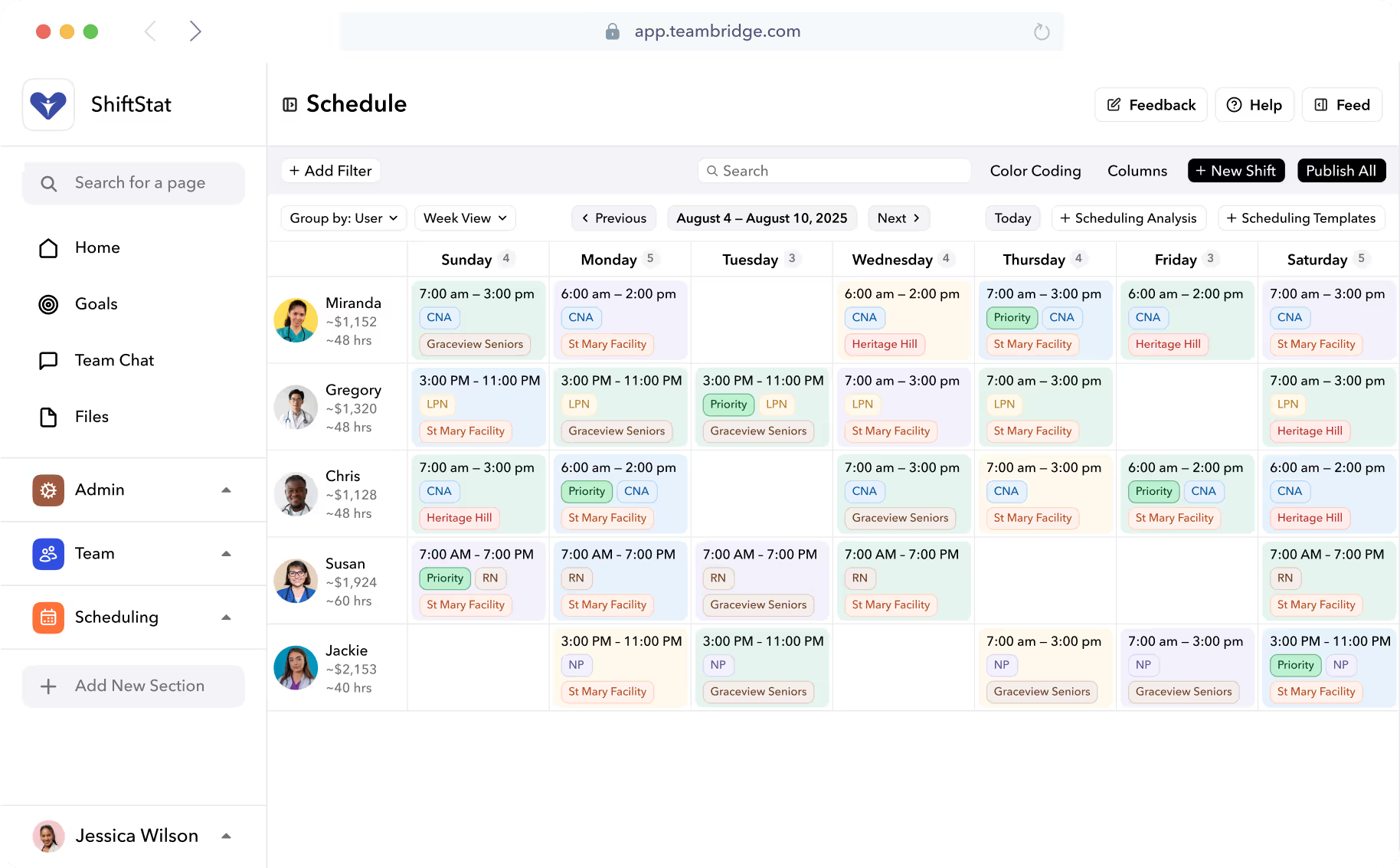
Teambridge time tracking describes mobile punches connected to the scheduled shift, worker, site, and review workflow. It also supports reviewing scheduled and recorded time alongside supporting context. Those records can help an analyst investigate a late start or another timecard exception.
The evidence boundary matters. A clock record can establish a recorded start or end time, but it does not necessarily establish which activity occurred throughout the shift. A person recorded as working from 08:15 to 16:00 might have changed activities several times inside that span.
For the example table, the analyst needs evidence that lunch actually continued until 12:45. If the available records contain only an arrival and departure punch, that interval cannot be established from those punches alone. It requires an appropriate activity record or a documented correction supported by evidence.
The cited product page does not establish a native Teambridge engine for calculating activity level schedule adherence. Treat time capture and exception review as inputs to the analysis, not proof of the entire calculation.
Before finalizing a report, the responsible analyst needs access to the relevant schedule and actual activity evidence. Preserve the reconciled intervals and the references supporting any corrections. If an exception remains unresolved, keep the affected result provisional rather than manufacturing a complete activity history.
Report the percentage with its denominator and exception policy
Publish enough context for another analyst to reproduce the result. For this shift, that means reporting 420 adherent minutes out of 450 eligible scheduled minutes, or 93.33 percent, with scheduled lunch excluded, exact activity matching, no grace period, and no approved exception adjustment.
Keep the schedule version and reporting time zone with the supporting record. If the late arrival is later excluded, the revised report should show 435 eligible minutes and the exclusion reason. Do not replace the percentage while leaving readers to assume the denominator stayed the same.
The base result is not a performance benchmark. It describes one hypothetical shift under one explicit set of rules. A different lunch policy, activity mapping, or exception treatment could change the percentage without changing what happened on the floor.
Reuse the interval reconciliation table on one shift before aggregating a team or reporting period. Check that every elapsed interval is accounted for and that every eligible interval has a supported classification.
For the combined result, use total adherent minutes ÷ total eligible scheduled minutes × 100. Do not take a simple average of shift percentages when their denominators differ. Sum the underlying minutes first, calculate the ratio, and round only the reported result. That preserves the relationship between the percentage and the time it actually measures.

About the author

Content Writer at Teambridge
Anis Nanai is a content writer at Teambridge, with a focus on workforce management and the realities of running hourly teams. He prioritizes conversations with customers, staying close to the market, and understanding how workforce needs are changing. His writing connects those concerns to practical decisions about scheduling, time tracking, staffing, and automation. He examines product developments through the questions that matter to operators: what does this solve, how would it work for my team, and what evidence supports it?
Company perspective: this author works at Teambridge. Customer outcomes are attributed to their published sources.
View LinkedIn profile