

That one timecard is where staffing agencies quietly lose money — or, worse, quietly build a Department of Labor claim.
Holiday pay leakage doesn't show up as a line item on a P&L. It shows up as thin margins, wage complaints six months late, and a payroll manager who "handles it manually." The problem is not the payroll run. The problem is that the rules that should have fired at the shift level never did.
The Partial-Week Problem: Why Holiday Pay Leaks on Multi-Site Assignments
On a single-site assignment, holiday pay is boring. One worksite, one bill rate, one client policy, one state rule. Payroll runs it and moves on.
Split that same worker across two clients in the same workweek and every one of those variables forks. Bill rates diverge. Client holiday policies diverge. Statutory premium rules attach to the worksite, not the agency's headquarters. The timecard, however, still hits one payroll run.
Leakage happens in three directions, and agencies rarely notice more than one at a time:
- Underpayment. The worker's statutory floor was 1.5x for the holiday shift, and payroll paid straight time. That's a wage claim.
- Overpayment without billback. The agency correctly paid premium, but the client's MSA doesn't allow it to be billed through. Margin loss, silent.
- Wrong rule fired. Payroll applied a federal overtime rule to a state that has a stricter one, or missed a state that has one at all.
This is not a federal wage-and-hour problem. Federal law doesn't require holiday premium at all. It's a state-and-contract problem, and it compounds every time an assignment fragments across sites, weeks, or clients.
Which States Actually Force Your Hand: Rhode Island, Massachusetts, and the Daily-OT Trap
The first myth to kill: "holiday pay is optional." It usually is. It isn't always.
Rhode Island is the one state that will bite you
Rhode Island is the only U.S. state that mandates holiday premium pay for private-sector employees. Under R.I. General Laws § 5-23-2, most employees who work on a recognized state public holiday or Sunday must be paid time-and-a-half, regardless of whether they've worked 40 hours that week.
Read that again. Regardless of 40 hours. A CNA who works four hours on a Sunday in Rhode Island is owed 1.5x for those four hours, even if her total workweek is 12 hours.
Rhode Island also observes a holiday no other state does. Rhode Island uniquely observes Victory Day (second Monday in August), which is covered by this premium pay obligation. If your holiday calendar was built off a federal list, Victory Day is already leaking.
There are carve-outs, and this is where most agencies apply the rule wrong. The premium pay requirement does not apply to certain exempt groups including doctors, dentists, attorneys, accountants, supervisory employees, hotel and restaurant workers, and healthcare facility staff. That last category matters: a per-diem nurse placed at a hospital may fall inside the healthcare facility exemption, but a housekeeper the same agency places at the same hospital may not. Same client, same site, different rule.
Regulations tightened again recently. Effective August 17, 2025, new regulations define "retail business" and clarify how the 1.5x premium interacts with weekly overtime calculations. For retail placements, hours worked on Sunday or a holiday are excluded from the calculation of overtime pay. That is, they do not count toward the overtime threshold. If your agency staffs Rhode Island retail on Black Friday, that changes the arithmetic on the following Monday's payroll run.
Massachusetts: the rule that used to exist
Here's where many agency handbooks are actively wrong. Massachusetts used to require premium pay for retail work on Sundays and certain holidays. That obligation phased out. Massachusetts does not require premium holiday pay, and as of January 1, 2023, the state's former retail premium pay requirement for Sundays and certain holidays was fully eliminated following a phase-out under the 2018 Grand Bargain legislation.
What did not go away is the right to refuse. Even without premium pay, the voluntariness requirement remains a meaningful protection. Most retail employers cannot require Sunday work and cannot punish an employee in any way for refusing it. An agency that pressures a temp to accept a Sunday retail shift in Boston has a different exposure than the one in Providence — but exposure all the same.
California, Nevada, Colorado, Kentucky: no holiday premium, but everything else
These states don't mandate holiday premium. They stack rules that interact with holiday shifts in ways that look identical to premium pay when your timecard fragments.
In California, if an employee works seven consecutive days in one workweek, they must receive overtime pay. The first 8 hours on the seventh day must be paid at 1.5x. Any hours over eight on the seventh day must be paid at 2x. A worker who picks up a holiday shift at Client B on what turns out to be her seventh consecutive day across both assignments has triggered a rule the agency's scheduling system probably didn't see.
Warning
Daily-OT states measure the workweek at the employer level, not the client level. Two clients, one temp, one workweek. If you're staffing California, Colorado, Nevada, or Kentucky, the 7th-consecutive-day risk is yours regardless of which client the worker was standing at when it triggered.
The rules at a glance
| State | Holiday premium required? | The trap for staffing agencies |
|---|---|---|
| Rhode Island | Yes — 1.5x on Sundays and state holidays, no 40-hour threshold | Applies at worksite, not agency HQ. Victory Day is state-specific. Healthcare and hotel/restaurant carve-outs are narrower than most operators think. |
| Massachusetts | No (retail premium ended January 1, 2023) | Voluntariness rules and Blue Law exemptions still live. Handbooks written before 2023 are often wrong in both directions. |
| California | No | 7th-consecutive-day OT, daily OT over 8, double-time over 12. All measured across the agency's workweek. |
| Colorado, Nevada, Kentucky | No | Daily overtime thresholds and consecutive-day rules that interact with holiday shifts. |
| Federal (FLSA) | No | Weekly 40-hour OT only. Sets a floor, not a ceiling. |
Where the Money Actually Leaks: Five Pay Rule Collisions on a Fragmented Timecard
Here are the specific points where a partial-week, multi-site timecard breaks pay logic. Every one of these is a real leak we've seen agencies eat.
1. Regular rate blending across two bill rates
If a worker earns $22/hr at Client A and $26/hr at Client B in the same workweek and crosses 40 hours combined, her overtime regular rate isn't $22 or $26. It's a weighted blended rate. Most timekeeping systems don't blend — they apply OT to the last hours worked, at whatever rate those hours carried. That's an underpayment, and the DOL calculates it correctly even if payroll didn't.
2. RI premium not applied because the worker didn't hit 40 at either site
Rhode Island's premium doesn't wait for the 40-hour trigger. If a temp works six hours in Woonsocket on Victory Day and never comes close to 40 that week, the 1.5x is still owed. Systems that key holiday logic off overtime thresholds miss this every time.
3. Client-specific holiday policy in the MSA not reflected in the pay engine
Client A's MSA says billable holidays are the federal six. Client B's MSA says billable holidays include the day after Thanksgiving. Your pay engine has one holiday list. Whichever client's calendar isn't loaded, you're either overpaying or underbilling.
4. 7th-consecutive-day triggers across assignments
Monday through Saturday at Client A. Sunday at Client B. Under California rules, Sunday isn't a fresh start — it's day seven. The agency owes 1.5x for the first eight hours on Sunday and 2x beyond that, and the client's MSA almost certainly doesn't cover it.
5. Shift differentials layered on top of holiday premium in healthcare
Night-shift differential is $3/hr. The holiday multiplier is 1.5x. Is the multiplier applied to $22 + $3 or just $22? For federal regular rate purposes, differentials are included. Agencies that strip the differential before applying the multiplier are shorting the worker.
Worked example: $22/hr CNA over an RI holiday weekend
| Shift | Worksite | Hours | Base | What payroll ran | What was actually owed |
|---|---|---|---|---|---|
| Sun (RI holiday premium day) | Facility A | 8 | $22 | $176 (straight time) | $264 (1.5x under § 5-23-2) |
| Mon (Victory Day) | Facility B | 8 | $22 | $176 | $264 |
| Tue | Facility A | 8 | $22 | $176 | $176 |
| Wed | Facility B | 8 | $22 | $176 | $176 |
| Thu | Facility A | 8 | $22 | $176 | $176 |
| Total | 40 | $880 | $1,056 |
Underpayment: $176 per assignment, per worker, per holiday week. If the CNA is one of forty on your books that week, you're looking at a five-figure liability nobody flagged.
Assume the agency catches this before the DOL does and pays the delta out of margin. The bill-rate agreements say holiday premium isn't billable back to Facility A. That $176 is a permanent P&L hit. Across a fleet, that's the number that quietly kills gross margin between Thanksgiving and New Year's.

Ready to move?
Ready to see Teambridge in action?
The MSA Gap: When Client Holiday Policies Don't Match State Law
Most staffing MSAs specify billable holidays and premium multipliers per client. The client thinks that's the deal. The agency signs it because the account matters. And then the agency, as the employer of record, still owes the statutory floor to the worker regardless of what the MSA says.
That's the gap. The MSA governs what the agency can invoice. The state statute governs what the agency must pay. When those two documents disagree, the agency eats the difference.
Common failure pattern:
- Client A negotiates an MSA that says "no holiday premium billed through."
- Temp works Christmas Day at Client A's facility in Warwick, RI.
- Agency owes 1.5x because Rhode Island says so.
- Agency bills straight time because the MSA says so.
- Delta comes out of margin. Every year. For years.
What to put in the contract
Contract language should tie bill-rate premiums to the statutory obligation at the worksite. Not the agency's state. Not the client's headquarters. The worksite.
Recommended clause structure:
- Bill-rate multipliers for holiday, Sunday, and consecutive-day premiums shall be passed through at cost when required by the statute of the state where the worker performed services.
- Client acknowledges that state and local premium rules apply to the worker's worksite and that agency will invoice statutory premiums as billable pass-through.
- Client-specific holiday calendars, if broader than statutory, shall be billed per the client rate; statutory obligations shall be billed per statute regardless of client calendar.
Important
The host client is not going to absorb your miss. Under joint employer wage-and-hour theory, both the agency and the client can be liable to the worker for unpaid premium — but as between the two, the MSA governs who bills what, and the agency is the employer of record on the paycheck. If the client says "not our problem," they're right about the invoice and wrong about the DOL claim. Both of you will be named.
Audit every MSA for Rhode Island, Massachusetts, and any daily-OT state. If the contract doesn't authorize statutory pass-through, you're already paying for the gap.
What a Pay Engine Has to Do That Spreadsheets and Legacy Payroll Won't
A generic time clock tells you when someone worked. It doesn't tell you which rule should have fired when they clocked in. For a single-site, single-employer W-2 workforce, that gap is small. For a staffing agency running fragmented assignments across five states, that gap is the P&L.
Here's what the pay logic has to do:
- Apply premium at the worksite, not the employer of record. A New York-based agency placing a temp in Providence owes RI premiums. The system has to key the rule off the shift location, not the parent record.
- Maintain holiday calendars per state. Rhode Island observes Victory Day. Massachusetts observes Patriots' Day and Evacuation Day. Federal calendars don't cover either.
- Support client-level bill-rate overrides. Client A pays a 1.5x holiday multiplier voluntarily. Client B doesn't. Client C only pays it on the federal six. All three coexist in the same pay period.
- Detect 7th-consecutive-day triggers across assignments. The workweek is defined at the employer level. If the worker crosses sites, the consecutive-day count doesn't reset.
- Blend regular rate across multiple bill rates. For a workweek that crosses 40 hours across two rates, OT is calculated on the weighted average — not the last-worked rate.
- Flag exemption categories. RI's healthcare and hotel/restaurant carve-outs need to be settable per assignment, not per worker.
A spreadsheet can hold this once. It cannot enforce it at clock-in. Legacy payroll can pay it, but only if someone upstream tells it what to pay — and by the time payroll runs, the shift is a week old and the operator has moved on.
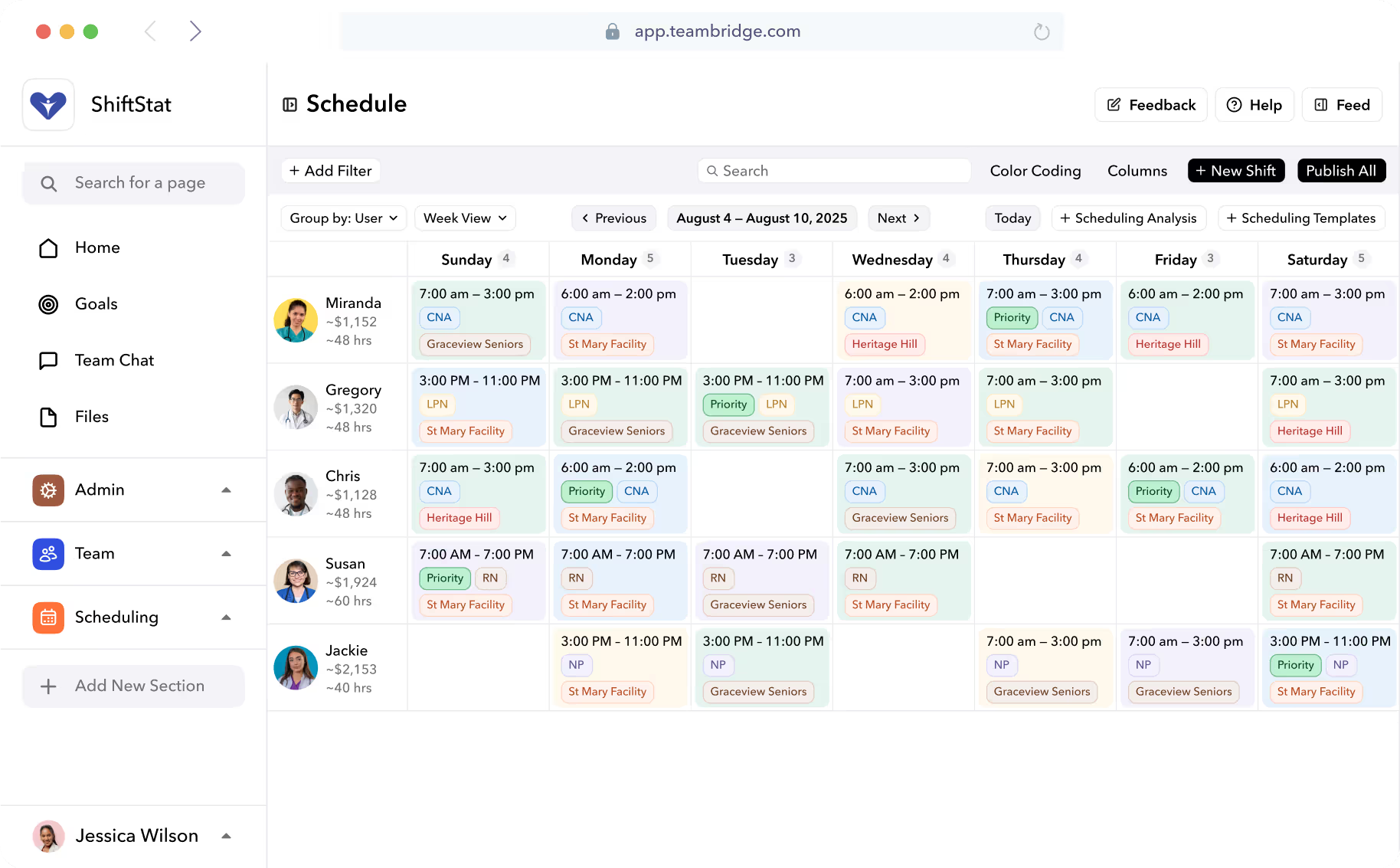
This is where the rule logic needs to live upstream, at the shift level. Teambridge's scheduling engine and time tracking apply state-specific and client-specific pay rules per shift, at the point of clock-in, not per employee record at the point of payroll. The exception fires when the worker taps the button on her phone, not two weeks later when the batch runs.
The Audit You Should Run Before the Next Federal Holiday
Run this in a week. It costs a payroll analyst's time and a data pull. It'll pay for itself the first time you find a missed premium.
The seven-day audit
- Pull last 12 months of timecards for any temp who worked across two or more client sites in the same workweek that contained a federal or state holiday.
- Flag every shift in Rhode Island, Massachusetts, California, Colorado, Kentucky, or Nevada on those weeks.
- Recompute against statutory premium rules at the worksite. RI: 1.5x for Sundays and state holidays including Victory Day. CA/CO/KY/NV: check 7th-consecutive-day and daily thresholds across combined assignments.
- Compare to what payroll actually paid. The delta is your leakage number. Keep it. You'll need it for a board conversation.
- Identify MSAs missing pass-through language. Any client where the delta was paid out of margin instead of billed is a contract renegotiation.
- Configure the scheduling and time system to auto-flag these patterns going forward. The audit shouldn't have to run twice.
Tip
Run this before Q4. Thanksgiving through New Year's is when partial-week, multi-site holiday coverage spikes — because clients close for some days, agencies backfill for others, and workers pick up second assignments. That six-week window is where a full year of leakage often lives.
What good looks like
- Every shift scheduled has a worksite tag, a state tag, and a client tag before it goes live.
- Every premium rule fires at clock-in based on those tags, not at payroll based on operator judgment.
- Every MSA has a pass-through clause tied to statutory obligation at the worksite.
- Every payroll run produces an exception report, not a surprise.
This is table stakes for agencies that have grown past a single state and a handful of clients. It's the operational floor for anyone placing workers in healthcare, light industrial, or hospitality, where partial-week and multi-site coverage is the norm rather than the exception.
Stop Paying for the Gap: Build the Rule Logic Once, Apply It Every Shift
Holiday pay leakage is not a payroll problem. It shows up on the payroll run, but by then the rule has already failed. It's a scheduling and time-tracking problem — a rule-enforcement problem — and it belongs upstream of payroll.
Agencies that push rule enforcement to the shift assignment and the clock-in event stop paying for the gap. Those that don't keep eating margin every holiday, hoping the wage claim doesn't come.
Rhode Island isn't going to loosen up. California isn't going to drop the 7th-day rule. Clients aren't going to volunteer to eat premiums their MSAs don't cover. The only lever the agency actually controls is whether the right rule fires when the worker taps the clock.
Teambridge's staffing agency platform is built around that principle: state, worksite, client, and worker-category rules configured once, applied at every shift. Not per employee. Per shift. Because on a multi-site week, that's the only unit that matters.

About the author

Content Writer at Teambridge
Anis Nanai is a content writer at Teambridge, with a focus on workforce management and the realities of running hourly teams. He prioritizes conversations with customers, staying close to the market, and understanding how workforce needs are changing. His writing connects those concerns to practical decisions about scheduling, time tracking, staffing, and automation. He examines product developments through the questions that matter to operators: what does this solve, how would it work for my team, and what evidence supports it?
Company perspective: this author works at Teambridge. Customer outcomes are attributed to their published sources.
View LinkedIn profile