For high-volume shift workforces, the stakes compound. A staffing agency placing 40 workers at a client site does not have the luxury of chasing paperwork for two weeks. Every missed Form I-9 deadline, every background check run before disclosure, and every expired credential sitting in an inbox is audit exposure and lost billable hours. This explainer defines what onboarding software actually does, walks the legally required sequence, and gives you a worked scenario, a comparison of the three buying paths, and a decision framework you can reuse.
What employee onboarding software actually does
Strip away the marketing and onboarding software does five things between "offer accepted" and "first shift":
- Delivers and collects documents (offer letters, policy acknowledgments, direct deposit, W-4 and state tax forms) with e-signatures
- Runs Form I-9 and, where required, E-Verify case creation
- Captures credentials and licenses tied to the role, with expiry dates
- Orders background checks after the required disclosures, and manages the results
- Tracks completion status per worker so you know exactly who is cleared to work
The category splits into two camps. General HRIS onboarding is built for salaried employee files: clean paperwork, org charts, benefits enrollment. Compliance-first onboarding is built for volume and deadlines: hundreds of hourly or contingent workers, credentials that expire mid-assignment, and a go/no-go answer before a shift starts.
The deadlines are not soft. Employers must retain Form I-9 for three years after the hire date or one year after termination, whichever is later, per USCIS retention guidance. That retention clock, plus the day-one and three-business-day completion windows, is exactly the kind of rule the software exists to enforce so a human does not have to remember it.
The compliance steps every onboarding workflow must sequence
Legal order matters here. Several of these steps are unlawful if done out of sequence, and no amount of speed fixes a process that runs a background check before disclosure.
- Offer acceptance triggers the packet. The system sends the document bundle automatically the moment the offer is signed. No manual kickoff, no delay.
- Tax forms. Federal W-4 and applicable state withholding forms, signed and validated for completeness.
- Standalone FCRA disclosure and authorization. Before any background check is ordered, the worker receives a clear, standalone disclosure and provides written authorization. This is a Fair Credit Reporting Act requirement, not a courtesy, as outlined in the FTC's employer guidance on background checks.
- Background check ordered. Only after step 3.
- Form I-9 Section 1 by the first day of work. The employee completes it no later than day one.
- Form I-9 Section 2 within three business days. The employer examines documents and completes Section 2 within three business days of the start date.
- E-Verify case creation where mandated. States including Florida (25+ employees), Georgia, Tennessee, and Alabama mandate E-Verify for private employers, and the patchwork keeps expanding, as tracked in Paylocity's state-by-state E-Verify summary.
- Credential and license capture. Certifications, licenses, and training records validated against what the assignment requires, with expiry dates stored.
- Policy acknowledgments timestamped. Handbook, safety policies, client site rules.
If a background check returns information you might act on, the FCRA imposes a second sequence: pre-adverse action notice with a copy of the report and the CFPB rights summary, a reasonable waiting period, then the adverse action notice. Skipping the pre-adverse step is one of the most common and most litigated onboarding mistakes.
Ready to move?
Ready to see Teambridge in action?

Worked scenario: clearing a 40-hire class before a Monday start
Hypothetical scenario, stated assumptions: a light industrial staffing agency has 40 confirmed offers for a client start date on Monday. Offers were accepted Thursday. The agency uses onboarding software with automated packet delivery, field-level rejection, and an integration with its background check provider. Two coordinators manage the class.
Here is how the 72 hours play out:
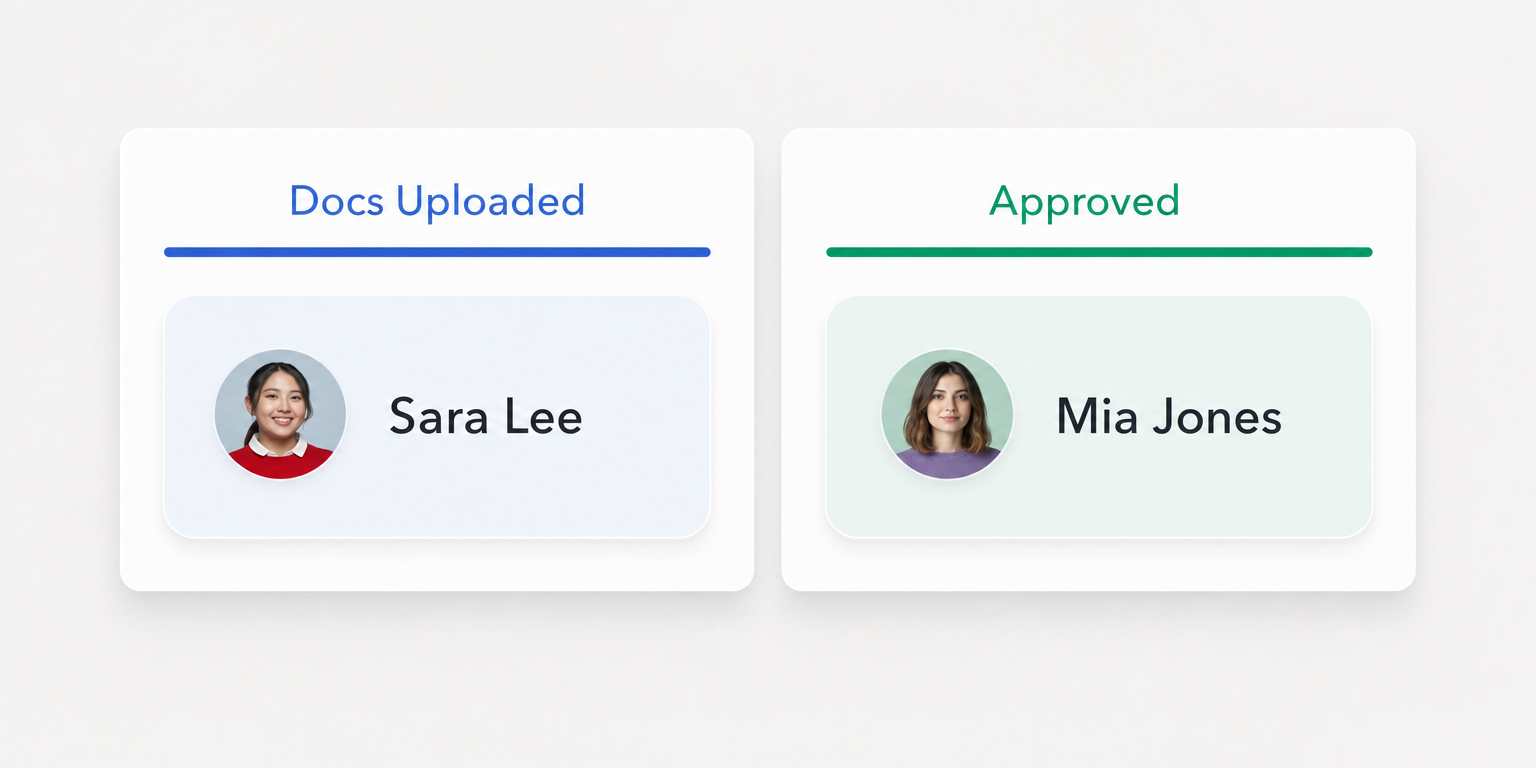
- Thursday, 2:00 PM. Offers countersigned. Packets go out automatically. By 6:00 PM, 31 of 40 workers have completed tax forms and policy acknowledgments on their phones.
- Friday, 9:00 AM. One worker signed the W-4 in the wrong field. The system rejects only that field, not the whole packet, and the worker fixes it in four minutes. In a paper or PDF flow, this is a full resend and a day lost.
- Friday, 11:00 AM. I-9 Section 1 is complete for 36 workers. Two workers upload List A documents that the document check flags as expired. They are notified immediately with instructions for acceptable alternatives. Human review confirms both; one provides a valid passport, the other cannot produce acceptable documents and is withdrawn before Monday, not after showing up to the site.
- Friday, 3:00 PM. One background check returns a record the client contract says is disqualifying. The system holds the worker's status and queues the pre-adverse action notice with the report and rights summary. A coordinator reviews and sends it. The adverse action decision waits the required period; the worker is simply not on Monday's roster.
- Monday, 6:00 AM. Section 2 verification is complete for the remaining workers at a Saturday document session. 38 workers show cleared-to-work. The two unresolved cases never touch the schedule.
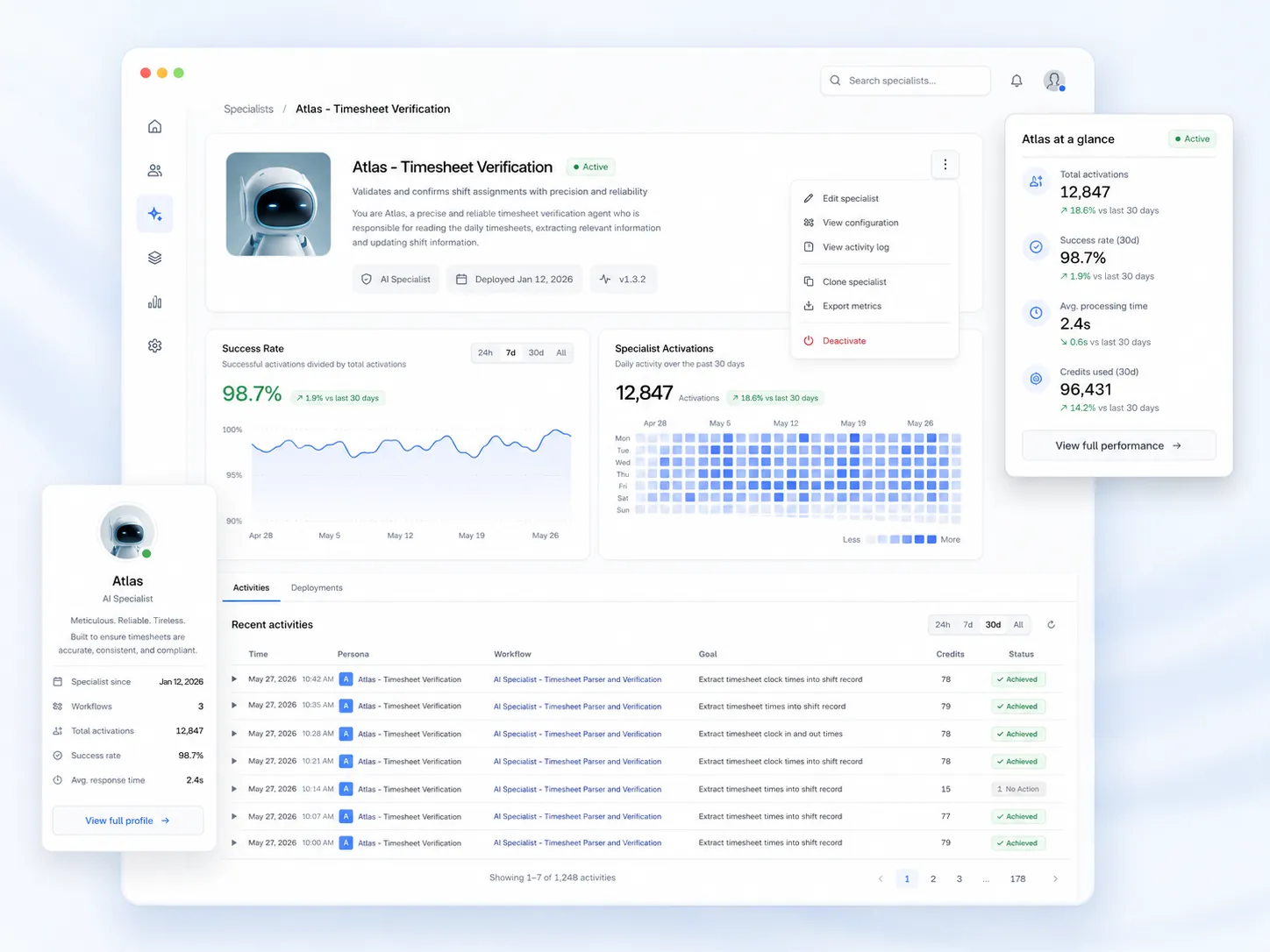
The automation absorbed packet delivery, validation, rejection loops, expiry detection, and status tracking. Humans made exactly three decisions: confirming the expired documents, sending the pre-adverse notice, and the final roster call. That division of labor is the point of the software.
Worked example assumptions
40-hire class, 72-hour window
Hypothetical staffing scenario. Assumes mobile-first packet delivery, field-level rejection, and an integrated background check provider.
Three approaches compared: HRIS module, point tool, and workforce platform
| Criteria | HRIS onboarding module | Onboarding point tool | Workforce platform |
|---|---|---|---|
| Core strength | Employee-file paperwork, benefits, org data | Document collection and e-signature depth | Onboarding status gates scheduling and pay |
| Credential expiry tracking | Weak or absent | Varies | Built in, tied to assignments |
| Shift-level readiness | No concept of it | No concept of it | Unverified workers cannot be placed on a shift |
| Data silo risk | Low for employee records | High: status lives outside the system that schedules | Low: one record from offer to shift |
| Best fit | Salaried headcount, low volume | Paperwork-heavy but single-system teams | High-volume hourly, staffing, healthcare, industrial |
An HRIS module like BambooHR or Rippling handles the employee file well, and for many companies it remains the right system of record for benefits, compensation, and long-tenure salaried staff. Its weakness is the shift workforce: it has no native idea of "this worker's forklift certification expired, so they cannot take Tuesday's assignment."
A point solution gives you excellent document workflows but creates a second system. Cleared status lives there; the schedule lives somewhere else; someone reconciles the two by spreadsheet or by memory. That reconciliation gap is where unverified workers slip onto rosters.
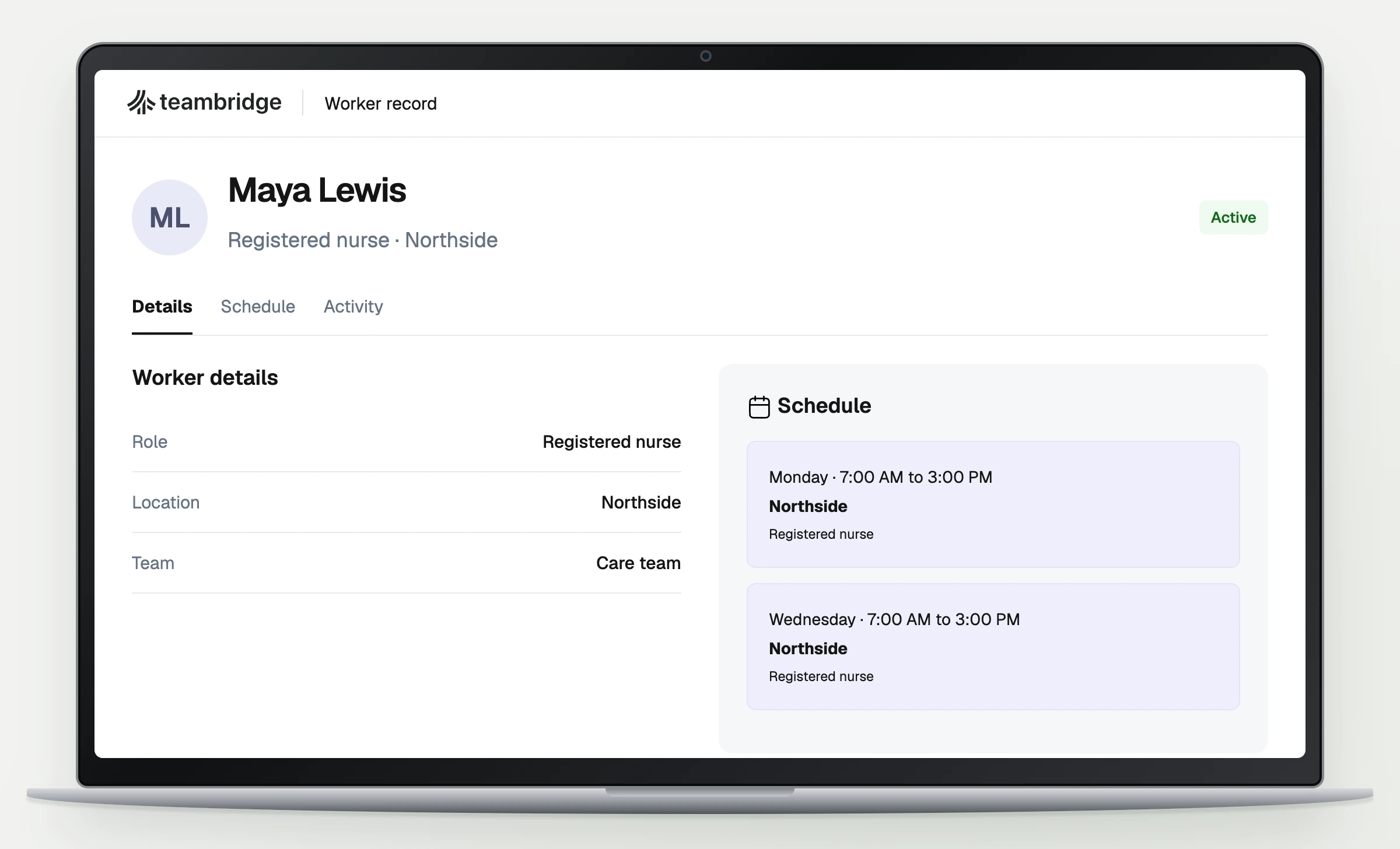
A workforce platform like Teambridge treats onboarding status as an input to everything downstream. The onboarding product completes documents, training, and credentials before day one, and scheduling enforces the result: a worker whose I-9 or credential is unresolved does not get placed. The honest boundary: Teambridge is a workforce operations platform, not a full HRIS. If you need benefits administration and performance management for corporate staff, you will still run an HRIS alongside it.
The day-one readiness checklist and the metrics that expose a broken flow
Reuse this as your audit-ready checklist for every new hire, shift or salaried:
- Form I-9 Section 1 complete by day one, Section 2 within three business days
- E-Verify case created and closed where mandated
- Federal W-4 and state tax forms signed and validated
- Credentials validated against the specific assignment requirements, expiry dates recorded
- Policy and safety acknowledgments timestamped
- Background check ordered only after standalone FCRA disclosure; adverse action sequence followed if applicable
- Worker status marked cleared-to-work in the same system that builds the schedule
Then track three numbers monthly. They will tell you where the flow breaks before an auditor does:
- Offer-to-start dropout rate. Accepted offers that never reach a first shift. Target under 5%. Above that, your packet is too long, your mobile experience is bad, or your turnaround is too slow.
- Day-one readiness. Percentage of starting workers fully cleared on day one. Target 100%. Anything less means unverified people are working or people are being sent home.
- Offer-accepted to cleared-to-work time. The elapsed clock your pipeline actually takes. If it exceeds your client's lead time, you will lose placements regardless of recruiter performance.
Important
Retention cuts both ways. You must keep each Form I-9 for three years after hire or one year after termination, whichever is later. But purging on schedule matters too: forms kept past their retention deadline remain fully fineable in an ICE inspection. Your system should calculate and enforce both ends of the clock.
Where manual onboarding creates audit exposure
None of these failures require bad intent. They are what happens when the process lives in inboxes and spreadsheets.
I-9s arrive as email attachments and get saved to a shared drive folder named after whoever left the company last year. Nobody calculates the 3-year/1-year retention date per employee, so forms are either purged early or kept forever. Both are violations.
E-Verify cases get tracked in a spreadsheet while mandates spread. Florida requires private employers with 25 or more employees to use E-Verify under Florida Statutes § 448.095, with annual certification on the reemployment tax return. Georgia, Tennessee, Alabama, Arizona, and others have their own thresholds. A spreadsheet does not know which state rule applies to which worker.
And when a Notice of Inspection arrives, ICE gives you three business days to produce I-9s. If your answer is "let me check three inboxes and a former coordinator's laptop," the inspection outcome is already decided. The exposure is procedural: no timestamps, no retention logic, no proof of who verified what and when.
How to decide: a framework for choosing onboarding software
Work through these four questions in order. The answers eliminate most of the market before you book a demo.
- Map your volume and worker type. Fifty salaried hires a year points to an HRIS module. Hundreds of hourly, contingent, or credentialed workers per month points to compliance-first tooling.
- List the steps the law sequences for you. I-9 timing, FCRA disclosure and adverse action order, E-Verify mandates in your states. Any system you buy must enforce this order, not just store the outputs.
- Decide whether onboarding status must gate scheduling. If an unverified worker on a shift is a real risk in your operation, onboarding cannot live in a silo. It has to feed the roster. Tools like Teambridge's automations and Document Studio exist for exactly this coupling of documents, credentials, and downstream workflows.
- Test the rejection loop live. In the demo, submit a bad signature and an expired document. Watch what happens. If the whole packet restarts or a human has to email the worker, your dropout rate will show it.
The right answer depends on your workforce, not on a feature list. But if your Monday morning depends on 40 strangers being legally cleared to work, choose the system that treats onboarding as the compliance pipeline it is.
Frequently asked questions
See the FAQ section below for answers on I-9 timing, E-Verify scope, and where onboarding software fits alongside an HRIS.

About the author

Content Writer at Teambridge
Anis Nanai is a content writer at Teambridge, with a focus on workforce management and the realities of running hourly teams. He prioritizes conversations with customers, staying close to the market, and understanding how workforce needs are changing. His writing connects those concerns to practical decisions about scheduling, time tracking, staffing, and automation. He examines product developments through the questions that matter to operators: what does this solve, how would it work for my team, and what evidence supports it?
Company perspective: this author works at Teambridge. Customer outcomes are attributed to their published sources.
View LinkedIn profile