

Shift differential pay adds a premium for designated hours
The figures below are original hypothetical calculations, not customer results or amounts published by DOL. Both examples use these assumptions:
- One covered, nonexempt employee, with each example representing a separate workweek.
- Base pay of $20 per hour, plus an additional $2 for eight eligible hours.
- No other compensation.
- Federal overtime after 40 hours, with no applicable daily overtime or special healthcare arrangement.
Start with 32 hours at $20 and 8 hours at $22. The $22 rate includes the $20 base rate plus the $2 differential. It is not a $22 premium on top of base pay.
Base earnings: 40 × $20 = $800.00.
Shift premium alone: 8 × $2 = $16.00.
Total straight time earnings: $800 + $16 = $816.00.
Regular rate: $816 ÷ 40 = $20.40 per hour.
Additional overtime premium: $0.00 because the employee did not exceed 40 hours.
Gross earnings: $816.00, before deductions.
You can check straight time earnings another way: (32 × $20) + (8 × $22) = $816. The two methods agree because they describe the same hours and compensation.
The distinction matters even in a week without overtime. The differential is only $16, while $816 is the total straight time compensation. Treating those amounts as interchangeable makes the next calculation harder to audit.
A separate 44 hour week requires a $40.73 overtime adjustment
Now consider a separate week with 36 hours at $20 and 8 hours at $22. The same assumptions apply, but total worked hours increase to 44. Four hours therefore require an overtime premium under the stated federal weekly rule.
First, calculate straight time compensation for every worked hour. Either of these checks produces the same result:
By hourly rate: (36 × $20) + (8 × $22) = $720 + $176 = $896.
By earnings component: (44 × $20) + (8 × $2) = $880 + $16 = $896.
Next, divide total straight time earnings by total worked hours:
Weighted regular rate: $896 ÷ 44 = $20.363636… per hour.
That rate is neither $20 nor $22. The $20 base rate leaves the differential out; the $22 shift rate treats every hour as if it earned the differential. The weighted calculation reflects the compensation actually earned across all 44 hours, following the method illustrated in DOL Fact Sheet 54.
Because the $896 already includes straight time for all 44 hours, only the additional half rate premium remains:
Additional overtime premium: 4 × 0.5 × ($896 ÷ 44) = $40.727272….
Gross earnings: $896 + $40.727272… = $936.73, rounded to cents.
Retain the full precision of $896 ÷ 44 through the calculation. Do not substitute a rounded $20.36 regular rate before calculating the overtime premium. The displayed adjustment is $40.73, but its unrounded value is what produces the final gross calculation above.
Warning
Do not add another 1.5 times the regular rate to $896 for the four overtime hours. That subtotal already pays straight time for those hours. Adding the full 1.5 multiplier would count their straight time twice.
The shift differential does not disappear when overtime begins. It enters the regular rate first, and that rate determines the additional overtime premium. For the broader payroll context, see Teambridge’s guide to regular rate of pay and overtime liability.

Map base pay, shift premiums, and overtime to separate codes
Use this copyable mapping to keep the three earnings components visible. These are proposed codes, not verified Teambridge codes or codes from a payroll vendor. The completed amounts use the separate 44 hour example above.
| Proposed code | Meaning | Example amount | Regular rate treatment |
|---|---|---|---|
| BASE | $20 for all 44 worked hours | $880.00 | Include earnings and count 44 worked hours once |
| SHIFTDIFF | Additional $2 for 8 eligible hours | $16.00 | Include earnings without adding another 8 worked hours |
| OTPREMIUM | Additional half of the regular rate for 4 overtime hours | $40.73 | Keep the statutory overtime premium separate from straight time inputs |
Completed reconciliation: $880.00 + $16.00 + $40.73 = $936.73.
SHIFTDIFF records premium eligibility, not additional time worked. The employee worked 44 hours, including eight hours that qualified for extra compensation. A payroll export that turns the premium quantity into eight more worked hours would use the wrong denominator for the regular rate.
Likewise, OTPREMIUM represents the additional statutory overtime premium, not another four hours of base earnings. Its treatment follows DOL’s regular rate and overtime examples; the code labels and arithmetic here are original.
Before using this mapping, confirm how your payroll system interprets each field. A quantity field might represent worked hours, premium eligible hours, or a calculation input. Matching the code name is not enough if the receiving system handles that quantity differently.
Put the workflow into practice
See how your team could use this workflow
Federal law does not itself require a night shift premium
There are two separate questions: must the employer offer a differential, and how must payroll treat it once paid?
The Department of Labor’s night work guidance states that the Fair Labor Standards Act does not itself require extra pay for night work. A differential can be a matter of agreement between the employer and the employee or employee representative. That is separate from the federal overtime obligation for covered, nonexempt employees who work more than 40 hours in a workweek.
The federal obligation to calculate overtime correctly is separate from the agreement to pay a shift differential.
Check the applicable agreement or policy to identify which hours qualify for the premium and its amount. Do not assume that every hour on a shift qualifies simply because some hours fall within the designated window. The examples here assume eight eligible hours; they do not establish eligibility for any actual employee.
State and local requirements need separate review. For example, California’s overtime guidance generally requires daily overtime after eight hours, along with additional daily and seventh day provisions, subject to exemptions and exceptions. A weekly total alone cannot resolve every California overtime calculation.
Source boundaries
Federal and California overtime boundaries
The examples also exclude the special healthcare arrangement described in DOL Fact Sheet 54. Qualifying hospitals and residential care establishments can use an agreed 8 and 80 system with a fixed 14 day period. Do not apply this article’s weekly arithmetic to that arrangement without reviewing its requirements.
Resolve eligible hours before exporting premium earnings
The arithmetic can be correct while its inputs are wrong. A missed punch changes total hours. An incorrect shift designation changes premium eligibility. A duplicated premium line can inflate earnings or, if mapped incorrectly, the hours denominator.
Before accepting the export, resolve three specific inputs:
- Worked hours: Confirm actual time worked and resolve missing or conflicting punches. Do not use the scheduled duration as a substitute for an unresolved time record.
- Eligible hours: Match the premium quantity to the applicable agreement and approved time record. Record the reason for any correction so another reviewer can reproduce the result.
- Export treatment: Confirm that the premium amount enters straight time earnings without creating duplicate worked hours. Compare the resulting gross pay with the completed mapping table.
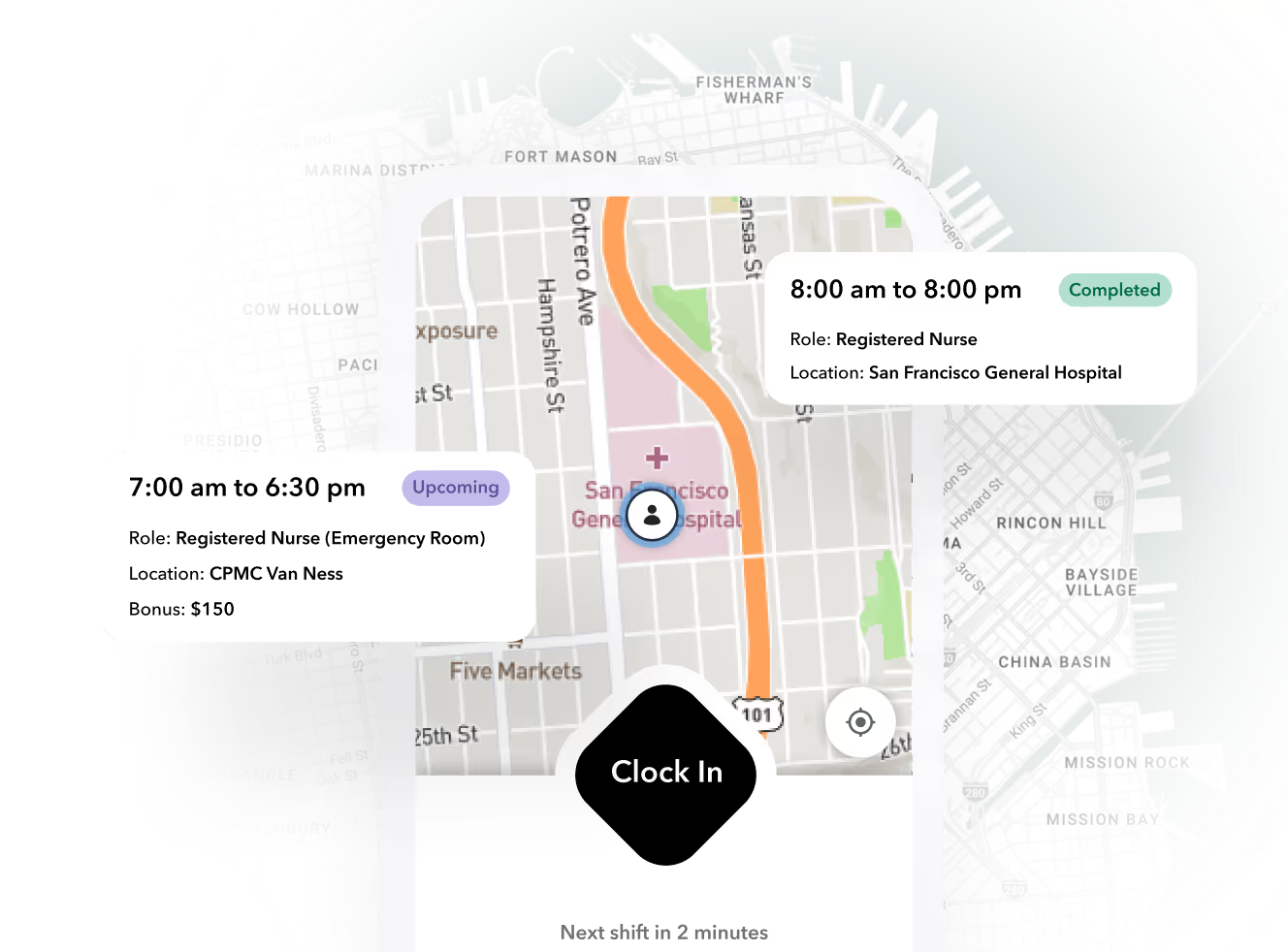
Teambridge’s time tracking product page describes reviewing schedules, punch history, location, and required fields together. That makes it an operational option for examining the records behind this calculation. Location information can provide context, but it does not by itself decide whether an hour qualifies for a differential.
The public page does not establish configuration instructions for the proposed pay codes, required permissions, or support for every differential agreement and jurisdiction. Keep payroll rule ownership with the authorized payroll administrator, and confirm the actual configuration before relying on an export.
If an exception remains unresolved, route it to the authorized reviewer rather than silently forcing the record to match the example. Save the approved correction and its explanation in the designated system of record, then regenerate and reconcile the payroll output. These are recommended review controls, not undocumented Teambridge setup instructions.
Approve payroll only when hours, premiums, and gross pay reconcile
For these examples, approval requires three facts to agree: worked hours appear once, eligible shift premium earnings enter the regular rate, and the additional overtime premium reconciles to gross pay.
Under the stated assumptions, the separate 40 hour week totals $816.00. The separate 44 hour week totals $936.73, consisting of $880.00 in base earnings, $16.00 in shift premium earnings, and a displayed $40.73 additional overtime premium.
Adapt the mapping table to your actual payroll codes before use. Confirm the governing agreement, applicable jurisdictional requirements, and receiving system’s treatment of premium quantities. The calculation is ready only when the time record, code mapping, and gross earnings tell the same story.

About the author

Content Writer at Teambridge
Anis Nanai is a content writer at Teambridge, with a focus on workforce management and the realities of running hourly teams. He prioritizes conversations with customers, staying close to the market, and understanding how workforce needs are changing. His writing connects those concerns to practical decisions about scheduling, time tracking, staffing, and automation. He examines product developments through the questions that matter to operators: what does this solve, how would it work for my team, and what evidence supports it?
Company perspective: this author works at Teambridge. Customer outcomes are attributed to their published sources.
View LinkedIn profile