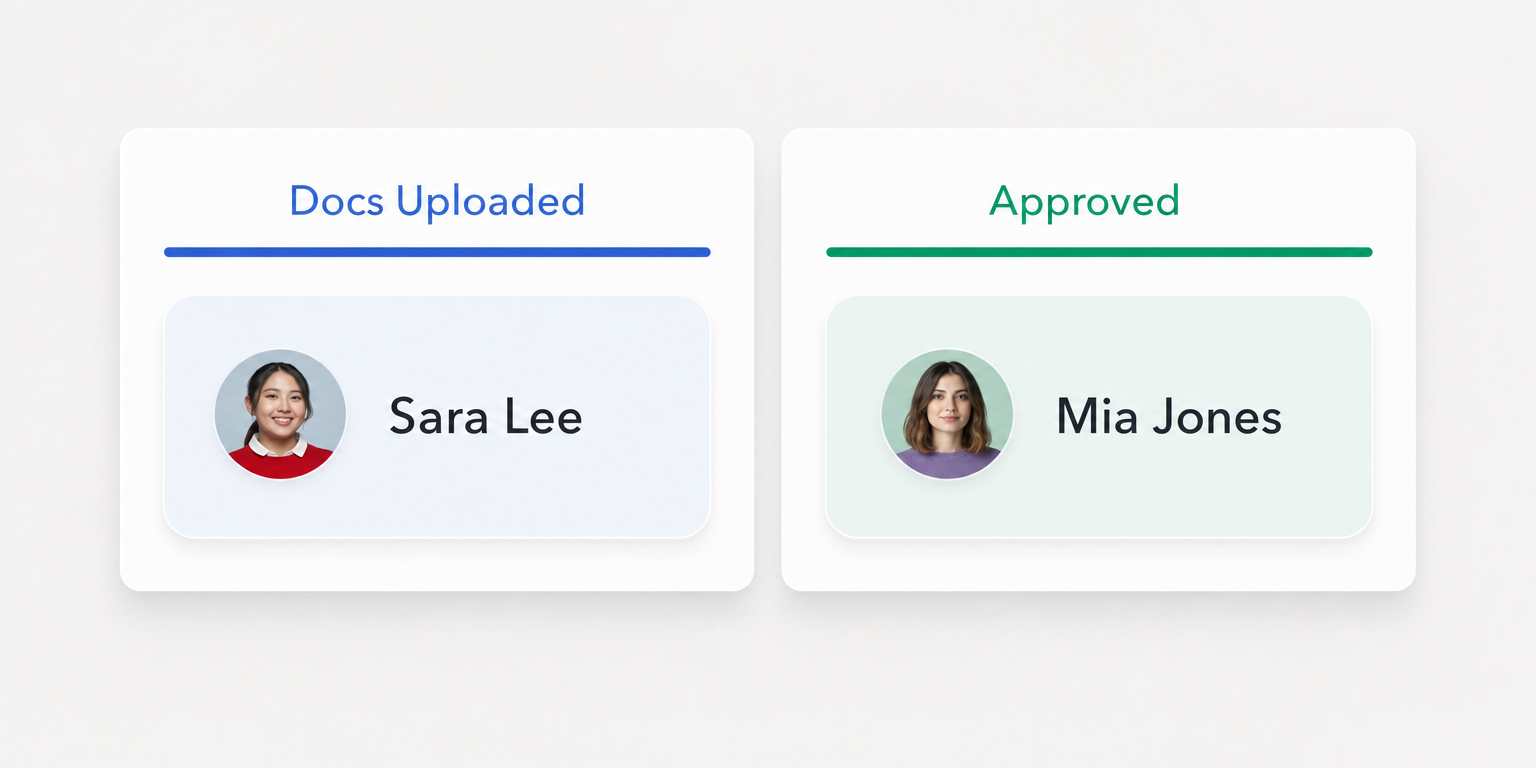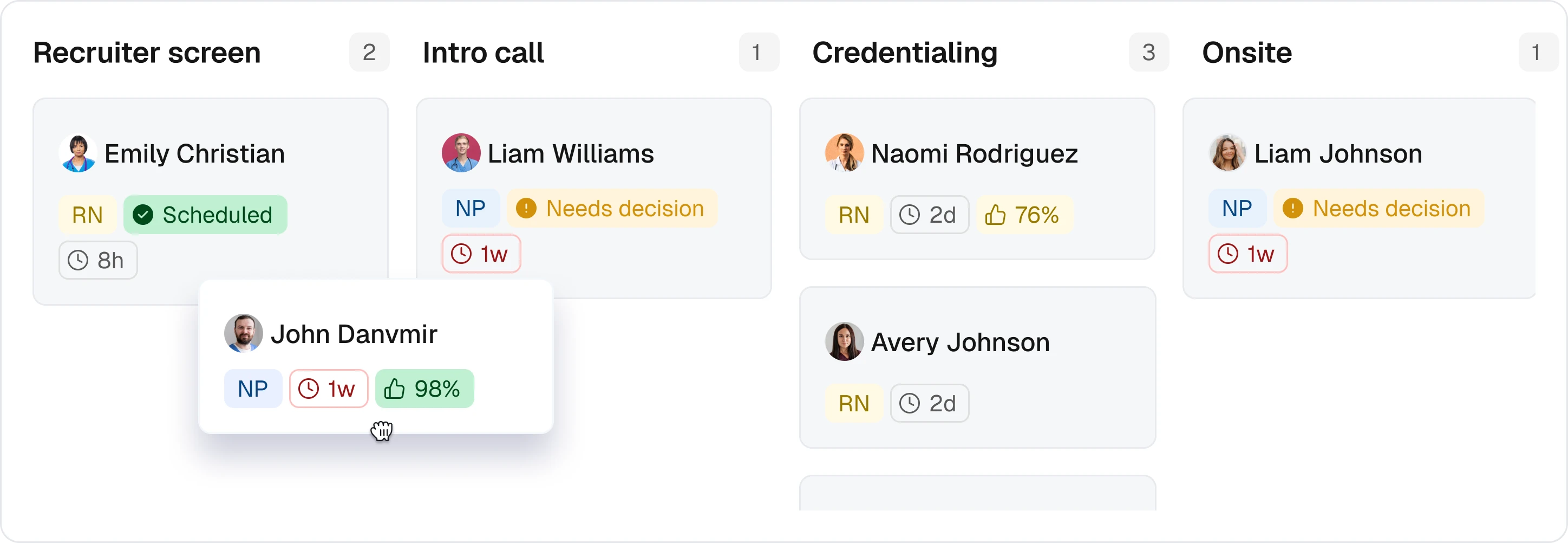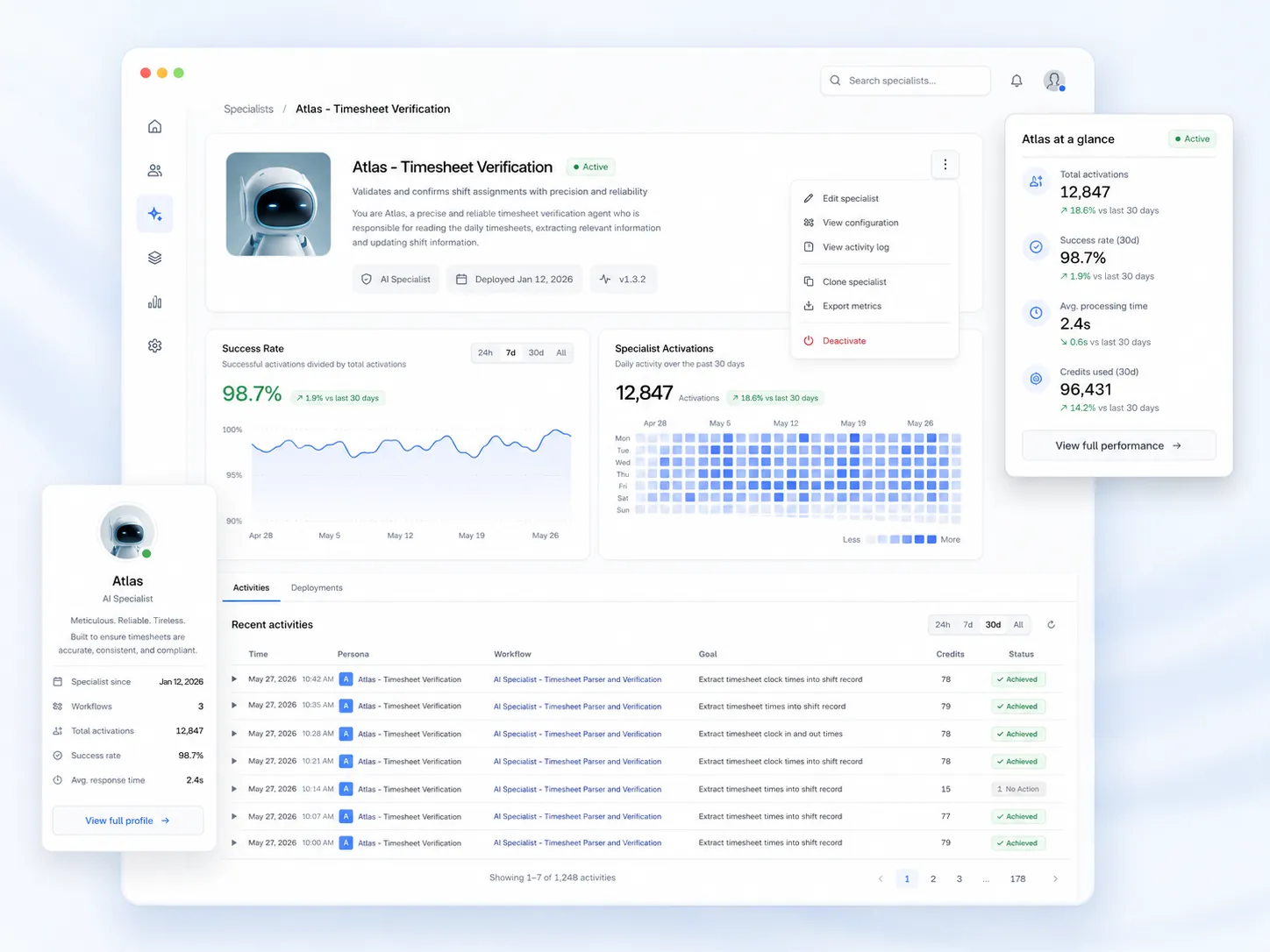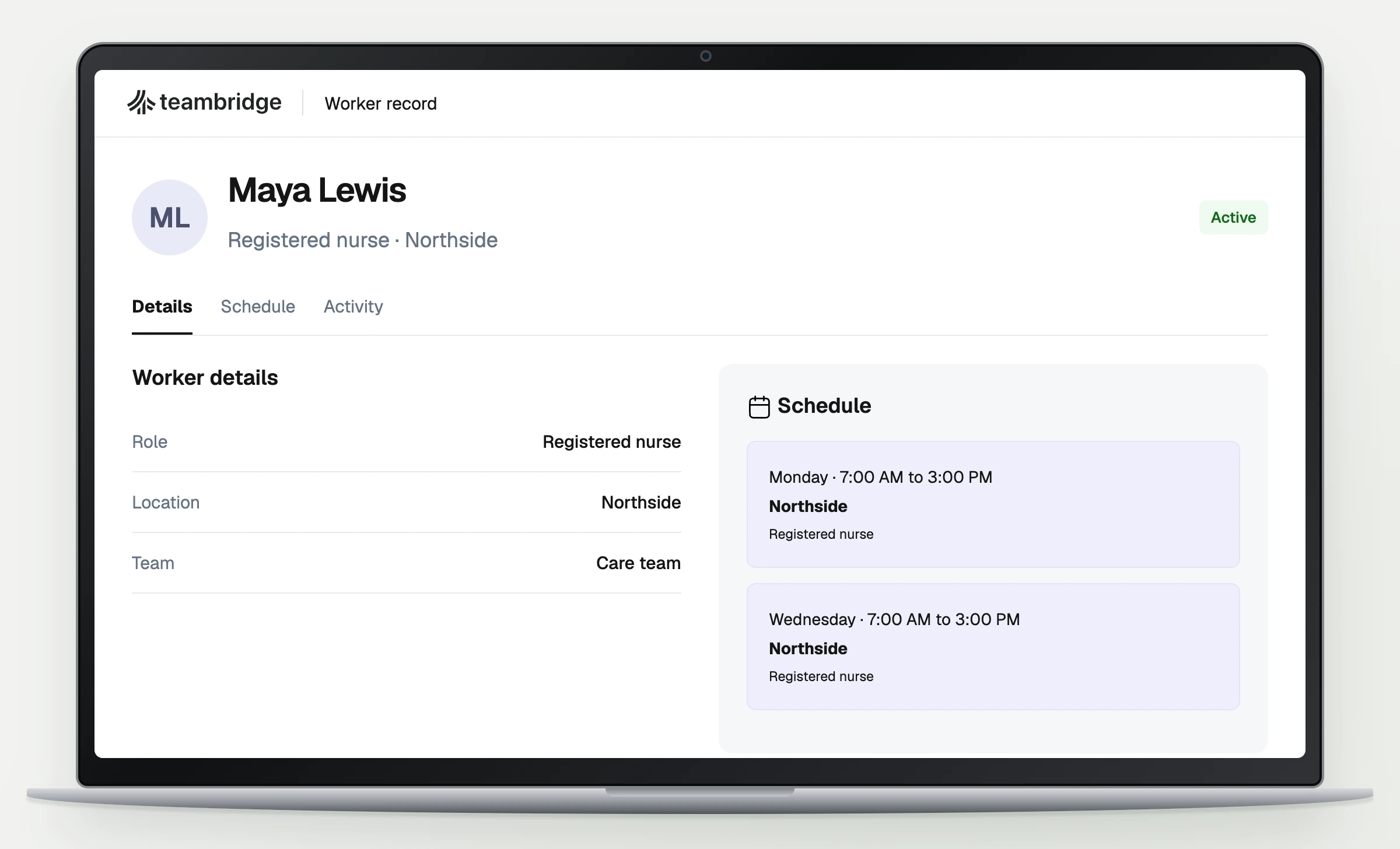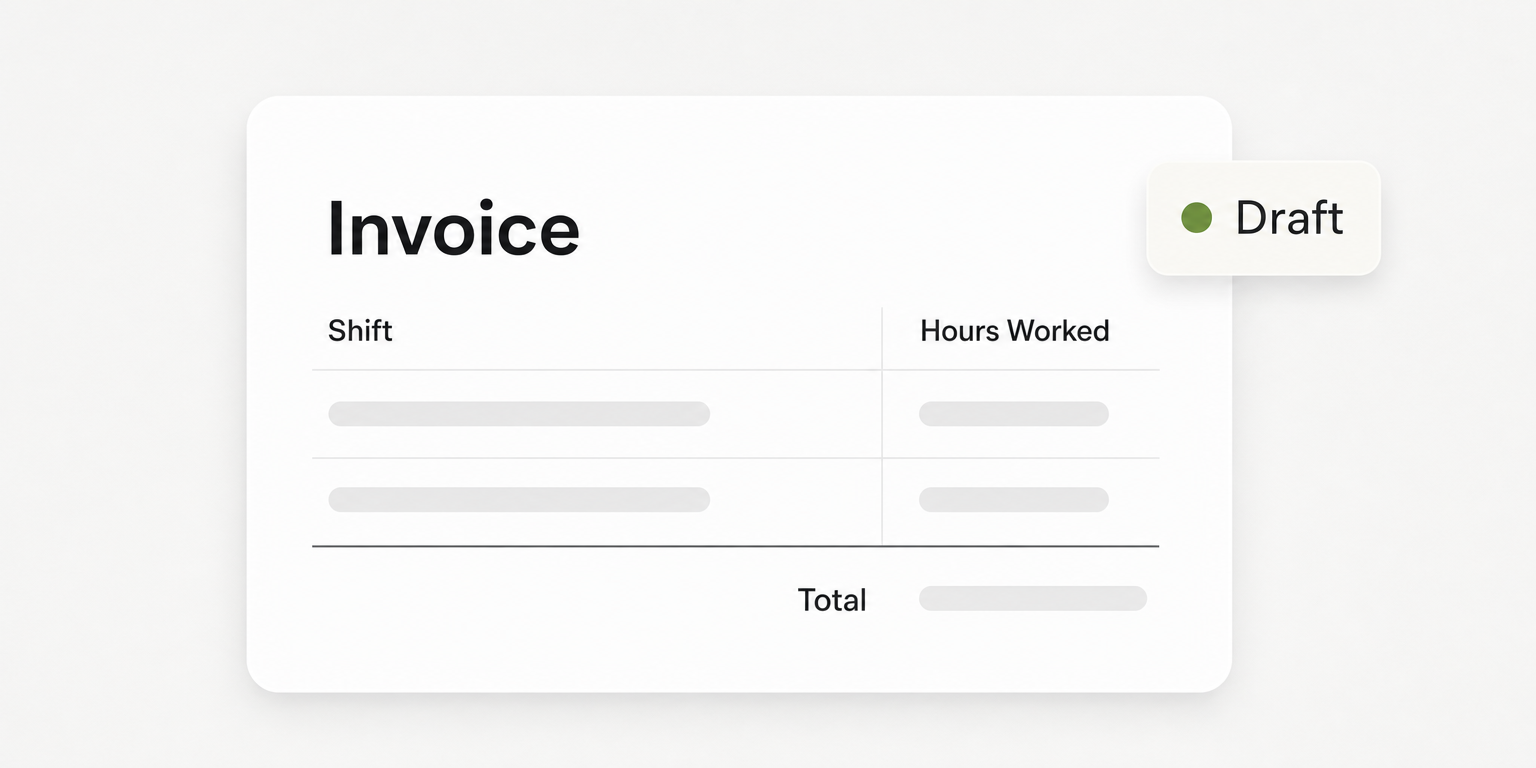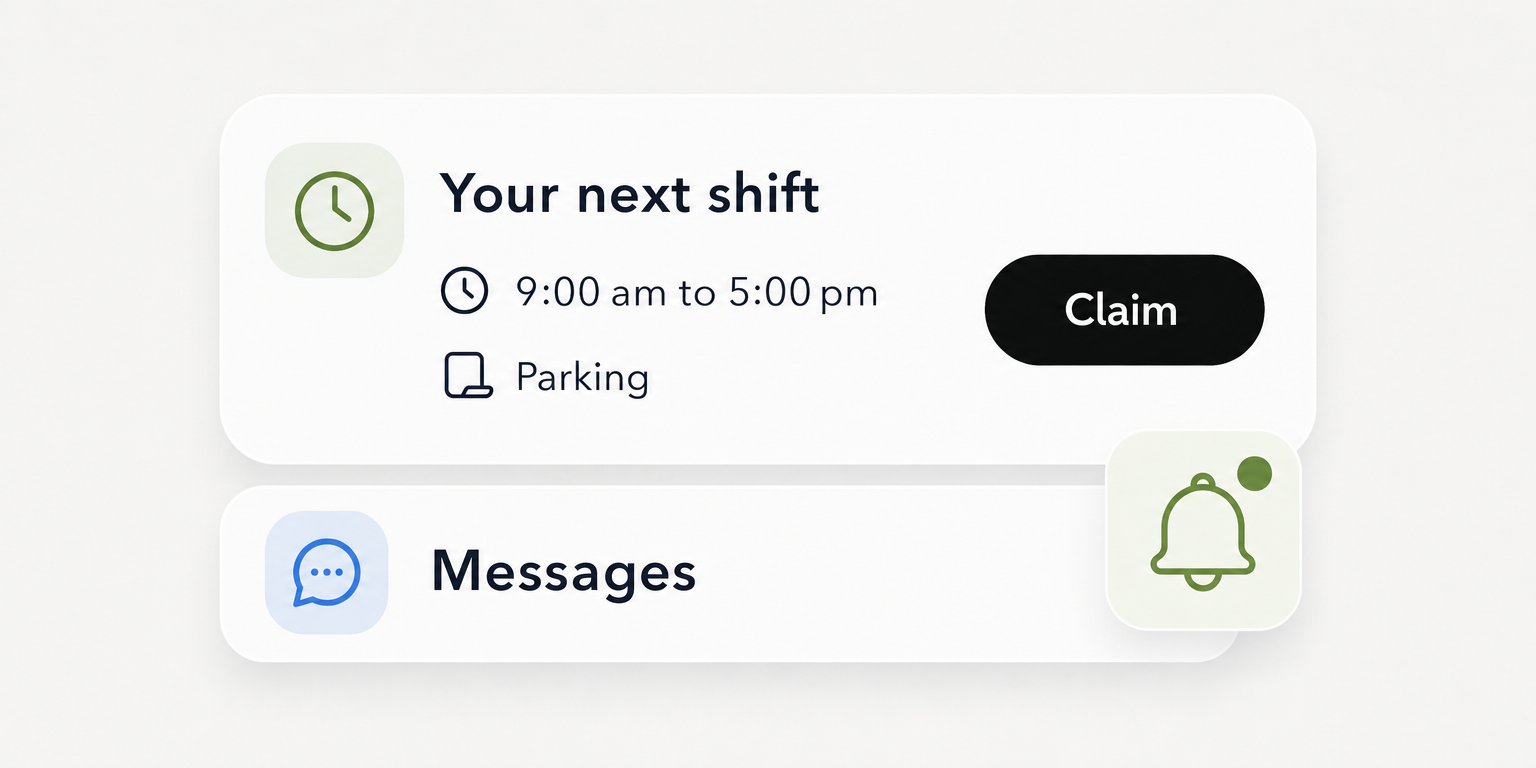
A reminder can be delivered while a worker remains unready for the first shift. A missing punch can trigger a replacement search while the assigned worker is already on site. Automating either sequence without verifying the outcome just moves the mistake faster.
HR workflow automation uses defined triggers and rules to move employee tasks between people and systems. For frontline teams, the goal is a completed process backed by the right record, not just a sent reminder. These five operating designs show what to trigger, who must act, what approval is required, and what evidence should remain when the work is done.
Define the final record before automating the first reminder
Start with the record you need at the end: approved readiness, a verified credential, confirmed attendance status, an approved timecard correction, or a committed assignment change. Then work backward to the evidence and authority needed to produce it. A notification is an intermediate action, not proof of completion.
These are proposed operating designs, not guaranteed Teambridge configurations or customer results. They assume reliable worker identifiers, accessible source records, named approvers, and agreed completion criteria. HR operations owns the process definition; the system administrator validates fields, access, and which changes the configured system can actually save.
Human review is not unique to any one vendor. Workato Workflow Apps documents approvals, review steps, and state transitions. The frontline implementation question is more specific: can the responsible person resolve this case against the correct worker, shift, or time record without leaving a second unresolved task elsewhere?
Use Teambridge’s HR automation best practices for broader planning. Here, keep each workflow bounded by one accountable owner, one explicit closure rule, and an exception path that remains visible until resolved.
Important
Separate “message sent,” “evidence received,” “approved,” and “record updated.” Before launch, establish where each state is stored and who can change it. If the system cannot preserve the required approval, retain an explicit approval reference in the case record rather than assuming it exists.
Move an accepted hire to approved first shift readiness
Trigger: an accepted offer associated with a reliable worker identifier. The onboarding lead owns incomplete requirements; the designated manager owns the readiness decision.
Teambridge’s candidate to first shift recipe describes documents, credentials, training, availability, reminders, and manager visibility. Use it as a starting design, then validate the approval and saved state requirements below against implementation documentation.
- Assemble the readiness record. Connect the worker ID, required documents, training status, availability, and intended start. The onboarding lead needs access to review the required records; the manager needs enough visibility to make the readiness decision.
- Assign incomplete work. Give every missing or rejected item an owner and next action due. A reminder may prompt submission, but it must not close the requirement.
- Approve readiness explicitly. The designated manager reviews the evidence and records the decision against the worker. The proposed final state includes the approval reference and any applicable role or assignment scope.
A rejected document stays open with a reason. If the intended start arrives before approval, route the blocked start to the assignment owner rather than silently treating the worker as ready. An unavailable approver needs a named delegate with validated access, not an informal approval buried in a message thread.
Track median time from offer acceptance to approved readiness alongside blocked starts. Decide how withdrawals and incomplete cases will be reported before measuring; otherwise, fast completed cases can hide a growing backlog.

Verify credential renewals before expiry affects assignments
Trigger: a credential enters the renewal window defined by its responsible owner. The credentialing owner verifies evidence, while the assignment owner handles any resulting coverage risk.
The credential expiration prevention recipe describes expiration windows, renewal requests, reminders, and manager review. The operating design should connect those actions to a reviewed credential record, not just an uploaded file.
- Identify the exposure. Collect the worker, credential type, recorded expiry date, applicable role, and upcoming assignments. The credentialing owner needs access to the evidence; the assignment owner needs visibility into unresolved readiness status.
- Request and review renewal evidence. Check readability, relevant dates, and whether the evidence matches the worker and required credential. Record the review decision rather than equating receipt with verification.
- Save the verified record or escalate. Close the renewal case only when the reviewed credential and verified expiry date are saved. If the renewal remains unresolved, give the assignment owner a separate next action for affected work.
Unreadable files, missing dates, and conflicting evidence stay open with an exception reason. Keep an unresolved assignment risk visible even if the document request has been answered. Validate whether assignment restrictions can be configured and which source record controls them; do not infer automatic blocking from a workflow recipe.
Measure renewals verified before expiry divided by renewals due, alongside unresolved assignment risks. Define the reporting period and treatment of withdrawn requirements in advance. This is an operational record maintenance design, not guidance on which credentials a law or contract requires.
Ready to move?
Ready to see Teambridge in action?
Verify a missing clock in before escalating an absence
Trigger: an expected clock in remains missing after a configured window. The site supervisor verifies attendance; the scheduler owns any replacement decision.
Teambridge’s absence recovery recipe describes worker prompts, risk checks, backup search, and manager alerts. This playbook adds a deliberate verification control: a missing event should not become a confirmed absence without checking what happened on site.
- Reconcile the available evidence. Bring together the assignment, expected start, attendance event, and worker response. Check whether delayed synchronization could explain the missing punch.
- Obtain supervisor verification. Record confirmed presence, confirmed absence, or unresolved status. A worker response can inform that decision, but the site supervisor remains accountable for verification.
- Separate attendance from coverage. Let the scheduler decide whether replacement action is needed. If the attendance case closes while coverage remains unresolved, preserve a linked coverage case with its own owner.
The supervisor needs access to the relevant assignment and attendance evidence. The scheduler needs authority to manage coverage, but that should not automatically grant authority to alter time records. Test both a delayed punch and a worker who is present without a recorded punch before enabling escalation.
A verified attendance status and a resolved coverage problem are different outcomes. Closing one must not erase the other.
Measure time to verified status, false alerts, and unresolved coverage cases. Define a false alert consistently, such as an alert later verified as presence rather than absence. Do not attribute backup search behavior to Teambridge Automations without confirming the required product and configuration.
Resolve timecard discrepancies before payroll handoff
Trigger: an attendance discrepancy requires review. The supervisor owns verification of the proposed correction; the payroll owner owns acceptance of the completed handoff.
For covered employers and workers, the U.S. Department of Labor’s recordkeeping guidance explains that actual hours must be recorded when work differs from a fixed schedule. That supports an important control here: do not substitute scheduled hours merely because the punch record is incomplete.
- Build the correction case. Preserve references to the original punches, assignment, worker explanation, and proposed correction. Missing explanations remain open for follow up rather than becoming permission to guess.
- Route supervisor review. The authorized reviewer approves or rejects the proposed correction. Validate who can edit time, who can approve it, and where the decision and resulting timecard are stored.
- Confirm the handoff. Have the payroll owner acknowledge that the completed record has reached the agreed handoff point. Closure requires both the approved correction and recorded handoff status.
Teambridge’s attendance exception resolution recipe describes correction requests, manager review, and an approved downstream record. It does not, by itself, establish payroll execution or confirmed receipt in a payroll system. Validate export, integration, or manual acceptance behavior separately.
Disputed corrections need an escalation owner. Unavailable approvers need a defined delegate, and cutoff pressure should not silently bypass the approval requirement. Track exceptions unresolved at cutoff, correction cycle time, and reopened cases; a cleared alert is not a substitute for an accepted record.
Close shift swap requests with a confirmed assignment
Trigger: a worker requests a swap against an existing assignment. The scheduler owns the decision and confirms that any approved change is reflected in the saved schedule.
The shift swap approval recipe describes eligibility checks, replacement acceptance, approval routing, and schedule updates. Treat conflict checks and final assignment behavior as implementation questions to test, not guaranteed behavior in every configuration.
- Capture a specific request. Record the original assignment, proposed replacement, availability, relevant readiness records, and replacement acceptance where required. An acknowledgment only confirms receipt.
- Review the current assignment. The scheduler checks that the request is still relevant and that the proposed replacement meets the applicable requirements. The reviewer needs access to readiness and availability records, plus the appropriate assignment editing authority.
- Recheck before saving. Confirm that readiness and conflicts have not changed since the request arrived. Then save the approved assignment change and verify the resulting schedule, or record a rejection with its reason.
Stale requests should receive an explicit disposition. Conflicting assignments, incomplete readiness, and rejected approvals stay visible until the scheduler resolves or rejects the request. If the schedule changes during approval, return the case to review rather than assuming the earlier decision still applies.
The final record is a confirmed assignment or a recorded rejection, not a message saying “approved.” Test simultaneous updates and failed saves to establish what happens when approval succeeds but the assignment change does not. Measure time from request to decision, unresolved swaps at shift start, and reversal rate.
Pilot one workflow with a reusable closure ledger
Choose one workflow at one site before connecting all five. HR operations should capture the existing closure time, unresolved cases, and manual touches, using consistent definitions. The administrator then tests missing data, duplicate events, rejected approvals, unavailable approvers, and conflicting updates.
Use the following workflow closure ledger as a blank case template. Copy it for each case, or transpose the fields into columns in your operating system. Store references to sensitive source records rather than copying documents into a broadly accessible tracker.
| Ledger field | Case entry |
|---|---|
| Case ID | |
| Trigger timestamp | |
| Source record | |
| Accountable owner | |
| Approval required | |
| Exception reason | |
| Next action due | |
| Final record | |
| Closure timestamp | |
| Reopened status |
The source record entry should identify the worker and relevant assignment, credential, or timecard without relying on a name alone. The final record entry should point to the saved outcome and approval evidence. Leave the closure timestamp empty while required work remains unresolved.
Decision framework
Three checks before selecting a system
- 01Establish the baseline
HR operations records closure time, unresolved cases, and manual touches before changing the workflow.
- 02Validate configuration
The administrator checks fields, permissions, and failure paths against Teambridge Automations.
- 03Pilot at one site
The operational owner reconciles ledger entries with final source records before proposing expansion.
During testing, verify that a repeated trigger does not create contradictory cases or duplicate downstream changes. A rejected approval must return to an owned exception path. If the available product documentation does not establish those behaviors, require a verified demonstration or an explicitly documented manual control before launch.
Expand only when closure quality holds under daily review
Set the acceptance criteria before the pilot starts. Define acceptable closure time, unresolved case counts, manual touches, and reopened cases against the measured baseline. Every completed case must also have its designated approval and final record; speed does not compensate for missing evidence.
The workflow owner reviews open exceptions daily during the pilot, focusing on overdue next actions and approaching shift or payroll deadlines. HR operations and the administrator review failure patterns weekly, distinguishing bad source data from unclear ownership or configuration defects. Process owners review rules and permissions monthly, including delegates and access that should be removed.
Pause expansion when duplicate events, incorrect closures, or missing approvals undermine those criteria. Keep unresolved exceptions visible while the defect is investigated. The operational owner should reconcile ledger entries against final source records before recommending another site or workflow.
Teambridge Automations documents triggers, conditions, timing, and actions, making it an option to evaluate for one bounded workforce process. Its workflow recipes still require configuration validation, and Agent behavior should not be assumed to exist in the automation builder. Start with the case your team can define and verify, then expand only when the saved records support the closure claims.

About the author

Content Writer at Teambridge
Anis Nanai is a content writer at Teambridge, with a focus on workforce management and the realities of running hourly teams. He prioritizes conversations with customers, staying close to the market, and understanding how workforce needs are changing. His writing connects those concerns to practical decisions about scheduling, time tracking, staffing, and automation. He examines product developments through the questions that matter to operators: what does this solve, how would it work for my team, and what evidence supports it?
Company perspective: this author works at Teambridge. Customer outcomes are attributed to their published sources.
View LinkedIn profile