

Run these five checks before marking an assignment closed
Copy the table below into your review record. Group the checks into ending, acceptance, and remaining obligations, then replace each bracketed field with a date, status, or evidence reference. Put the assignment identifier, client, worker reference, reviewer, and review date above the table.
These are recommended operational controls, not legal requirements or a native Teambridge checklist. The proposed owners are accountable roles; assign an actual person to each role before using the record.
| Stage and check | Accountable owner | Pass evidence | Fail signal | Escalation recipient | Due date | Review status |
|---|---|---|---|---|---|---|
| Ending: confirm actual end date | Assignment coordinator | Client confirmation, assignment record, and final shift agree; retain source and reviewer | Conflicting dates, unconfirmed extension, or later scheduled shift | Account manager | [Date] | [Pass or fail; evidence] |
| Ending: resolve final hours | Timekeeping lead | Reviewed time records and completed corrections | Missing punches, disputed time, or pending correction | Designated time approver | [Date] | [Pass or fail; evidence] |
| Acceptance: capture client signoff | Account manager | Authorized response identifies assignment and scope accepted | Missing, ambiguous, or qualified acceptance | Account lead | [Date] | [Pass or fail; evidence] |
| Acceptance: confirm worker communication | Assignment coordinator | Worker acknowledges end date and receives time or pay contact | Message sent without acknowledgment | Assignment coordinator for direct follow up | [Date] | [Pass or fail; evidence] |
| Remaining obligations: assign unresolved billing | Billing lead | Resolved items documented; open items have case, owner, next action, and due date | Unowned dispute or incomplete billing evidence | Finance lead | [Date] | [Resolved, handoff accepted, or fail; evidence] |
A pass needs a retrievable record, not just a checkmark. Use a message reference, approved time record, correction case, or billing case that the next reviewer can access. Keep sensitive worker and pay details in the appropriate restricted record rather than copying them into a broadly shared table.
The billing row deliberately permits an accepted handoff. That means ownership is established, not that the balance is settled. Record assignment status and financial closeout status separately beneath the table so a green review does not conceal an open dispute.
Important
The table’s due dates are internal review targets. They do not replace applicable wage payment deadlines, contractual obligations, or required record retention.
Confirm the actual end date against the final scheduled shift
The assignment coordinator should compare three records: the client’s ending confirmation, the assignment record, and the final scheduled shift. All three must identify the same assignment and ending date. Save the confirmation reference and the reviewer’s identity with the first checklist row.
A schedule ending on Friday is not enough if the client has asked for Monday coverage. Likewise, an email saying “finished this week” does not establish a precise end date when the assignment record still shows another shift. Ask for clarification rather than choosing whichever date makes the record easiest to close.
Fail the check when an extension is unconfirmed, dates conflict, or a later shift remains scheduled. The account manager must resolve the conflict before the ending status changes. Retain the original evidence and the clarification so a later reviewer can understand why the date changed.
After an authorized correction, compare the records again. The verification is the agreement among the corrected records, not the fact that someone submitted an edit request. Keep this review limited to the assignment ending; it does not require a decision about the worker’s next placement.

Resolve final hours without treating scheduled time as worked time
The timekeeping lead should account for every final shift, including shifts with no submitted time. Review missing punches, disputed duration, pending corrections, and any record awaiting approval. An empty time record is an exception to investigate, not evidence that no work occurred.
The U.S. Department of Labor’s Fact Sheet 21 on recordkeeping permits fixed schedule records when employers indicate that scheduled hours were actually worked. When actual hours differ, the employer must record the hours actually worked. That distinction is why a scheduled shift cannot simply become approved hours during closeout.
For this checklist, pass only when the final worked time has been reviewed and necessary corrections are resolved. Save references to the approved records and correction evidence. If a supervisor still needs to decide a disputed punch, mark the check failed and route it to the designated time approver with a specific next review date.
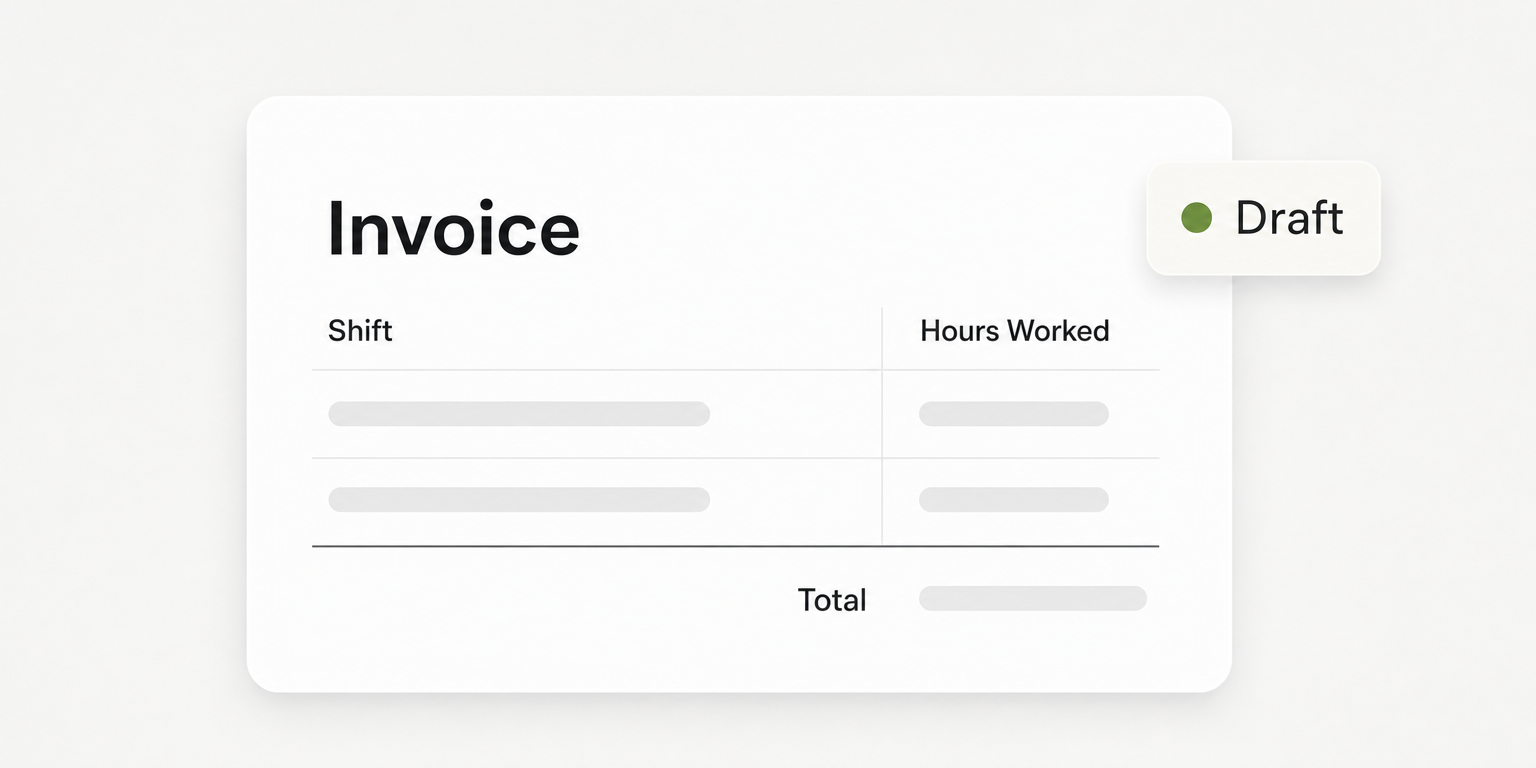
Teambridge Invoicing documents the use of approved workforce time records to create invoice drafts with worker, role, site, hours, and billing context. That supports the connection between reviewed time and billing inputs. It does not establish that approving hours completes an assignment; that separation is an editorial control in this checklist.
Keep client billing questions out of the time approval decision. A disputed premium may leave billing open even when the underlying worked hours are approved. Conversely, client acceptance of the assignment does not cure a missing time record.
Put the workflow into practice
See how your team could use this workflow
Capture client acceptance and worker acknowledgment separately
Client acceptance and worker acknowledgment answer different questions. The client confirms the scope accepted; the worker confirms awareness of the ending date and knows where to raise outstanding time or pay questions. Neither record substitutes for the other.
Client acceptance must identify what was accepted
The account manager should retain a response from a client contact authorized under the account’s established process. The response must identify the assignment and say what was accepted, such as the ending date and completion of the assignment. Do not interpret a casual “thanks” as approval of every hour, charge, or adjustment.
Missing, ambiguous, or qualified acceptance fails this check and goes to the account lead. If the response says the assignment ended but reserves a billing dispute, preserve that qualification. The account lead should establish the accepted operational scope and route the remaining financial issue to the billing row rather than rewriting the response as unconditional approval.
Worker acknowledgment requires more than a sent message
The assignment coordinator should communicate the confirmed end date and provide a contact for outstanding time or pay questions. Retain the worker’s acknowledgment separately from the client response. A sent notification alone does not pass this recommended control.
When acknowledgment is missing, the coordinator should follow up directly through an approved contact method and document the outcome. If the worker raises a missing shift or incorrect end date, return that issue to the relevant checklist row. Acknowledgment does not mean the worker has waived a concern.
An assignment ending is not, by itself, a determination that employment has ended.
Keep any employment or final pay determination with the responsible payroll or HR owner. The Department of Labor’s last paycheck guidance explains that federal law does not require an immediate final paycheck for former employees, while some states require immediate payment. This checklist establishes neither a universal payment deadline nor that an assignment ending constitutes employment termination.
Keep disputed billing open after the assignment ends
The billing lead should review outstanding charges, missing rates, unexpected adjustments, and incomplete source data. Teambridge’s invoicing product page describes review of these billing exceptions before an invoice moves forward. Identifying an exception is useful, but identification alone does not resolve it.
Use three distinct outcomes in the billing row:
- Resolved: Evidence shows the item was corrected or otherwise settled through the authorized process.
- Handoff accepted: A linked case has an accountable person, next action, and due date, but the issue remains open.
- Fail: The issue lacks ownership, evidence, or a usable next action and must go to the finance lead.
An email forwarded to finance is not an accepted handoff. The receiving owner must accept responsibility, and the case must show what happens next. If that acceptance is missing, the billing lead retains responsibility for escalation.
Completed hypothetical example: ending confirmed, premium disputed
This teaching example assumes one worker, one client, and a final shift on October 16, 2026. It also assumes supporting records exist for the ending date, approved final hours, client acceptance, and worker acknowledgment. All references below are fictional teaching labels, not customer records or results.
The client accepts the assignment’s completion while reserving a premium charge dispute. Billing accepts that dispute for review by October 21, 2026. The same checklist now reads:
| Stage and check | Accountable owner | Pass evidence | Fail signal | Escalation recipient | Due date | Review status |
|---|---|---|---|---|---|---|
| Ending: confirm actual end date | Assignment coordinator | E1: client confirmation, assignment record, and final shift match October 16; coordinator review retained | None under the assumptions | Account manager | October 16, 2026 | Pass; E1 |
| Ending: resolve final hours | Timekeeping lead | T1: final worked hours approved; corrections complete | None under the assumptions | Designated time approver | October 19, 2026 | Pass; T1 |
| Acceptance: capture client signoff | Account manager | C1: authorized acceptance of completion; premium dispute explicitly reserved | Financial qualification retained in B1 | Account lead | October 19, 2026 | Pass for assignment acceptance; C1 |
| Acceptance: confirm worker communication | Assignment coordinator | W1: end date acknowledged; time and pay contact received | None under the assumptions | Assignment coordinator for direct follow up | October 16, 2026 | Pass; W1 |
| Remaining obligations: assign unresolved billing | Billing lead | B1: billing accepts premium dispute; next action is to compare the charge with agreed rate evidence | Premium remains disputed | Finance lead if ownership or review lapses | October 21, 2026 | Handoff accepted; B1 remains open |
The outcome is assignment ended; financial closeout open. The premium dispute is not resolved, and the example makes no claim that an invoice has been paid. On October 21, the billing owner must record a decision or a documented next action and review date rather than silently carrying the item forward.
Review the closeout record before adopting it in your system
Test the table against one recently ended assignment before making it a routine control. Start with the actual records, not a reconstruction from memory. Every failed check should have an evidence reference, accountable owner, next action, and next review date.
- Populate the record. Enter the assignment identity, reviewer, five checks, and separate assignment and financial statuses. Confirm that each evidence link opens for its intended reviewer.
- Test a failed check. Use a missing acknowledgment or unresolved billing item to verify that the owner accepts the next action. Do not assume a status change automatically routes an exception.
- Reopen the saved record. Confirm that evidence, ownership, dates, and both statuses persist, and that permitted reviewers can see the information they need.
The Teambridge Platform documents configurable records, views, fields, permissions, forms, and workflows. Those capabilities make it an operational option for this review, but the cited page does not document a native assignment closeout checklist or exact setup instructions. Before configuring it, have the workspace administrator validate the required access, allowed edits, saved states, and exception path against current product documentation and the configured workspace.
Operator view
Supporting evidence
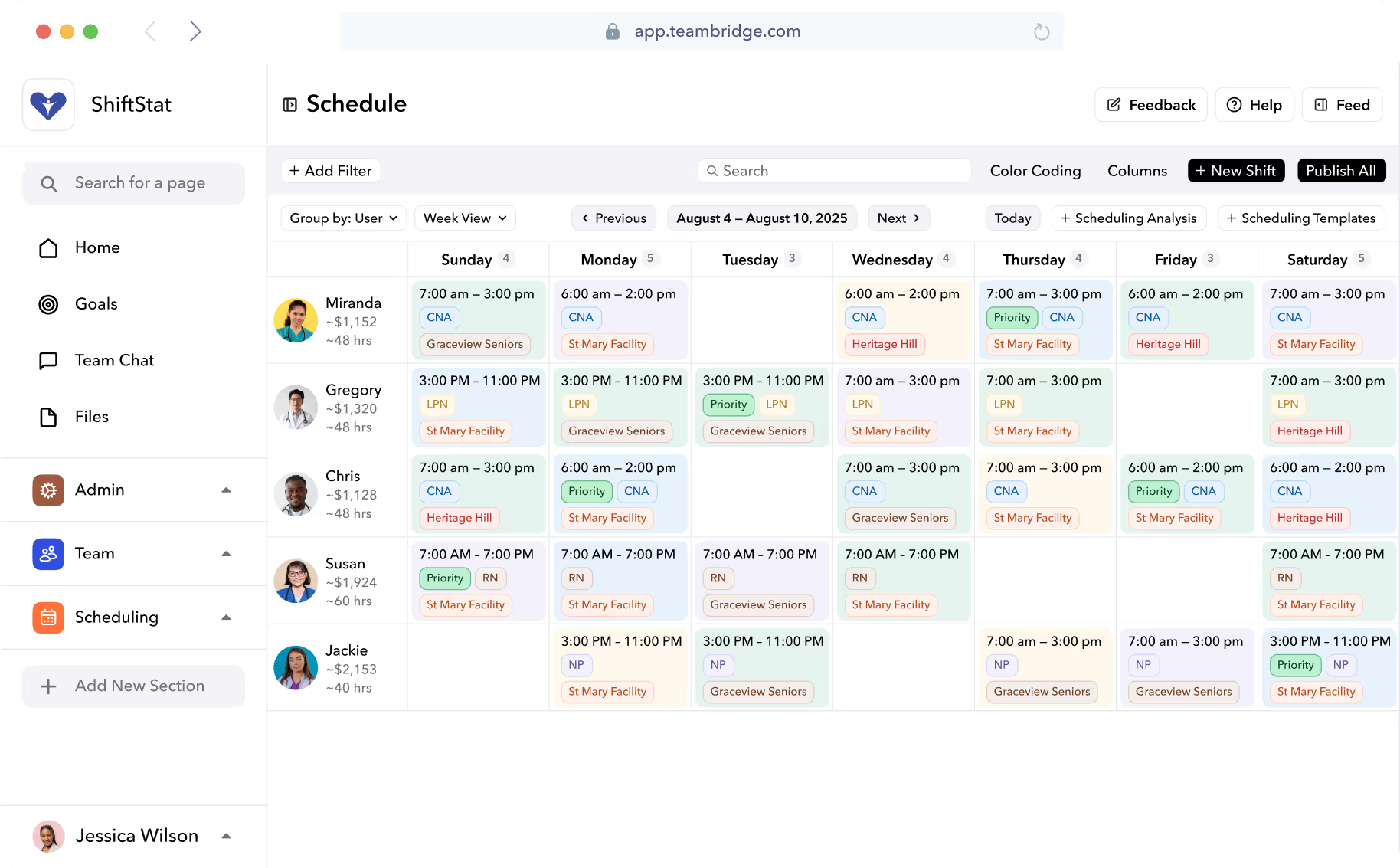
Teambridge billing workspace shown on its invoicing product page. This view provides billing context, not an assignment closeout checklist.
A maintained invoice status does not establish automatic payment reconciliation or guaranteed collection. Keep accounting verification with the responsible finance process. The closeout record should make the remaining work visible without claiming that workforce operations software has settled it.
For the next assignment review, use the table to answer two separate questions: has the assignment ended, and what obligations remain? Accept the record only when each answer has evidence and every unresolved item has someone responsible for the next action.

About the author

Content Writer at Teambridge
Anis Nanai is a content writer at Teambridge, with a focus on workforce management and the realities of running hourly teams. He prioritizes conversations with customers, staying close to the market, and understanding how workforce needs are changing. His writing connects those concerns to practical decisions about scheduling, time tracking, staffing, and automation. He examines product developments through the questions that matter to operators: what does this solve, how would it work for my team, and what evidence supports it?
Company perspective: this author works at Teambridge. Customer outcomes are attributed to their published sources.
View LinkedIn profile