Workers can install a mobile app while the office keeps doing the same work. Supervisors still repair permissions, reconcile rejected updates, and chase assignment changes by text. The deployment has moved the interface, but not the responsibility.
When comparing mobile workforce management software companies, ask what your team will still own after launch. A mobile feature list cannot tell you who maintains eligibility rules, fixes integration failures, or changes access when someone moves between locations.
The mobile subscription is only part of what you are buying
Separate the purchase into three decisions: software capability, implementation services, and ongoing administration. The first establishes what the product can do. The second establishes who makes it work for your operation. The third establishes who keeps it working when your operation changes.
Those decisions need separate evidence. A demonstration can prove that a worker can claim an assignment. It does not prove that your worker records, approval rules, and downstream systems are configured to accept that claim without office intervention.
Teambridge, Skedulo, and Microsoft Dynamics 365 Field Service are options worth evaluating against the actual work. Their documentation exposes different setup obligations, but it does not provide comparable implementation quotes or independently measured administrative workloads. Treat the sources below as capability evidence, not vendor rankings.
Start by defining the transaction you need to complete. Is it an eligible worker claiming an open shift, a mobile worker receiving an assignment, or a technician updating a service work order? Follow that action through to the office record that must change before calling the workflow complete.
An installed app is not a completed deployment. Acceptance should depend on the worker action and the resulting operational record.
Teambridge, Skedulo, and Microsoft document different setup obligations
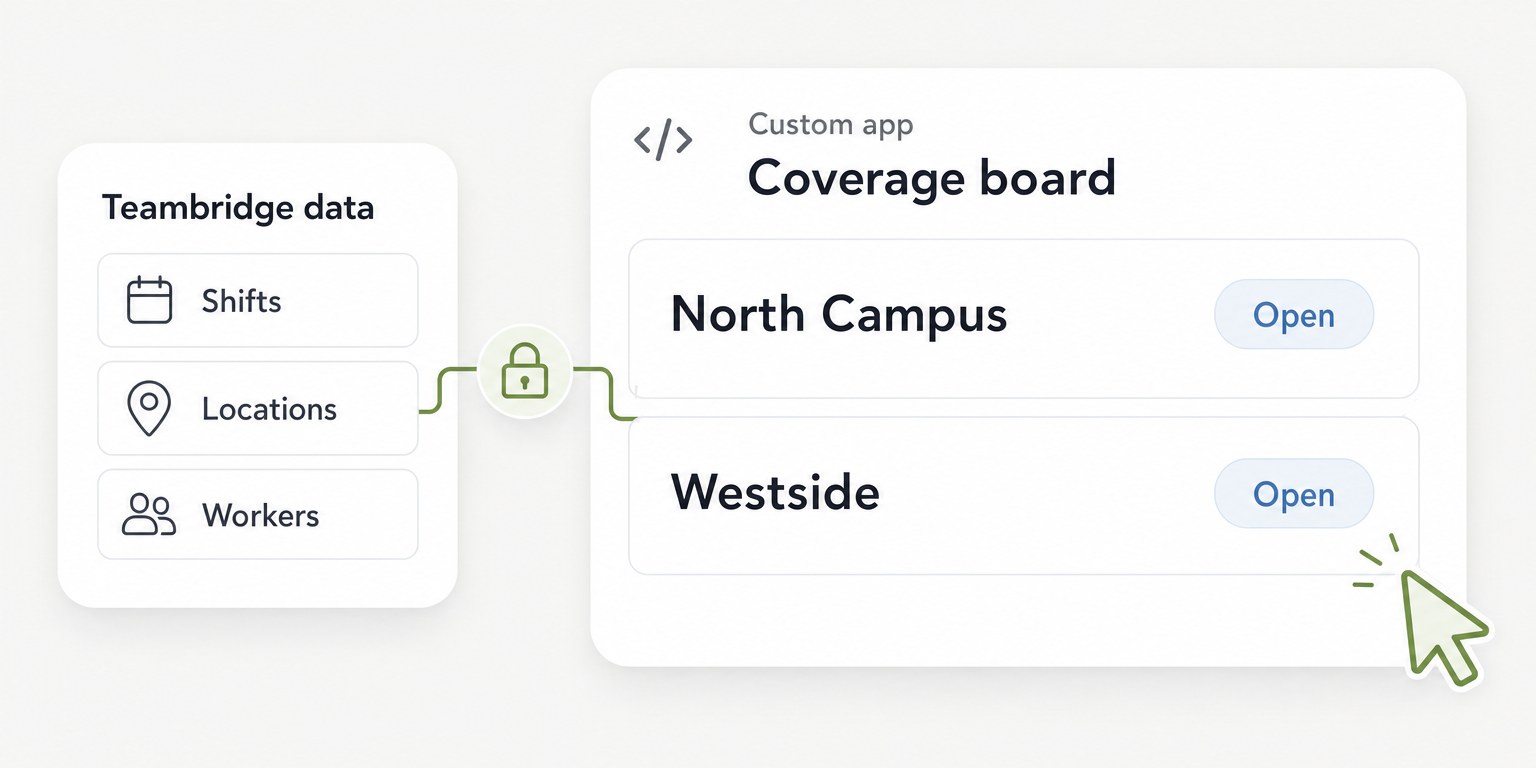
The Teambridge platform documents configurable records, views, fields, permissions, forms, and workflows. That gives buyers operational building blocks. It does not establish who builds them, whether configuration services are included, or who maintains them after handover.
For a buyer with changing assignment rules, that distinction is central. Ask who translates operating policy into fields and permissions, who approves the configuration, and who updates it when a customer adds a requirement. Flexibility only helps if someone owns the configuration work.
Skedulo’s product FAQ documents Android and iOS support, offline capability, prebuilt integrations, and an onboarding package delivered with its Customer Success and Delivery teams. It also describes professional services for complex implementations. The FAQ does not enumerate every offline transaction or provide an itemized statement of work for onboarding.
Ask which migration, training, integration, and acceptance deliverables the proposed package covers. A prebuilt connector may be relevant, but the catalog alone does not establish your field mappings, write-back behavior, or maintenance arrangement.
Microsoft’s mobile overview states that the Field Service mobile app is included in the Field Service license at no extra charge. Its frontline worker setup documentation separately describes bookable resources, skills, territories, time zones, security roles, field security profiles, and mobile offline profiles. Each frontline worker needs an assigned Field Service license.
App inclusion therefore answers a licensing question, not a deployment question. Your proposal still needs to identify who creates and validates those records and access settings.
Decision framework
Three checks before selecting a system
Platform documentation
Product FAQ
Frontline worker setup

Require the proposal to separate included features from configured behavior
A useful proposal connects every important feature to the configuration that makes it usable. “Open-shift claims” is a capability. “Workers can claim only assignments that satisfy the approved eligibility rules” is a configured behavior that needs demonstration and an owner.
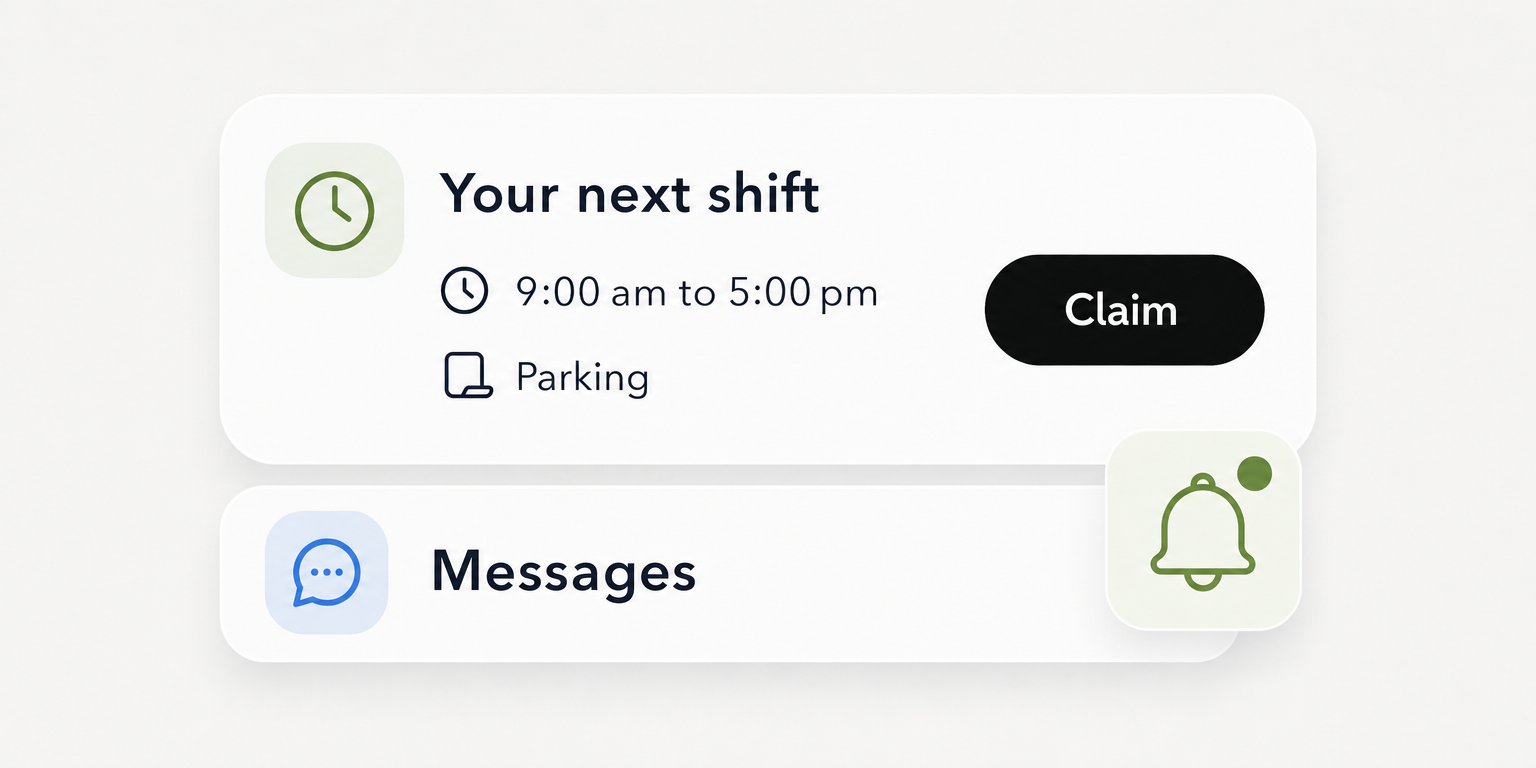
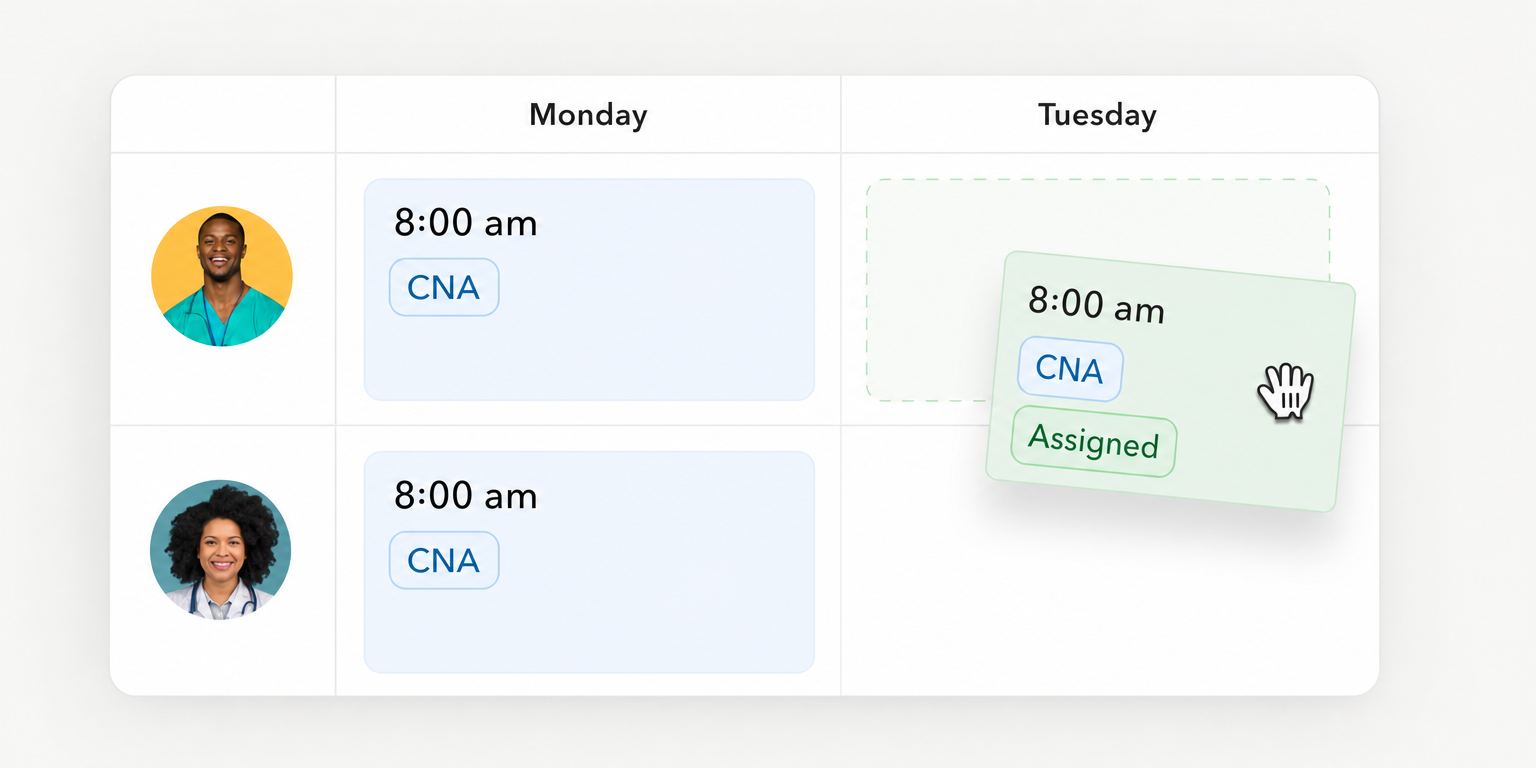
Teambridge’s scheduling page describes workers reviewing shift details and claiming open work through the mobile experience. It also describes rules using roles, locations, credentials, availability, and other worker fields, with the exact setup defined during implementation. Require the proposal to specify which rules will be built and what happens when a necessary field is missing or stale.
The same discipline applies to automation. Teambridge AI describes event-triggered agents using approved data and configured tools, with human approval and review points available. That does not mean every deployment includes every agent or action.
Ask the proposal to name:
- Included agents and the events that trigger them.
- Authorized actions and the data each action can use.
- Human review points and responsibility for exceptions.
- Configuration services and ownership of later changes.
Apply equivalent scrutiny elsewhere. Microsoft’s included mobile app does not establish total configuration cost. Skedulo’s integration catalog does not establish the implementation scope of a particular connector.
Important
The reviewed Teambridge platform, scheduling, and AI pages do not establish offline transaction support, route optimization, or service-parts inventory. Mark each relevant requirement require verification, not “unsupported.” If one is mandatory, keep the purchase unresolved until the proposed scope proves it.
You now have a useful dividing line: documented capability on one side, contracted delivery on the other. The remaining evaluation should establish how much work sits between them and who accepts it.
Ready to move?
Ready to see Teambridge in action?
Data maintenance determines how much work returns to the office
Before evaluating integrations, name the authoritative source for worker records, credentials, assignments, permissions, and approved time. These records do not necessarily belong to the same system. The important question is which system is allowed to change each one and how the other systems receive the update.
For each record type, ask where changes originate, where they write back, and who resolves rejection or conflict. An integration that transfers a record is not sufficient evidence that a supervisor can correct it without creating another inconsistency. Ask for the correction path, not just the successful transfer.
This is particularly relevant to staffing operations, where worker readiness, assignment eligibility, and approved hours need to remain aligned. A newly onboarded worker may still be unavailable for assignment if required information has not reached the operational system. A corrected time record can still need office attention if its destination rejects the update.
Microsoft provides a concrete example of administration beyond installation. Its offline profile setup documentation describes administrator control over tables, filters, relationships, and synchronization intervals, along with reviewing profile changes introduced through Field Service updates. Those are continuing configuration responsibilities, not merely installation steps.
Do not infer equivalent behavior in Teambridge or Skedulo from Microsoft’s documentation. Also, do not assume every Microsoft mobile experience has identical offline coverage: the mobile overview distinguishes the refreshed experience, which it states does not currently support offline operation. Name the proposed experience and its configuration in the scope.
The buying question is not simply whether an administrator exists. It is whether that administrator has the access, training, capacity, and contractual support to resolve operational exceptions.
Use a weighted vendor delivery scorecard, with blockers outside the total
Use this vendor delivery scorecard as the reusable evaluation record. Complete one copy per vendor against the same workflows, worker population, devices, integrations, and evaluation period. The weights are editorial recommendations, not research findings or measured vendor performance.
The table deliberately leaves scores blank. Blank means unverified, not zero. Replace “To confirm” with a named buyer team, vendor responsibility, or implementation-partner responsibility, and reference the relevant proposal section or acceptance evidence.
| Selection criterion | Weight | Capability proof to request | Implementation owner | Ongoing owner | Quoted scope | Score 0 to 4 |
|---|---|---|---|---|---|---|
| Priority mobile workflow completion | 30% | Worker action and resulting office record | To confirm | To confirm | To confirm | |
| Implementation and administration | 25% | Configuration, change handling, and exception responsibilities | To confirm | To confirm | To confirm | |
| Integration and data maintenance | 20% | Authoritative records, write-back, and rejected-update handling | To confirm | To confirm | To confirm | |
| Devices, connectivity, and access | 15% | Proposed devices, permissions, and connectivity configuration | To confirm | To confirm | To confirm | |
| Commercial scope and support | 10% | Itemized licenses, services, training, and support | To confirm | To confirm | To confirm |
Agree on the scoring scale before demonstrations
Score zero for a demonstrated failure, one for major gaps, and two for partial delivery with material buyer work. Score three for verified delivery with limited, explicitly assigned buyer work. Score four when delivery is verified within the quoted scope, including any buyer responsibilities your team has explicitly accepted.
A high score does not require the vendor to do everything. It requires an evidenced delivery model that your team can maintain. Conversely, an attractive demonstration should not earn full marks if the services needed to reproduce it are outside the quote.
Use the scorecard in this order:
- Define mandatory pass/fail gates, such as a required transaction, access restriction, or connectivity condition. Record unverified gates as unresolved, not passed.
- Request evidence for each weighted criterion and record both implementation and ongoing ownership.
- Score only verified criteria using the agreed scale. Keep unresolved evidence visible rather than estimating a score.
- Once complete, calculate
sum(weight × score / 4), using whole-number percentage weights of 30, 25, 20, 15, and 10 for a result out of 100.
Do not publish an incomplete total as comparable to a completed evaluation. More importantly, do not let a high total compensate for a failed mandatory requirement. Weighted preferences help choose among viable proposals; they cannot make a blocking gap acceptable.
Make implementation ownership and change costs contractual
Every unresolved ownership cell should become a procurement question. “Vendor supported” is not a sufficient answer if nobody is accountable for doing the work. Distinguish the software vendor, implementation partner, and buyer explicitly.
Who imports worker records, and who validates the migration? Ask what validation includes and who approves it. A successful file import should not, by itself, establish that permissions, assignment eligibility, and required fields are correct.
Who configures eligibility rules and approves access? Separate the person implementing a rule from the operational owner authorized to approve it. The proposal should also explain who can change that rule after launch and how the change is checked.
Who maintains integrations and handles rejected updates? Require an escalation path that identifies who investigates the source record, mapping, permissions, and destination response. Otherwise, the buyer may become the coordinator between vendors whenever an update fails.
Who trains supervisors and owns later configuration changes? Training should cover exception handling and administration relevant to the buyer’s assigned responsibilities, not only worker navigation. If an implementation partner exits after launch, identify who inherits its configuration knowledge.
Request itemized licenses, configuration, integrations, training, support, and post-launch changes. Ask which assumptions would change the quote, including migration condition, custom mappings, worker groups, or additional workflows. Compare proposals over the same period and scope rather than treating unlike service packages as equivalent subscriptions.
Tie rollout acceptance to demonstrated priority workflows. Any remaining exception needs a named owner, an agreed disposition, and a clear statement of whether it blocks acceptance. “We will address it after launch” is not an ownership assignment.
Choose the delivery model your team can maintain after launch
Shortlist vendors that pass mandatory requirements, substantiate their weighted scores, and assign responsibility for setup and ongoing changes. Then choose the division of work your operation can sustain. The lowest administrative burden is not established by the shortest feature list or the most polished mobile demonstration.
Teambridge’s configurable platform may fit a buyer prepared to own or contract for frontline workflow configuration. Skedulo’s documented onboarding package warrants a close look at deliverables, exclusions, and handover. Microsoft’s included mobile app still requires the worker, access, and mobile administration described in its documentation.
These are different starting points for procurement, not a universal ranking. Teambridge is an operational option for configurable frontline workflows, not an assumed replacement for specialized field-service requirements. Route optimization, service-parts inventory, and offline transactions remain verification questions where the reviewed Teambridge pages do not establish coverage.
Bring the completed delivery scorecard to a scoped Teambridge platform demonstration. Ask the team to show the priority worker action, its resulting office record, and the configuration responsibilities behind both. The useful outcome is a proposal that makes the remaining work visible before your supervisors inherit it.