

Check four separate states before closing a notification audit
Use the register below as the audit checklist. These are recommended operating controls, not an industry standard or verified Teambridge defaults.
Create one row per intended worker and shift notification, including workers with no message record. Enter Pass, Fail, or Unknown independently in the audience, delivery, acknowledgment, and assignment columns, followed by an evidence reference. The combined columns keep the register compact without dropping identifiers or accountability.
| Shift and worker | Audience | Message and channel | Delivery | Acknowledgment | Assignment | Owner and deadline | Resolution |
|---|---|---|---|---|---|---|---|
| Shift ID; worker ID | Result; intended recipient evidence | Message ID or missing; channel | Result; original status; timestamp; evidence | Result; response evidence; timestamp | Result; assignment record; required acceptance evidence | Exception owner by stage; deadline | Open, recovered, or closed; supporting reason |
Link evidence to a saved audience list, message record, response, or assignment record that an authorized reviewer can inspect. Record dates and a stated time zone. Preserve each message attempt and contact outcome rather than replacing a failed attempt with a successful recovery.
Before reviewing notifications, agree on the notification deadline, acknowledgment deadline, and assignment cutoff. Those deadlines depend on the operation; this checklist does not prescribe universal intervals.
Audience checks fail when an affected worker is missing
- Audience check: The scheduler reconciles affected workers against notification records, including missing and unintended recipients.
Begin with the shift change itself. The scheduler identifies which workers need the information using the relevant shift, location, assignment, and schedule details. Save that audience evidence before comparing it with the actual recipients.
Pass requires every intended worker to have a matching notification record, with no unintended recipient included. A missing worker or an extra recipient is Fail. If the intended audience cannot be established from available records, mark the check Unknown rather than accepting a broadcast count.
The scheduler owns audience correction before the locally agreed notification deadline. Keep a missing message visible in its worker’s row, and record unintended recipients as additional exception rows. Do not shrink the intended audience to match whichever messages happened to be sent.
Teambridge Communication describes targeting by people, roles, locations, and assignments. Available targeting depends on configured records and workflows, so selecting a location or role is not itself evidence that every affected worker was included. The audit still needs the actual recipient membership.

Delivery checks need channel evidence, not a sent label
- Delivery check: The communication administrator verifies each message identifier, channel, latest status, timestamp, and available error evidence.
A delivery pass must use the channel’s documented meaning. For example, Twilio’s message status documentation defines sent as acceptance by the nearest upstream carrier. Its delivered status means delivery confirmation was received from the upstream carrier and, where available, the destination handset. Neither establishes that a worker accepted a shift.
Preserve the original provider status in the register. Twilio distinguishes failed, when an outbound message fails to send, from undelivered, when a delivery receipt indicates it was not delivered. Both fail this delivery check, but keeping the specific status gives the administrator useful investigation evidence.
Push reporting also needs interpretation. Firebase’s message delivery reports distinguish sends, app receipt, notification display, and opens; its Sends metric includes messages queued for delivery or passed to another service. These are examples of channel semantics, not evidence that Teambridge uses either provider.
Pass requires positive delivery evidence supported by the channel. A documented failure is Fail immediately; a pending status or unavailable evidence remains Unknown and escalates at the agreed deadline. Missing read evidence alone does not prove failed delivery, particularly where read reporting is unsupported or disabled.
The communication administrator owns the delivery exception. Record the error evidence and any subsequent attempt, keeping the original message intact. If the deadline arrives before delivery can be established, the supervisor takes responsibility for contacting the worker while the technical investigation continues.
Operator view
Supporting evidence
https://www.twilio.com/docs/messaging/api/message-resource#message-status-values
https://www.teambridge.com/product/communication
Warning
Do not wait for a status display to update after the contact deadline. Escalate the worker contact separately from the delivery investigation, and keep both owners visible.
Put the workflow into practice
See how your team could use this workflow
Acknowledgment passes only with an explicit worker response
- Acknowledgment check: The supervisor verifies an explicit response tied to the relevant shift details.
Acknowledgment answers whether the worker explicitly confirmed awareness of the information. Pass requires a reply, a supported acknowledgment action, or a documented direct conversation. A message open or read receipt alone does not pass this operating control.
Check what the response refers to. A reply to yesterday’s start time does not establish acknowledgment of today’s location change. Save the relevant shift identifier, details acknowledged, response time, and evidence reference in the same register.
When evidence is absent, acknowledgment stays Unknown. At the agreed deadline, the supervisor makes direct contact and records the attempt and outcome. An unanswered call is a contact attempt, not an acknowledgment.
Acknowledging details is also different from accepting an assignment. A worker can confirm that they understand the new start time while saying they cannot attend. Preserve that distinction for the scheduler rather than treating any response as coverage.
Confirmed assignment requires a separate scheduling check
- Assignment check: The scheduler verifies the authoritative assignment record and any acceptance evidence required by the team’s assignment process.
Pass requires the correct worker and shift in the authoritative record, with the operation’s confirmation requirements satisfied. Pending confirmation or missing evidence remains Unknown. A decline or a conflicting worker, shift, or assignment record is Fail and requires resolution.
The scheduler owns this check even if the supervisor collected acceptance during a call. The supervisor saves the conversation evidence; the scheduler verifies the assignment record against it. Where an authorized update is necessary, save that update and its reference before marking assignment as passed.
Unresolved coverage goes to the operations manager by a locally defined cutoff before the shift. A delivered message cannot extend that cutoff, and a worker’s acknowledgment cannot substitute for the scheduling check.
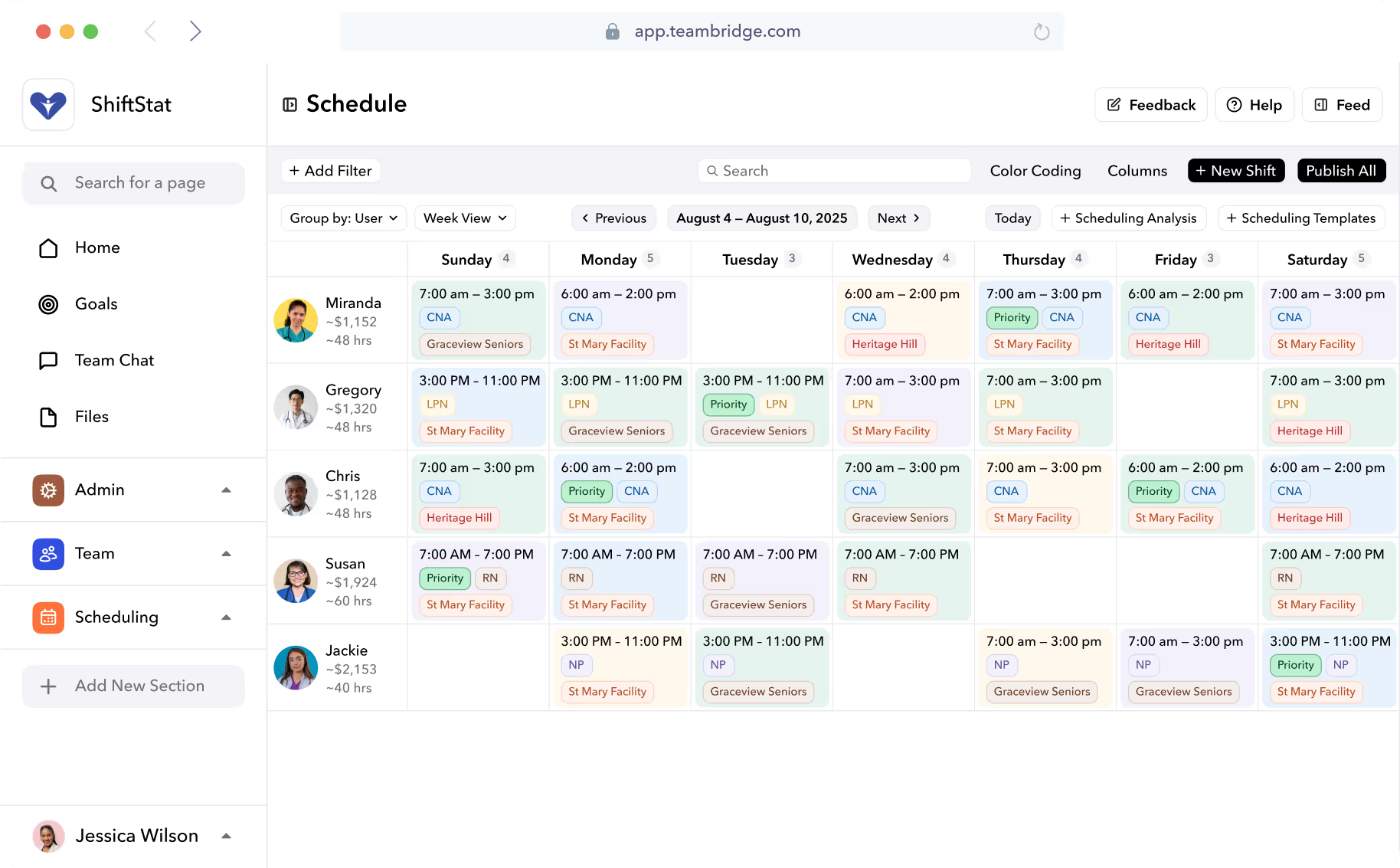
The Teambridge Platform describes connected worker, shift, and communication context, along with configurable fields, views, permissions, forms, and workflows. That makes it an operational option for connecting evidence, but the reviewed page does not establish a dedicated notification audit export or automatic assignment confirmation from acknowledgment.
Before implementing this register in Teambridge, verify the required access and actions against implementation documentation or a configured demonstration. Establish who can inspect communication evidence, who can update assignments, what state is saved after each action, and where exceptions go. If authorized users cannot retrieve a required state, retain Unknown and use a documented manual verification path rather than inventing a product status.
Hypothetical example: a failed message stays visible after recovery
This example is hypothetical, not a customer result. Assume one intended worker, W027, receives an update for shift S104 starting at 08:00. All times are on the same day in the America/Chicago time zone, the acknowledgment deadline and assignment cutoff are 07:00, and assignment confirmation is initially pending.
For this example, a documented telephone conversation can satisfy the team’s acknowledgment and acceptance requirements. The communication administrator has a separate 10:00 deadline to review the technical delivery exception.
At 06:45, SMS message M881 has status undelivered. The saved audience list R3 identifies W027 as the sole intended recipient, and the message record matches that audience. Audience therefore passes, delivery fails, and acknowledgment and assignment remain Unknown.
The communication administrator starts the delivery investigation while the supervisor calls at 06:50. During that conversation, the worker explicitly acknowledges the shift details and accepts the assignment; the supervisor saves contact note C12. At 06:55, the scheduler verifies assignment record A19 against the worker, shift, and acceptance evidence.
The completed row uses the same register:
| Shift and worker | Audience | Message and channel | Delivery | Acknowledgment | Assignment | Owner and deadline | Resolution |
|---|---|---|---|---|---|---|---|
| S104; W027 | Pass; audience list R3 matches W027; no extra recipient | M881; SMS | Fail; undelivered at 06:45; M881 status record | Pass; telephone acknowledgment at 06:50; contact note C12 | Pass; acceptance in C12; A19 verified at 06:55 | Supervisor and scheduler: 07:00; communication administrator: 10:00 technical review | Coverage recovered; original SMS failure retained; technical investigation open |
The operations manager can accept the documented operational recovery without calling the SMS delivered. The communication administrator still owns the unresolved technical issue. Recovery changes the resolution, not the historical delivery evidence.
Close the review only when every exception has evidence and an owner
The operations manager accepts the review after checking the individual records, not an aggregate send total. Firebase’s delivery reporting documentation explicitly notes that aggregate metrics do not cover every message scenario. A total cannot establish what happened to a particular worker’s notification.
Use this final acceptance sequence:
- Reconcile the rows. Every intended worker appears, including anyone with no message record. Unintended recipients remain visible as exceptions rather than disappearing from the review.
- Inspect the four results. Delivery has supporting evidence or an explicit Unknown label. Acknowledgment and assignment have separate evidence, and later contact has not overwritten an earlier delivery failure.
- Approve or retain each exception. Record the owner, deadline, and disposition. Accept documented recovery where justified; keep unresolved coverage or technical work assigned until its own closure criteria are met.
If using Teambridge, confirm configured channels, status visibility, permissions, and assignment behavior before relying on the register operationally. The useful end state is not a page of green message statuses. It is a traceable record of who needed the update, what happened to it, what the worker explicitly confirmed, and whether the assignment is actually settled.

About the author

Content Writer at Teambridge
Anis Nanai is a content writer at Teambridge, with a focus on workforce management and the realities of running hourly teams. He prioritizes conversations with customers, staying close to the market, and understanding how workforce needs are changing. His writing connects those concerns to practical decisions about scheduling, time tracking, staffing, and automation. He examines product developments through the questions that matter to operators: what does this solve, how would it work for my team, and what evidence supports it?
Company perspective: this author works at Teambridge. Customer outcomes are attributed to their published sources.
View LinkedIn profile