

By the time payroll runs, the ops manager at the staffing agency has a decision to make: reconstruct three days of split time from memory and text messages, or push the timecard through and eat the correction later. Neither is a real option. Both happen anyway.
This is the failure mode that breaks union dues remittance for construction staffing agencies. The math itself isn't hard. The problem is that field time, local-specific CBA rules, and each local's remittance calendar live in three different systems — and nobody reconciles them until checks are already cut.
Why Multi-Local Rotations Break Standard Payroll Workflows
Union payroll is not a bolt-on to standard payroll. It's a parallel workflow. Processing union payroll requires executing a structured workflow that maintains compliance with collective bargaining agreements while ensuring accurate compensation for union employees, and the process differs significantly from non-union payroll due to the additional payroll fields and verification requirements.
For single-local shops, that parallel workflow is manageable. One CBA. One rate table. One remittance calendar. A spreadsheet and a diligent bookkeeper get the job done.
Staffing agencies don't have that luxury. A construction staffing agency in the Northeast might run crews across five or ten locals in any given month. Local 3 may require remittance by the 15th of each month. Local 134 may operate on a different calendar. Manual systems that work for single-local operations fail when scaled across five or ten different labor unions.
The cracks show up in three places at once:
- Field time capture — the timecard has to know which local applies to which hours, not just the total for the week.
- Rate and fringe application — every hour needs the right classification, the right base rate, and the right fringe stack for the local that governs that job site.
- Remittance packaging — each local wants its own report, in its own format, by its own deadline.
Miss any one of the three and the whole packet fails. And the failure doesn't surface until a fund audit six months later.
The Four Error Patterns That Cost Agencies the Most
After you talk to enough construction staffing ops leaders, the same four mistakes come up on every call.
1. Wrong local assignment mid-week
The worker shows up at a job that's under a different local than his home local, and the timecard rolls into payroll under the wrong jurisdiction. The dues go to the wrong place. The reciprocity paperwork never gets filed.
2. Wrong calculation method
This is the sneakiest one. The primary union-specific deductions are dues and assessments, and the calculation methods vary more than many contractors expect. Some unions calculate dues as a percentage of gross wages, perhaps 2.5% of total earnings for the period. Others use an hourly amount, collecting a set rate (like $0.75) for each hour worked. Still others charge flat weekly or monthly amounts regardless of hours, and some use combinations that include a base amount plus a percentage.
Using the wrong calculation method results in incorrect collections that require correction, so verify the specific method in your CBA before processing.
3. Missed reciprocity between locals
When a member of Local A works in Local B's jurisdiction, fringe contributions often need to route back to Local A's benefit funds under a reciprocity agreement. Miss the reciprocity form and the worker's pension credit doesn't move — and the worker finds out at retirement.
4. Late remittance on an off-cycle calendar
Most locals want payment by a fixed day of the following month. As one example, the Wisconsin Laborers Fringe Benefit Funds state that fringe benefits for the month are due by the 15th of the following month, and a penalty is automatically assessed on all past-due fringe benefits.
Multiply that across five locals with five different due dates, and one missed deadline turns into recurring penalties.
| Error pattern | Root cause | Downstream cost |
|---|---|---|
| Wrong local assignment | Timecard doesn't capture job-site local | Dues remitted to wrong fund; reciprocity broken |
| Wrong calculation method | CBA rule not encoded in system | Under- or over-collection; corrections next cycle |
| Missed reciprocity | Home local vs. work local not tracked | Worker loses pension credit; grievance risk |
| Late remittance | No per-local calendar view | Penalties, interest, delinquency letters |
Classification Drift: When a Journeyman Becomes a Foreman Tuesday Afternoon
Underneath the dues problem sits a nastier problem: classification drift.
A worker classified as a journeyman electrician on Monday may work as a foreman on Tuesday. Each classification carries a different wage rate. Each rate feeds a different fringe calculation. Each fringe calculation contributes to a different remittance total.
Employees may perform duties that fall under different classifications throughout a single pay period, or even the same day, making accurate rate application a constant challenge.
Here's how it silently corrupts the dues base. If the field never captures the classification change, the whole day gets logged as journeyman hours. The base wage is lower than it should be. The percentage-based dues calculation is lower than it should be. The fringe contribution to the health and welfare fund is lower than it should be.
A common mistake is under-calculating or over-calculating these contributions, especially when a worker splits time across multiple job classifications. Getting this wrong can trigger a benefit fund audit or leave workers without the coverage they're entitled to.
Warning
Classification drift doesn't just cost money on the remittance. It breaks the audit trail. Once the wrong classification hits the timecard, every downstream report — certified payroll, fund contribution, union remittance — inherits the error. Rebuilding six months later means going back to daily logs and hoping someone remembers what actually happened.
The Remittance Calendar Problem: Partial Payments Get Returned
Operators tend to treat the remittance calendar as an admin nuisance. It isn't. It's a compliance risk with teeth.
Missing these deadlines can result in penalties and administrative complications. For example, similar to a mortgage payment, most unions do not allow partial payment of fringes. All fringes due for all workers and hours for a particular timeframe are due in full upon deadline. Partial payments will be returned.
Read that again. A partial payment is not a partial payment. It's a returned payment. The fund kicks it back and treats the whole remittance as unpaid until the full amount arrives.
For a staffing agency running crews across five locals, that means:
- Five separate deadline stacks
- Five separate remittance packets, each in the local's required format
- Zero tolerance for a missing timecard on Friday afternoon
- One late timecard from one crew leader can hold the entire local's remittance
And when a project involves multiple trades under different locals — an electrical crew under Local 3, laborers under LIUNA, operating engineers under Local 15 — the coordination burden compounds. Each trade has its own pay scales, its own benefit funds, and its own reporting procedures.
Ready to move?
Ready to see Teambridge in action?
What a Clean Remittance Workflow Actually Looks Like
Here's the operator playbook. It's not exotic. It just has to be enforced at the point of clock-in, not reconstructed on Friday night.
Every shift needs to capture four things at the moment the worker clocks in:
- The worker — with their home local on file.
- The governing local — the local whose jurisdiction the job site falls under.
- The classification for those hours — journeyman, foreman, apprentice year 3, whatever applies to the work being performed right now.
- The job or cost code — so the hours can be job-costed and, where required, appear on certified payroll.
That's the foundation. Without those four fields on every punch, the rest of the workflow is guessing.
On top of that, three things need to be automated:
- Rate lookups by local and classification, effective-dated.
- Fringe calculations by fund, respecting hour caps and straight-time-only rules where they apply.
- Report formatting for each local's required remittance packet plus certified payroll where required.
The documentation coming out the other end has to show, for every remittance: contractor information, a list of workers by name and classification, hours worked per worker, gross wages, dues deducted, and total remittance amounts.
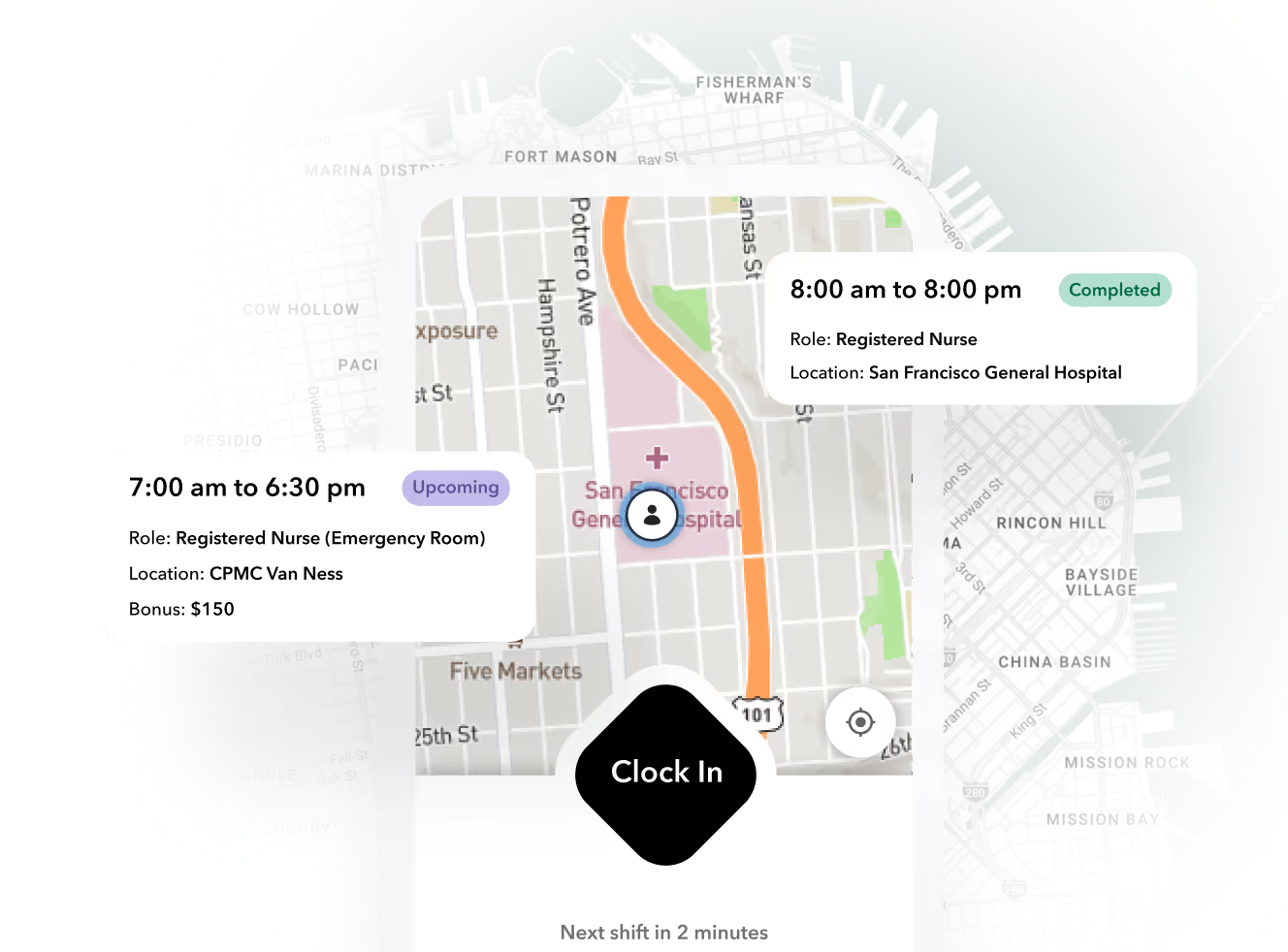
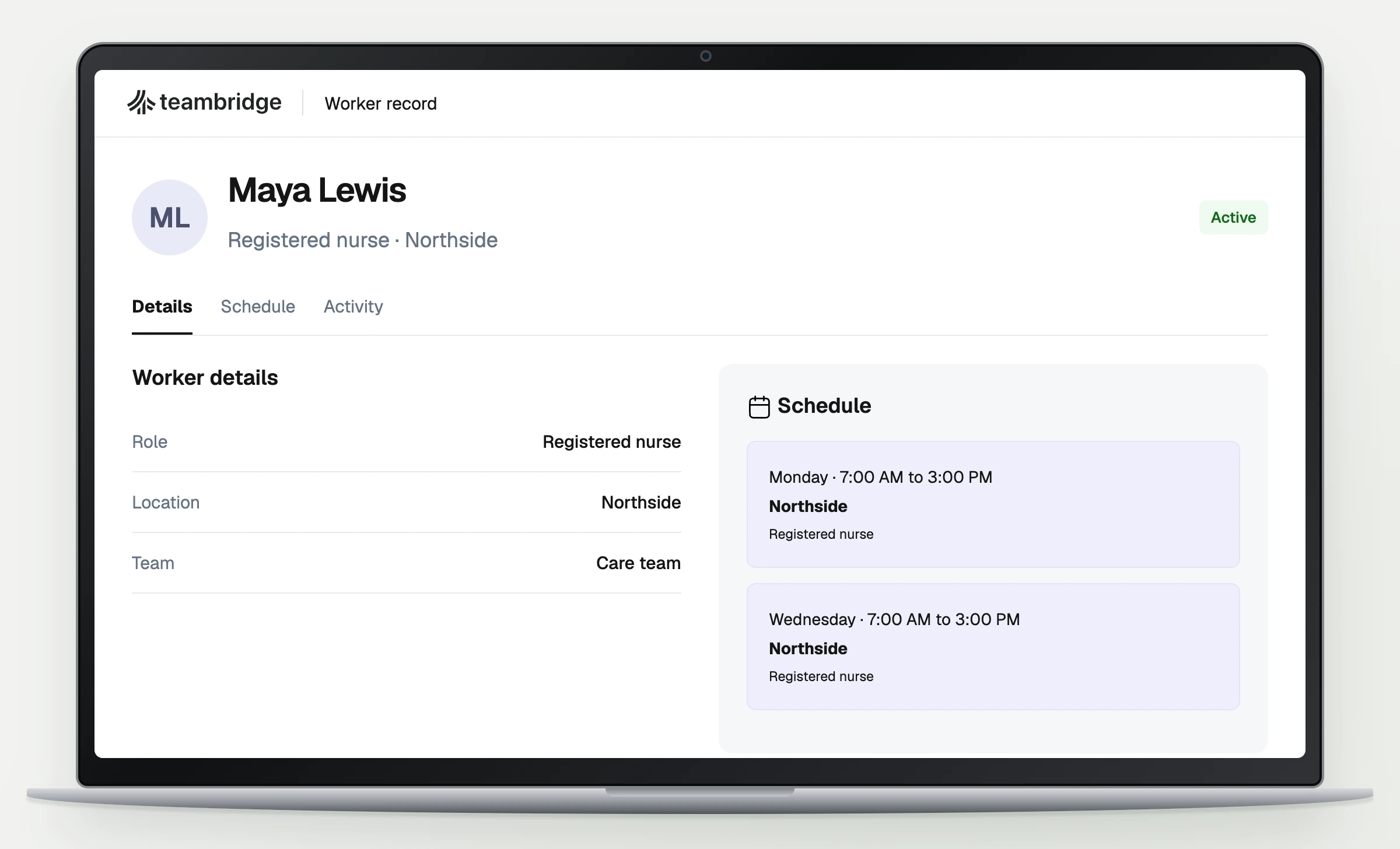
This is what Teambridge's Time Tracking product is built to support at the field layer, and what the Construction industry implementation wires together end-to-end. GPS-verified clock-in captures the job site. The job site drives the governing local. The classification is confirmed at punch, not reconstructed. The hours flow directly into per-local rate tables and per-fund contribution logic.
Tip
If your current workflow requires a supervisor to hand-annotate timecards with local and classification codes on Friday afternoon, you don't have a time tracking problem. You have a remittance problem waiting to happen. Move the capture upstream to the clock-in event.
Handling CBA Updates Without a Fire Drill
CBAs get renegotiated. Rate tables shift. New fringe categories get added. Existing categories get bumped.
When that happens mid-project, one of two things is true: your system either handles effective-dated rates natively, or your ops team is about to spend a weekend rebuilding a spreadsheet from scratch.
A CBA renegotiation with a retroactive effective date can invalidate a month of remittances that already went out the door. If the system can't version rates by effective date, every retroactive adjustment turns into a manual re-run.
The operational requirement is straightforward:
- Rate tables per local, indexed by classification.
- Effective dates on every rate, so historical windows resolve to the rate in force at the time.
- Re-runnable remittance reports against any historical period, without rebuilding the calculation by hand.
Most staffing agencies discover this requirement the hard way — the first time a CBA lands with a retroactive raise and 400 timecards need to be re-costed.
The Single-System Test for Construction Staffing Agencies
If you're evaluating platforms, here's the test to run. Not the demo script the vendor wants to show you. The one that maps to what actually breaks.
The four questions
- Can field time be captured at the local and classification level at the moment of clock-in? Not on the timecard review screen. Not on the supervisor's Friday sign-off. At clock-in.
- Can the platform handle union payroll alongside standard payroll in the same system? Staffing agencies run mixed crews. Union electricians on one job, non-union warehouse staff on another. Two systems means two sources of truth and inevitable drift.
- Can it produce audit-ready remittance packets per local, on each local's calendar, without a spreadsheet in the middle? If the answer involves an export to Excel and a template, that's a spreadsheet in the middle.
- Does it version rates by effective date? So a CBA update doesn't force a manual rebuild of every affected report.
If a platform can't do all four, it's not a single system. It's a data source that feeds a spreadsheet, and the spreadsheet is where your compliance actually lives.
Teambridge's Platform is built to close that loop — field clock-in, classification and local capture, per-local rate application, fringe calculation, and audit-ready output for each local's remittance packet. For staffing agencies running multi-local projects, that consolidation is the difference between clean Fridays and quarterly correction cycles. You can see how other agencies have restructured this workflow in Teambridge's customer stories.
The test isn't whether your system can run union payroll. Most systems can, given enough manual handling. The test is whether it can run union payroll across three locals for one journeyman in one pay period, without an ops manager reconciling anything by hand.
That's the bar. Everything else is expensive workaround.

About the author

Content Writer at Teambridge
Anis Nanai is a content writer at Teambridge, with a focus on workforce management and the realities of running hourly teams. He prioritizes conversations with customers, staying close to the market, and understanding how workforce needs are changing. His writing connects those concerns to practical decisions about scheduling, time tracking, staffing, and automation. He examines product developments through the questions that matter to operators: what does this solve, how would it work for my team, and what evidence supports it?
Company perspective: this author works at Teambridge. Customer outcomes are attributed to their published sources.
View LinkedIn profile