

The best healthcare staffing software depends on what your agency places, which exceptions consume staff time, and what the vendor can demonstrate within the quoted scope. A polished clinician profile does not prove that an eligible worker can accept tonight's shift, complete an assignment, and reach payroll without another manual reconciliation.
The best healthcare staffing software depends on what you place
Per-diem, travel, and recruiting-led agencies should not run identical evaluations. Their records overlap, but the operational consequences of a missed handoff differ.
- Per-diem agencies need to establish facility readiness, reach eligible clinicians, resolve competing responses, and confirm coverage under time pressure.
- Travel-heavy agencies need assignment continuity, reliable credential dates, and clear handling of assignment terms and time exceptions.
- Recruiting-led agencies need sourcing, candidate progression, client coordination, and a dependable transition from accepted offer to placement.
For a mixed agency, identify the workflow that creates the most rework before selecting finalists. Otherwise, the team with the best demo attendance can steer the purchase toward its department while other teams inherit the gaps.
This guide compares software for healthcare staffing agencies, not hospital clinical systems. It uses official product descriptions, not independent performance tests. The reviewed evidence does not establish like-for-like pricing, package inclusion, or comparable implementation timelines, so the comparison supports a shortlist rather than a universal winner.
Bullhorn, Avionté, and Teambridge offer different consolidation paths
The useful distinction is not simply ATS versus scheduling. These vendors advertise overlapping capabilities, but they describe different routes to connecting recruiting, placement operations, and back-office work.
Treat every advertised capability as a question for the quote. A function may depend on a particular product, integration, configuration, or service rather than the base subscription.
| Product | Advertised healthcare scope | Purchasing implication | Scope to verify |
|---|---|---|---|
| Bullhorn | Provider matching, credential requirements and expiration tracking, scheduling, clinician self-service, and healthcare time interpretation | Investigate a broad healthcare staffing workflow, not only an ATS | Products required for each function, configuration responsibilities, and downstream payroll ownership |
| Avionté | Healthcare sourcing, credential-management and background-screening integrations, and mobile access; broader platform includes ATS, CRM, payroll, and billing | Investigate when recruiting and back-office consolidation are central | Healthcare package inclusions, integration dependencies, and correction and tax-service responsibilities |
| Teambridge | Configurable healthcare placement operations, retained-system connections, and separately described ATS functionality | Investigate when workforce operations and connections to existing systems are priorities | Included products, facility-rule configuration, available connections, and recruiting depth against your requirements |
Bullhorn's healthcare page explicitly describes scheduling and time interpretation, including differentials and guaranteed hours. Reducing it to a recruiting database would miss a substantial part of its advertised scope.
Avionté's healthcare page describes credential-management integrations and mobile access. Its payroll and billing page provides the more relevant starting point for back-office evaluation, but buyers still need the healthcare package and connected services identified in writing.
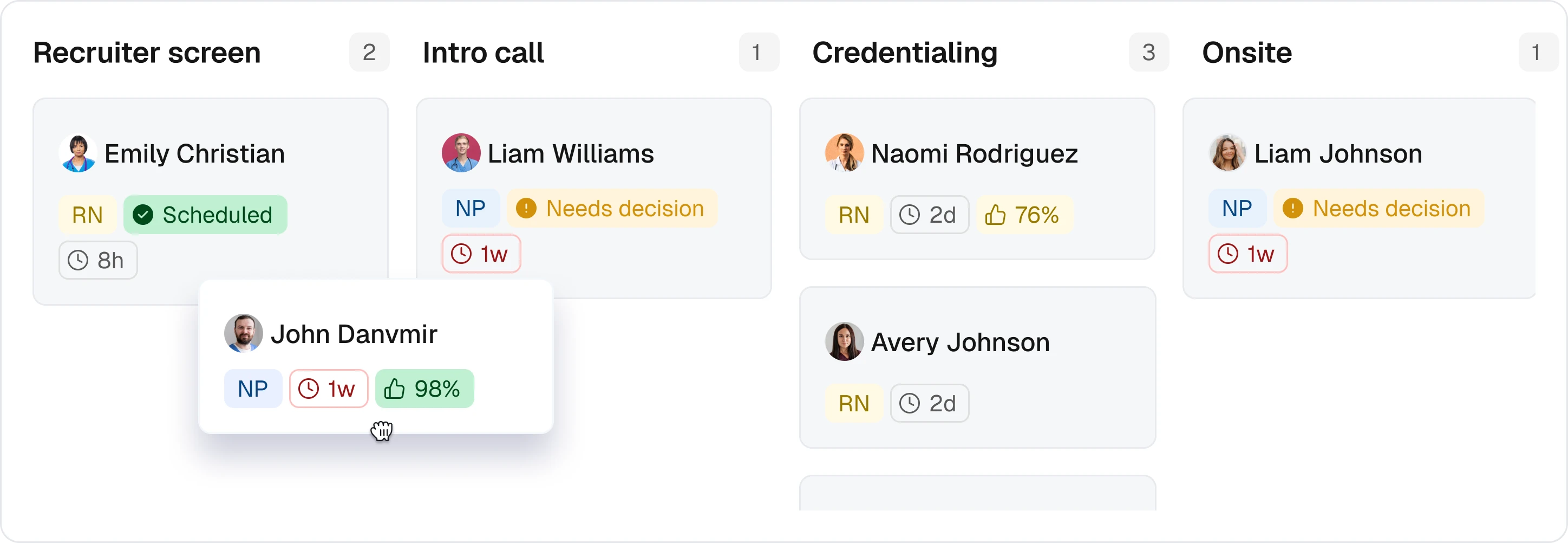
Teambridge's healthcare offering describes connected placement operations while allowing agencies to retain existing systems. Its ATS page also describes sourcing, screening, interview coordination, and onboarding handoffs. That supports evaluating recruiting functionality, not assuming feature parity with another ATS.
Ask each vendor to annotate the same workflow with the exact product or service responsible for each step. “Available on the platform” is not a sufficient answer when the proposal does not identify what you are buying.

Facility readiness must survive missing records and expired credentials
A clinician can have a complete-looking profile and still be unsuitable for a particular facility assignment. The evaluation should expose that difference before dispatchers rely on the platform during an urgent opening.
Separate three states: a document is stored, a credential is verified, and the facility has accepted the clinician for the assignment. Those states may depend on different records and owners.
NCSBN describes Nursys as a source for nurse licensure, discipline, and practice-privilege information in participating jurisdictions. A stored license image or expiration date should not be treated as proof that the relevant verification occurred.
Use representative, de-identified records to structure the demonstration:
- Introduce a readiness failure. Give a clinician a missing facility requirement or expired credential. Ask what becomes blocked, what remains available, and whether an override records who authorized it.
- Create a coverage conflict. Have two clinicians respond to one opening, then cancel the accepted assignment. Observe how the system handles competing claims, replacement outreach, and confirmation.
- Make connected records disagree. Change a credential date or facility status in one system. Require the vendor to show which record wins, who sees the conflict, and how it gets resolved.
These are proposed acceptance tests, not claims that every product supports the behavior. Ask whether readiness is checked when a worker is first matched, when the shift is claimed, and when an assignment begins.
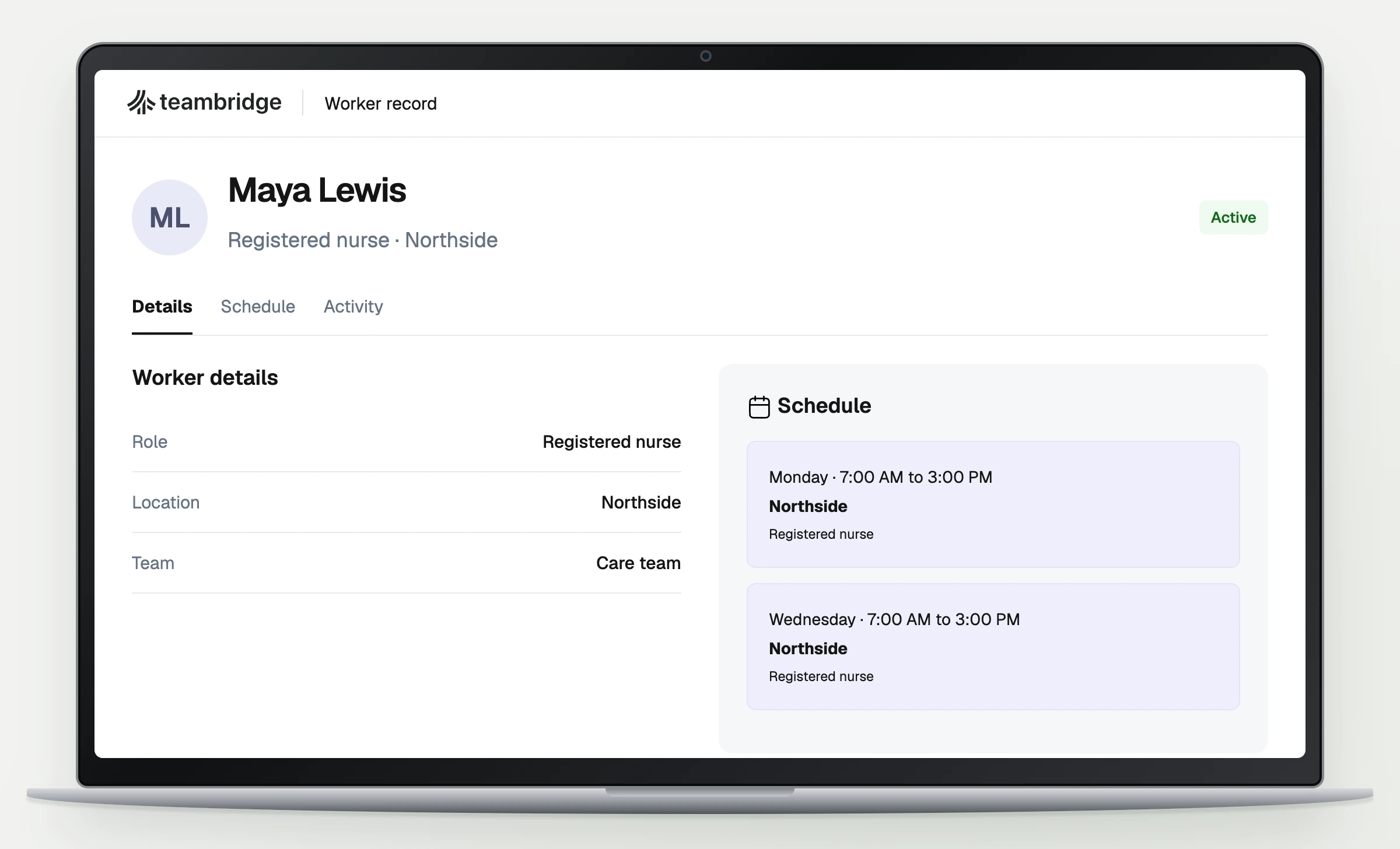
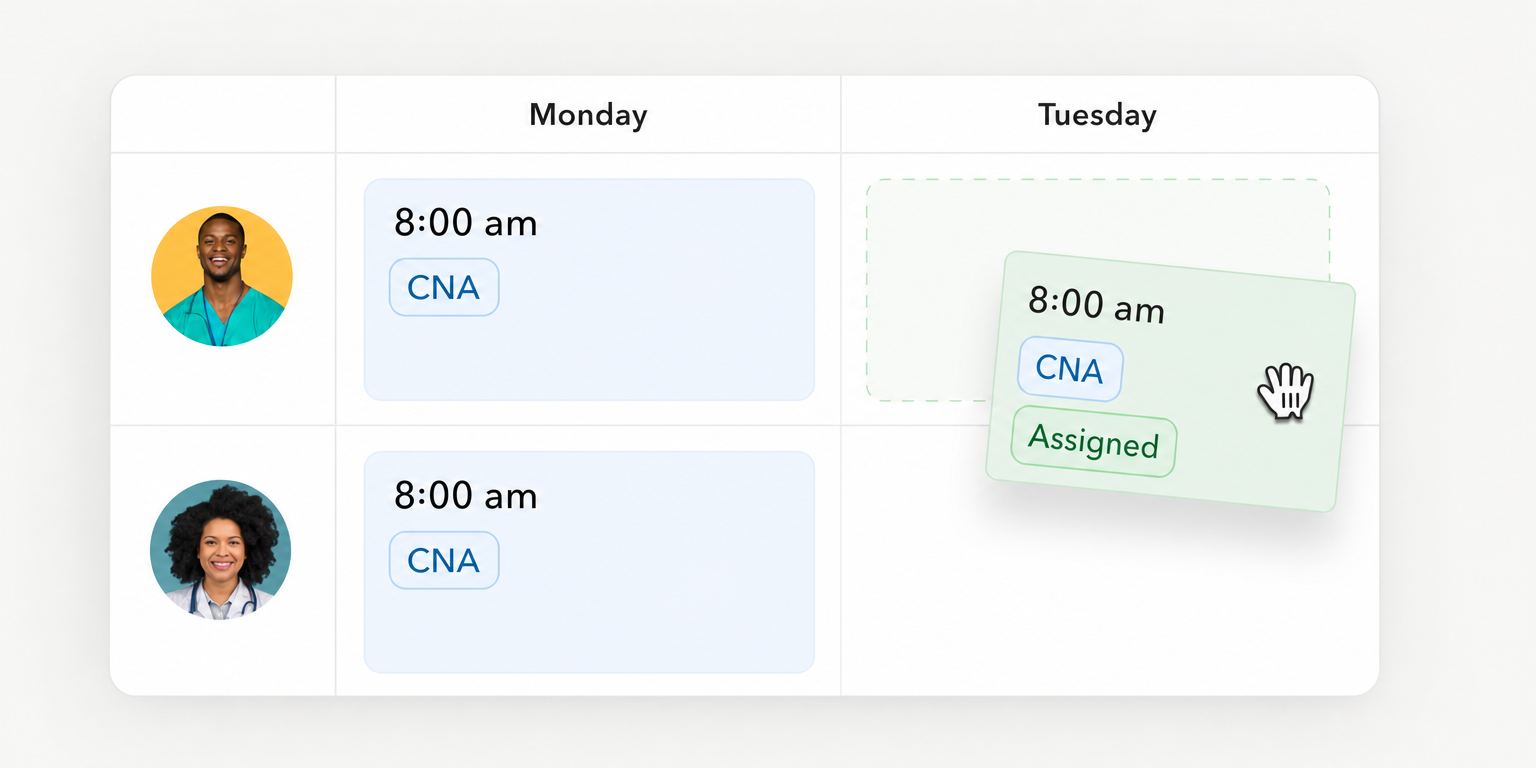
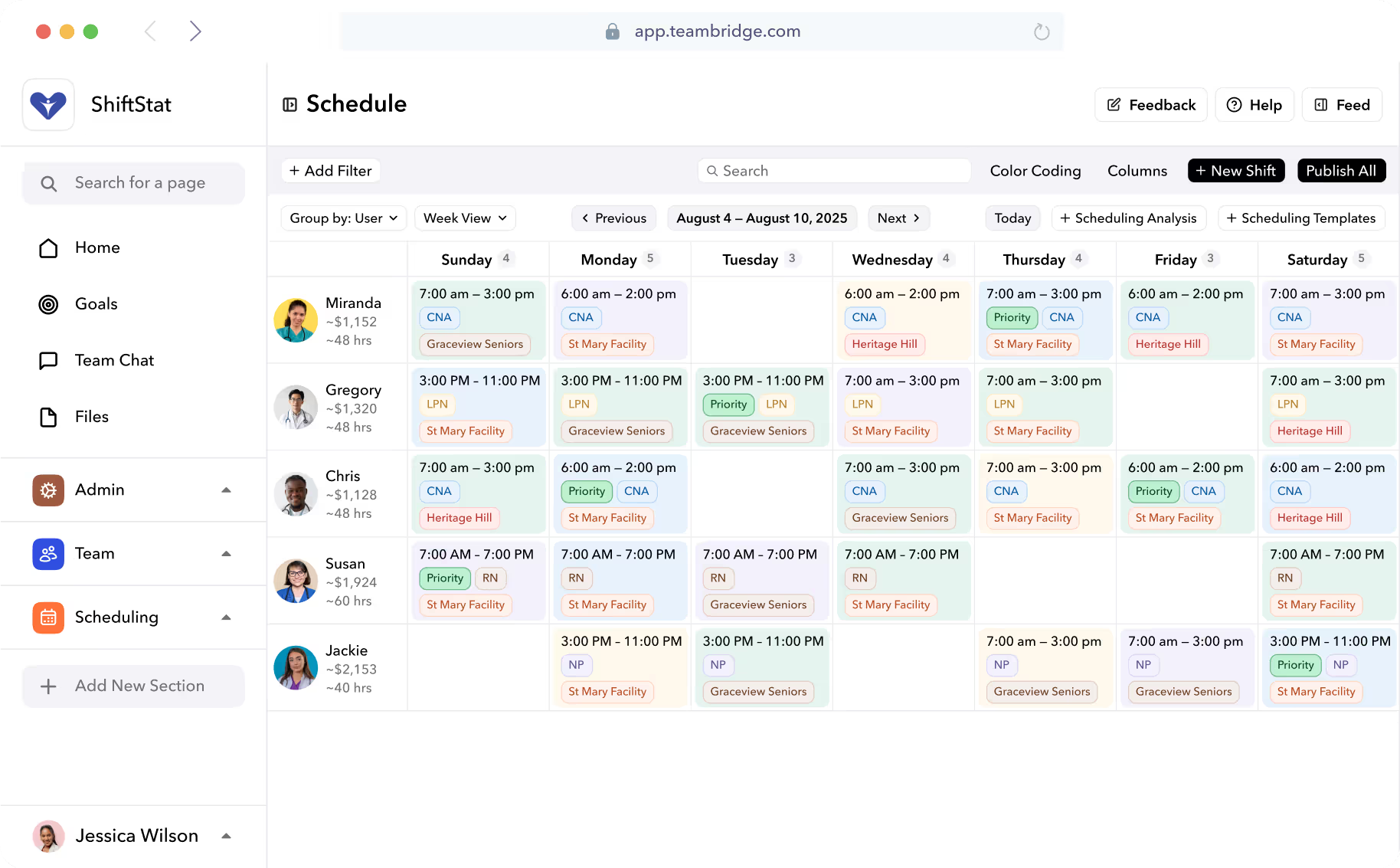
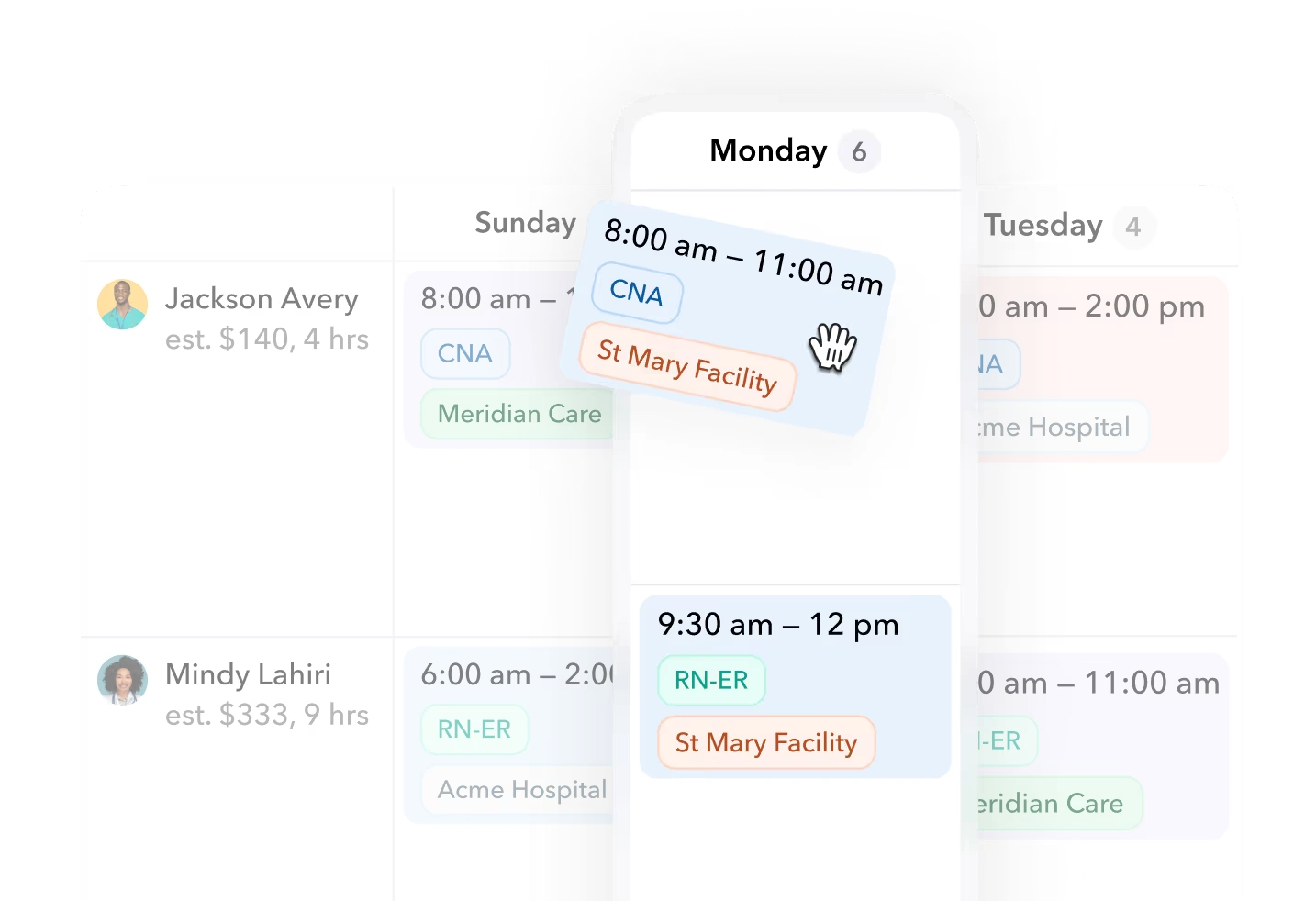
Teambridge scheduling advertises filtering by role, credentials, location, tier, and custom worker fields, alongside availability and hours considerations. It also describes mobile shift claims returning to the schedule. Exact configuration is defined during implementation, so do not assume every facility rule is already configured.
Teambridge scheduling illustration showing workers, shift times, roles, and facilities.
A filled shift is not the same as a facility-ready assignment.
Record what actually happened in the demonstration. A verbal assurance about blocking behavior should remain pending until the proposed configuration produces it.
Ready to move?
Ready to see Teambridge in action?
Payroll and credentialing labels conceal different product boundaries
“Payroll” can describe approved-time export, earnings calculation, payroll execution, or tax filing. Those are separate purchasing questions, with separate failure points.
The IRS distinguishes payroll service functions, including paycheck preparation, return preparation and filing, and federal tax deposits. Publication 15, section 16, also explains that employers generally remain responsible when outsourcing federal payroll tax duties, subject to the third-party arrangement. A software label does not settle those responsibilities.
Ask vendors to carry representative time exceptions through the proposed stack: a shift differential, disputed punch, manager approval, and a correction after export. Include guaranteed hours if they are relevant to your assignments. The test should show which system calculates earnings and which party resolves a mismatch after payroll or billing receives the record.
Decision framework
Three checks before selecting a system
https://www.bullhorn.com/healthcare/
https://www.avionte.com/payroll-billing/
https://www.teambridge.com/industry/healthcare
Credentialing needs the same discipline. Tracking an expiration, obtaining primary-source verification, and managing clinical privileging are not interchangeable. NCSBN explains that participating boards designate Nursys as their primary-source equivalent through written agreements in its QuickConfirm explanation.
For all three products, treat EHR functionality, electronic visit verification, VMS connectivity, payroll tax filing, and clinical privileging as requirements to verify. This guide establishes neither their inclusion nor their absence. Teambridge's workforce operations scope should not be interpreted as proof that it replaces clinical systems, verification services, or payroll execution.
Weight the shortlist around per-diem work, then require proof
Use the following healthcare staffing purchase scorecard once per vendor. It is the reusable purchasing record for demonstrations, scope discussions, and implementation dependencies, rather than a feature-count ranking.
The weights are hypothetical editorial starting assumptions for a per-diem-heavy agency, not benchmarks or tested vendor scores. Facility readiness and urgent coverage each receive 25% of the proposed weight because this model prioritizes safe assignment readiness and fast response. Adjust the weights before demonstrations if your placement mix differs.
| Criterion | Weight | Required demonstration | Vendor rating | Evidence | Contracted module | Owner | Unresolved dependency | Weighted points |
|---|---|---|---|---|---|---|---|---|
| Facility-specific placement readiness | 25% | Missing and expired records, facility requirements, blocks, and override history | Pending | Pending | Pending | Pending | Pending | Pending |
| Urgent coverage and clinician response | 25% | Eligible outreach, competing claims, cancellation, and confirmation | Pending | Pending | Pending | Pending | Pending | Pending |
| Recruiting and redeployment | 15% | Candidate progression, onboarding handoff, and return to available status | Pending | Pending | Pending | Pending | Pending | Pending |
| Time, pay, and billing exceptions | 20% | Differentials, disputed time, approvals, and post-export correction | Pending | Pending | Pending | Pending | Pending | Pending |
| Implementation and contracted scope | 15% | Migration approach, configured scope, named owners, and recovery arrangements | Pending | Pending | Pending | Pending | Pending | Pending |
Rate each criterion from 0 to 4 using evidence from the proposed scope:
- 0: Demonstrated failure to meet the requirement.
- 1: A limited part works, but substantial manual handling remains.
- 2: The main path works, but important exception handling remains manual.
- 3: Required paths and exceptions work, with a bounded dependency the buyer accepts.
- 4: Required paths and exceptions work within the quoted scope, with accepted evidence and ownership.
Calculate weighted points as weight × rating ÷ 4, using percentage-point weights such as 25. Leave an unverified claim pending rather than awarding credit or disguising it as a tested failure. Do not compare final totals while mandatory evidence remains pending.
In the evidence column, link to the demonstration recording, sample output, or agreed acceptance record. Use the owner column for the accountable role or party, not a vague entry such as “integration.” Record an external verification service, retained payroll system, or separately priced connector as a dependency where relevant.
Important
A failed mandatory requirement overrides the weighted total. Define mandatory requirements before demonstrations so a high score elsewhere cannot excuse an unusable placement or payroll handoff.
Travel-heavy agencies should reconsider the weight given to assignment continuity and time exceptions. Recruiting-led agencies should reconsider recruiting and onboarding priorities. Change those assumptions before seeing vendor scores, not afterward to justify a preferred purchase.
Make migration, correction handling, and ownership part of the quote
A successful demo can still hide a weak cutover plan. The proposal needs to explain how existing clinician records, credential dates, facility requirements, and open assignments become usable in the new configuration.
Establish who delivers usable records
Who extracts, cleans, maps, and validates each record type? What happens to attachments, conflicting dates, duplicate clinician profiles, and assignments already in progress? Ask who signs off on readiness to operate, not merely on successful data import.
Recruiting handoffs deserve particular attention. If evaluating Teambridge ATS, demonstrate how the proposed sourcing, screening, and onboarding flow connects to the agency's placement-readiness process. An accepted offer and completed e-signature should not be assumed to establish facility acceptance.
Follow corrections beyond the first export
Who owns a failed connection or conflicting update? How does a corrected time record reach payroll or billing after the original was exported, and how is duplicate processing avoided? Require an explanation of reconciliation and administrator permissions within the quoted design.
During an outage, dispatchers still need a defined way to handle open assignments and communicate changes. Ask what remains accessible, how interim records are reconciled, and who authorizes rollback if cutover cannot continue.
Put services and dependencies beside subscription scope
Identify included modules, separately priced connections, configuration work, training, and support responsibilities. Ask who maintains rules when a facility changes its requirements and whether ongoing administrator work belongs to the agency, vendor, or another provider.
Teambridge's healthcare page describes mapping current operations, configuring rules and connections, and launching in phases. It also makes integration availability dependent on the systems and implementation scope. The reviewed evidence establishes neither universal integration support nor a standard implementation duration.
Add these answers to the same scorecard, especially its evidence, owner, and unresolved-dependency columns. An unanswered implementation question belongs in the purchasing record, not in a meeting note that disappears before signature.
Choose only after the quoted platform proves your mandatory work
Investigate Bullhorn when evaluating a broad healthcare staffing workflow. Investigate Avionté when ATS and back-office consolidation are central. Investigate Teambridge when configurable workforce operations and retained-system connections are important. These are evaluation starting points, not exclusive product categories or superiority claims.
Before interpreting the weighted total, review mandatory failures, pending evidence, and dependencies outside the quote. A strong aggregate score cannot compensate for an unresolved facility-readiness rule or a correction process nobody owns.
One next step is a Teambridge healthcare demonstration using your facility requirements and representative time exceptions. Give every finalist equivalent inputs so the comparison reflects your operation rather than each vendor's preferred path through the demo. Include the people who will own dispatch, payroll reconciliation, recruiting handoffs, and system administration, because each can expose a different dependency.
The final purchasing decision should make payroll execution, clinical systems, credential verification, and integration ownership explicit. Sign when the proposed configuration proves the mandatory work and the contract identifies who delivers it. Until then, a capability claim is a reason to investigate, not a reason to award points.

About the author

Content Writer at Teambridge
Anis Nanai is a content writer at Teambridge, with a focus on workforce management and the realities of running hourly teams. He prioritizes conversations with customers, staying close to the market, and understanding how workforce needs are changing. His writing connects those concerns to practical decisions about scheduling, time tracking, staffing, and automation. He examines product developments through the questions that matter to operators: what does this solve, how would it work for my team, and what evidence supports it?
Company perspective: this author works at Teambridge. Customer outcomes are attributed to their published sources.
View LinkedIn profile