
Choosing the right applicant tracking system (ATS), customer relationship management (CRM) platform, and Time & Expense (T&E) solution (or T&A, Time & Attendance, in Bullhorn’s terminology) is critical for recruiting agencies. Your selection directly affects operational efficiency, candidate management, back-office accuracy, and client relationships, whether you rely on Bullhorn’s tools or another recruiting platform. This article provides a comprehensive analysis of leading Bullhorn alternatives, updated for 2025.
Why agencies look for Bullhorn alternatives
Recruitment agencies often seek Bullhorn alternatives when they realize that competing tools, including newer Bullhorn competitors, may better match how their recruitment teams operate day to day. Common concerns include complex pricing structures, a steep learning curve, a lengthy implementation time, and limited flexibility for specialized workflows or real-time messaging with candidates and clients. Agencies require solutions that offer robust features without compromising usability or affordability, supporting both individual recruiters and firm goals. They prioritize platforms that align precisely with their unique operational demands, optimization goals, and long-term growth objectives, including how they build and manage talent pools.
What Bullhorn does well
Bullhorn has established itself as a prominent player in the recruitment software market and remains widely used across staffing agencies. Understanding its strengths is essential before evaluating alternatives, especially as many organizations assess whether newer tools are easier to use or offer more modern capabilities for today’s hiring process. Bullhorn’s long-standing position makes it a familiar choice for recruitment agencies, recruiting firms, and talent acquisition teams that want a proven system aligned with traditional recruitment process needs.
Core features
Bullhorn excels in several key areas, functioning as both an applicant tracking system and a CRM platform. Its comprehensive suite integrates ATS, CRM, and VMS functionalities, creating a unified ecosystem supported by numerous third-party modules. Key strengths include:
- Robust ATS: Manages candidate pipelines, tracks applications, supports effective candidate sourcing, and helps streamline the hiring process with automated job posting tools across multiple job boards.
- Integrated CRM: Supports client relationships, sales forecasting, and communication tools for targeted outreach and follow-ups.
- Extensive integrations: Offers a broad marketplace that connects with social media platforms, AI-powered extensions, analytics dashboards, and more, expanding overall functionality.
- Staffing-specific focus: Built for the staffing industry, offering customization options that align with recruitment workflows and operational demands.
What drives users to switch
Despite its strengths, Bullhorn presents several limitations that prompt agencies to explore other options. These concerns often reflect the need for systems that streamline day-to-day staffing operations without requiring additional workarounds.
- Complex pricing: Its tiered, add-on model can be costly, particularly for agencies that need specific functionality not included in the base modules. Many prefer platforms with simpler pricing that they can forecast accurately.
- Steep learning curve: New users often report a significant time investment to understand its extensive workflow structure and automation settings.
- Outdated interface: Some users find the layout less user-friendly, especially when handling resume parsing, messaging, or real-time updates during busy periods.
- Customization challenges: While flexible, deeper adjustments may require developer support, slowing teams trying to streamline or modify their processes.
- Customer support variances: Experiences can differ widely, which may affect issue resolution and overall platform satisfaction.
- Mobile experience: The mobile app provides core features but may not deliver the seamless integration or ease of use that staffing teams working on-the-go expect.
- VMS complexity: Agencies that rely heavily on a vendor management system or enterprise programs sometimes feel Bullhorn offers less agility compared to newer competitors like JobDiva or Ceipal.
- Lengthy integration process: Implementing Bullhorn can require extensive setup, configuration, and onboarding, especially for agencies with complex workflows. Teams often encounter long ramp-up periods that don’t keep up with shifting needs.
- Salesforce dependency: With Bullhorn being built on Salesforce, teams often feel pressured to adopt or expand their Salesforce tech stack due to certain Bullhorn modules and integrations, increasing overall costs and operational complexity.
- Poorly integrated acquisitions: Several of Bullhorn’s add-on products, including its T&E solution, come from acquisitions and feel bolted on rather than fully unified to create disjointed workflows, inconsistent data syncing, and added complexity.
These factors collectively drive agencies to evaluate Bullhorn alternatives that better match operational needs, long-term workflow efficiency, and staffing industry expectations.
How to pick Bullhorn alternatives
Selecting the right alternative starts with understanding whether your agency wants to maintain a patchwork of integrations, often the case with Bullhorn’s more fragmented ecosystem, or an all-in-one solution that reduces complexity and manual work. A structured evaluation process ensures your chosen platform supports both front-office efficiency and back-office accuracy while offering a more modern, cohesive experience for your team.
Key features to look for
A strong alternative must provide comprehensive functionality across every stage of the recruitment cycle. Prioritize platforms offering:
- Advanced ATS capabilities: Tools for candidate sourcing, efficient resume parsing, automated workflows, and intelligent interview scheduling help recruiters maintain consistent output.
- Integrated CRM functionality: Systems should support strong client relationships, communication tracking, and customizable pipelines.
- AI-powered automation: Solutions with modern optimization, automated outreach, and smart triggers can streamline repetitive tasks.
- Reporting and analytics: Dashboards must offer actionable insights for recruitment teams and support long-term planning.
- User-friendly interface: An intuitive layout minimizes training time and increases adoption, especially for teams evaluating all-in-one staffing platforms.
- Mobile-first capabilities: A seamless mobile experience that enables recruiters to manage candidates, client communication, and workflows on the go—something increasingly expected in modern staffing environments.
- Integrated Time, Expense, and Attendance: Agencies that rely heavily on T&E/T&A workflows benefit from platforms with fully unified back-office tools, which Bullhorn’s add-on model may not provide.
Pricing
Assess each platform’s pricing model against your agency’s budget and long-term goals.
- Pricing: Ensure there are no hidden fees or surprises when adding users or new modules.
- Scalability: Confirm that the system can grow with your agency, from small teams to enterprise-level recruiting firms.
- Return on investment: Evaluate potential gains in efficiency, reduced back-office workload, improved hiring speed, and better placement outcomes.
- Feature-to-cost ratio: Compare the depth of features offered relative to monthly or annual costs. Some alternatives, like Zoho Recruit and Recruit CRM, emphasize cost-effective plans, while others focus on premium enterprise needs.
Ease of integrations
Your chosen platform must fit seamlessly within your existing tech stack.
- Third-party integrations: Confirm compatibility with calendars, email systems, social media recruitment channels, job boards, and any vendor management system you rely on.
- API access: Look for platforms offering strong integration options for custom data flows and extended functionality.
- Future-proofing: Consider the vendor’s roadmap and whether they plan to expand automation, mobile features, or workflow tools meaningful to staffing agencies.
Top Bullhorn alternatives
This section provides a detailed overview of the leading Bullhorn alternatives, highlighting their strengths, ideal use cases, and the types of recruitment teams they best support. Each platform offers different functionality that aligns with the needs of staffing agencies, talent acquisition groups, and growing recruiting firms evaluating options beyond Bullhorn and other jobdiva-style enterprise systems.
1. Teambridge
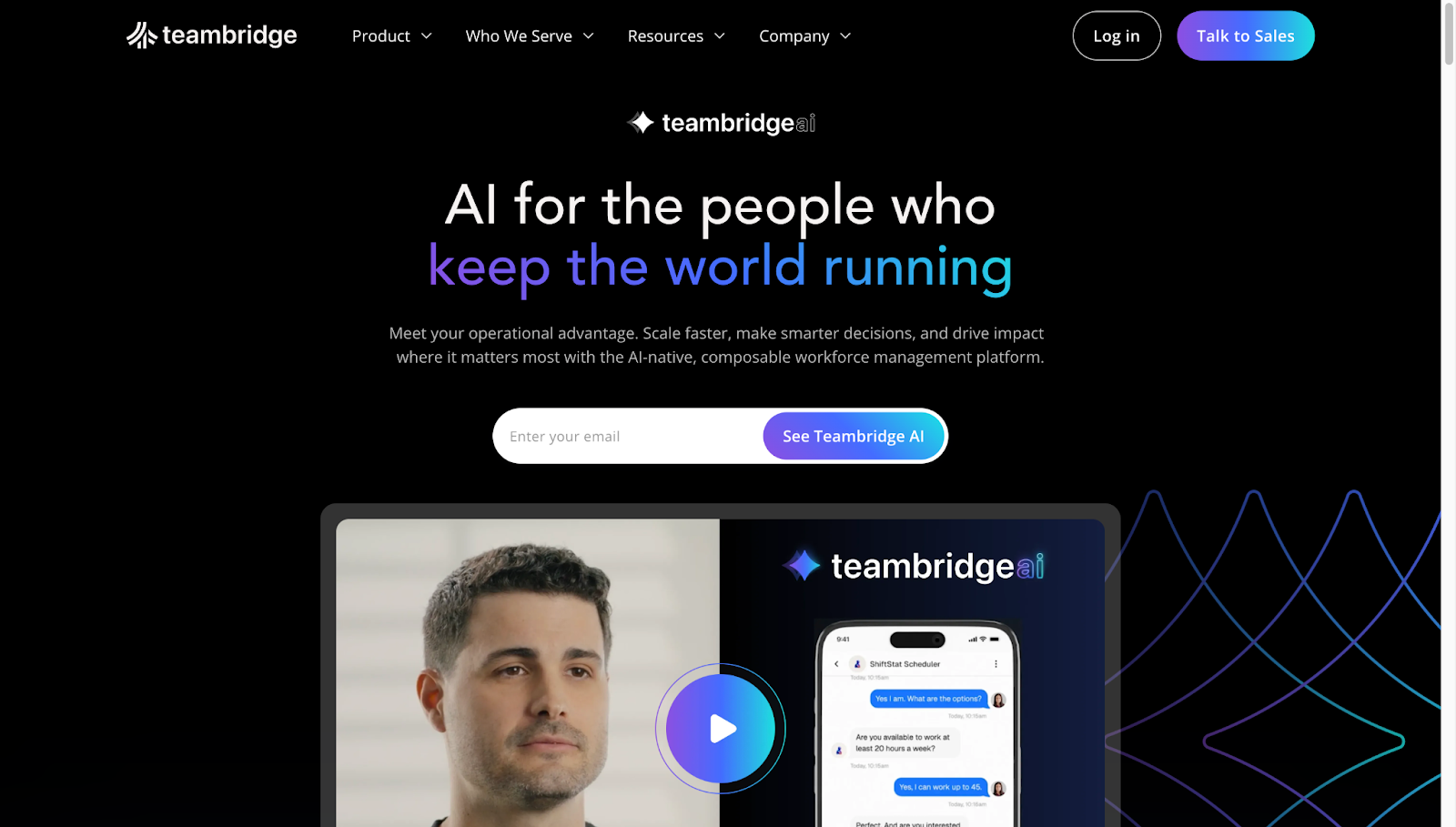
Teambridge is a modern, all-in-one staffing platform that combines a full applicant tracking system (ATS) with powerful workforce management tools. It supports the entire recruitment lifecycle—from sourcing and screening through onboarding, scheduling, time tracking, payroll connectivity, and staff communication—within a single streamlined system. Unlike platforms that require multiple add-ons or external integrations, Teambridge delivers a unified workflow that minimizes manual work and keeps both recruiters and workers connected through a mobile-first experience.
- Key features: Full ATS with job posting, resume parsing, and candidate screening; configurable onboarding workflows; mobile-first scheduling tools; time and attendance tracking; payroll system connectivity; messaging and communication tools; Instant Pay for same-day earnings access; automated workflows for hiring and staffing operations
- Strengths: Modern interface, strong ease of use, intelligent automation across hiring and workforce management, mobile-first functionality, customizable workflows, dependable customer support, and an all-in-one platform that reduces the need for clunky integrations
- Ideal for: Staffing agencies of all sizes seeking a streamlined, scalable system that consolidates ATS, onboarding, scheduling, and workforce management, especially those managing hourly or shift-based workers who benefit from fast hiring, mobile tools, and Instant Pay access.
2. Zoho Recruit
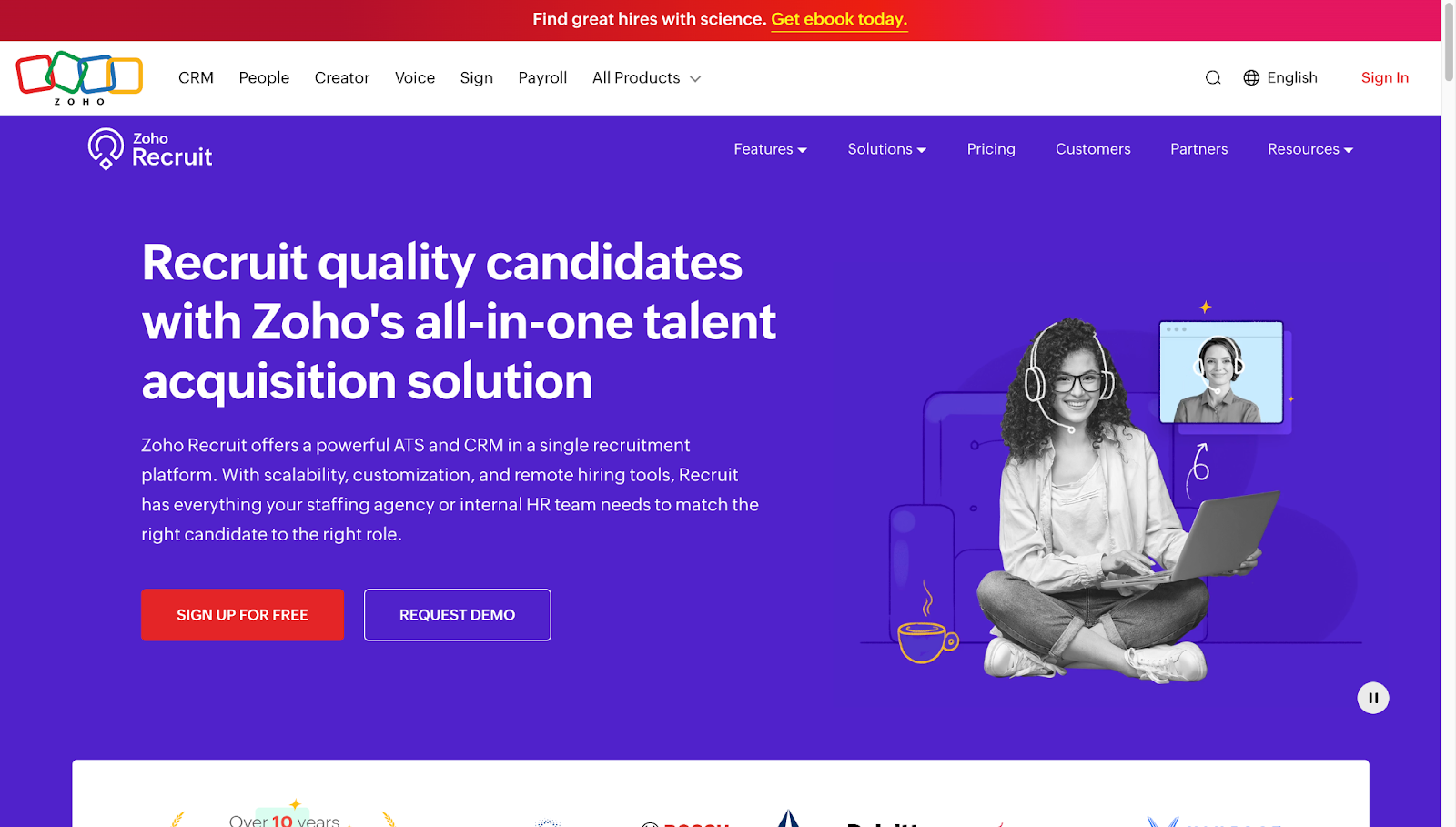
Zoho Recruit provides a basic suite of recruiting tools aimed at both corporate HR teams and staffing agencies. While it combines ATS and CRM capabilities within the larger Zoho ecosystem, its functionality is often best suited for teams that prioritize affordability over depth. The platform’s cloud-based setup supports standard recruiting tasks, but some users may find its interface and workflows less streamlined than those of more modern competitors.
- Key features: Candidate sourcing, resume parsing, interview scheduling, client and contact management, custom workflows, and strong integration with other Zoho tools, including LinkedIn and external job boards.
- Strengths: Can be cost-effective, part of a robust business ecosystem, strong customization options, and suitable for teams needing flexible pricing tiers.
- Ideal for: Budget-conscious staffing agencies or recruitment teams already using Zoho’s CRM tools who want tighter system alignment and consistent mobile app functionality.
3. JobDiva
JobDiva is an older, enterprise-oriented platform with a wide range of features built up over many years. While it combines ATS, CRM, and vendor management system tools, its interface and workflow structure can feel dated compared to newer platforms. It continues to be used by large staffing organizations mainly because of its long-standing presence in the market and its emphasis on database-driven search rather than modern usability or flexibility.
- Key features: Advanced search and match technology, comprehensive VMS integration, strong reporting tools, database-driven talent pools, and detailed compliance tracking.
- Strengths: Highly scalable, excellent search capabilities, strong compliance controls, and preferred by staffing organizations that rely heavily on structured recruiting tools.
- Ideal for: Large enterprise staffing agencies or organizations that require complex workflows, extensive reporting, and a technology suite built for long-term operational support.
4. Ceipal ATS
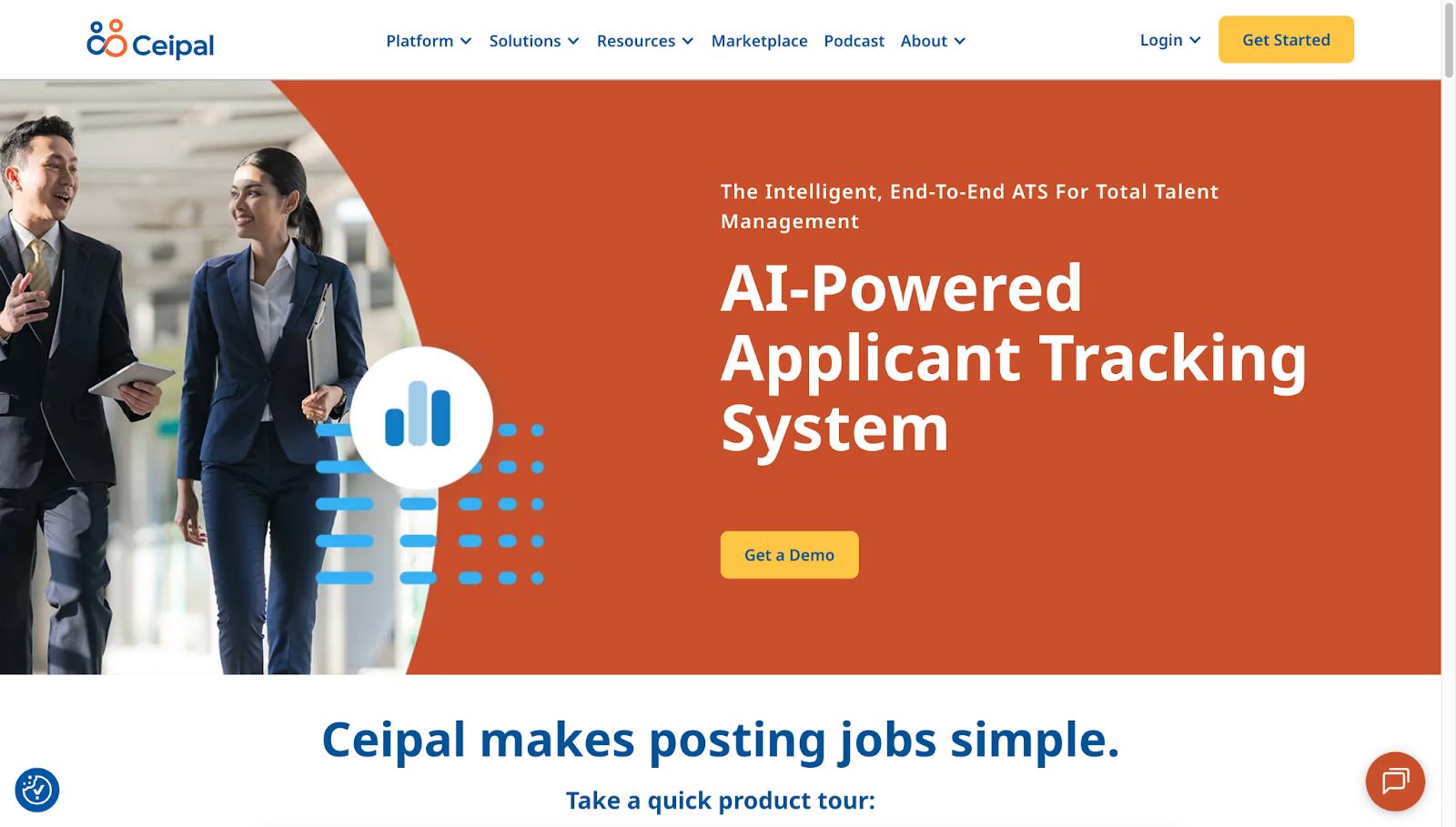
Ceipal ATS provides an all-in-one talent acquisition platform designed to handle high-volume recruitment, though its interface and workflow setup can feel cluttered for some teams. The system relies heavily on automation and analytics tools, but these features may require significant configuration to deliver meaningful value. Agencies often choose Ceipal because it offers a broad set of features and numerous integrations, even if the overall experience can feel more utilitarian than truly modern or streamlined.
- Key features: AI-driven candidate matching, automated resume parsing, robust applicant tracking, vendor management workflows, onboarding modules, and a feature-rich mobile app.
- Strengths: Competitive pricing, strong AI capabilities, broad integration options, and excellent support for teams seeking faster hiring pipelines.
- Ideal for: Staffing teams and recruiting firms looking for a cost-effective system that supports scalable hiring needs and improves operational efficiency across the recruitment cycle.
5. Greenhouse
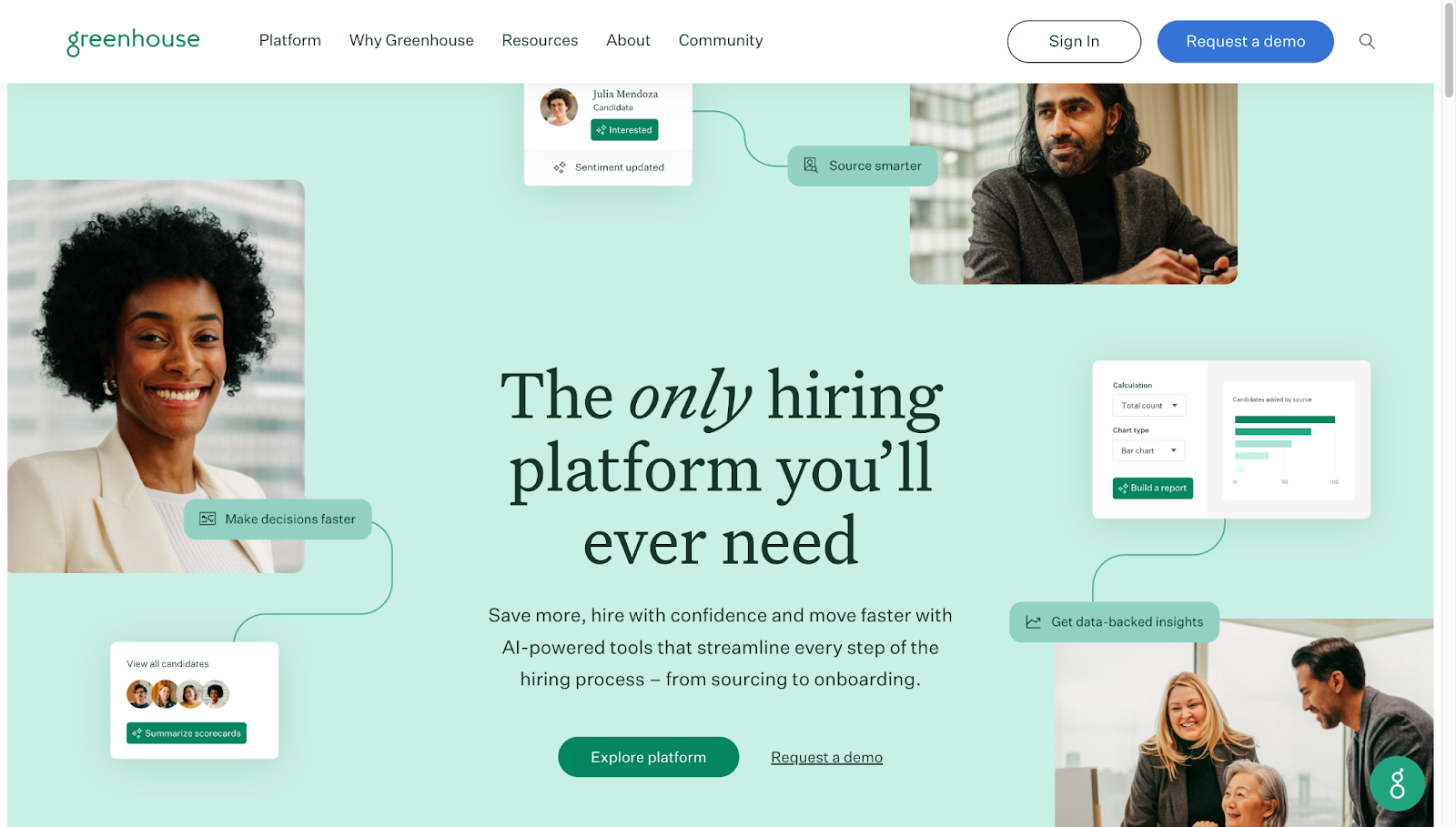
Greenhouse is a widely adopted talent acquisition platform, particularly among internal HR teams that favor rigid, process-heavy workflows. While it’s often compared to other enterprise recruiting systems, its emphasis on structured hiring can feel overly prescriptive for agencies that need flexibility. The platform focuses heavily on standardized interview steps and documentation, which can be useful for compliance-driven environments but may add unnecessary complexity for teams seeking faster, more adaptable hiring cycles.
- Key features: Structured hiring workflows, comprehensive interview kits, advanced analytics dashboards, strong integration options, and tools that improve candidate experience.
- Strengths: Excellent for process consistency, robust analytics, and a clear focus on fair evaluation methodologies. The platform is ideal for teams that need reliable CRM functionality to support collaboration among hiring managers and recruiting staff.
- Ideal for: Agencies prioritizing structured interviewing, data-driven insights, and a high degree of control across hiring stages, particularly those with complex or multi-step recruitment requirements.
6. Recruit CRM
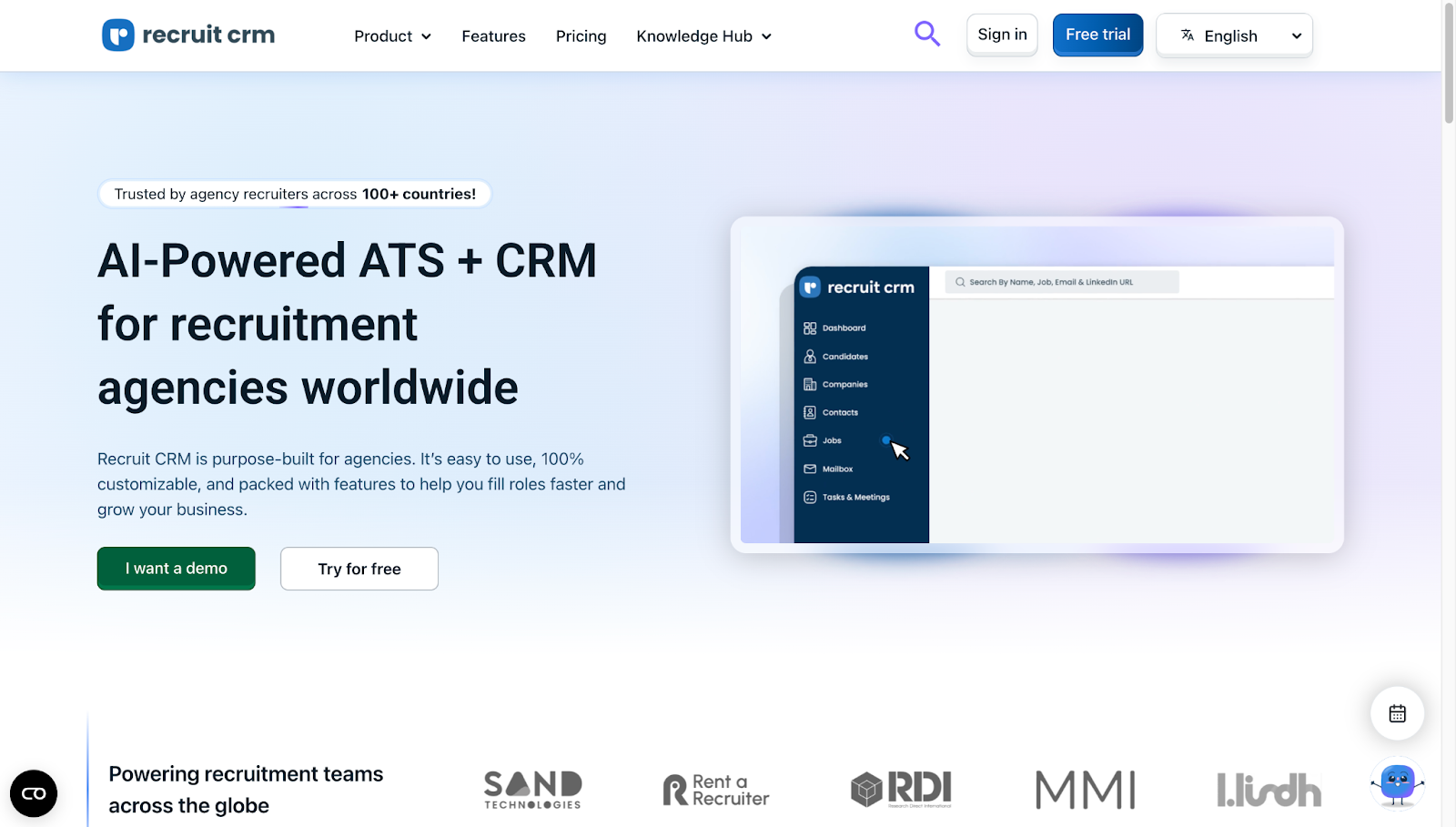
Recruit CRM offers an all-in-one recruitment platform aimed primarily at smaller agencies, but its feature set can feel limited for teams with more complex needs. While it combines ATS and CRM capabilities, the platform’s simplicity sometimes comes at the expense of deeper functionality and scalability. Its clean interface appeals to teams that want a lightweight system, though it may fall short for agencies evaluating Bullhorn alternatives that require more advanced workflows or customization.
- Key features: Integrated ATS and CRM tools, email syncing, pipeline customization, advanced search, mobile access, and a built-in website builder. These key features make it easy for smaller teams to stay organized.
- Strengths: Highly intuitive, competitively priced, and ideal for agencies seeking fast setup with minimal friction. Its flexibility also appeals to users comparing similar solutions like RecruitCRM or regional systems with lighter feature sets.
- Ideal for: Small to medium-sized staffing agencies wanting a straightforward, efficient platform that supports quick adoption without sacrificing essential CRM functionality or candidate management capabilities.
7. Workable
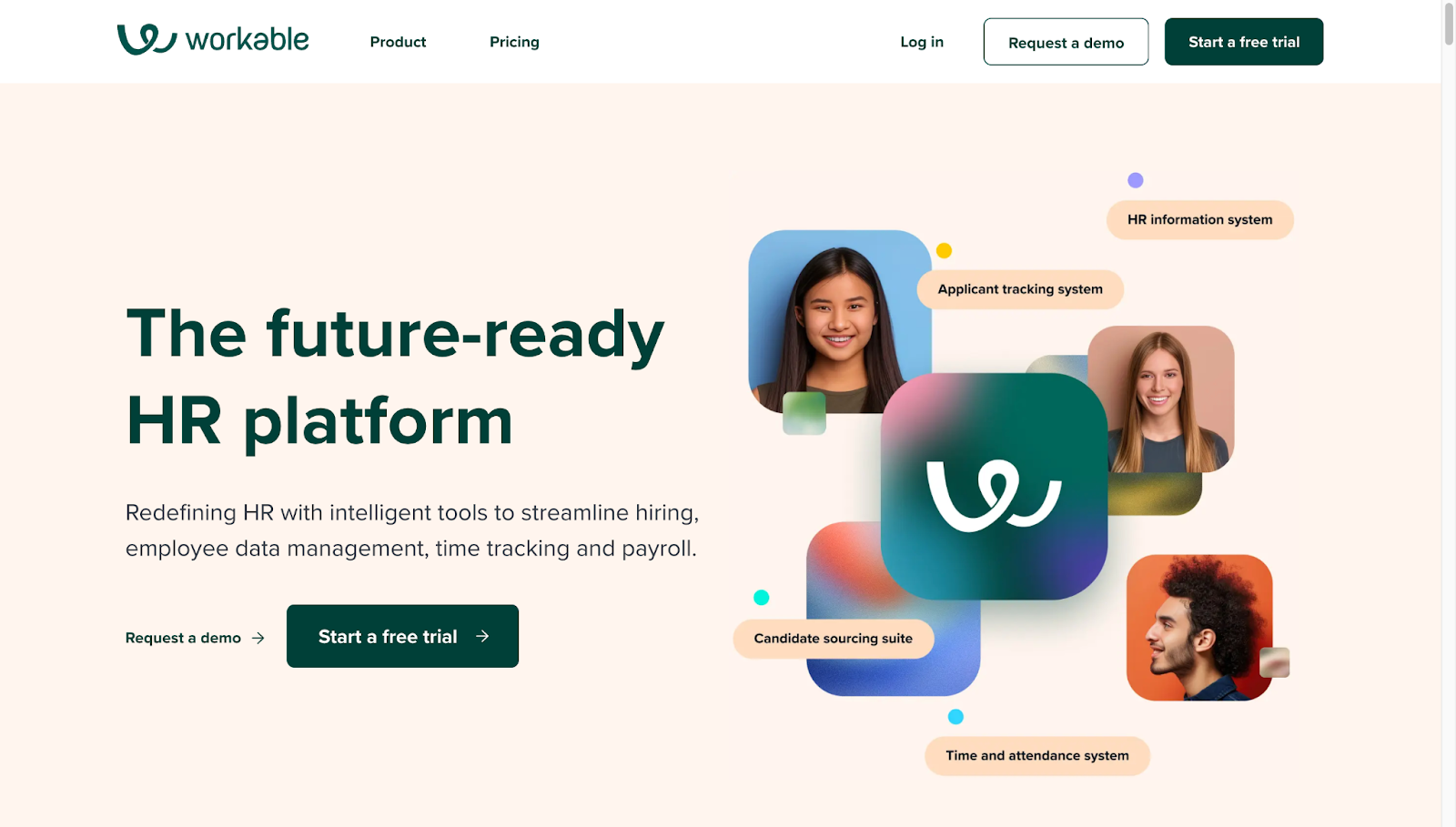
Workable is a widely used recruiting platform, but its appeal largely centers on simplicity rather than depth. Its ATS foundation covers the basics, though teams with more complex workflows may find its feature set limiting. The platform is easy to set up and navigate, which suits organizations that prioritize speed over advanced customization. While it helps users post jobs and move candidates through standard stages, it doesn’t offer the level of control or sophistication that some agencies expect from a full-scale Bullhorn alternative.
- Key features: AI-powered candidate sourcing, one-click job posting to major boards, streamlined interview scheduling, automated reminders, and collaborative tools that increase transparency.
- Strengths: Highly intuitive interface, excellent for collaborative hiring, reliable scheduling tools, and strong candidate engagement features that help keep communication consistent.
- Ideal for: Agencies that want an ATS designed for simplicity and speed, especially those that need a platform suited for industries such as tech, creative fields, and healthcare recruiting.
8. Manatal
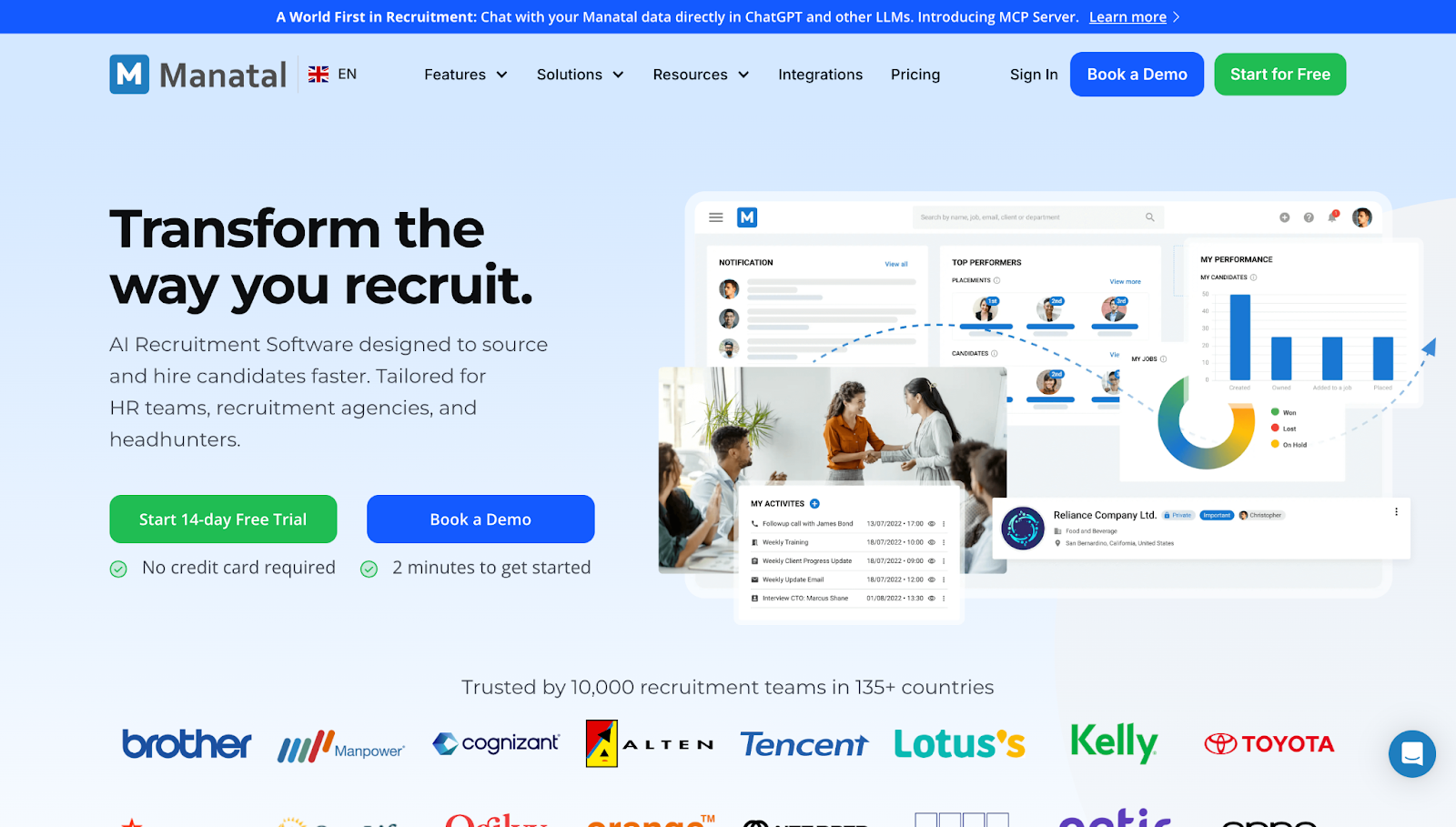
Manatal is an AI-focused recruitment platform aimed at smaller or growing agencies, though its feature set often leans more toward simplicity than advanced capability. While it offers a clean interface and basic automation tools, some teams may find its AI recommendations limited and its overall functionality lighter than expected. It appeals mainly to recruiters who prioritize an easy-to-use system, even if that means sacrificing deeper customization or more robust workflow options.
- Key features: AI-driven recommendations, automated actions, intuitive applicant tracking tools, CRM capabilities, social media recruitment, and easy pipeline management.
- Strengths: Competitive pricing, modern interface, predictive recommendations, and a streamlined workflow that supports quick sourcing and smoother hiring outcomes.
- Ideal for: Agencies seeking a modern platform that blends simplicity with AI, making it a strong fit for teams that want practical automation tools without sacrificing usability.
Pricing comparison snapshot
Pricing varies significantly depending on features, user count, and included modules. Below is a general comparison framework to help agencies identify the best balance between investment and capability.
- Bullhorn: Typically falls on the higher end due to its add-on–driven pricing. Costs increase quickly as agencies expand users or require additional modules.
- Teambridge: Value-driven with scalable pricing and strong automation features. Designed for high scalability and measurable performance improvements.
- Zoho Recruit: One of the most cost-effective options, particularly for smaller agencies or teams already integrated into the Zoho ecosystem.
- JobDiva: Higher pricing reflects its enterprise-level tools and deep VMS capabilities.
- Ceipal ATS: Competitive rates for teams focused on automation and large-scale hiring needs.
- Greenhouse: Premium pricing aligns with its structured hiring strengths, advanced analytics, and extensive integration ecosystem.
- Recruit CRM: Affordable and accessible, especially for small and midsized agencies that need fast setup and straightforward workflows.
- Workable: Moderate to premium pricing with strong collaborative features and reliable support for diverse industries.
- Manatal: Competitive mid-range cost, with AI-powered features exceeding expectations for the price.
Exact pricing requires consultation with each vendor, as costs vary depending on scale and specific requirements.
Choosing the right Bullhorn alternative
Your agency’s size, specialization, and growth objectives will determine the best Bullhorn alternative. Structured selection ensures long-term efficiency and performance, particularly for recruiting firms that need reliable tools and scalable workflows.
Best options by agency size and type
- Small to medium-sized agencies
- Teambridge: Offers advanced automation and strong customization options that help smaller staffing agencies operate with the precision of larger teams. Its intuitive workflows reduce training time for recruitment teams.
- Recruit CRM: Delivers an all-in-one experience at an accessible price point, ideal for agencies prioritizing speed, simplicity, and better client relationships.
- Manatal: Provides modern AI capabilities and an easy-to-navigate interface suited for small teams with rapid-growth goals.
- Zoho Recruit: A cost-effective choice for agencies already using the Zoho ecosystem, offering helpful modules and consistent mobile app access.
- Large staffing enterprises
- Teambridge: Its advanced automation, deep workflow capabilities, back-office coordination, and seamless integration make it a strong fit for large, complex staffing operations.
- JobDiva: A powerful option for high-volume organizations needing detailed reporting, VMS workflows, and real-time performance tracking.
- Greenhouse: Strong for structured hiring and data-driven workflows, especially for recruitment teams managing multiple departments or locations.
- Specialized recruitment firms (e.g., IT, healthcare)
- Teambridge: Built to support niche industries, including healthcare, with specialized workflows, compliance-aware processes, and customizable automation.
- Ceipal ATS: Effective for specialized and high-volume roles thanks to strong integrations, AI matching, and workflows built for fast placement cycles.
Consider your agency’s specific pain points with Bullhorn. If pricing is the issue, Zoho Recruit or Recruit CRM may be most suitable. If the concern is complex workflows or a steep learning curve, Teambridge, Workable, or Manatal offer more intuitive alternatives. For agencies that need enterprise-grade features, automation, or deep reporting, Teambridge and JobDiva continue to stand out.
The bottom line on Bullhorn alternatives
The market offers a strong selection of Bullhorn alternatives, each with unique strengths that can support different agency structures, workflows, and long-term goals. Your final choice should align with the specific needs of your recruitment process, budget, and operational constraints. Evaluate each platform carefully by reviewing its ATS tools, CRM capabilities, automation features, integration options, and full staff lifecycle management. Consider how each system supports both individual recruiters and broader recruitment teams as they manage candidates, clients, and internal operations.
Teambridge stands out as a truly end-to-end platform purpose-built for the entire staffing lifecycle; it supports everything from candidate acquisition and onboarding to scheduling, communication, and ongoing workforce management. Our modern design, advanced automation, and configurable workflows allow agencies to unify front-office recruiting with post-hire operations in a single system. Teambridge gives staffing organizations far greater control than legacy solutions like Ceipal or older platforms that struggle to support the full continuum of staffing needs.
Book a demo to see how Teambridge can lower costs while driving revenue today.