Every weekend, somewhere in a healthcare staffing agency's operations team, a Sunday morning ICU shift falls through. Not because a nurse called out. Not because the client changed the order. Because a BLS card quietly expired on Thursday, nobody caught it, and the hospital's credentialing portal spit back the submittal at 4:47 PM on Friday — after the compliance team had gone home.
That's not a scheduling problem. That's a credential-visibility problem that surfaced 48 hours too late. And the fix isn't more recruiter diligence. It's tying deployment eligibility to real-time credential status so a lapsed cert makes the shift physically un-bookable.
The Friday 4pm Problem: How One Expired BLS Card Cascades Into a Sunday ICU Hole
Here is the failure mode, step by step. A per-diem RN in your float pool has a BLS certification that quietly rolls past its expiration on Thursday. She doesn't notice — most clinicians don't track their own dates. Her recruiter doesn't notice either, because he's working from a candidate profile that was last verified during onboarding four months ago. On Friday afternoon, the recruiter submits her for a Saturday and Sunday ICU block. The hospital's credentialing portal rejects the submittal at 4:47 PM. By Saturday night, the unit is short two bodies and the charge nurse is calling every agency in the market.
This is not a rare event. It is the predictable outcome of managing hundreds of rolling expiration dates through spreadsheets and recruiter memory. When compliance issues arise, the consequences are immediate. A nurse removed mid-shift due to an expired license leaves gaps that jeopardize patient care and team morale.
The agencies that get burned repeatedly all have the same pattern: credential data lives in one system, scheduling lives in another, and a human is expected to reconcile them under time pressure. Manual tracking at that volume is simply not a realistic strategy.
Why Weekend Surge Coverage Exposes Every Weakness in Your Credential Workflow
Weekends break float pool operations in ways weekdays don't, and the reasons are structural.
Credentialing teams are usually offline from Friday evening through Monday morning. Primary source verification stalls because state boards and issuing bodies aren't returning queries. Recruiters covering the on-call pager lean on their memory of who's "ready" — memory that was accurate on Tuesday and isn't accurate anymore by Saturday. Meanwhile, ICU demand doesn't pause for the credentialing calendar.
The handoff between recruiting and credentialing is where most agencies lose the game. A candidate looks ready to the recruiter because paperwork was submitted. But submitted is not verified, and verified is not current. Three different states of the same record, and the recruiter can only see one of them.
Warning
If your recruiter can offer a shift before your compliance system has confirmed every required credential is active and unrestricted, you have a structural gap. It will surface on a weekend.

There's a second problem baked into weekend surge coverage: client-specific requirements. Multi-state license verification, OIG, SAM, and exclusion monitoring, credential expiration and document tracking, and client-specific compliance requirements — meeting hospital, health system, and health plan standards that may exceed baseline requirements — every ICU client has a slightly different stack. One hospital enforces a 90-day cushion on state license expiration. Another requires an annual facility-specific competency check. A recruiter working from memory cannot hold that matrix in their head.
The Real Margin Math on a Cancelled Per-Diem ICU Shift
Most agency operators know a cancelled weekend shift hurts. Few of them price it out.
Here's the P&L on a single cancelled 12-hour ICU shift at a mid-market bill rate:
| Line item | Impact |
|---|---|
| Lost bill revenue (12 hrs @ ~$90/hr) | ~$1,080 gone |
| Backfill premium (if you can fill it) | +15-30% pay rate |
| Recruiter time to re-fill on Saturday | 2-4 hours |
| Client trust erosion | Unmeasured, compounding |
| Downstream account risk | Silent — the hospital just stops calling |
And the margin math is uglier than the top-line loss suggests. Pay rates continued to normalize after their surge during the pandemic, but housing and M&I costs rose on a per-hour basis even while bill rates declined. The result was an aggregate decline in gross margin from 20.6% in 2023 to 19.3% in 2024. When your gross margin is sitting under 20 points, a single backfill premium on a Sunday ICU can erase a month of per-diem contribution on that account.
The broader context matters here. After growing more than sixfold from $6.5 billion in 2019 to $42.7 billion in 2022, the travel nursing market shrank 40% to $25.6 billion in 2023, according to a June report by research and advisory firm Staffing Industry Analysts (SIA). The contraction has continued — Staffing Industry Analysts projects 2025 marked the third consecutive year of contraction, with travel nurse revenue projected to decline 16% to $14.2 billion from the year before. In a market that's compressed this hard, agencies cannot afford to leak revenue through preventable credential lapses.
And the downstream risk is the one nobody puts on the spreadsheet. When you're placing nurses, CNAs, and therapists across multiple client sites, credential currency isn't just your internal compliance problem. It's a contractual obligation to every facility you staff. One expired license among your placed workforce can create liability exposure at the client, damage the relationship, and trigger your own internal audit. ICU coverage is a trust product. Miss two weekends in a row and the DON stops taking your call.
Ready to move?
Ready to see Teambridge in action?
Credential-Aware Scheduling: Making Lapsed Certs Physically Un-Bookable
The operational fix is not "train recruiters to check twice." The fix is architectural. Deployment eligibility should be tied directly to current credential status so a lapsed certification blocks the shift assignment automatically — no recruiter action required, no memory required.
Inside Teambridge's scheduling system, this looks like:
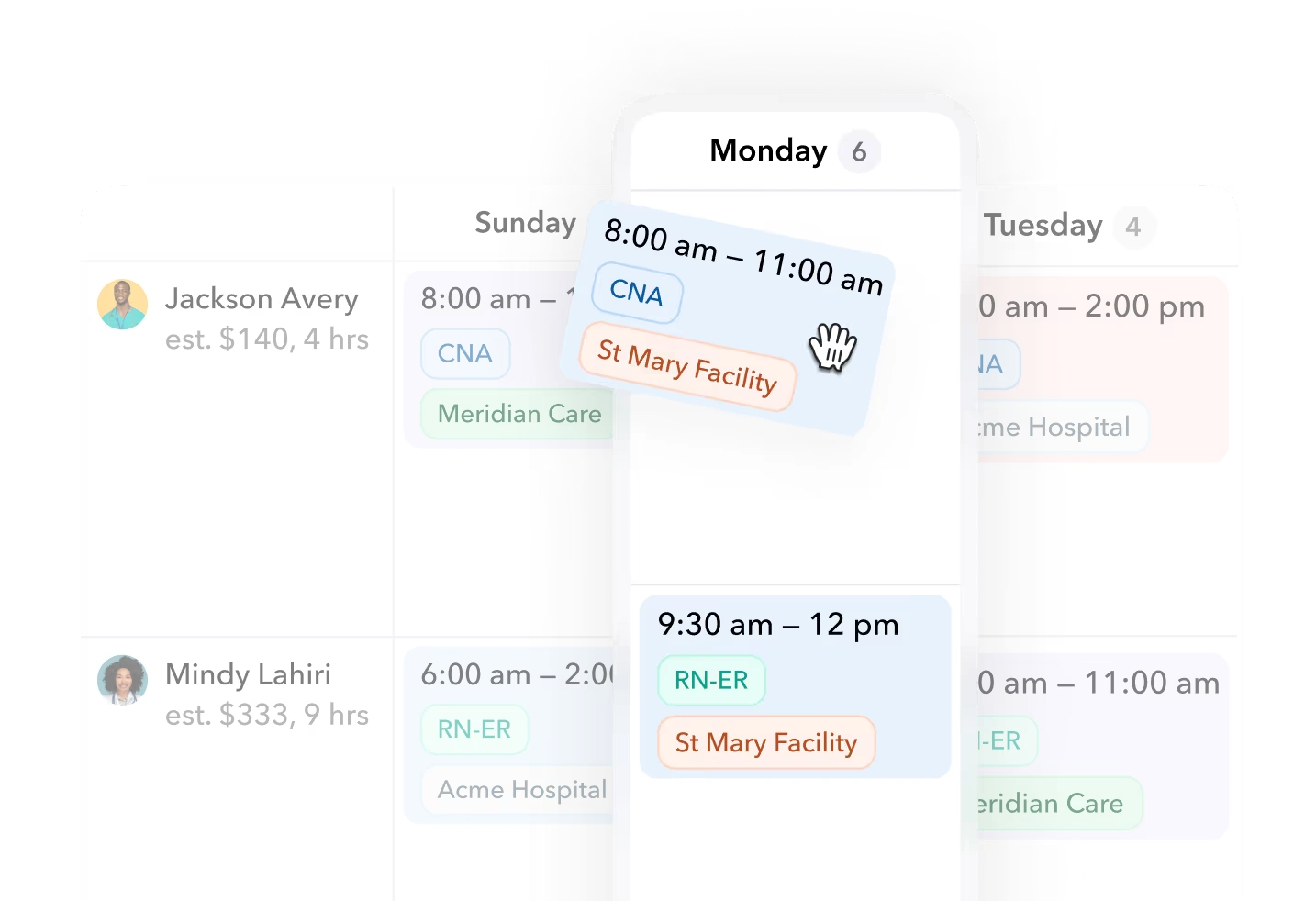
- Credential fields gate shift offers before they broadcast. If a required cert is expired or expires before the shift date, the clinician is excluded from the eligible pool.
- ICU-specific requirement stacks live as reusable templates: state RN license, ACLS, BLS, critical care hours threshold, facility-specific competency, TB test, N95 fit-test currency.
- Client requirement overlays apply on top of role requirements — the same RN might be eligible at Hospital A and blocked at Hospital B because Hospital B enforces a 90-day license cushion.
- No override without a compliance sign-off, logged and auditable.
This is the difference between credential status being displayed next to a candidate profile and credential status gating the booking. Displayed is decorative. Gating is operational.
The payoff is that recruiters stop being the last line of defense against a credential lapse. They can move faster because the system will not let them make an ineligible offer in the first place. For a deeper look at how this ties into broader healthcare staffing operations, the pattern is the same across nursing, allied health, and per-diem: credential status is the input, deployment eligibility is the output.
Tip
Test your current system by trying to book an obviously ineligible clinician into a shift. If the system lets you do it and just shows a yellow flag, credentials are not actually gating scheduling — they're just decorating it.
The 30/14/7/1 Renewal Cadence That Kills Weekend Surprises
Blocking ineligible bookings is defense. Preventing the lapse in the first place is offense. The two work together.
Here is the renewal cadence that keeps a working pool continuously deployable:
- 30 days out: Automated reminder to the clinician with a one-tap upload link. First email.
- 14 days out: Escalated reminder to both the clinician and their assigned recruiter. Add SMS.
- 7 days out: Escalation to the compliance lead. Clinician is flagged in scheduling as "renewal required before shift."
- 1 day out: Auto-block on any shift assignment that extends past the expiration date. Recruiter notified.
This is not novel. Vendors across the credentialing space have converged on some version of it — CredGuard uses escalating reminders at 60, 30, 14, 7, 3, and 1 day before expiration. Email first, then SMS. The specific intervals matter less than the discipline of automation. What breaks agencies is treating renewals as ad-hoc outreach instead of a routine calendar operation.
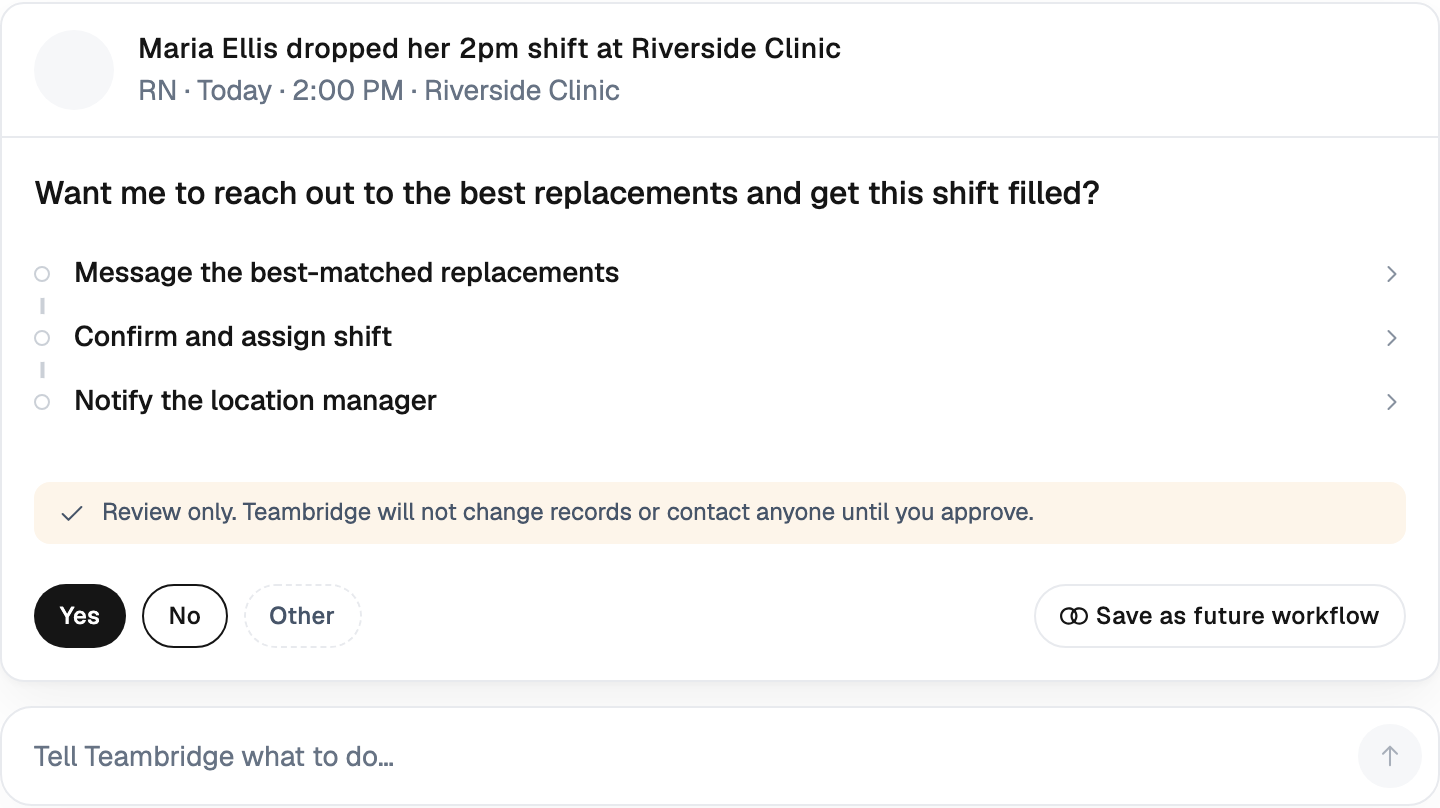
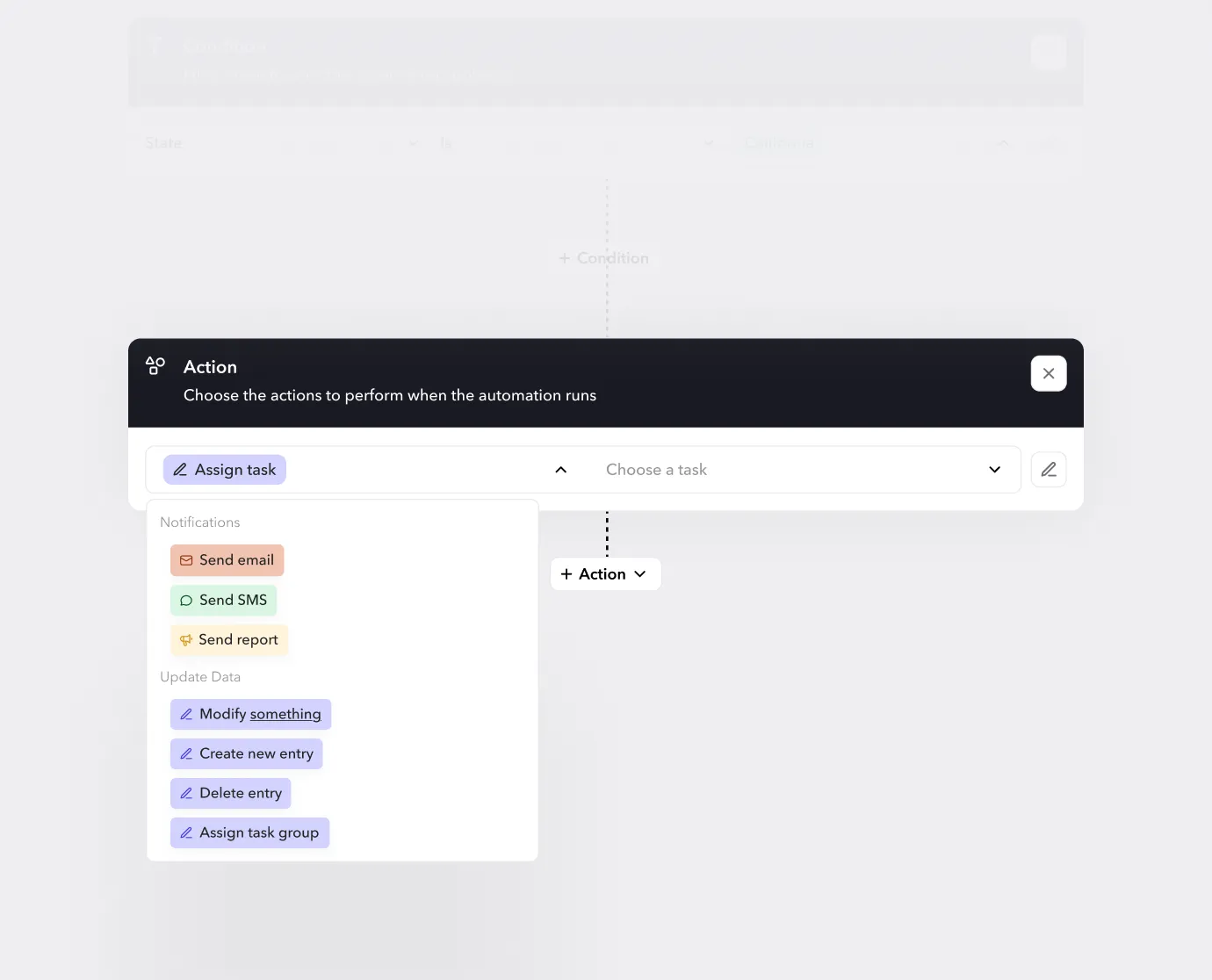
The operational rule that turns this from a policy into a system: no float pool RN inside 14 days of a credential expiry gets offered a weekend ICU shift without a renewal confirmation on file. Encode that as an automation, not a Slack norm. This is exactly the kind of workflow Teambridge's automation builder exists to handle — credential renewals, no-show follow-ups, onboarding steps, all running without a human triggering them.
Weekend-Ready Float Pool: The Pre-Flight Check Every Friday Morning
Even with credential-aware scheduling and a tight renewal cadence, one ritual makes the difference between a clean weekend and a scramble: the Friday morning pre-flight.
Here's the report your compliance lead should be looking at every Friday by 9 AM:
- Every clinician scheduled for Saturday and Sunday shifts
- Cross-referenced against every credential type required by the assigned client
- Flagged if any credential expires within the next 30 days
- Sorted by shift start time so the earliest exposures surface first
Compliance clears or pulls before the client's staffing office closes for the weekend, not after. If a pull is needed, the recruiter has Friday afternoon to backfill from the eligible pool — not Saturday night from the on-call pager.

This is where the three data layers — credential status, scheduling, client requirements — have to actually converge in one view. If your compliance lead is opening three tabs to run this check, you'll skip it under pressure. If it's one report generated automatically at 8 AM every Friday, it becomes a ritual.
What Changes When Credential Status, Scheduling, and Client Requirements Live in One System
When the three layers stop being separate spreadsheets, the operational results are measurable:
| Metric | Fragmented systems | Unified system |
|---|---|---|
| Weekend ICU cancellation rate | 6-12% typical | 1-3% typical |
| Same-day per-diem fill rate | 40-55% | 70-85% |
| Recruiter time on credential verification | 30-40% of workday | Under 10% |
| Backfill premium as % of gross margin | Meaningful, unpredictable | Rare, contained |
| Compliance audit prep time | Days | Hours |
The reason unification works is not magic. It's that unlike spreadsheets, dedicated software provides automation, built-in compliance logic, role-based controls, and advanced analytics. Features like automated verification, expiration reminders, audit logs, and integration with HR systems are impossible in spreadsheets. When credential currency is a live field the scheduler queries every time it offers a shift, lapses cannot cascade quietly for two days before surfacing.
The broader industry is moving in this direction. Travel nursing demonstrates that MSP/VMS adoption can quickly become the norm. As hospitals seek efficiency and transparency, the same dynamics will likely emerge in locum staffing. Agencies that treat credential-scheduling integration as table stakes will hold their weekend ICU accounts. Agencies that don't will keep losing them one Sunday at a time.
For the specific operational patterns other staffing agencies use to close this gap, and for customer stories from teams that rebuilt their weekend fill workflow around credential-aware scheduling, the pattern is consistent: the win comes from removing recruiter memory as a load-bearing part of the process.
Where to Start This Week if Your Weekend ICU Fill Rate Is Slipping
If your weekend ICU numbers are drifting, don't reorganize the recruiting team. Run this five-step audit first.
- Pull the last 90 days of weekend cancellations. Tag which were credential-driven versus true call-outs versus client-side cancellations. If credential-driven is more than 15%, the rest of this list is your priority for the quarter.
- List every credential type your top three ICU clients require. Include the client-specific overlays — cushion days on license expiration, facility competency refreshers, drug screen cadence. Most agencies underestimate this matrix by half.
- Map your current expiration monitoring cadence and its gaps. Who gets a 30-day alert? A 7-day alert? Who owns escalation if the clinician doesn't respond? If any of those answers is "the recruiter, informally," that's a gap.
- Identify who owns the Friday pre-flight. If nobody owns it, assign it. If it exists but takes more than 20 minutes, the underlying data isn't unified enough.
- Evaluate whether credential status actually gates shift booking in your current system, or is just displayed next to it. Try to book an ineligible clinician on purpose. If the system lets you, you have a scheduling problem masquerading as a discipline problem.
Important
The single biggest lever is step five. Credential-aware scheduling — where lapses are physically un-bookable — eliminates entire categories of Friday afternoon fire drills. Everything else is optimization on top of that foundation.
Weekend ICU coverage is the highest-stakes, highest-margin, highest-visibility product a healthcare staffing agency sells. It's also the one most vulnerable to preventable credential lapses. The agencies that hold these accounts long-term are the ones that stopped treating credentials as paperwork and started treating them as a real-time input to every scheduling decision.