

Payroll sees the 8. New York labor law cares about the 15.
That gap — between the hours your systems track and the spread the state measures — is where routine split shifts across hotel outlets quietly become six-figure wage claims. It rarely looks like a violation. It looks like good coverage. And because most hotel timekeeping was built to count hours worked, not the shape of the day, the exposure piles up shift after shift until a DOL audit or a plaintiff's attorney does the math for you.
Why split shifts across outlets are a compliance blind spot
Hotels are structurally built to create spread-of-hours problems. One property runs F&B, banquets, room service, and a lobby bar — often as separate departments, sometimes with separate timeclocks and always with separate managers. Staff flow between all of them based on banquet event orders, occupancy, and who called out.
From an operations standpoint, that's flexibility. From a compliance standpoint, it's a day that no single system is measuring end to end. The breakfast outlet sees a 3.5-hour shift. The banquet captain sees a 5-hour evening shift. Nobody — and no system — sees the 15-hour spread between the first punch and the last.
The failure mode isn't malice or corner-cutting. It's that "hours worked" is the only number most payroll setups were designed to total. Spread is a different measurement entirely, and if nothing in your stack calculates it, you won't know you owe it.

What New York's spread-of-hours rule actually requires
Under the New York State Department of Labor's hospitality industry wage order (12 NYCRR Part 146), the rule is straightforward and unforgiving:
- On any day an employee's spread of hours exceeds 10 — measured from first clock-in to last clock-out, including meal breaks and off-duty gaps — the employer owes one extra hour of pay.
- That extra hour is paid at the full basic minimum wage, not the tipped cash wage. The tip credit does not apply to the spread hour.
- Any day with a split shift triggers it too, even if the total span stays under 10 hours.
- In hospitality, it applies regardless of the employee's regular pay rate. A $30/hour sous chef gets the same extra hour as a dishwasher on minimum wage.
As of January 2026, the basic minimum wage is $17.00/hour in New York City, Long Island, and Westchester, and $16.00/hour for the rest of the state — that's the rate each qualifying spread hour is paid at, per NYSDOL's minimum wage schedule.
Important
The spread hour is owed on top of all wages for hours actually worked, and it stacks with weekly overtime. It is not a credit against anything else you paid that day.
Ready to move?
Ready to see Teambridge in action?
The math nobody does until a DOL audit: 6 years plus 100% liquidated damages
The daily number looks trivial. That's exactly why it compounds.
Take a mid-size NYC hotel with 40 tipped banquet and F&B workers. Say banquet season means an average of 3 qualifying spread-of-hours days per worker, per week — a morning buyout plus an evening event, which is a completely normal week. Using the 2025 NYC rate of $16.50:
| Scenario | Calculation | Exposure |
|---|---|---|
| Per worker, per week | 3 days × $16.50 | $49.50 |
| 40 workers, per week | 40 × $49.50 | $1,980 |
| One year | $1,980 × 52 | $102,960 |
| 6-year lookback | $102,960 × 6 | $617,760 |
| Plus 100% liquidated damages | × 2 | $1,235,520 |
That's before interest and attorney's fees, both of which New York also awards. And the lookback matters: federal FLSA claims reach back 2–3 years, but New York's statute of limitations on wage claims is 6 years, with liquidated damages of 100% of unpaid wages under Labor Law § 663.
A seven-figure exposure built entirely out of $16.50 line items nobody was tracking.
This is also a known plaintiffs' bar target in New York hospitality. Spread-of-hours claims are routinely bundled into class and collective actions against hotel and restaurant groups precisely because the violation is mechanical: either the premium was paid or it wasn't, and the time records answer the question.
The four ways multi-outlet properties create violations without noticing
1. Timeclocks that never stitch the day together
Separate clocks or departments per outlet means the ballroom system and the rooftop system each record a clean, short shift. Payroll totals hours worked — 3.5 plus 5 — and never computes the 15-hour span between the punches. The violation exists only in the gap between systems.
2. The "come back tonight" request
A banquet captain texts a server at 2 PM: "Can you come back for the wedding?" She says yes. The schedule of record still shows a single morning shift, so even a system that could flag spread never gets the chance. The schedule and the punches diverge, and the punches are what the DOL will use.
3. Tip credit applied to the spread hour
This one is a payroll configuration error, and it's common. Payroll codes the spread premium at the tipped cash wage — say $11.00 instead of the full $16.50 or $17.00 — because that's the rate on the employee's record. The spread hour must be paid at the full minimum wage. A partial payment is still a violation, every single day it happens.
4. Sister properties sharing banquet staff
A hotel group floats banquet staff between two properties three blocks apart. Each property's system owns half the day. No single record shows that the worker's spread ran from an 8 AM lunch setup at Property A to a midnight breakdown at Property B. Legally, if it's the same employer, that's one day — and it's a 16-hour spread.
Catch it at scheduling, not at payroll
The cheapest spread-of-hours fix happens before the shift is ever published. Once the day is worked, the premium is owed — your only choices are paying it on time or paying it with damages later.
The upstream fix looks like this:
- Treat each worker's day as one continuous record across every outlet and property, not as a stack of unrelated shifts.
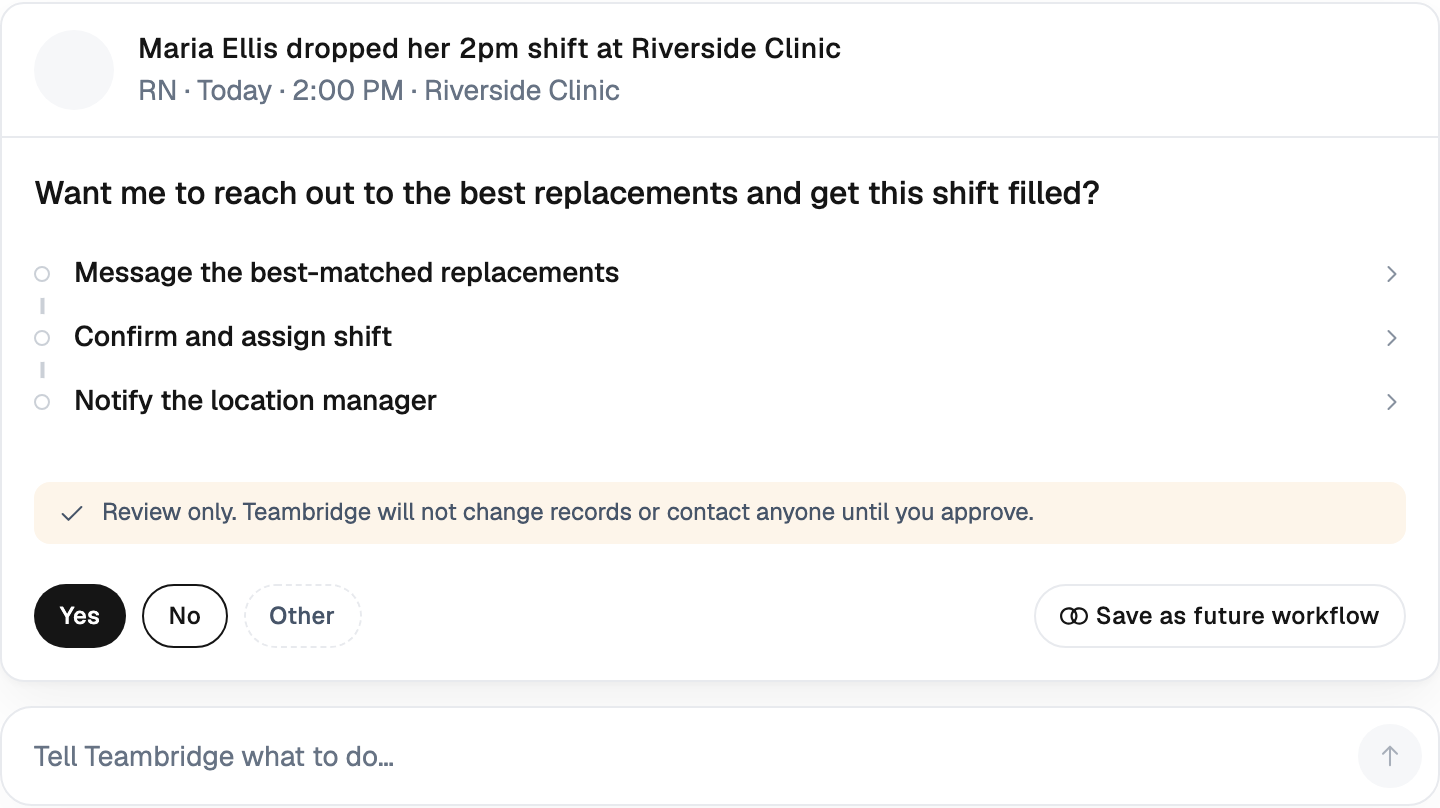
- Flag any assignment that would push a daily spread past 10 hours at the moment a manager builds or edits the schedule — not in a payroll report two weeks later.
- Route the decision: split the assignment across two workers, adjust the timing, or approve the spread premium knowingly with the cost visible.
- Handle the "come back tonight" request in the system, so the schedule of record always matches reality and the flag fires in real time.
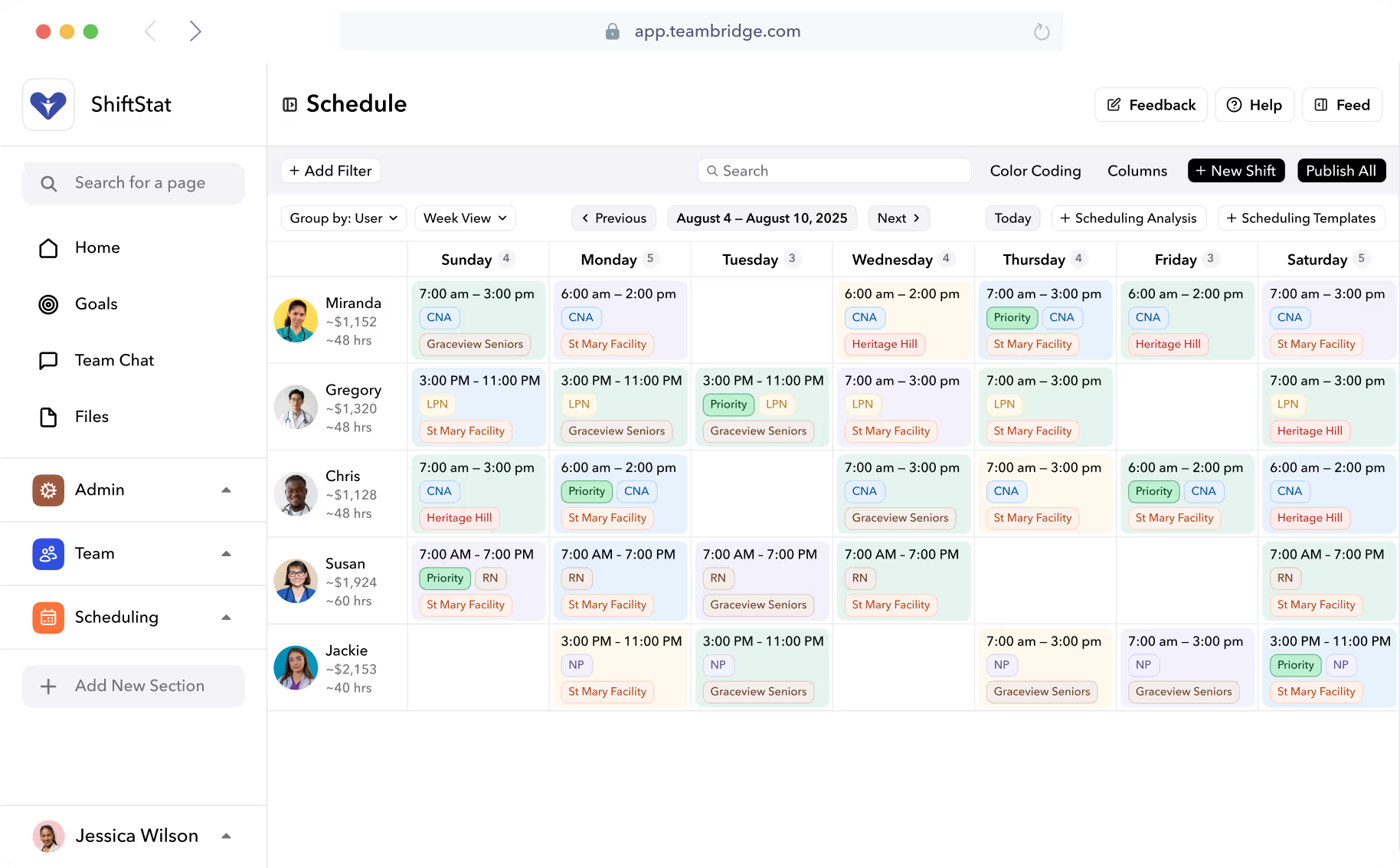
This is how Teambridge Scheduling is built to work: a worker's day is a single object across outlets, and schedule edits that would create a spread violation surface a warning to the manager before the shift goes out. For multi-property operators, the Teambridge hotels solution extends the same logic across sister properties sharing a banquet bench, so cross-property coverage doesn't silently assemble a 15-hour day.
Tip
Not every 10+ hour spread is avoidable — a sold-out Saturday with a lunch buyout and a gala is going to need long days. The goal isn't zero spread premiums. It's that every premium is a deliberate, costed decision at scheduling time, and paid automatically at payroll time.
When spread violations do happen, you need one audit trail
If a claim or audit lands anyway, the question becomes documentary: can you reconstruct any worker's spread for any day in the last six years?
If a worker's day spans three outlets and two systems, the answer is usually "not quickly." You're exporting punches from multiple clocks, cross-referencing banquet event orders, and hoping the timestamps line up — while the other side's argument is simply that your records are unreliable, which under New York law shifts the burden toward the employer.
One time-tracking record per worker per day changes the posture completely:
- Spread premiums are calculated automatically from the full first-punch-to-last-punch span, at the correct full minimum wage rate — no tip-credit misconfiguration.
- Exception reporting in Teambridge Admin Tools surfaces any day where a premium was flagged but not paid, so you fix it in the current pay period instead of discovering it in year four of a lookback.
- If a spread premium genuinely wasn't owed, you can prove it with a single record rather than reconstructing a day from fragments.
In practice, this is the difference between producing a spreadsheet and producing an affidavit from your payroll vendor.
Stop paying the violation tax
Spread-of-hours compliance is not a payroll tweak. It's a design problem: your scheduling tool has to see the whole day before it happens, and your time tracking has to record the whole day as one thing when it does. Properties that solve it at those two points pay the occasional $17 premium on purpose. Properties that don't find out what they owed six years later, doubled, with fees.
If you run a New York hotel or banquet operation with staff moving across outlets, see how Teambridge handles hospitality workforce operations end to end, or check the platform overview to see how scheduling, time tracking, and compliance reporting share one record per worker per day.

About the author

Content Writer at Teambridge
Anis Nanai is a content writer at Teambridge, with a focus on workforce management and the realities of running hourly teams. He prioritizes conversations with customers, staying close to the market, and understanding how workforce needs are changing. His writing connects those concerns to practical decisions about scheduling, time tracking, staffing, and automation. He examines product developments through the questions that matter to operators: what does this solve, how would it work for my team, and what evidence supports it?
Company perspective: this author works at Teambridge. Customer outcomes are attributed to their published sources.
View LinkedIn profile