The Monday 6 AM Problem: A Valid Card in One State, A Turnaway in the Next
A foreman rolls a 12-person crew out of a Texas yard at 4 AM Sunday, drives north through the night, and pulls up to a NYC public works gate at 6 AM Monday. Three workers get turned away. Their OSHA 10 cards are more than five years old. The GC's compliance clerk flags them at the trailer, the site safety manager backs the call, and now the foreman is short-handed on a job that started billing at first light.
The cruel part: those cards are technically valid. At the federal level, OSHA 10 certification does not expire. The Occupational Safety and Health Administration does not require renewal, and once workers complete the training, they receive an OSHA 10-Hour certification and an official Department of Labor (DOL) OSHA card that remains valid for life. The wallet card looks fine. The DOL database says the training was completed. Federally, nothing is wrong.
But federal isn't what runs the gate. State law, general contractor policy, and union rules override the federal baseline the moment the crew crosses a jurisdictional line. Technically, OSHA DOL cards don't have an expiration date. However, the parties that require an OSHA 10 card, including state and local governments or employers, will usually also specify how often the training needs to be renewed. It depends on the local law or individual employer, but three to five years is common.
Multi-state staffing agencies get burned worst here. A single-market GC learns their state's rule and lives inside it. An agency dispatching crews across Texas, Missouri, New York, Connecticut, and Massachusetts has to run a different rule set for every truck. And most of them still track it in a spreadsheet.
The Seven-State Trap: Where OSHA Cards Actually Go Stale
The federal fiction of a lifetime card breaks against a stack of state statutes and city codes. There are seven states plus New York City where a five-year window becomes the operative rule for covered projects: New York, Connecticut, Nevada, Massachusetts, New Hampshire, Rhode Island, and Missouri. About a dozen states run their own OSHA-approved programs. Several — including Connecticut, Missouri, Nevada, and New York — require a refresher for certain construction work, often every five years.
The triggers aren't uniform. They fire at different contract values, on different funding sources, and against different worker classifications.
| State / Jurisdiction | Trigger | Refresh Window |
|---|---|---|
| New York (Labor Law §220-h) | Public works contracts at set thresholds | 5 years (NYC); state cert good for life on Article 8 |
| Connecticut (§31-53b) | State-funded public works ≥ $100,000 | 5 years (contractor practice) |
| Massachusetts | Public works ≥ $10,000 | 5 years |
| Nevada | Construction workers within 15 days of hire | 5 years |
| Missouri | All publicly funded projects | 5 years |
| New Hampshire / Rhode Island | Public works | 5 years |
| NYC (Local Law 196) | Any site with a Site Safety Plan | 5 years (SST card cycle) |
Connecticut is a clean example of how the language creates ambiguity that coordinators have to resolve at dispatch. Connecticut General Statutes §31-53b requires OSHA 10 for laborers, mechanics, and workers on state-funded public works projects valued at $100,000 or more. The card itself doesn't expire, but the law requires the training to have been "successfully completed" — and many state agencies and unions interpret that as needing to be current. Most CT contractors require renewal every 5 years.
And remember that Construction (29 CFR 1926) and General Industry (29 CFR 1910) are separate tracks. A worker with a General Industry OSHA 10 doesn't satisfy a construction site requirement. A dispatcher who filters by "has OSHA 10 = yes" is going to send the wrong worker to the wrong site eventually.
Warning
There is no shorter "refresher" version of OSHA 10 in the federal Outreach program. When a state or employer says you need to refresh, they mean retake the full 10-hour course. Same modules. Same hours. New issue date on the new card. Budget the time and the seat cost accordingly — this isn't a two-hour online quiz.
NYC Local Law 196 and the SST Card Stack That Breaks Dispatch
NYC is the worst-case study, and every multi-state agency should treat it as the ceiling for compliance complexity.
Passed in 2017, Local Law 196 created the Site Safety Training (SST) card system administered by the NYC Department of Buildings. Any construction or demolition project that requires a Site Safety Manager, Site Safety Coordinator, or Construction Superintendent must have SST-carded workers on-site. That covers most major projects in the five boroughs.
The SST card sits on top of the OSHA card, and it's the SST card the gate actually checks. But the SST card is only valid if the underlying OSHA training is fresh. To obtain or renew an SST card, your OSHA 10 or OSHA 30 training must have been completed within the last 5 years. If your OSHA training is older than that, the NYC DOB considers it "stale" — and you'll need to either retake it or complete an approved OSHA refresher course before your SST card can be issued or renewed.
So a 2016 OSHA 30 card is worthless in NYC in 2026 — even though the DOL will confirm it was earned, even though it looks perfectly valid in the worker's wallet.
The cost of getting this wrong is not theoretical. Employers face fines up to $5,000 per untrained worker on covered job sites — and NYC DOB can issue that penalty separately to the owner, permit holder, and employer, meaning total exposure per worker can reach $15,000. Multiply by a 12-person crew and one bad dispatch decision is a six-figure event.

SST renewal itself is a separate hours obligation on top of the OSHA refresh. Before the card's 5th anniversary, workers will need to complete 8 hours of renewal training, while SST Supervisors will need 16 hours total. Everyone will need 4-hour Supported Scaffold Training, as well as a Fall Prevention course that is 4 hours long for workers and 8 hours for supervisors. Supervisors will need additional courses: a 2-hour Toolbox Talks and a 2-hour Pre-Task Safety Meeting.
That's a lot of moving parts for a coordinator to track on paper. And the underlying OSHA date is the linchpin — miss it and the whole SST stack collapses.
Why Spreadsheets and PDF Folders Miss the Expiration Window
Most staffing operations still track credentials the way they tracked I-9s in 2005: a boolean flag on the worker record, a PDF in a shared folder, and a coordinator who "knows" who's got what.
That model fails at three specific points.
- "Card on file" is not the same as "card valid for this job." A yes/no flag doesn't capture issue date, track (1926 vs 1910), issuing trainer, or jurisdiction. All four matter at the gate.
- No proactive expiration ladder. Without automated 60-day and 30-day reminders tied to the issue date, expirations get discovered on Monday morning by a foreman, not on Friday afternoon by a coordinator.
- No scheduling block. Even if the coordinator knows a card is stale, nothing physically prevents the dispatcher in the next seat from assigning that worker to a NY public works job.
There's a fourth trap that catches agencies off guard: the replacement-card window. Generally speaking, replacement OSHA Outreach cards are requested through the authorizing trainer, but the DOL will only reissue if the class was within the last 5 years. If a worker loses a card from a class taken more than five years ago, they don't get a replacement — they retake the whole 10-hour course. Agencies that promise same-week deployment don't have that runway.
Ready to move?
Ready to see Teambridge in action?
Wiring Credential Rules Into the Schedule, Not the HR Folder
The fix isn't better tracking. It's enforcement at the point of assignment.
Credential status has to be a scheduling constraint, not a reference document. When a coordinator drags a worker onto a shift, the system needs to answer three questions before the assignment locks:
- What jurisdiction is this project in?
- What triggers apply (contract value, funding source, GC policy, LL196 status)?
- Does this worker's OSHA card meet the freshest applicable rule?
If the answer to the third question is no, the assignment shouldn't just warn — it should block. That's the piece a spreadsheet fundamentally can't do.
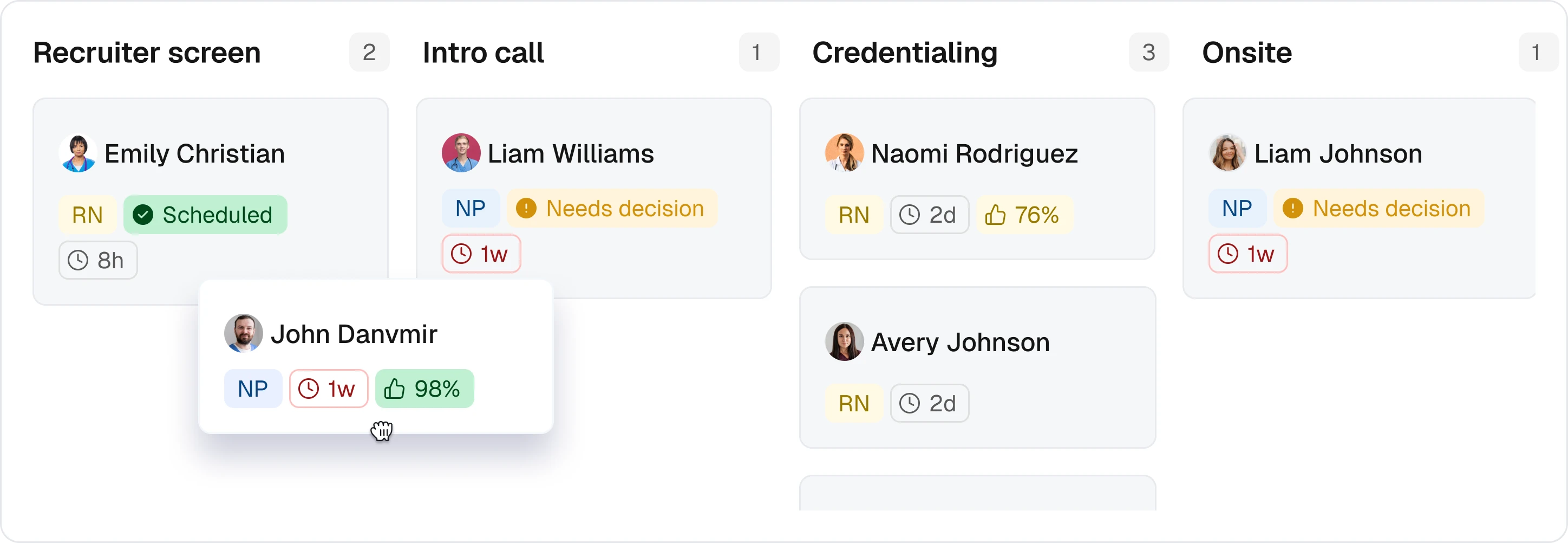
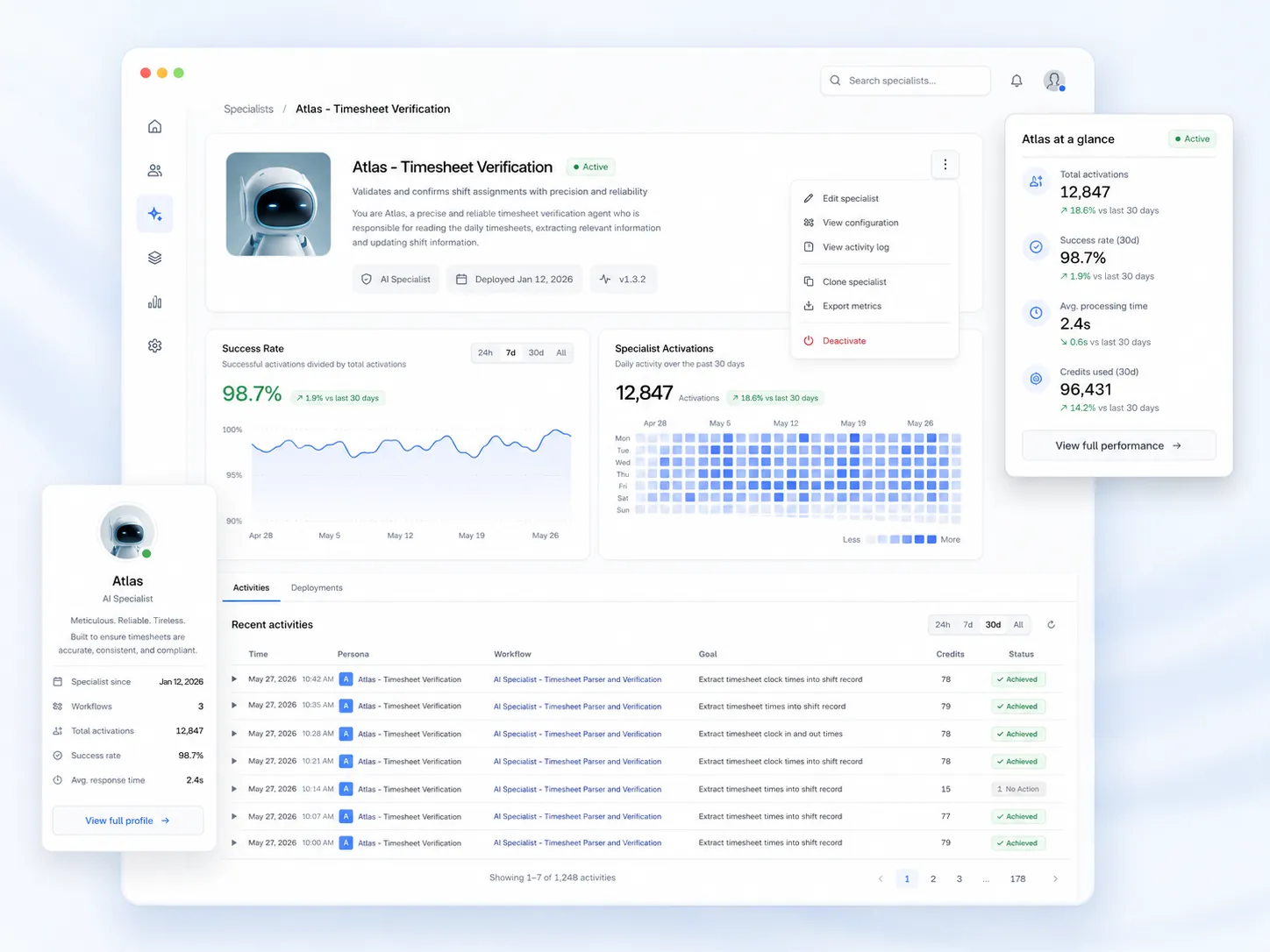
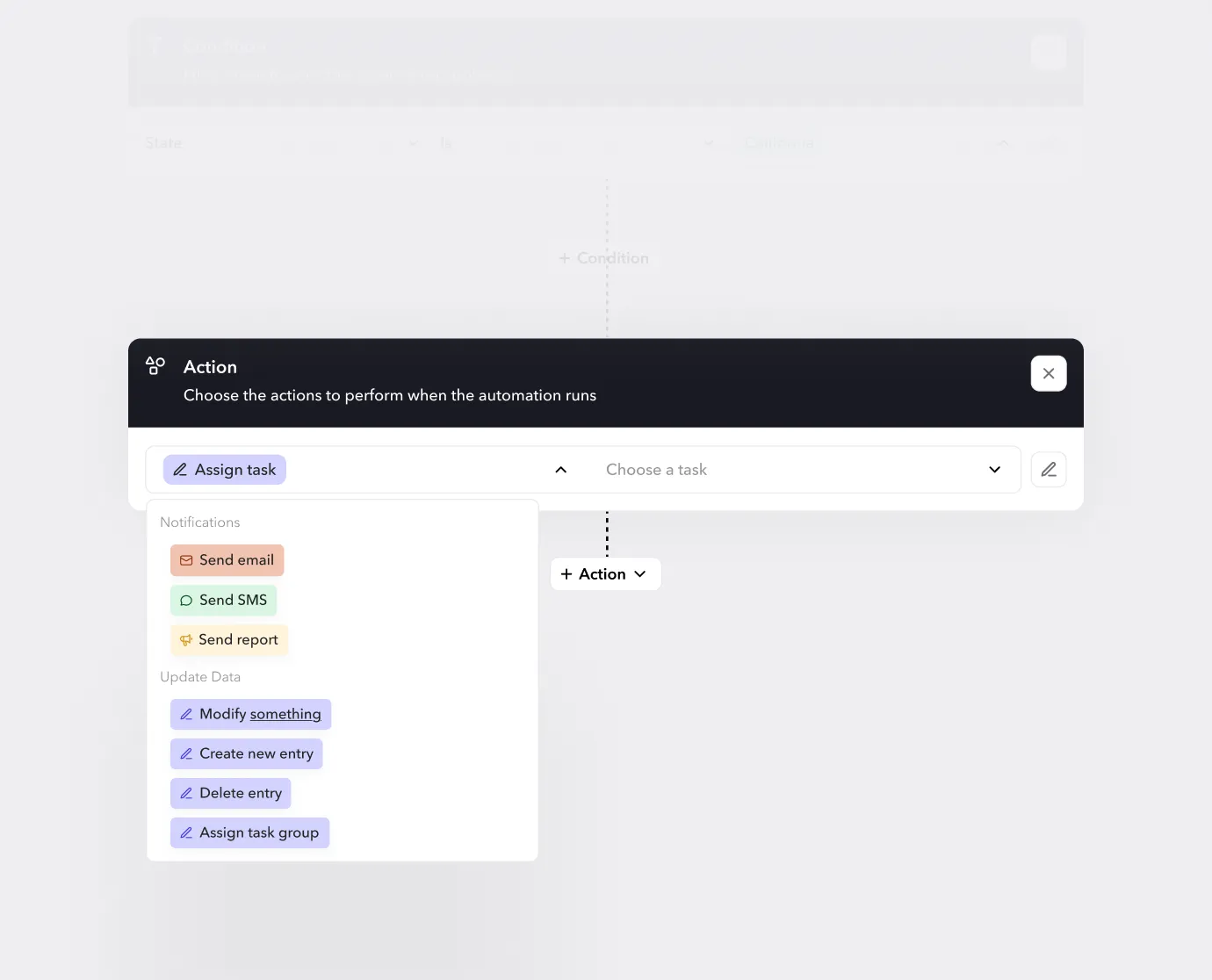
Teambridge Scheduling treats credentials as first-class scheduling constraints: the system auto-fills gaps and enforces credential rules per project profile, so a stale OSHA 10 blocks the assignment before dispatch is confirmed. Paired with Automations, the expiration ladder runs itself: 60 days out, the worker gets enrolled in a refresher course; 30 days out, a coordinator gets pinged if enrollment isn't confirmed; 15 days out, the worker is auto-flagged as ineligible for any covered project after the expiration date.
Tip
Build the ladder backwards from the covered-project expiration date, not from the wallet card's issue date. NYC's SST refresher training must be taken within a year of applying for renewal, so the enrollment window is narrower than most operators assume.
The renewal cadence that actually works
- T-90 days: Automation identifies workers with any covered-state exposure and cards approaching 5 years.
- T-60 days: Auto-enroll worker in a refresher course. Notify supervisor and worker via mobile app.
- T-30 days: Escalate if refresher not scheduled. Coordinator gets a task, not a report.
- T-15 days: Worker becomes ineligible for future assignments on covered projects past the expiration date. Existing bookings past that date are auto-flagged for reassignment.
- T-0: New card date recorded. Ladder resets. Worker returns to full eligibility.
Pre-Mobilization: Catching Expirations Before the Bid, Not the Gate
Enforcement at dispatch is the last line of defense. The first line runs at the estimating stage.
Contractors that have employees performing work on a public works project that is being paid for in part, or in full, by state funding or its agencies, where the total cost is over $100,000 are required to have all their employees have an OSHA 10-hour certification card prior to going onsite. 30 days before the contract is awarded, the contractor has to turn in proof that each employee has completed the 10-hour course successfully. Failure to do so will restrict those employees from working on the job.
That 30-day window is the operational deadline that matters. Most agencies discover credential gaps too late to close them without pulling workers off other jobs to sit in a classroom for two days.
The fix is to run every prospective job through a credential feasibility check at the estimate stage. The system needs to know:
- Project state, funding source, and contract value
- GC-specific credentialing rules
- Whether LL196 applies
- Which workers on the roster meet the applicable rule set for the projected mobilization date
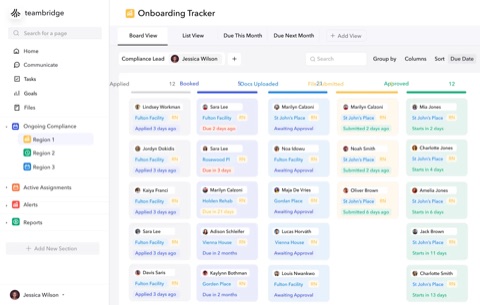
With Onboarding and Document Studio wired to the job record, a coordinator running an estimate for a $300K Buffalo public works project sees immediately: 8 of the 14 workers you'd staff to this job have OSHA 10 cards that will be more than 5 years old on the mobilization date. Enroll them now, or bid the job with a different roster.
According to Lancaster Safety Consulting, refresher training must also be conducted by an authorized trainer every 5 years for state or federally funded jobs — which means the classroom capacity has to be reserved, not assumed. In-person refreshers book out weeks in advance in dense markets.
The Multi-State Playbook: A Ruleset Staffing Ops Can Actually Run
Here's the operating framework. It's not novel, but running it consistently across states is where most agencies fail.
Tag every worker credential with:
- Card type (OSHA 10 vs OSHA 30)
- Track (1926 Construction vs 1910 General Industry)
- Issue date
- Issuing authorized trainer
- DOL card number
- SST card status and expiration (if applicable)
Tag every client project with:
- State
- Funding source (private, state-funded, federal-funded)
- Contract value
- LL196 applicability
- GC-specific rules layered on top
- Union agreement (if any)
Let the system match — not the coordinator
A rule engine runs the intersection. A default 5-year rolling refresh policy applies to any crew member who may cross into NY, CT, NV, MA, NH, RI, or MO. Workers who never leave a permissive state can keep their original cards, but the moment they're considered for a covered project, the tighter rule kicks in.
See how this maps across our construction and light industrial industry pages — the same credential-as-constraint pattern applies wherever OSHA training gates access, whether that's a NYC high-rise or a Missouri distribution center.
Note
Union agreements often set stricter refresh intervals than state law. If your crews run under a collective bargaining agreement, treat the CBA as the floor and layer state rules on top. The tightest rule wins.
Stop Losing Monday Mornings to Expired Cards
The OSHA card in the wallet lies. It says the worker is trained. It doesn't say whether the training is fresh enough for the state, the contract value, the funding source, or the GC's policy on the specific project this worker is being dispatched to on Monday.
The only thing that stops a turnaway at the gate is a system that knows the state rule, the project trigger, and the card's issue date — and blocks the assignment before the worker gets on the van.
Spreadsheets don't do that. PDF folders don't do that. A veteran coordinator who "knows the crew" doesn't do it consistently at scale across seven jurisdictional rulesets. What does it is a credential-aware scheduling engine wired to automated renewal workflows, running upstream of dispatch and upstream of the bid.
See how Teambridge handles this end-to-end on the Construction industry page, and how Automations turns the 60/30/15-day renewal ladder into background workflow instead of a Friday afternoon fire drill.