

Staffing agency payroll software must handle actual hours, multiple assignments and payroll delivery
The operations leader and payroll manager should first separate three responsibilities: preparing payroll records, calculating earnings and delivering payroll services. An export may cover the first without covering wage disbursement or tax filing.
Write down what the purchase must replace and what stays with existing providers. Every handoff needs an owner, a deadline and evidence that the receiving system accepted the records.
Have payroll define correct earnings before vendors demonstrate calculations
Payroll should prepare anonymized records covering multiple assignments, different rates, a missed punch and overtime awaiting client approval.
For covered, nonexempt employees, federal overtime generally applies after 40 hours in a workweek. Weeks cannot be averaged; multiple rates generally require a weighted average regular rate unless a permitted alternative applies. Client authorization does not erase compensable overtime owed. Payroll must also validate applicable jurisdictional requirements.
Operator view
Supporting evidence
https://www.dol.gov/agencies/whd/fact-sheets/23-flsa-overtime-pay
https://www.irs.gov/businesses/small-businesses-self-employed/outsourcing-payroll-duties

Run every vendor through one payroll acceptance checklist
Copy this checklist into your evaluation record. These are recommended acceptance tests, not assertions that any particular product supports them.
| Owner | Acceptance criterion | Test input | Expected result | Vendor question | Demonstration evidence | Unresolved issue | Release decision |
|---|---|---|---|---|---|---|---|
| Operations | Correct actual time while preserving worker and assignment identity | Missed punch corrected after initial export | Corrected hours reach the receiving record without losing assignment attribution | Who can edit, approve and resend this correction? | Record original punch, correction, approver and resulting export | Enter missing evidence and owner | Unresolved until demonstrated |
| Payroll | Calculate earnings across assignments and rates | One worker, two assignments, different rates and weekly overtime | Earnings match payroll’s approved calculation | How do you combine hours and rates across clients? | Attach expected earnings, vendor output and reconciliation | Enter each unexplained difference | Unresolved until demonstrated |
| Integration owner | Recover a rejected transfer without duplication | Invalid worker identifier, corrected transfer and repeat submission | Rejection is visible; corrected record is accepted once | How do we find rejected records and safely resubmit them? | Capture rejection, accepted record and duplicate check | Enter recovery gaps and owner | Unresolved until demonstrated |
| Finance | Assign and independently verify tax deposits | Provider responsibility schedule and deposit verification exercise | Named depositor and independent evidence of payment | How can we verify deposits outside your dashboard? | Attach contract responsibility and verification evidence | Enter access or responsibility gaps | Unresolved until demonstrated |
Use exactly three evidence statuses: demonstrated, unresolved or failed. Record the decision separately as release or hold. A demonstrated feature is not enough if the agency cannot reproduce it with its own configuration and authorized users.
A vendor explanation is not demonstration evidence. Ask the operator to change the record, save it, show the resulting state and follow the change into the receiving system. If a step requires support intervention or a separate paid service, record that dependency.
Complete the payroll row with a realistic earnings test
Consider this hypothetical test, not a customer result. One covered, nonexempt employee works 24 hours at $20 per hour on one assignment and 20 hours at $25 on another during the same workweek. The second assignment initially shows 18 hours until operations corrects a missed punch.
Assume all 44 hours are compensable, both assignments belong to the same employer, no additional compensation enters the regular rate and the weighted average method applies. This example excludes taxes, deductions and any jurisdictional requirements that would change the calculation.
The approved baseline is:
- Straight time earnings: 24 × $20 + 20 × $25 = $980.
- Weighted average regular rate: $980 ÷ 44 = approximately $22.2727 per hour.
- Additional overtime premium: 4 × 0.5 × $22.2727 = approximately $44.55.
- Total gross earnings: $980 + $44.55 = $1,024.55, rounded at the end for this example.
The additional premium is half the regular rate because straight time earnings already cover all 44 hours. The Department of Labor’s overtime guidance supports the general weighted average approach and describes permitted alternatives. Payroll must approve the method and rounding treatment used in the actual implementation.
For a completed hypothetical checklist entry, payroll records $1,024.55 as the expected result. Suppose the demonstration produces that amount and exposes the underlying hours and rates: payroll marks the earnings test demonstrated. If the corrected transfer then creates a second record in the receiving system, the integration test is failed and the release decision remains hold.
Now leave client approval pending. Require the vendor to show how that status affects payroll and billing separately, without treating a billing dispute as permission to remove compensable work from earnings.
A client approval problem is not the same thing as a worker pay problem.
Put the workflow into practice
See how your team could use this workflow
Put payment duties, tax verification and full costs in the contract
A successful export does not tell finance who will fund payroll, transmit wages or deposit taxes. Before signing, the agency owner and finance lead should attach a responsibility schedule to the agreement. Name the party responsible for each action and the escalation contact when it fails.
The schedule should cover earnings calculation, funding authorization, wage disbursement, filings, tax deposits and corrections. It should also distinguish an error discovered before payment from one discovered after payment. Those situations can require different approvals, timing and costs.
The IRS guidance on outsourcing payroll duties warns that using a payroll service provider does not automatically remove the employer’s federal tax responsibilities. Depending on the arrangement, the employer may remain liable for unpaid taxes, penalties and interest.
Warning
A provider dashboard showing “processed” is not independent proof of a federal tax deposit. The IRS recommends that employers obtain their own EFTPS access and periodically verify payments made on their behalf.
Finance should identify who maintains verification access, who checks deposits and who receives tax correspondence. The IRS also advises employers to keep their own address of record rather than substitute the provider’s address.
Ask for written pricing across these independently chargeable areas wherever applicable:
- Implementation, data conversion and configuration.
- Connections, maintenance and changes to export formats.
- Regular payroll runs, additional runs and corrections.
- Support, escalation coverage and service dependencies.
- Historical data access and exit exports.
Do not assume an integration includes every payroll service. The contract should identify what the connection transports, what the receiving provider does and what agency staff must still complete manually.
Evaluate Teambridge for payroll preparation without assuming tax processing
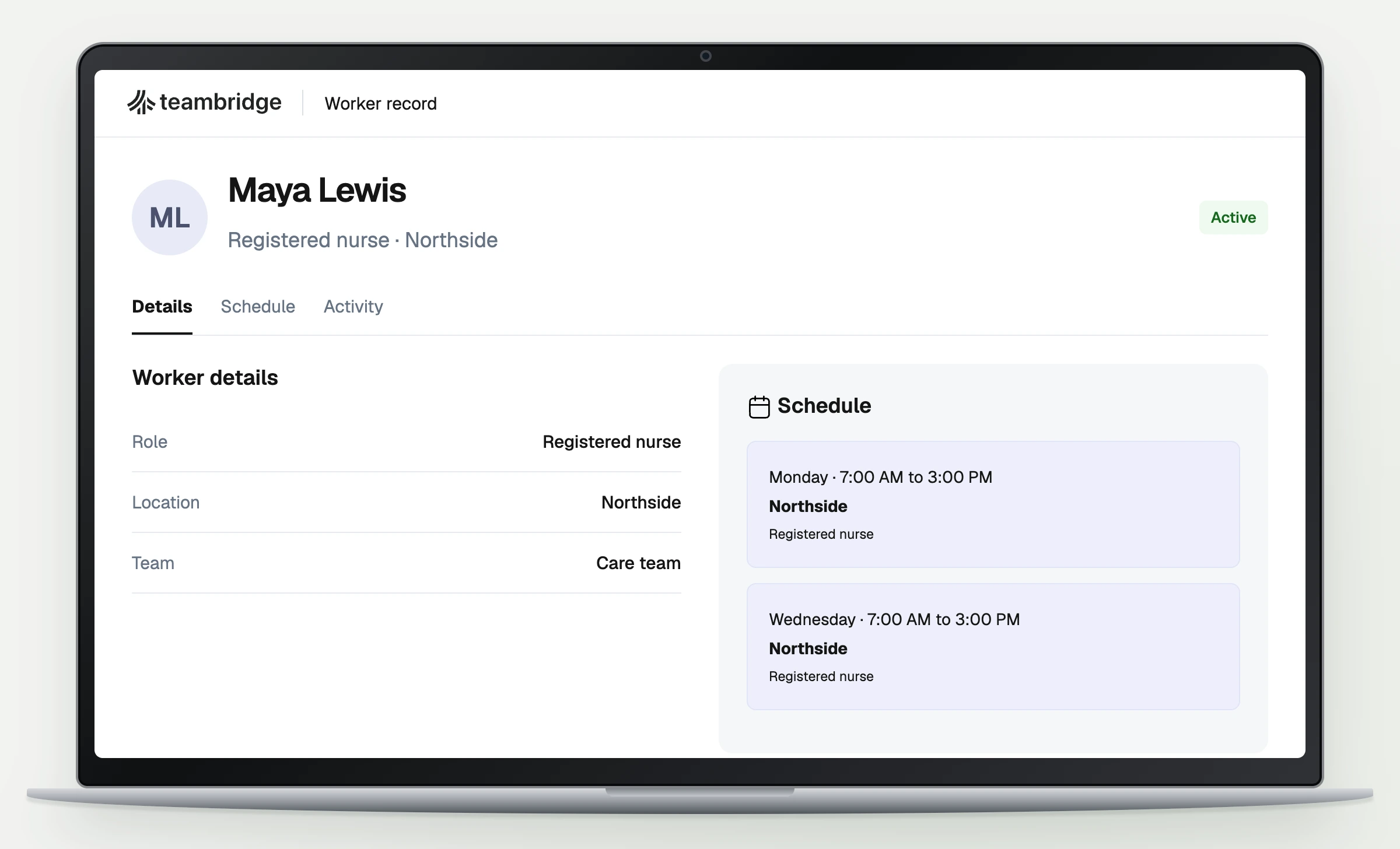
The Teambridge platform describes connected worker, client, job, shift, time, document, pay and billing records. That makes it relevant to the operational work of preparing payroll inputs across assignments. It does not, by itself, establish wage disbursement, complete payroll processing or tax filing coverage.
Teambridge’s Running Payroll documentation describes aggregate CSV exports, detailed exports by employee or location, and configurable CSV and PDF templates. The documented action is to select a pay period, click Export, choose a format, enter an email address and export. The resulting email contains a report download link.
Treat that downloaded report as the documented output. Do not treat it as proof that the receiving payroll provider accepted the records, paid workers or submitted taxes. The documented delivery troubleshooting step is to check spam if the report email does not arrive.
Verify record selection before trusting an export
The documentation distinguishes “Detailed Report (All),” which contains clocked shifts, from “Sorted Shift Detail (All),” which contains published shifts. Those datasets are not interchangeable. A published shift can describe planned work rather than the actual time that belongs in the earnings calculation.
During evaluation, have an authorized agency user export the same test period in the relevant formats. Compare the corrected worker’s identity, assignment, hours and pay inputs with the approved baseline. Retain the report used for reconciliation and record which version was sent downstream.
The help article does not establish required permission roles, payroll locking, correction history, rejection handling or duplicate prevention. Ask Teambridge to demonstrate the required access and saved state for your workflow rather than assuming those controls exist. If an export or receiving record is wrong, keep the transfer on hold until the correction path is demonstrated.
Use the Teambridge integrations directory to scope the proposed connection. Confirm availability, supported fields, transfer direction, timing and approval points for the specific receiving system. Error visibility, reconciliation and repeat submission behavior still need proof against the acceptance checklist.
Reconcile a parallel payroll before moving live payments
A parallel run compares candidate output with an approved baseline while the established process continues to control live payments. It should test the full route from corrected time to accepted payroll records, not just compare two totals on a screen.
Use the same acceptance checklist through implementation:
- Payroll approves expected earnings. Freeze a test baseline covering assignments, rates, actual hours, overtime and applicable adjustments. Document the assumptions behind each expected result.
- Operations validates identities and assignments. Confirm that worker identifiers map to the right person and that assignment records carry the intended rates. Resolve missing workers before sending the file.
- The integration owner maps and tests the transfer. Verify required fields and exercise missing identifiers, rejected records, late corrections and repeat submissions. Save evidence of both failure and recovery.
- Finance reconciles candidate output. Compare worker counts and individual earnings with the baseline. Investigate differences before authorizing any change to the payment process.
A matching grand total can conceal one omitted worker and one duplicated worker. Reconcile at the worker level, then check assignment attribution where it affects earnings or downstream records. Retain enough evidence to explain what changed between runs.
Keep live payment release under the existing authorized process during testing. If a candidate environment can disburse funds, establish and verify a control that prevents the parallel run from paying anyone. Do not rely on an informal reminder to avoid duplicate payments.
Proposed release gates are zero unexplained earnings differences, zero duplicate or omitted workers, and a named owner for every unresolved exception. These are recommended agency acceptance standards, not industry benchmarks or reported customer outcomes. Any blocking failure keeps the release decision on hold.
Approve rollout only when payday exceptions have owners and deadlines
During implementation, operations should review time and assignment exceptions daily. Payroll should reconcile every pilot run, while finance should review corrections after each payday. Keep decisions in the acceptance record so a resolved problem does not reappear as an undocumented workaround.
Track unexplained earnings differences, omitted or duplicate workers, unresolved exception age and corrections required after payment. Agree locally on targets and escalation deadlines. Separate exceptions that block accurate payment from issues that can remain open without putting wages or required responsibilities at risk.
Every exception needs a specific owner, a next action and a due date. “Waiting on vendor” is not an owner. Record who will pursue the vendor, what evidence will close the issue and what happens if it remains unresolved at the funding deadline.
Finance should authorize release only after blocking failures are resolved and the payment responsibilities are explicit. An unresolved requirement may justify another test, a narrower implementation or rejection of the purchase. It should not disappear because the contract date is approaching.
Take the same acceptance checklist into your next vendor demonstration. Require the vendor to show the correction, the transfer, the receiving record and the payment responsibility before you sign.

About the author

Content Writer at Teambridge
Anis Nanai is a content writer at Teambridge, with a focus on workforce management and the realities of running hourly teams. He prioritizes conversations with customers, staying close to the market, and understanding how workforce needs are changing. His writing connects those concerns to practical decisions about scheduling, time tracking, staffing, and automation. He examines product developments through the questions that matter to operators: what does this solve, how would it work for my team, and what evidence supports it?
Company perspective: this author works at Teambridge. Customer outcomes are attributed to their published sources.
View LinkedIn profile