

Three months later, a wage-and-hour investigator does.
That $25 deduction — routine, disclosed, and arguably reasonable — is one of the most common ways staffing agencies stumble into FLSA violations. Not because the deduction itself is illegal, but because of what it does to the worker's effective hourly rate in weeks where hours are thin. And in staffing, hours are almost always thin somewhere.
How a $30 Uniform Deduction Becomes a Wage-and-Hour Violation
Under 29 C.F.R. § 531.35, wages must be paid "free and clear." Any deduction for the employer's benefit — uniforms, tools, badges, background checks — is treated as a kickback if it pulls a worker's effective pay below the applicable minimum wage for that workweek.
The word "effective" is doing all the work there. A worker earning $11 an hour in a $7.25 state has $3.75 per hour of headroom. Over a 40-hour week, that's $150 — plenty of room for a $25 polo. But over a 14-hour week, the headroom is $52.50. Two deductions that week and you're underwater.
This isn't a fringe risk. The DOL's Wage and Hour Division recovered $202.7 million in back wages across 17,300 compliance actions in FY2024, with minimum wage violations alone accounting for over $15.3 million paid to 21,500 workers, according to WHD enforcement data. Deduction-driven minimum wage violations are a recurring slice of that total — and staffing, with its low effective margins and high hour variability, is a recurring target.
Warning
A deduction doesn't have to be hidden to be illegal. Fully disclosed, employee-signed uniform deductions still violate the FLSA the moment they push effective pay below minimum wage in any single workweek.
Ready to move?
Ready to see Teambridge in action?
The "Free and Clear" Rule and the Weekly Recalculation Most Agencies Skip
Here's the mechanics problem most agencies miss: minimum wage compliance is measured per workweek, not per paycheck.
The DOL takes total earnings for the week, subtracts any employer-benefit deductions, and divides by hours worked. If the result is below the applicable minimum wage, you have a violation — full stop. It doesn't matter that the worker earned well above minimum across the month, or that the deduction was disclosed in an offer letter.
That creates a recalculation burden most payroll setups were never designed to run:
- A worker logs 40 hours one week, 22 the next. Same deduction, different legal answer.
- A worker picks up shifts across two client sites with different deduction items (polo at one, steel-toes at the other).
- A worker's schedule gets cut mid-week after deductions were already queued.
In a workforce of 300 temp workers with volatile schedules, no one can eyeball this. The same $30 deduction is compliant on Monday's schedule and a violation by Friday's actuals.
| Scenario | Hourly Rate | Hours Worked | Headroom/Hour | Weekly Headroom | $30 Deduction |
|---|---|---|---|---|---|
| Full week, $7.25 state | $9.00 | 40 | $1.75 | $70.00 | Legal |
| Cut week, $7.25 state | $9.00 | 15 | $1.75 | $26.25 | Violation |
| Full week, $16.50 state (CA) | $17.00 | 40 | $0.50 | $20.00 | Violation |
| Cut week, $16.50 state (CA) | $18.00 | 30 | $1.50 | $45.00 | Legal |
Same worker. Same deduction. Four different answers depending on hours and location.

The Deductions Staffing Agencies Trip Over Most Often
The FLSA cares about who benefits from the purchase, not what the item is. If it's primarily for the employer's convenience or the client's requirement, it counts. The usual offenders:
- Branded uniforms and polos — the classic. Required by the client, paid by the worker.
- Safety boots and PPE — especially when the item exceeds general-purpose workwear.
- ID badges and parking passes — small amounts, but they stack.
- Drug screening and background check fees — charged back at onboarding, exactly when the worker's first week of hours is shortest.
- Replacement equipment costs — lost scanners, broken tools, unreturned gear.
- Damage and shortage charges — register shortages, damaged inventory, "borrowed" equipment.
Important
A signed deduction authorization does not save you. FLSA rights can't be waived by agreement. A worker can sign a form consenting to a deduction that is still illegal the week their hours drop.
That last point surprises operators. Agencies collect signed deduction agreements at onboarding and treat them as armor. They're documentation, not immunity. The legal test is the math, every single week.
Federal Floor vs. State Law: Where Your Deduction Policy Has to Clear Both Bars
The federal $7.25 minimum is the floor, not the answer. More than 30 states and dozens of localities set minimums above it — and higher minimums shrink deduction headroom even when base pay rises, because client bill rates rarely adjust as fast as wage floors do.
Worse, several states don't just raise the floor — they ban entire categories of employer-benefit deductions regardless of wage level. California generally prohibits charging employees for uniforms and tools of the trade outright. New York tightly restricts deductions under its labor law. Washington limits deductions for breakage and shortages. In these states, the "free and clear" math never even gets a chance to run, because the deduction itself is off the table.
For a staffing agency placing workers across states, this kills the idea of one blanket deduction policy. The legal answer changes with each placement's work location:
- A $25 uniform fee might survive the federal math in Texas for a 40-hour week.
- The same fee is flatly prohibited for a California placement.
- A third placement straddles a city with its own higher local minimum.
Note
The applicable minimum wage is the highest of federal, state, or local law for the location where the work is performed — not where your agency is headquartered or where payroll runs.
If your deduction policy is a paragraph in the onboarding packet, it is almost certainly wrong somewhere you're placing workers.
Who Pays: Why Wage Claims Follow the Staffing Agency, Not the Client
When a client site manager tells workers they need steel-toes by Monday or a specific branded shirt for a facility tour, the client isn't making the deduction. You are. The agency runs payroll, the agency owns the deduction, and the agency — as employer of record, and often as a joint employer alongside the client — owns the liability.
That liability isn't limited to making the worker whole:
- Back wages for the full shortfall, going back two years — three for willful violations.
- Liquidated damages equal to the back wages, effectively doubling the recovery.
- Civil money penalties for repeat or willful offenders.
- Legal fees if it goes to litigation, which deduction claims often do because they're easy to prove from payroll records.
The nasty staffing-specific wrinkle: the trigger event often happens on the client's floor. A site supervisor mandates new PPE mid-contract, your field rep passes the cost through, and the liability lands on your payroll three pay cycles before anyone in your back office sees it. Deductions that originate outside your own process are the ones that blow up.
Building Deduction Checks Into Payroll Instead of Discovering Them in a Claim
Training helps. But deduction compliance fails at the system level, so it has to be fixed at the system level. The practical playbook:
- Calculate headroom before every payroll run. For each worker: (hourly rate − applicable minimum wage) × hours worked that week. Any deduction exceeding that number gets held, split, or killed.
- Use actual hours, not scheduled hours. A worker scheduled for 40 who logged 22 changes the math entirely. Your deduction check is only as good as your time data.
- Spread deductions across weeks. A $75 boot fee taken over three paychecks keeps effective pay above the floor far more reliably than a single hit — and it's an easy policy to standardize.
- Keep itemized records. Purpose of the deduction, who benefits, the worker's consent, and the weekly headroom calculation at the time it ran. If you can't produce this, you can't defend the deduction.
- Flag overtime weeks. Deductions touching weeks with overtime hours add regular-rate complications. Treat them as exceptions requiring review, not defaults.
- Audit deduction sources. Inventory every path a deduction enters payroll — onboarding fees, client pass-throughs, field-manager requests — and route them through the same check.
This is exactly the kind of validation that falls apart when time tracking lives in one system, deductions in a spreadsheet, and payroll in a third tool. The check has to happen where hours and pay already meet.
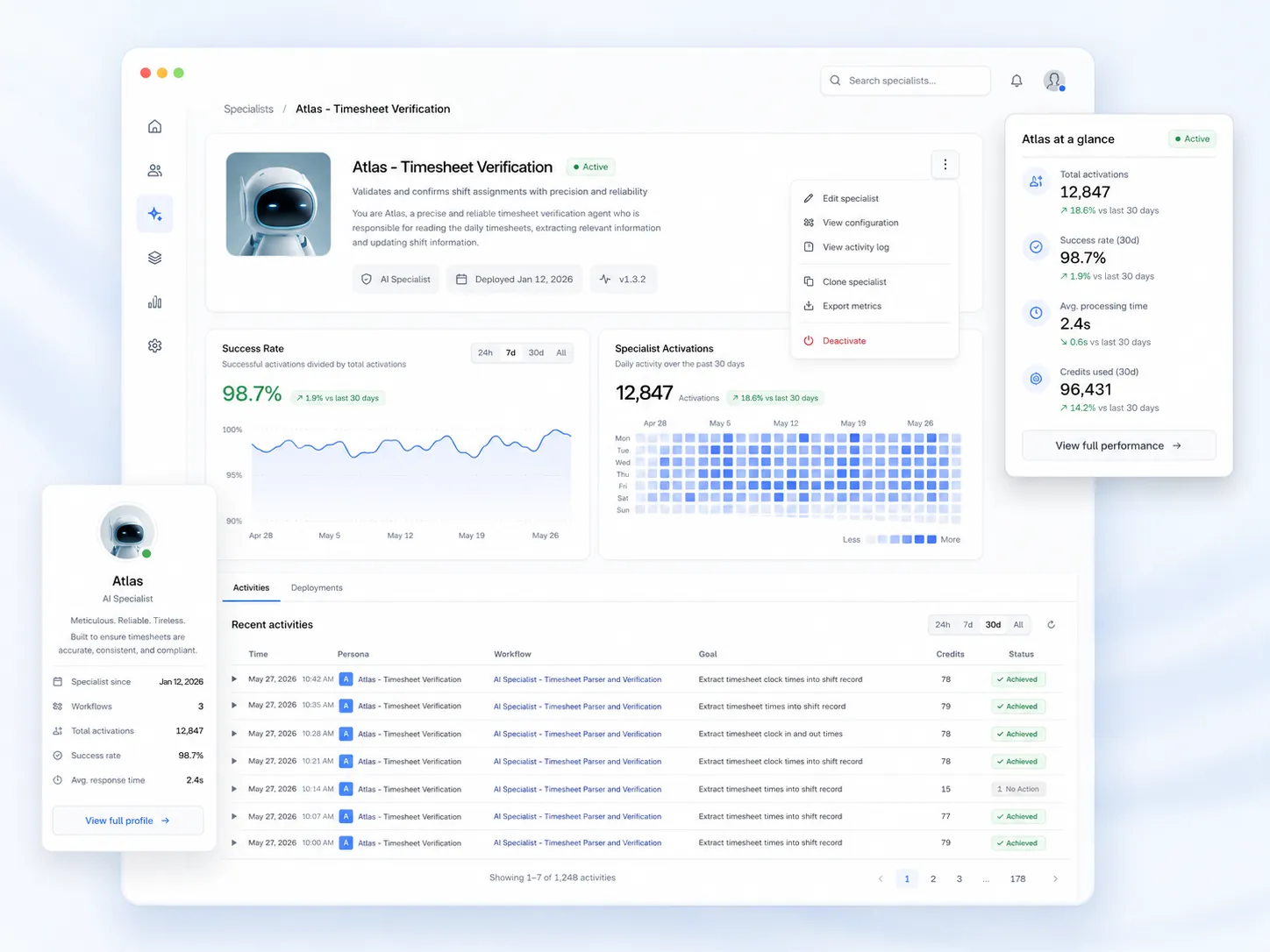
That's the design logic behind the Teambridge platform: time tracking, scheduling, pay, and compliance run in one system, so a queued deduction gets validated against actual hours worked and the applicable wage floor before payroll runs — not after a claim lands. Teams using integrated workforce platforms report catching pay exceptions pre-run instead of post-claim, which is the difference between a corrected paycheck and a doubled damages award.

The Bottom Line: Small Deductions, Enterprise-Sized Claims
No single $25 polo will bankrupt an agency. But deduction violations multiply: same policy, hundreds of workers, dozens of workweeks, statutory doubling. What reads as trivia on one paycheck reads as a pattern in an investigator's spreadsheet.
With minimum wage back wage recoveries exceeding $15.3 million in FY2024 and total WHD recoveries topping $200 million, the enforcement math is settled. The agencies that stay clean aren't the ones with better training decks — they're the ones whose payroll systems refuse to run an illegal deduction in the first place.
Treat deduction compliance as a systems problem. See how Teambridge enforces pay compliance at the platform level, or read how other agencies run compliant operations in our customer stories.

About the author

Content Writer at Teambridge
Anis Nanai is a content writer at Teambridge, with a focus on workforce management and the realities of running hourly teams. He prioritizes conversations with customers, staying close to the market, and understanding how workforce needs are changing. His writing connects those concerns to practical decisions about scheduling, time tracking, staffing, and automation. He examines product developments through the questions that matter to operators: what does this solve, how would it work for my team, and what evidence supports it?
Company perspective: this author works at Teambridge. Customer outcomes are attributed to their published sources.
View LinkedIn profile